


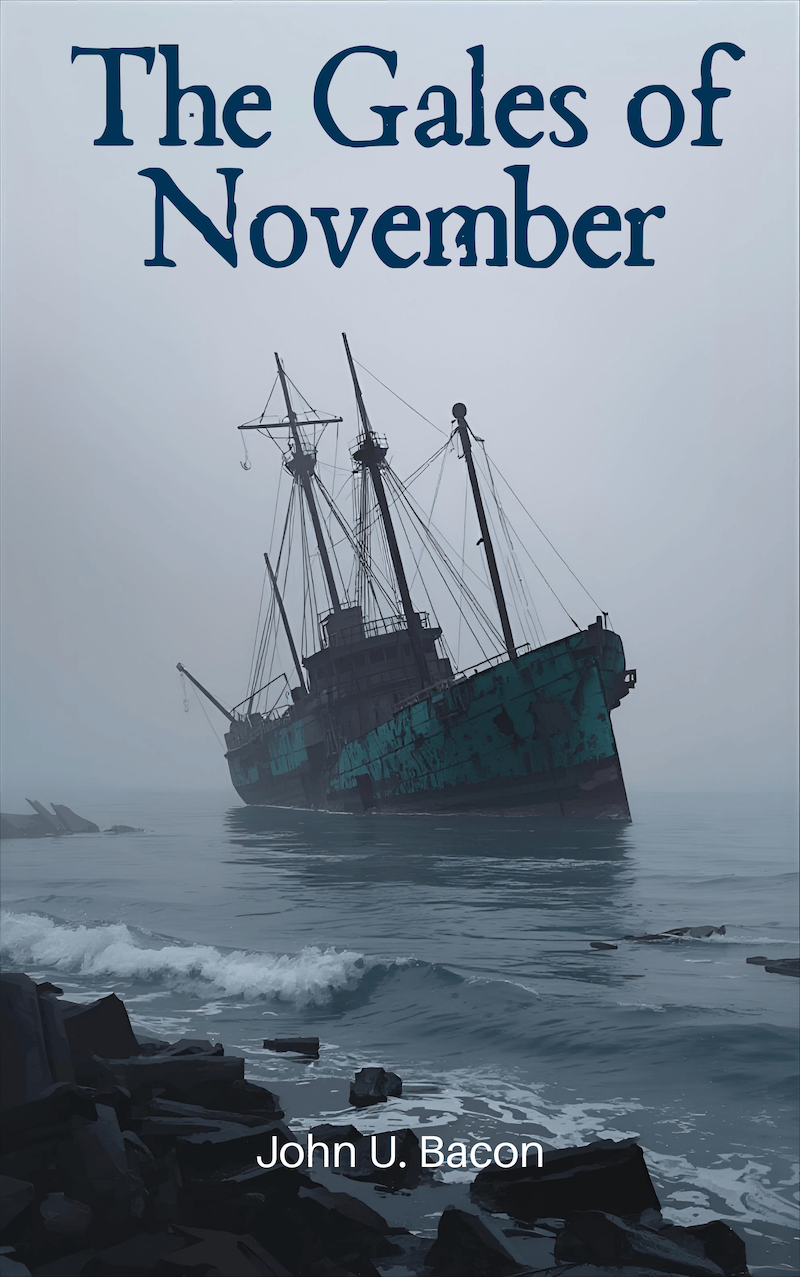
Prefer the print book? Buy on Amazon
As an Amazon Associate, Sumizeit earns from qualifying purchases.
The Gales of November Book Summary
This The Gales of November Book Summary covers the key ideas, lessons, and takeaways in about 20 minutes.
Short Description:
The Gales of November shows progress and peril in Great Lakes.
At the same time, the book affirms the value of collective responsibility. The reforms born from tragedy have saved countless lives, proving that loss need not be meaningless. By remembering what happened and why, the Great Lakes community transformed grief into vigilance, ensuring that the sacrifices of those lost continue to protect those who sail today.
Helps with these goals
Want the complete 20-minute summary?
- Full structured summary
- Video Summary
- Podcast Summary
- Audio summary
- Key takeaways
- Exercises
- Quiz
- Highlights and notes
- Ask the book with AI
Want a Free Weekly Read?
Get a free summary every week straight to your mailbox.
Preview the The Gales of November book summary
Below is a preview of Sumizeit’s comprehensive human-written summary of The Gales of November by John U. Bacon. The full summary is 15-20 minutes long and covers the book’s key ideas in text, audio, visual, and video formats. Unlock the full 20 Minute Summary
The story begins by overturning a common assumption: that danger belongs to saltwater and safety to inland lakes. The Great Lakes, vast enough to generate their own weather systems, behave less like calm reservoirs and more like unpredictable seas. Their sheer size allows winds to build immense waves in a remarkably short time, and those waves behave very differently from ocean swells. Instead of long, rolling rises, freshwater waves form steeply and cluster close together, creating sharp peaks and deep troughs that strike ships again and again without relief.
This difference is not academic. Long freighters can be suspended between wave crests, leaving their centers unsupported, a phenomenon sailors call sagging. When the opposite occurs—when the bow and stern dip while the middle rides high—the hull experiences hogging. Both stresses bend steel beyond what designers intended, especially when repeated for hours. Add freezing spray that coats decks, rails, and rigging with heavy ice, and ships can gain hundreds of tons above their waterline, raising their center of gravity and making them harder to control.
November is the most dangerous month of all. As warm air from the south collides with early Arctic blasts, storms explode in strength and speed. Winds shift abruptly. Visibility disappears under snow, sleet, or driving rain. On the Great Lakes, there is rarely time to escape once conditions turn severe. Captains must commit early and live with their decisions, navigating storms that evolve faster than forecasts can track.
A Transportation Network That Built a Nation
The book places these dangers within a larger historical context, showing how the Great Lakes became the backbone of American industrial power. Long before highways or railroads dominated commerce, water offered the cheapest and most efficient way to move heavy materials. The lakes connected forests, mines, farms, and factories across thousands of miles, turning geography into economic leverage.
Iron ore from Minnesota, limestone from Michigan, grain from the plains, and coal from Appalachia flowed through this inland sea. Barges and freighters carried quantities so large that land transport could not compete. As the nation industrialized, the scale of this system expanded dramatically. Entire cities grew around ports, mills, and shipyards, their fortunes tied to the rhythm of shipping seasons.
After World War II, this system reached its peak. Factories that had produced tanks and aircraft converted to civilian goods at astonishing speed. Automobiles, appliances, and steel poured out of Midwestern cities. To feed this production, ships carried iron ore in unprecedented volumes. The demand pushed vessels to become longer, faster, and more specialized, setting the stage for both prosperity and risk.
A crucial turning point came with the development of taconite, a low-grade ore once considered useless. Through innovative processing, it became a reliable source of iron, forming pellets that were easy to transport and smelt. This breakthrough extended the life of Great Lakes mining and shipping, reinforcing the region’s dominance during the height of American industrial expansion.
Engineering Choices That Favored Efficiency Over Resilience
Great Lakes freighters evolved under unique…
Want the complete 20-minute summary?
- Full structured summary
- Video Summary
- Podcast Summary
- Audio summary
- Key takeaways
- Exercises
- Quiz
- Highlights and notes
- Ask the book with AI
Who should read The Gales of November?
The Gales of November is essential reading for anyone fascinated by maritime history, industrial America, or how systems fail under pressure. It will resonate particularly with those who appreciate narratives that weave together technical complexity, human drama, and historical consequence, as well as readers interested in how disasters reshape industries and cultures.
Why does The Gales of November matter?
This book examines one of America's greatest maritime disasters while illuminating broader truths about how progress, confidence, and cost-cutting can quietly erode safety margins. In an era of complex systems and competing priorities, John U. Bacon's account offers a crucial reminder that vigilance and humility matter more than speed and efficiency, and that lessons learned at terrible cost can save countless lives if we choose to remember them.
What are the key themes in The Gales of November?
- The hidden dangers of the Great Lakes and freshwater storm dynamics
- Industrial ambition and the trade-offs between efficiency and resilience
- How institutional memory fades and warnings go unheeded
- Maritime culture and the ethics of mutual aid and duty
- The gap between technological capability and human forecasting
- Systems failure and the accumulation of small compromises
Want the complete 20-minute summary?
- Full structured summary
- Video Summary
- Podcast Summary
- Audio summary
- Key takeaways
- Exercises
- Quiz
- Highlights and notes
- Ask the book with AI
How can you apply ideas from The Gales of November?
- Audit complex systems for design compromises that prioritize efficiency over resilience, asking whether short-term gains justify long-term vulnerabilities
- Establish mechanisms for institutional memory about past failures and warnings, ensuring lessons don't fade as personnel change and decades pass
- Foster a culture where caution and humility are valued over speed and bravado, especially in environments where stakes are high
- Invest in real-time forecasting and communication technologies to close the gap between prediction models and actual conditions
- Regularly test whether safety margins have eroded due to regulatory changes or industry practice, treating them as active protections rather than starting points for optimization
- Create clear protocols for when conditions exceed historical experience, requiring consultation rather than solo decision-making
- Build shared responsibility cultures where mutual aid and reporting of problems are rewarded over individual heroics and competitive achievement
What common mistakes do readers make with The Gales of November?
- Assuming that technological progress eliminates danger, leading to overconfidence in systems that still operate within natural limits
- Allowing success to breed complacency, where repeated safe passages convince operators that risk has been mastered rather than managed
- Ignoring or dismissing warnings from earlier incidents as outdated or specific to different circumstances
- Prioritizing efficiency metrics and cost-cutting in ways that quietly reduce safety margins until a catastrophic failure reveals the accumulated compromises
Sumizeit Exercises Apply what you've learned
Turn ideas from The Gales of November into action with a short guided reflection: identify the biggest takeaway, connect it to your life, and commit to one step you can take in the next 24 hours.
What is the expert analysis of The Gales of November?
Overview
The Gales of November by John U. Bacon is a compelling exploration of the perilous nature of Great Lakes shipping, centered on the tragic sinking of the Edmund Fitzgerald. Bacon, a seasoned journalist with a talent for weaving detailed research into engaging narratives, situates this maritime disaster within a broader historical, technological, and cultural framework. The book is significant not only as a maritime history but also as a meditation on human ambition, industrial progress, and the complex interplay between nature’s indifference and human endeavor.
Core Thesis
Bacon’s central argument is that the Great Lakes, often mistakenly perceived as safe inland waters, are in fact treacherous environments shaped by unique meteorological and geographical conditions. The industrial imperative to maximize efficiency led to engineering and operational choices that compromised vessel resilience, culminating in disasters like the Edmund Fitzgerald. The book posits that overconfidence and economic pressures dulled vigilance, and only through tragedy did the industry embrace a culture of safety and humility. Thus, progress and peril are inseparable, and respect for natural forces is essential to sustainable human enterprise.
Strengths
- Rich Historical Context: Bacon excels at embedding the narrative of the Edmund Fitzgerald within the expansive story of American industrialization and regional economic development, lending depth and resonance to the tragedy.
- Technical Insight: The detailed explanation of ship design, wave dynamics, and meteorological phenomena provides readers with a nuanced understanding of why the Great Lakes pose unique challenges to navigation and vessel integrity.
- Human Dimension: The portrayal of Captain McSorley and the maritime culture of toughness and camaraderie adds emotional weight and complexity, moving beyond mere technical analysis to explore leadership, decision-making, and community values.
- Balanced Narrative: The book neither sensationalizes the disaster nor reduces it to a simple cautionary tale; instead, it acknowledges uncertainty and multiple plausible explanations, reflecting the real-world complexity of maritime accidents.
- Impact on Industry and Culture: Bacon convincingly traces how the disaster catalyzed meaningful reforms, highlighting the transformative power of collective memory and institutional learning.
Critiques & Counterarguments
- Potential Oversimplification of Causality: While the book emphasizes engineering compromises and cultural bravado, it may understate systemic regulatory failures or the role of broader economic forces such as deregulation and globalization that also shaped shipping practices.
- Limited Engagement with Opposing Perspectives: The narrative largely accepts the prevailing interpretation of the Edmund Fitzgerald’s sinking without deeply engaging with alternative theories or dissenting expert opinions that question aspects of the official investigations.
- Technological Determinism: The focus on technological and design factors risks overshadowing human agency and decision-making nuances, including the psychological pressures on captains and crews operating under competitive and hazardous conditions.
- Comparative Maritime Scholarship: Research from oceanic maritime studies sometimes challenges the uniqueness of Great Lakes conditions, suggesting that similar risks and design trade-offs exist in other inland or coastal waters, which the book does not fully address.
- Environmental Change Considerations: The book’s historical scope does not extensively consider how climate change and evolving weather patterns might alter the risks and operational realities for Great Lakes shipping in the future.
Who Should Read This
The Gales of November is ideal for readers interested in maritime history, industrial and economic history, and the sociology of risk and safety culture. It appeals to professionals in shipping, engineering, and environmental studies seeking a richly contextualized case study of technological and human factors in disaster. Additionally, readers fascinated by leadership under pressure and the interplay between nature and human systems will find Bacon’s narrative both illuminating and thought-provoking. Its accessible yet sophisticated prose makes it suitable for both academic audiences and general readers drawn to stories of resilience and transformation.
Frequently asked questions about the The Gales of November book summary
What is The Gales of November about?
The Gales of November by John U. Bacon chronicles the disappearance of the Edmund Fitzgerald, the longest ship on the Great Lakes, which sank in a catastrophic November storm in 1975. The book explores the technical, historical, and cultural forces that converged to create this disaster, examining how engineering trade-offs, fading institutional memory, overconfidence, and a perfect storm combined to claim the ship and its crew.
Who should read The Gales of November?
Anyone interested in maritime history, industrial America, systems failures, or how disasters reshape industries will find value in this book. It appeals to readers who appreciate narrative nonfiction that weaves together technical complexity with human drama, as well as those seeking to understand how institutional failures occur and how vigilance can prevent them.
What are the main takeaways from The Gales of November?
The book teaches that progress and peril often travel together, with the same ingenuity that builds great systems also producing hidden vulnerabilities. It demonstrates how success breeds dangerous confidence, how safety margins erode quietly through small compromises, and crucially, that lessons learned at terrible cost can save countless lives if communities choose to remember them and act on that knowledge.
Why is the Great Lakes so dangerous compared to ocean shipping?
The Great Lakes generate their own weather systems and produce steeply formed waves that cluster close together rather than rolling gradually like ocean swells. These waves strike ships repeatedly without relief, causing sagging and hogging that stress steel hulls. In November, when warm and Arctic air masses collide, storms intensify faster than forecasts can predict, leaving captains little time to escape.
What design choices made the Edmund Fitzgerald vulnerable?
The Fitzgerald was extraordinarily long but relatively narrow to fit through locks at Sault Ste. Marie, maximizing cargo volume at the cost of stability in rough seas. It sat shallow in the water even when fully loaded, and regulatory changes allowed it to ride even lower, reducing freeboard and leaving less margin for error when waves washed over the bow. Modern welding techniques provided flexibility but also introduced uncertainties about structural limits.
Did the Great Lakes industry learn from the Fitzgerald disaster?
Yes. Unlike earlier disasters, the Fitzgerald's loss triggered lasting reforms because of its scale and public attention. Weather forecasting improved dramatically, communication systems became more reliable, inspections grew stricter, and loading practices were reevaluated. Most importantly, the culture shifted from valuing bravado to valuing caution, resulting in an unprecedented safety record with no vessel losses in decades since the disaster.
What was unique about the November 1975 storm that sank the Fitzgerald?
The storm was extraordinary because it defied forecasts by stalling and intensifying rather than moving quickly across the region. It generated hurricane-strength winds, waves that overwhelmed even large ships, and near-zero visibility under snow and spray. Critical navigational aids failed, leaving captains without radar or shore lights in conditions that erased landmarks, making precise navigation nearly impossible.
How does maritime culture influence ship safety?
The Great Lakes maritime culture is built on an unwritten code of mutual aid, where ships are obligated to risk themselves to rescue others because today's rescuer might become tomorrow's victim. This culture is powerful and honorable, but it can also reinforce bravado and risk-taking. The post-Fitzgerald reforms shifted this culture toward valuing caution and collective responsibility over individual heroics and competitive achievement.
About Sumizeit
Sumizeit is a profitable Scomy LLC company based in Miami, Florida. Our founders, Clemens Raemy and Weina Scott, are successful entrepreneurs with several exits. Sumizeit is a popular book summary app / micro learning app used by busy professionals and entrepreneurs with over 2,500 non-fiction book summaries and 10,000 podcast summaries in text, audio, visual, podcast, and video format. We also have stellar retention tools to make ideas stick - such as flashcards with spaced repetition, quizzes, streaks, highlighting and notes, daily challenges, riddles, mini-courses, meditation, and more. You won't only learn the idea, but also remember it. Over 90% of our users change their habits with Sumizeit.
Upgrade Now
Want the complete 20-minute summary?
- Full structured summary
- Video Summary
- Podcast Summary
- Audio summary
- Key takeaways
- Exercises
- Quiz
- Highlights and notes
- Ask the book with AI
Here's why readers love Sumizeit
Join thousands of learners getting smarter every day
"Great experience. Detailed summaries. Loved the gamification feature. Makes learning fun. Good customer service. I recommend Sumizeit to anyone. You'll learn a lot."
"I always felt busy but still wanting to keep up with the book discussion in my friend group. This was a great supplement to help me keep reading the books I find fun while keeping up with important books."
"I love this website. Instead of scrolling social media, I find myself learning a lot. I use it everyday. I recommend this app for anyone who is too busy and wants to get up to speed with their favorite books."
The Gales of November Book Summary PDF
Looking for a The Gales of November Book Summary PDF you can save and revisit offline? Our The Gales of November Book Summary PDF captures the book’s core ideas in a clean, printable format — the key frameworks, takeaways, and structure without the fluff. Download the The Gales of November Book Summary PDF when you want a reference you can annotate, share with your team, or review on the go. Get your The Gales of November Book Summary PDF from the download page below.
Download The Gales of November Book Summary PDFPeople also liked these summaries
Readers who explored The Gales of November often enjoyed these titles next.


Want the complete 20-minute summary?
- Full structured summary
- Video Summary
- Podcast Summary
- Audio summary
- Key takeaways
- Exercises
- Quiz
- Highlights and notes
- Ask the book with AI
Featured Book Titles
Popular Book Summaries at sumizeit, leading book summary app