


Prefer the print book? Buy on Amazon
As an Amazon Associate, Sumizeit earns from qualifying purchases.
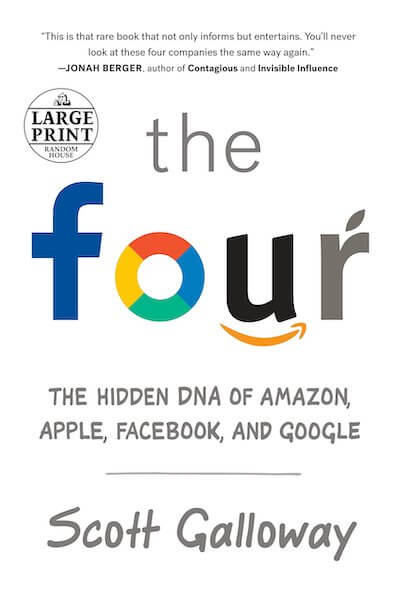
The Four Book Summary
This The Four Book Summary covers the key ideas, lessons, and takeaways in about 20 minutes.
They were able to achieve success by appealing to our very human desires.
While they will likely be around for a while, it is also possible for one of The Four to fall and a new company to rise up. However, for now, it is all about living in this world and finding success based on how the world has changed.
Helps with these goals
Want the complete 20-minute summary?
- Full structured summary
- Video Summary
- Podcast Summary
- Audio summary
- Key takeaways
- Exercises
- Quiz
- Highlights and notes
- Ask the book with AI
Not ready to upgrade?
Get this summary + 2 more picks sent to your inbox, free.
What is in the The Four book summary?
Below is a preview of Sumizeit’s expert-written summary of The Four by Scott Galloway. The full summary covers the book’s key ideas in text, audio, and video.
Have you ever wondered how the four greatest companies of our time rose to power? Do you know what their secrets to success are?
In The Four: The Hidden DNA of Amazon, Apple, Facebook, and Google, Scott Galloway looks at what it takes for a business to be successful using the secrets that allowed the big four to rise to power.
In this book, Galloway shows readers how Amazon, Apple, Facebook, and Google achieved their immense success and how they have spread the message of being pioneers for the future.
The Four is a major part of modern life, even if their presence is not always well-meaning
As humans, we all have needs. And between Amazon, Apple, Facebook, and Google, these companies look to meet those needs.
Google gives us answers to all of our questions. Facebook lets us interact with friends and family, giving us a sense of connection and love. Apple is more about sex appeal. And finally, there is Amazon which helps us with our consumption needs, allowing us to get many of the things our heart desires.
Easily an example of the Four Horsemen, these four companies have certainly helped to change the world. While many people might even say that these companies have improved our lives, they are not as benevolent as one might believe.
All four companies have done good things to change the world. They make things more accessible to more people. And yet, there are also downsides to all four of these companies, with Amazon not paying sales tax, Facebook selling people’s information, and even Apple refusing to follow court orders.
Amazon might get us all the things we need and want, but it is also ruining its competition and destroying jobs
In 2016, half of all online growth was thanks to Amazon. And every year the number of households with Amazon Prime continues to grow. In fact, in 2017 alone nearly 52 percent of households had a Prime account.
What led to Amazon’s success? The fact that it appeals to people’s gathering urges.
One of society's most popular activities is said to be buying and hoarding things, which Amazon allows us all to do. You can buy almost anything on Amazon and have it delivered to your door without having to go anywhere.
Much of Amazon’s success is due to its size. It can reach millions of people, but in doing so it has destroyed other companies. Because of the company’s size, it is able to undersell so many other people and businesses out there.
Amazon has been able to put many of their competitors out of business, which has destroyed thousands of jobs. As they have destroyed jobs, they have not created a lot of jobs in the process. Thanks to mechanization and robots, many humans are being put out of work.
One estimate the book points out is that in 2017 Amazon’s growth actually eliminated 76,000 jobs.
Apple is a luxury brand that appeals to our need to be…
Want the complete 20-minute summary?
- Full structured summary
- Video Summary
- Podcast Summary
- Audio summary
- Key takeaways
- Exercises
- Quiz
- Highlights and notes
- Ask the book with AI
Who should read The Four?
The Four is essential reading for entrepreneurs, business professionals, and anyone curious about how tech giants shape modern life. If you want to understand the invisible forces driving today's economy and culture, or you're building a business in a world dominated by Amazon, Apple, Facebook, and Google, this book provides crucial insights into their strategies and vulnerabilities.
Why does The Four matter?
These four companies don't just dominate business—they fundamentally shape how we connect, shop, think, and express ourselves. Scott Galloway reveals that understanding their methods isn't academic; it's practical knowledge for anyone trying to succeed in a world reshaped by their influence. The book exposes both their genius and their dark side, helping readers navigate an ecosystem where these giants extract value from our behavior while appearing benevolent.
What are the key themes in The Four?
- How tech giants exploit fundamental human needs and desires
- The difference between innovation and appropriation in business
- Data as the new currency and its ethical implications
- The concentration of power in four companies and its societal impact
- What it takes to build a trillion-dollar company
- The role of brand mythology and cult-like loyalty in business success
Want the complete 20-minute summary?
- Full structured summary
- Video Summary
- Podcast Summary
- Audio summary
- Key takeaways
- Exercises
- Quiz
- Highlights and notes
- Ask the book with AI
How can you apply ideas from The Four?
- Audit your personal data footprint and consciously limit what you share across the Four's platforms to reduce manipulation and preserve privacy
- Build your professional brand on social media and urban networks rather than relying solely on traditional credentials or merit
- Develop emotional resilience and curiosity as core professional skills, since these are increasingly valued in roles shaped by tech-driven change
- Consider geographic relocation to a major city or innovation hub to access the 90% of new jobs created in urban centers
- Learn data literacy and basic AI concepts to remain competitive in an economy where these skills increasingly determine career trajectory
- Position yourself as an owner of projects and initiatives rather than a task executor to stand out in organizations influenced by the Four's culture
- Study the vertical integration strategies of the Four to identify similar opportunities in your own business or industry
What common mistakes do readers make with The Four?
- Assuming the Four's success is purely due to innovation when much of it comes from execution, scale, and strategic appropriation of existing ideas
- Believing these companies are primarily altruistic or neutral platforms rather than recognizing how they extract value from user behavior and data
- Overlooking the importance of brand likability and assuming regulatory compliance alone protects companies from public backlash or intervention
- Thinking that geographic location doesn't matter in the digital age, when proximity to innovation hubs and talent pools remains a critical competitive advantage
Sumizeit Exercises Apply what you've learned
Turn ideas from The Four into action with a short guided reflection: identify the biggest takeaway, connect it to your life, and commit to one step you can take in the next 24 hours.
What is the expert analysis of The Four?
Overview
The Four: The Hidden DNA of Amazon, Apple, Facebook, and Google is a compelling examination of the dominant forces shaping the modern digital economy, authored by Scott Galloway, a respected marketing professor at New York University’s Stern School of Business and a seasoned entrepreneur. Galloway’s unique vantage point—as both an academic and a practitioner—allows him to dissect the rise of these four tech giants with a blend of rigorous analysis and accessible narrative. The book’s significance lies in its ability to elucidate how these companies have not only transformed markets but also deeply influenced human behavior and societal structures.
Core Thesis
Galloway’s central argument is that Amazon, Apple, Facebook, and Google have achieved unparalleled success by tapping into fundamental human desires—our need for knowledge, connection, consumption, and status—and by leveraging their vast data ecosystems and market power to entrench themselves as near-omnipotent entities. He posits that these companies operate as modern “DNA,” shaping not just commerce but culture and personal identity. Moreover, while they have democratized access and innovation, they also engage in practices that undermine competition, privacy, and social cohesion, effectively “borrowing” from society’s resources to fuel their dominance.
Strengths
- Interdisciplinary Insight: Galloway skillfully integrates concepts from psychology, economics, and sociology to explain the emotional and cognitive appeals that underpin each company’s success.
- Clear Characterization of Each Company: By associating each firm with a core human drive—Amazon with consumption, Apple with status, Facebook with connection, and Google with knowledge—he provides a memorable framework for understanding their distinct roles.
- Critical Yet Balanced Perspective: The book acknowledges the positive impacts of these companies, such as accessibility and innovation, while not shying away from their ethical and societal shortcomings.
- Actionable Framework: The identification of eight attributes necessary for a future trillion-dollar company offers a forward-looking lens on innovation and competition.
- Engaging Style: Galloway’s prose is accessible yet intellectually stimulating, making complex business phenomena understandable to a broad audience without sacrificing depth.
Critiques & Counterarguments
- Oversimplification of Complex Entities: While the framework of four companies tied to singular human desires is elegant, it risks reducing multifaceted corporations to caricatures, potentially overlooking internal diversity and strategic nuance.
- Evidence and Data Limitations: Some claims, such as the exact number of jobs Amazon has eliminated or the degree of Apple’s “sex appeal,” rely on anecdotal or dated data, which may not fully capture ongoing developments or countervailing trends.
- Neglect of Regulatory and Competitive Dynamics: The book underemphasizes the growing role of government intervention and emerging competitors, which complicate the narrative of unchallenged dominance.
- Competing Perspectives on Technology’s Role: Opposing schools of thought argue that these companies also empower users through decentralization and democratization of information, challenging Galloway’s more critical stance.
- Global and Cultural Variability: The analysis is largely Western-centric, with limited engagement on how these companies operate or are perceived in diverse geopolitical contexts, such as China’s unique digital ecosystem.
Who Should Read This
The Four is essential reading for business leaders, marketers, policymakers, and scholars interested in understanding the architecture of contemporary digital capitalism. It is also valuable for informed consumers and citizens seeking to grasp how technology shapes their daily lives and societal norms. The book’s blend of critical insight and accessible storytelling makes it suitable for readers who appreciate nuanced yet clear analysis of complex corporate phenomena and their broader implications.
Frequently asked questions about the The Four book summary
What is The Four about?
The Four by Scott Galloway analyzes how Amazon, Apple, Facebook, and Google became the world's most dominant companies by appealing to fundamental human needs—consumption, status, connection, and knowledge. The book reveals their business strategies, ethical implications, and what would be required for a new company to challenge their dominance.
Who should read The Four?
Entrepreneurs, business professionals, marketers, investors, and anyone curious about tech giants should read this book. It's especially valuable for people building businesses in industries shaped by the Four, or those wanting to understand the invisible forces controlling modern commerce and culture.
What are the main takeaways from The Four?
The Four dominate by exploiting human desires rather than pure innovation, extract value from data and user behavior while remaining beloved, and face very few credible challengers. Success in their world requires emotional maturity, continuous learning, geographic proximity to opportunity, professional visibility, and ownership mentality.
How did Amazon, Apple, Facebook, and Google become so powerful?
Each company identified and exploited a fundamental human need: Amazon the urge to consume, Apple the desire for status and elegance, Facebook the need for social connection, and Google the search for answers. They scaled globally, created powerful brand loyalty, collected invaluable data, and used their size to outlast or undercut competitors.
Is there a company that could challenge the Four?
Galloway examines candidates like Alibaba, Uber, Microsoft, and Walmart, but each has fatal flaws preventing serious challenge. Alibaba lacks global reach, Uber has likability issues, and older companies lack the brand mythology needed. A true challenger would need all eight attributes Galloway identifies: differentiation, visionary capital, global reach, likability, vertical integration, AI capabilities, career acceleration, and proximity to innovation hubs.
What are the ethical concerns raised about the Four?
The Four face criticism for exploiting human psychology, avoiding taxes, selling personal data without explicit consent, eliminating jobs through automation, refusing regulatory accountability, and algorithmically reinforcing polarization. Despite these practices, their brand loyalty and user trust allow them to operate with less scrutiny than traditional corporations.
How can individuals succeed in a world dominated by the Four?
Develop emotional maturity and curiosity, commit to continuous learning and skill development, relocate to urban innovation centers where 90% of new jobs emerge, build your personal brand through social media, take ownership of projects, and think strategically about geographic location and access to prestigious institutions and networks.
About Sumizeit
Sumizeit is a profitable Scomy LLC company based in Miami, Florida. It has been helping readers learn from nonfiction books for 7 years with expert-written summaries in text, audio, podcast, and video.
Want the complete 20-minute summary?
- Full structured summary
- Video Summary
- Podcast Summary
- Audio summary
- Key takeaways
- Exercises
- Quiz
- Highlights and notes
- Ask the book with AI
Here's why readers love Sumizeit
Join thousands of learners getting smarter every day
"Great experience. Detailed summaries. Loved the gamification feature. Makes learning fun. Good customer service. I recommend Sumizeit to anyone. You'll learn a lot."
"I always felt busy but still wanting to keep up with the book discussion in my friend group. This was a great supplement to help me keep reading the books I find fun while keeping up with important books."
"I love this website. Instead of scrolling social media, I find myself learning a lot. I use it everyday. I recommend this app for anyone who is too busy and wants to get up to speed with their favorite books."
The Four Book Summary PDF
Looking for a The Four Book Summary PDF you can save and revisit offline? Our The Four Book Summary PDF captures the book’s core ideas in a clean, printable format — the key frameworks, takeaways, and structure without the fluff. Download the The Four Book Summary PDF when you want a reference you can annotate, share with your team, or review on the go. Get your The Four Book Summary PDF from the download page below.
Download The Four Book Summary PDFPeople also liked these summaries
Readers who explored The Four often enjoyed these titles next.




Want the complete 20-minute summary?
- Full structured summary
- Video Summary
- Podcast Summary
- Audio summary
- Key takeaways
- Exercises
- Quiz
- Highlights and notes
- Ask the book with AI
Featured Book Titles
Popular Book Summaries at sumizeit, leading book summary app