Question 1 of 5
According to the summary, where and when did Jeff Bezos start Amazon?
The summary states Jeff Bezos started Amazon in his garage in 1994.


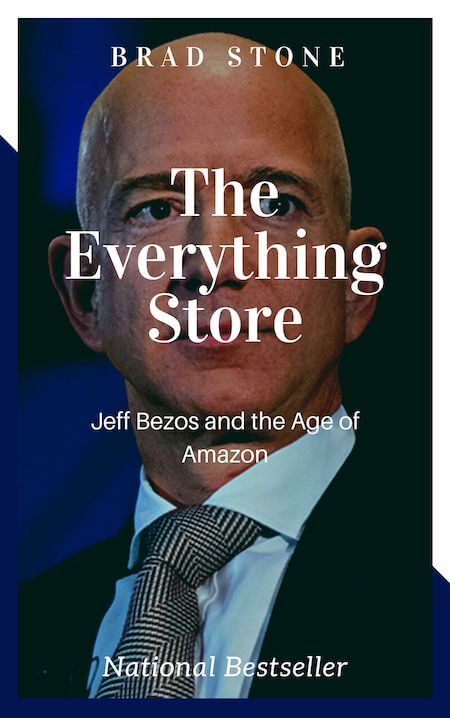
Prefer the print book? Buy on Amazon
As an Amazon Associate, Sumizeit earns from qualifying purchases.
This The Everything Store: Jeff Bezos and the Age of Amazon Book Summary covers the key ideas, lessons, and takeaways in about 20 minutes.
Want a Free Weekly Read?
Get a free summary every week straight to your mailbox.
Below is a preview of Sumizeit’s comprehensive human-written summary of The Everything Store: Jeff Bezos and the Age of Amazon by Brad Stone. The full summary is 15-20 minutes long and covers the book’s key ideas in text, audio, visual, and video formats. Unlock the full 20 Minute Summary
When Jeff Bezos started Amazon in his garage in 1994, he had no idea that more than two decades later, his now multibillion-dollar company would be a highly-regarded household name. While the hugely successful corporation’s path has been a long and winding one, The Everything Store: Jeff Bezos and the Age of Amazon provides a broad overview of the company’s successes and failures over the years as well as highlighting some of the more controversial business practices and policies. Ultimately, the reader can decide, is Amazon a true force for good, or is employing unethical tactics to dominate the e-commerce sector? Or is the reality a mix of both?
In terms of customer service, Amazon has always been a step ahead.
Why?
Because the retail superpower takes calculated risks.
And usually, they pay off.
For instance, when Amazon initially developed a feature to allow customer reviews, the corporation was met with strong resistance from publishers, because they assumed that critical feedback would lead to a reduction in product sales. As it turned out, the review feature was well-received by the consumer base and has remained a key aspect of Amazon’s process ever since.
Here is another example. When Amazon made the decision to allow the sale of used products, they were met with opposition once again. However, to this day, Amazon’s ability to connect consumers to a wide variety of cost-reduced, used products has contributed significantly to the corporation’s overall success.
While calculated risks, such as the above, are essential in providing top-notch customer service, so is the integration of another operating factor: efficiency.
To this end, Jeff Bezos moved the needle forward on Amazon when he discovered a key efficiency advantage that would set the company apart from industry competitors: e-commerce.
Unlike traditional business models, e-commerce allows for easy data collection that can then be turned into predictive analytics for consumer behavior. Amazon has the ability to track website hits, purchases, time spent on a particular page, etc. Then, Amazon uses this information to modify the user experience, such as by suggesting other items that are related to what the consumer has recently purchased. In creating these connections between the habits of consumers and their customized Amazon interface, Bezos and his team uncovered metrics for driving the efficiency and sales trajectory of the site.
Limitations promote innovation.
How?
Because when you have fewer resources at your disposal, you are forced to get creative in your problem-solving techniques. You work with what you have.
Based on this philosophy of frugality, employees are required to pay for their own snacks, sleep two to a room on company trips, and fund their own parking permits.
And do not expect any cash prizes from Amazon, even if you win a company award. Embodying its trademark thriftiness, Amazon provides winners with products rather than money, such as Nike sneakers that were worn by famous basketball players.
But at what point is cost-cutting more of a hindrance than a…
The Everything Store is essential reading for entrepreneurs, business students, and anyone curious about how Amazon became a global powerhouse. If you want to understand the strategic decisions, cultural practices, and controversial trade-offs behind one of the world's most influential companies, this book offers critical insights into both Bezos's visionary leadership and the human costs of his relentless efficiency model.
Understanding Amazon's rise is crucial for grasping modern commerce, technology, and corporate culture in the 21st century. Brad Stone's balanced examination reveals how Bezos's long-term thinking and willingness to sacrifice short-term profits redefined retail while raising important questions about worker treatment and corporate ethics that remain relevant today.
Turn ideas from The Everything Store: Jeff Bezos and the Age of Amazon into action with a short guided reflection: identify the biggest takeaway, connect it to your life, and commit to one step you can take in the next 24 hours.
The Everything Store: Jeff Bezos and the Age of Amazon is a comprehensive biography and corporate chronicle authored by Brad Stone, a seasoned technology journalist with extensive experience covering Silicon Valley’s most influential companies. Published in 2013, the book offers an incisive exploration of Amazon’s meteoric rise from a modest online bookstore to a global e-commerce and technology powerhouse. Stone’s insider access and journalistic rigor provide readers with a nuanced portrait of Jeff Bezos—the visionary founder—and the corporate culture that has propelled Amazon’s unprecedented growth. The significance of this work lies in its balanced treatment of Amazon’s innovative strategies alongside its controversial labor practices, making it essential reading for those seeking to understand the complex dynamics of modern capitalism and technological disruption.
At its core, Stone’s narrative advances the thesis that Amazon’s extraordinary success is the product of Jeff Bezos’s relentless focus on customer-centric innovation, operational efficiency, and long-term strategic vision, underpinned by a corporate culture that prizes frugality, bold risk-taking, and data-driven decision-making. The book argues that Amazon’s ability to disrupt traditional retail and technology sectors stems from its willingness to embrace short-term sacrifices for future gains, as well as its unconventional management practices that foster small, autonomous teams. However, this thesis is complicated by the ethical and human costs embedded in Amazon’s labor policies and aggressive competitive tactics, inviting readers to grapple with the dual nature of the company as both a transformative force and a contentious corporate entity.
The Everything Store is ideally suited for readers interested in the intersection of technology, business strategy, and contemporary capitalism. Business professionals, entrepreneurs, and students of corporate strategy will find valuable lessons in Bezos’s long-term vision and Amazon’s operational innovations. Additionally, those engaged in labor studies, ethics, and organizational behavior will benefit from the book’s candid portrayal of Amazon’s workplace culture and the attendant controversies. Finally, readers fascinated by biographies of transformative leaders and the evolution of digital economies will appreciate Stone’s compelling storytelling and analytical depth.
Try a few questions from the The Everything Store: Jeff Bezos and the Age of Amazon quiz. Unlock the full summary for the full quiz and answers that will help the ideas stick.
Question 1 of 5
The summary states Jeff Bezos started Amazon in his garage in 1994.
Question 2 of 5
The summary explains publishers resisted the customer review feature, but consumers embraced it.
Question 3 of 5
The summary states e-commerce enabled Amazon to collect data (hits, purchases, time on page) and use predictive analytics to drive efficiency and sales.
Question 4 of 5
The summary describes frugality such as employees being required to pay for their own snacks.
Question 5 of 5
The summary notes fulfillment center workers can be required to walk up to 30 kilometers per day while receiving sub-par pay.
The Everything Store: Jeff Bezos and the Age of Amazon by Brad Stone is a comprehensive biography of Amazon's rise from a garage startup in 1994 to a multi-billion-dollar retail and technology powerhouse. The book explores Bezos's strategic vision, Amazon's unconventional corporate culture, key business practices like extreme frugality and customer obsession, and the company's controversial labor practices, ultimately presenting a balanced view of Amazon's successes and ethical challenges.
This book is ideal for entrepreneurs, business leaders, technology enthusiasts, and anyone seeking to understand how modern e-commerce and digital platforms work. Managers interested in organizational culture, students of business strategy, and consumers wanting to understand the company behind their purchases will all find valuable insights in Stone's detailed exploration of Amazon's principles and practices.
Key takeaways include the power of long-term thinking over short-term profits, the importance of data-driven decision-making and customer obsession, the use of constraints to drive innovation, the value of small autonomous teams, and the balance between operational excellence and ethical responsibility. The book also highlights how Bezos's willingness to enter new markets and accept strategic losses has enabled Amazon to become an 'everything store' spanning retail, cloud services, and beyond.
Despite publisher resistance, Amazon implemented customer reviews as a calculated risk that proved transformative. The feature was widely embraced by customers, built trust in product quality, and became a cornerstone of Amazon's customer-centric approach. This willingness to take calculated risks on customer benefits became emblematic of Bezos's strategy for long-term competitive advantage.
The two-pizza rule is Amazon's principle that teams should be small enough to be fed by two pizzas, typically 6-10 people. Bezos believes small teams operate more autonomously, make faster decisions, and waste less time in unnecessary debate. Teams compete internally for resources, maintaining frugality while enabling decentralized execution of strategic initiatives.
Amazon Web Services (AWS) is Amazon's cloud computing platform that allows businesses, governments, and tech giants like Netflix and Instagram to rent computing infrastructure. AWS transformed Amazon from a pure retailer into a technology company and became a massive profit generator, demonstrating how expanding into complementary services can create entirely new revenue streams and strategic leverage.
Brad Stone highlights Amazon's extreme cost-cutting measures that burden employees, including requiring fulfillment center workers to walk up to 18 miles per day for sub-standard pay and firing employees for talking during shifts. Additionally, Amazon hires tens of thousands of seasonal workers only to lay them off after peak periods. These practices raise important questions about whether relentless efficiency sacrifices worker dignity and long-term brand sustainability.
Sumizeit is a profitable Scomy LLC company based in Miami, Florida. It has been helping readers learn from nonfiction books for 7 years with expert-written summaries in text, audio, podcast, and video.
Join thousands of learners getting smarter every day
"Great experience. Detailed summaries. Loved the gamification feature. Makes learning fun. Good customer service. I recommend Sumizeit to anyone. You'll learn a lot."
"I always felt busy but still wanting to keep up with the book discussion in my friend group. This was a great supplement to help me keep reading the books I find fun while keeping up with important books."
"I love this website. Instead of scrolling social media, I find myself learning a lot. I use it everyday. I recommend this app for anyone who is too busy and wants to get up to speed with their favorite books."
Looking for a The Everything Store: Jeff Bezos and the Age of Amazon Book Summary PDF you can save and revisit offline? Our The Everything Store: Jeff Bezos and the Age of Amazon Book Summary PDF captures the book’s core ideas in a clean, printable format — the key frameworks, takeaways, and structure without the fluff. Download the The Everything Store: Jeff Bezos and the Age of Amazon Book Summary PDF when you want a reference you can annotate, share with your team, or review on the go. Get your The Everything Store: Jeff Bezos and the Age of Amazon Book Summary PDF from the download page below.
Download The Everything Store: Jeff Bezos and the Age of Amazon Book Summary PDFReaders who explored The Everything Store: Jeff Bezos and the Age of Amazon often enjoyed these titles next.
Popular Book Summaries at sumizeit, leading book summary app