


As an Amazon Associate, Sumizeit earns from qualifying purchases.
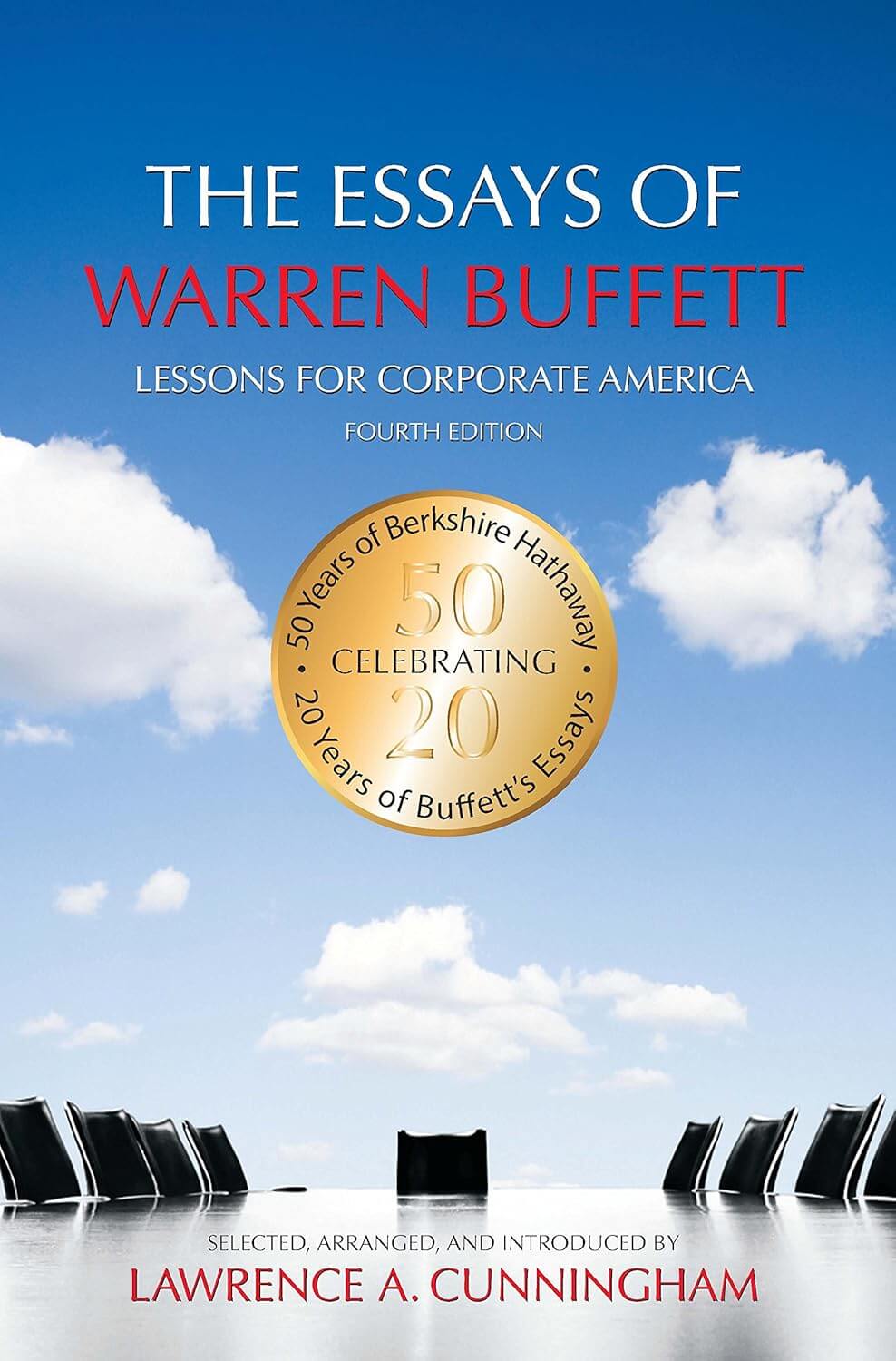
The Essays of Warren Buffett Book Summary
This The Essays of Warren Buffett Book Summary covers the key ideas, lessons, and takeaways in about 20 minutes.
Buffett’s philosophy challenges many norms of modern finance: relentless trading, blind diversification, leverage-driven growth, and complexity for its own sake. In their place, he offers a model grounded in simplicity, transparency, and alignment of incentives. The essays argue that when decision-makers share risk with owners, when capital is treated with respect, and when time is allowed to work, extraordinary outcomes can emerge without extraordinary behavior.
Ultimately, the book is less about money than about judgment. It suggests that the same qualities that build financial success—patience, honesty, accountability, and humility—also build institutions worth owning and legacies worth preserving.
Helps with these goals
Want the complete 20-minute summary?
- Full structured summary
- Video Summary
- Podcast Summary
- Audio summary
- Key takeaways
- Exercises
- Quiz
- Highlights and notes
- Ask the book with AI
What is in the The Essays of Warren Buffett book summary?
Below is a preview of Sumizeit’s expert-written summary of The Essays of Warren Buffett by Warren Buffett. The full summary covers the book’s key ideas in text, audio, and video.
The Essays of Warren Buffett is not a how-to guide filled with formulas, shortcuts, or tactical trading advice. Instead, it is a carefully assembled record of reasoning—an extended conversation between a business owner and his partners about how capital should be treated, how businesses should be judged, and how incentives shape behavior. Compiled from decades of shareholder letters, the book captures the intellectual architecture behind one of the most successful capital allocation records in history.
At the center of these essays is Warren Buffett, a figure whose public persona stands in sharp contrast to the prevailing image of financial power. Rather than projecting speed, complexity, or bravado, Buffett emphasizes patience, simplicity, accountability, and humility. His writings are not meant to impress but to clarify. He does not attempt to mystify investing; he attempts to demystify it, even when that means openly criticizing large parts of his own industry.
The essays were originally written for the shareholders of Berkshire Hathaway, whom Buffett consistently describes as co-owners rather than clients. This framing is not rhetorical—it determines everything from how profits are discussed to how mistakes are admitted. The letters explain not only what decisions were made, but why they were made, what alternatives were rejected, and what risks remain. In doing so, Buffett turns routine corporate communication into an ongoing education in business judgment.
What emerges is a philosophy that is easy to understand but exceptionally difficult to execute. The ideas require discipline in the face of crowd behavior, restraint in moments of excitement, and moral clarity when incentives encourage shortcuts. The book ultimately argues that long-term wealth creation is not a matter of cleverness, but of character applied consistently over time.
Buffett’s Background and the Evolution of His Perspective
Buffett’s worldview did not emerge in a vacuum. His early fascination with numbers, combined with growing up amid economic uncertainty, shaped a deep respect for financial independence and stability. Rather than seeking prestige or excitement in financial centers, he deliberately built his career in Omaha, far from Wall Street’s cultural gravity. This distance allowed him to think independently, insulated from the feedback loops of fashion and hype that dominate financial markets.
Berkshire Hathaway itself began as a struggling textile operation—hardly the foundation one would expect for a future conglomerate. Buffett initially acquired it as an investment opportunity, but over time recognized that the underlying business was structurally weak. Rather than doubling down on a failing model, he transformed the company into a holding structure, redirecting capital into businesses with durable economics. This pivot was not glamorous, but it proved decisive.
Over decades, Berkshire evolved into a vast collection of operating businesses spanning insurance, manufacturing, retail, energy, and consumer goods. Yet Buffett’s essays make clear that scale was never the goal. Growth was tolerated only when it served per-share value creation. This distinction—between getting bigger and getting better—runs throughout the book and forms a core critique of modern corporate behavior.
Investing as Ownership, Not Trading
The foundational idea repeated…
Want the complete 20-minute summary?
- Full structured summary
- Video Summary
- Podcast Summary
- Audio summary
- Key takeaways
- Exercises
- Quiz
- Highlights and notes
- Ask the book with AI
Who should read The Essays of Warren Buffett?
The Essays of Warren Buffett is essential reading for individual investors seeking to understand the principles behind successful long-term wealth creation, as well as business owners and corporate leaders interested in sound capital allocation and governance. It also appeals to anyone disillusioned with mainstream financial advice and looking for clarity on how markets actually work. Whether you manage your own portfolio or simply want to think more rationally about money, this book offers timeless wisdom stripped of jargon and sales tactics.
Why does The Essays of Warren Buffett matter?
In an era dominated by short-term trading, algorithmic speculation, and financial complexity designed to obscure rather than enlighten, Warren Buffett's essays provide a counternarrative grounded in decades of proven success. The book challenges prevalent myths about markets, exposes conflicts of interest embedded in the financial industry, and demonstrates that ordinary investors can achieve extraordinary results by applying rational discipline over time. At a moment when financial fragility and misaligned incentives threaten both individual wealth and systemic stability, Buffett's emphasis on simplicity, transparency, and real economic value has never been more relevant.
What are the key themes in The Essays of Warren Buffett?
- Investing as ownership, not trading or speculation
- The power of compounding and patience over decades
- Operating within a circle of competence to minimize hidden risks
- Distinguishing between productive and unproductive assets
- The dangers of leverage, complexity, and financial intermediation
- Governance accountability and aligned incentives
- Volatility as opportunity rather than threat
- Capital allocation as the central responsibility of leadership
What are the key lessons from the The Essays of Warren Buffett book summary?
A stock is a claim on a real business, not an abstract symbol
Viewing stock ownership as equivalent to owning a slice of an operating business with real cash flows transforms how investors evaluate opportunities and interpret price movements. This framing redirects focus from short-term price changes to long-term business performance and value creation.
Market prices serve investors; they should not instruct them
Price quotations are tools available for those who want to use them, not signals that must be obeyed. Low prices signal potential opportunity rather than danger, and high prices warrant skepticism rather than celebration.
Compounding rewards inaction and punishes unnecessary activity
Frequent trading interrupts compounding through taxes, fees, and errors that accumulate silently over time. True wealth building comes from allowing sound investments to compound undisturbed for decades.
Volatility is not risk; misunderstanding is risk
Price fluctuations driven by fear and panic differ fundamentally from permanent impairment of business value. Disciplined investors distinguish between temporary noise and genuine threats, turning volatility into advantage.
A margin of safety protects against both error and misfortune
Purchasing assets significantly below their calculated intrinsic value provides cushion against unforeseen developments and errors in analysis. This practice separates investing from speculation.
Understand what you own before you buy it
Operating within a defined circle of competence ensures that risks can be thoughtfully evaluated rather than blindly accepted. Venturing into unfamiliar territory introduces hidden vulnerabilities that cannot be quantified.
Simple, repeatable business models outperform speculative ventures
Businesses offering predictable economics tied to consistent human needs provide resilience that innovation-dependent enterprises cannot match. Durability trumps excitement in long-term wealth creation.
Fee-driven intermediaries often destroy value while claiming to create it
Financial advisers, brokers, and managers frequently benefit from activity and complexity regardless of whether clients prosper. Transparency and alignment of incentives distinguish genuine helpers from wealth extractors.
Productive assets generate cash flows; unproductive assets rely on price appreciation
Owning a business or income-producing real estate differs fundamentally from owning gold or collectibles, which generate nothing and depend entirely on someone else paying more later. Real value comes from economic output, not perception shifts.
Debt magnifies losses faster than it amplifies gains
Leverage makes outcomes more extreme while introducing fragility that surfaces without warning. Financial strength is resilience and flexibility, not aggressiveness.
Derivatives are bets disguised as hedges, often masking systemic risk
Complex financial instruments allow risk to be hidden behind layers of abstraction while creating interconnected vulnerabilities that threaten entire systems. Widespread derivative use introduces dangers that are difficult to monitor or contain.
Stock options often reward executives for taking risks they do not bear
Option-based compensation creates asymmetric incentives where managers benefit from upside without experiencing downside, encouraging excessive risk-taking. True alignment requires that decision-makers share both gains and losses alongside other owners.
Most acquisitions destroy shareholder value through overpayment and integration failure
Growth through purchasing other companies often fails because of inflated prices, unrealistic synergy projections, and cultural mismatches. Disciplined capital allocation requires saying no to most deals, not pursuing growth for its own sake.
Leveraged buyouts shift risk onto employees and operations while extracting fees
Loading acquired companies with debt allows financial engineers to profit while concentrating risk on those without voice in decisions. This practice prioritizes fee extraction over sustainable business building.
Markets are not perfectly efficient; opportunities emerge from fear and euphoria
If markets always priced assets rationally, there would be no dislocations between price and underlying value. The persistence of opportunities proves that human emotion still moves markets.
Blind diversification can dilute returns without reducing risk
Owning many mediocre assets that you do not understand may not reduce risk if none are well analyzed. Concentration paired with deep knowledge can be safer than spreading capital thin across incomprehensible holdings.
Transparency and accountability align management behavior with owner interests
When executives and board members hold substantial personal investments and face real consequences for decisions, incentives naturally shift toward stewardship. Accountability creates culture that endures.
Retained earnings should compound internally only if they earn higher returns than shareholders could independently achieve
Deciding whether to reinvest profits or distribute them requires honest assessment of opportunity quality. Forced action is inferior to the discipline of waiting for genuinely attractive investments.
Share buybacks only make sense when stock trades below intrinsic worth
Repurchasing shares concentrates ownership without tax consequences, but only improves value per share if the price is genuinely depressed. Buybacks at inflated prices destroy value just as surely as overpaying for acquisitions.
Systems and principles matter more than individual brilliance
Sustainable organizations embed values into incentive structures and culture rather than depending on any single leader. Institutions designed to endure survive leadership changes and continue serving shareholders effectively.
Want the complete 20-minute summary?
- Full structured summary
- Video Summary
- Podcast Summary
- Audio summary
- Key takeaways
- Exercises
- Quiz
- Highlights and notes
- Ask the book with AI
How can you apply ideas from The Essays of Warren Buffett?
- Evaluate stocks as fractional business ownership by analyzing competitive advantages, cash flows, and management quality rather than charting price patterns
- Build a concentrated portfolio of businesses you thoroughly understand and allow compounding to work undisturbed for decades
- Use market downturns as opportunities to purchase stakes in strong businesses trading below intrinsic value rather than selling in panic
- Minimize fees and taxes by buying-and-holding rather than frequent trading, and favor low-cost index funds if individual company analysis is impractical
- Structure personal or corporate compensation tied to actual economic performance over meaningful time horizons, with decision-makers holding substantial personal stakes in outcomes
- Evaluate acquisitions rigorously against a margin of safety, rejecting deals based on growth targets or synergy projections that cannot be confidently quantified
- Maintain financial strength through conservative debt levels and adequate cash reserves, creating flexibility to act opportunistically when others are forced to retreat
- Demand transparency in financial reporting that reflects economic reality rather than cosmetic metrics, and scrutinize board independence and audit effectiveness
What common mistakes do readers make with The Essays of Warren Buffett?
- Believing that active trading, market timing, or following financial news will improve returns rather than harming them through costs and errors
- Confusing price volatility with business risk, selling sound investments during temporary panic or holding weak businesses through temporary euphoria
- Investing in complex products or unfamiliar businesses in pursuit of higher returns without understanding how they make money or what could disrupt them
- Accepting financial advice from intermediaries whose compensation depends on activity or product sales rather than client outcomes
Sumizeit Exercises Apply what you've learned
Turn ideas from The Essays of Warren Buffett into action with a short guided reflection: identify the biggest takeaway, connect it to your life, and commit to one step you can take in the next 24 hours.
What is the expert analysis of The Essays of Warren Buffett?
Overview
The Essays of Warren Buffett is a seminal collection of writings by Warren Buffett, arguably one of the most influential investors of the 20th and 21st centuries. Rather than serving as a conventional investment manual, the book compiles Buffett’s shareholder letters into a coherent philosophy on capital allocation, business judgment, and ethical stewardship. Its significance lies not only in its practical insights but also in its articulation of investing as a discipline rooted in character, patience, and rationality. Buffett’s unique position as both a business owner and a public intellectual lends the work enduring authority and relevance.
Core Thesis
At the heart of Buffett’s essays is the conviction that investing should be approached as ownership rather than speculation. Stocks represent claims on real businesses, and their value is derived from underlying economic performance, not market noise. Long-term wealth creation depends on disciplined capital allocation, emotional control, and adherence to principles such as simplicity, transparency, and alignment of incentives. Buffett challenges prevailing financial orthodoxy—market efficiency, diversification dogma, and the glorification of complexity—arguing instead for a model grounded in integrity, patience, and deep understanding within one’s circle of competence.
Strengths
- Clarity and Accessibility: Buffett’s plainspoken style demystifies complex financial concepts without sacrificing rigor, making the essays accessible to sophisticated readers and practitioners alike.
- Philosophical Depth: The book transcends technical investing advice by embedding financial decisions within ethical and behavioral frameworks, emphasizing character and judgment over formulas.
- Timelessness: By focusing on enduring principles rather than transient market trends, the essays maintain relevance across decades and various economic cycles.
- Transparency and Accountability: Buffett’s candid discussion of mistakes and rationale fosters trust and models corporate governance grounded in responsibility.
- Integration of Theory and Practice: The essays bridge academic finance and real-world business management, offering insights into capital allocation, corporate culture, and systemic risk.
Critiques & Counterarguments
- Potential Oversimplification: While Buffett’s emphasis on simplicity is a strength, some critics argue that his dismissal of complexity and innovation may underappreciate the transformative potential of emerging industries and technologies that do not fit traditional molds.
- Limited Empirical Testing: The essays rely heavily on Buffett’s personal experience and observation rather than systematic empirical analysis, which may limit generalizability in different market contexts or economic regimes.
- Contrasting Financial Theories: Efficient Market Hypothesis (EMH) proponents contest Buffett’s rejection of market efficiency, arguing that apparent anomalies can be explained by risk factors or behavioral biases that do not guarantee exploitable opportunities.
- Diversification Debate: Modern portfolio theory advocates diversification as a risk management tool, especially for investors lacking Buffett’s expertise; his critique may underestimate the protective value of diversification for the average investor.
- Changing Market Dynamics: The financial landscape has evolved with algorithmic trading, global interconnectedness, and regulatory shifts; some of Buffett’s views on volatility and market behavior might require adaptation to these new realities.
Who Should Read This
The Essays of Warren Buffett is essential reading for investors, business leaders, and students of finance who seek a principled, long-term approach to capital allocation and corporate governance. It is particularly valuable for those who appreciate a synthesis of practical wisdom and ethical reflection, and who are willing to cultivate patience and discipline in their decision-making. While novices can gain foundational insights, the book’s depth and nuance make it especially suited for sophisticated readers aiming to deepen their understanding of investment philosophy beyond technical metrics or market speculation.
Frequently asked questions about the The Essays of Warren Buffett book summary
What is The Essays of Warren Buffett about?
The Essays of Warren Buffett is a collection of shareholder letters compiled from decades of Buffett's communication with Berkshire Hathaway owners. It presents a philosophy of business judgment, capital allocation, and long-term wealth creation based on rationality, simplicity, and alignment of incentives rather than complexity or speculation. The book emphasizes treating stock ownership as equivalent to owning a business, distinguishes between investing and speculation, and critiques practices common in the financial industry that harm investor returns.
Who should read The Essays of Warren Buffett?
Individual investors seeking to understand principles behind successful long-term wealth creation should read this book, as should business owners and corporate leaders interested in sound capital allocation and governance. It also benefits anyone skeptical of mainstream financial advice, disillusioned with trading culture, or wanting to think more clearly about money and markets. Whether managing your own portfolio or leading an organization, this book offers timeless wisdom applicable to your decisions.
What are the main takeaways from The Essays of Warren Buffett?
The main takeaways are: wealth is built through consistent rational behavior applied over long periods rather than brilliance or speed; stocks should be viewed as ownership stakes in real businesses, not trading vehicles; compounding rewards patience and punishes unnecessary activity; volatility is opportunity, not threat; fees and complexity destroy returns while benefiting intermediaries; debt magnifies losses while fragility surfaces without warning; and extraordinary outcomes emerge when decision-makers share risk with owners and time is allowed to work. Ultimately, success requires the same qualities that build sound institutions: patience, honesty, accountability, and humility.
How does Warren Buffett define investing versus speculation?
Buffett defines investing as a practice grounded in analysis, valuation, and a margin of safety, where the investor's returns depend on the underlying business performance over meaningful time horizons. Speculation, by contrast, relies on price movements and hopes that someone else will pay more later, lacking a reliable foundation. While speculation can occasionally succeed, investing provides a systematic approach where favorable results do not depend on precise predictions about the future.
What does Warren Buffett say about market efficiency and timing?
Buffett rejects the belief that markets are perfectly efficient and that prices always reflect all available information. He argues that if markets were always rational, opportunities created by fear and euphoria would not exist. Rather than attempting to predict market direction, which he considers neither necessary nor useful, Buffett advocates preparing for a range of outcomes and structuring investments so that favorable results do not depend on correctly forecasting the future.
Why does Warren Buffett caution against debt and leverage?
Buffett warns that debt magnifies both gains and losses, but losses often arrive faster and with less warning. Leverage makes outcomes more extreme while introducing fragility that surfaces without warning when conditions deteriorate. In corporate contexts, debt-financed growth frequently benefits managers while endangering shareholders, employees, and communities. Financial strength is framed as resilience and flexibility, not aggressiveness, allowing businesses to survive downturns and act opportunistically.
What is Buffett's critique of the financial industry?
Buffett argues that many financial products and advisory services exist primarily to generate fees rather than improve investor outcomes, with compensation incentives often misaligned with client results. Brokers, fund managers, and advisers frequently benefit from activity rather than results, and complexity becomes a feature rather than a flaw because it discourages scrutiny. Few professionals consistently outperform simple market averages once fees are considered, and transparency with independent compensation structures is preferable to commission-driven arrangements.
About Sumizeit
Sumizeit is a profitable Scomy LLC company based in Miami, Florida. It has been helping readers learn from nonfiction books for 7 years with expert-written summaries in text, audio, podcast, and video.
Want the complete 20-minute summary?
- Full structured summary
- Video Summary
- Podcast Summary
- Audio summary
- Key takeaways
- Exercises
- Quiz
- Highlights and notes
- Ask the book with AI
Here's why readers love Sumizeit
Join thousands of learners getting smarter every day
"Great experience. Detailed summaries. Loved the gamification feature. Makes learning fun. Good customer service. I recommend Sumizeit to anyone. You'll learn a lot."
"I always felt busy but still wanting to keep up with the book discussion in my friend group. This was a great supplement to help me keep reading the books I find fun while keeping up with important books."
"I love this website. Instead of scrolling social media, I find myself learning a lot. I use it everyday. I recommend this app for anyone who is too busy and wants to get up to speed with their favorite books."
The Essays of Warren Buffett Book Summary PDF
Looking for a The Essays of Warren Buffett Book Summary PDF you can save and revisit offline? Our The Essays of Warren Buffett Book Summary PDF captures the book’s core ideas in a clean, printable format — the key frameworks, takeaways, and structure without the fluff. Download the The Essays of Warren Buffett Book Summary PDF when you want a reference you can annotate, share with your team, or review on the go. Get your The Essays of Warren Buffett Book Summary PDF from the download page below.
Download The Essays of Warren Buffett Book Summary PDFPeople also liked these summaries
Readers who explored The Essays of Warren Buffett often enjoyed these titles next.



Want the complete 20-minute summary?
- Full structured summary
- Video Summary
- Podcast Summary
- Audio summary
- Key takeaways
- Exercises
- Quiz
- Highlights and notes
- Ask the book with AI
Featured Book Titles
Popular Book Summaries at sumizeit, leading book summary app