


As an Amazon Associate, Sumizeit earns from qualifying purchases.
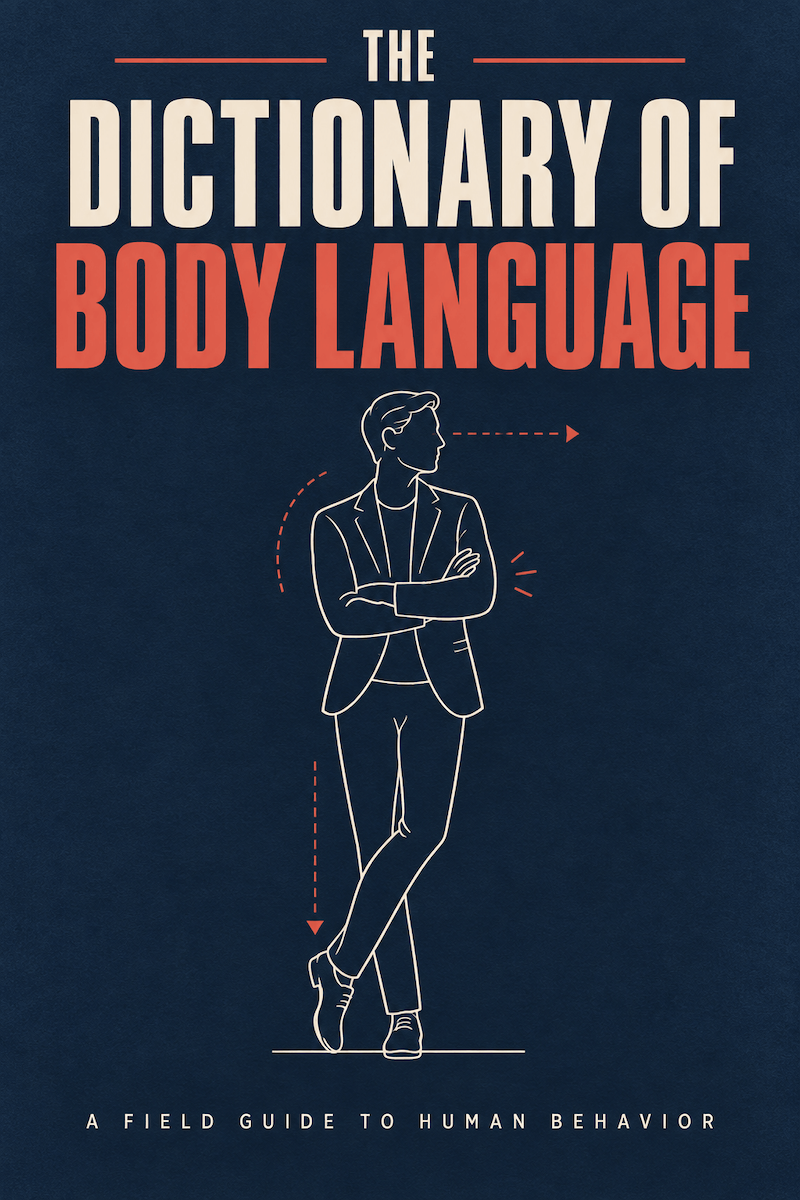
The Dictionary of Body Language Book Summary
This The Dictionary of Body Language Book Summary covers the key ideas, lessons, and takeaways in about 20 minutes.
Helps with these goals
Want the complete 20-minute summary?
- Full structured summary
- Video Summary
- Podcast Summary
- Audio summary
- Key takeaways
- Exercises
- Quiz
- Highlights and notes
- Ask the book with AI
What is in the The Dictionary of Body Language book summary?
Below is a preview of Sumizeit’s expert-written summary of The Dictionary of Body Language by Joe Navarro. The full summary covers the book’s key ideas in text, audio, and video.
Joe Navarro spent 25 years as an FBI special agent, and for most of that career, his job was to read people. He interrogated spies, tracked down criminals, and built a reputation as one of the country's sharpest experts on nonverbal communication. The Dictionary of Body Language is his attempt to hand that skill to everyone else. Think of it less like a novel you read cover to cover and more like a field guide you keep nearby and flip open when you need it. You spot a gesture, you look it up, and you get a straight answer on what it probably means.
This book is the companion to Navarro's earlier work, What Every BODY Is Saying, which lays out the deeper theory behind reading people. The Dictionary is the practical half. Navarro's core claim is simple. Once you learn to notice what people's bodies are telling you, whether that's a coworker in a meeting, a date across the table, or a stranger on the subway, you get better at your relationships and better at understanding what's actually going on around you.
Before you can use any of the specific cues in this book, though, Navarro wants you to absorb two ground rules. Skip these, and you'll misread people constantly.
Rule One, Figure Out What's Normal for This Specific Person
Here's the trap most people fall into. They see a behavior, they assume it means one universal thing, and they stop thinking. Navarro says that's backwards. The same physical action can mean completely different things depending on who's doing it, so before you draw any conclusion, you need a baseline for that individual.
Take sweating. It's a classic stress signal, and later in the book Navarro explains why. But some people sweat heavily no matter what's going on emotionally, just because of how their body works. If you don't know that about someone, you'll read a perfectly calm person as anxious just because their palms are damp.
Navarro's fix is to build a quick mental snapshot of a person the moment you start interacting with them. Notice how they're carrying themselves in general. Are they loose and put together, or already a bit tense and disheveled? Factor in where they are and what they're doing, too. Someone sitting across from you in a job interview is naturally going to show more nervous energy than someone standing in line at the grocery store, and that's not a warning sign, that's just the situation doing what situations do. Once you've got that baseline in your head, you have something real to compare their later behavior against. A shift away from their normal is what actually tells you something.
Rule Two, Never Trust a Single Gesture on Its Own
The second rule matters just as much. A lot of individual body language cues can mean more than one thing, so instead of fixating on one signal, Navarro wants you to look at the whole cluster of what someone's body is doing at…
Want the complete 20-minute summary?
- Full structured summary
- Video Summary
- Podcast Summary
- Audio summary
- Key takeaways
- Exercises
- Quiz
- Highlights and notes
- Ask the book with AI
Who should read The Dictionary of Body Language?
The Dictionary of Body Language is for anyone who wants to understand what people really think and feel beneath their words—professionals in negotiations or sales, people navigating relationships, managers reading their teams, or simply those curious about human behavior. Whether you're in a job interview, on a date, or sitting in a meeting, this book gives you tools to read the room more accurately.
Why does The Dictionary of Body Language matter?
In a world where people often say one thing while their bodies signal another, learning to read nonverbal cues is a practical life skill that cuts through miscommunication and deception. Joe Navarro draws on 25 years as an FBI interrogator to make this expertise accessible, showing that body language awareness isn't manipulation—it's informed empathy that improves relationships, negotiations, and decision-making.
What are the key themes in The Dictionary of Body Language?
- Body language reveals emotions more honestly than words
- Context and baseline behavior are essential to accurate interpretation
- Clusters of signals matter more than isolated gestures
- Physical posture influences mental confidence and conviction
- Feet and eye tension are harder to control than facial expressions
What are the key lessons from the The Dictionary of Body Language book summary?
Establish a personal baseline before interpreting signals
Before you can accurately read someone's behavior, you need to know what's normal for that specific person in their typical state. Without this baseline, you'll misinterpret ordinary traits—like heavy sweating—as signs of stress or dishonesty.
Never rely on a single gesture in isolation
A smile, lack of eye contact, or crossed arms can mean many different things depending on the full context. Only by looking at clusters of signals together—facial expression, body position, and foot placement—can you form a reliable interpretation.
Repetitive motions signal self-soothing and stress
When people repeat small gestures like self-massage, rocking, or finger-tapping, they're usually trying to calm their nervous system. These repetitive behaviors trigger endorphins and lower stress hormones, which is why they happen under pressure.
Stress makes people feel warmer and triggers cooling behaviors
Anxiety and stress raise body temperature through fight-or-flight hormones, so stressed people instinctively cool themselves by sweating, running fingers through hair, or lifting their hair off their neck. Always rule out environmental heat first.
Pursed lips and raised eyebrows signal disagreement or doubt
When someone's mouth tightens and pushes forward, or when they raise a single eyebrow, they're typically disagreeing or questioning what they hear, even if they're not saying so aloud.
Narrowed eyes and a clenched jaw reveal anger
Anger shows up as physical tightness throughout the face and body. A visibly tensed jaw is one of the most reliable anger indicators, as it directly reflects the muscular tension of suppressed anger.
Crossed arms and closed postures signal discomfort or self-protection
When people feel unsafe or uncomfortable, they instinctively close themselves off, crossing their arms to protect vulnerable organs or turning away. This defensive posturing is harder to fake than a polite expression.
Feet reveal true feelings more honestly than faces
Feet are difficult to control consciously, so they often betray how someone actually feels. Watch where feet point in conversations and meetings—away from you signals disengagement, toward you signals genuine interest.
Eye tension appears before other facial stress signals
The muscles around the eyes reveal tension and discomfort before other parts of the face do, making this area especially useful for catching subtle mood shifts and detecting when someone is uncomfortable.
Open, upright posture creates and signals genuine confidence
Confident people carry themselves with open shoulders and straight backs, and research shows that adopting this posture actually increases conviction in your own thoughts and opinions, not just how others perceive you.
The eyebrow flash is a genuine universal greeting signal
A quick involuntary flash of raised eyebrows lasting under a second indicates genuine pleasure at seeing someone. This signal appears across dozens of cultures and is one of the most reliable tells of authentic happiness.
Excitement produces upward, springy physical energy
Genuine excitement manifests as bouncing, jumping, or light-footed movement as the body releases excess dopamine. This upward, energetic quality is distinct from other emotional states and hard to fake convincingly.
Rocking behavior requires context to interpret correctly
While rocking can signal psychological distress, it's also a common self-regulation technique among neurodivergent people, especially those on the autism spectrum. Context about the individual is essential to avoid misreading this cue.
Boredom shows up as chin-resting and finger-tapping
Resting your head in both open palms with a slack expression signals boredom or fatigue, as does tapping fingers in a cascading rolling motion—the classic sign of impatience waiting for something to end.
A fist held near the throat signals fear or real discomfort
The throat is a vulnerable spot, and when someone protectively places a fist near it, they're signaling significant fear or discomfort, making this one of the most reliable defensive postures.
Context always overrides gesture interpretation
Environmental factors like temperature, location, and situation can completely change what a behavior means. Someone sweating at ninety degrees is probably just hot, not anxious, so always rule out the obvious explanation first.
Smiles without supporting signals often mask discomfort
A polite smile without relaxed eye muscles, open body language, and feet pointed toward you usually masks discomfort or forced politeness rather than genuine warmth or interest.
Eye contact alone cannot determine honesty or deception
People often increase eye contact while lying because they know avoiding it looks suspicious, so steady eye contact is meaningless in isolation. You must pair it with other behavioral clusters to assess truthfulness.
Stimming serves regulatory purposes beyond stress relief
Self-stimulating behaviors like rocking, tapping, or fidgeting help people calm down, manage overstimulation, or feel good. Some research suggests rocking even improves sleep quality and memory through vestibular system stimulation.
Observation practice trains your instinctive reading ability
Building body language literacy takes deliberate practice: watch someone, note three specific physical details, interpret what emotion they suggest, then check your read against context. This discipline transforms the knowledge into genuine skill.
Want the complete 20-minute summary?
- Full structured summary
- Video Summary
- Podcast Summary
- Audio summary
- Key takeaways
- Exercises
- Quiz
- Highlights and notes
- Ask the book with AI
How can you apply ideas from The Dictionary of Body Language?
- Watch people's feet in meetings to see who genuinely agrees with a proposal, regardless of what they're saying aloud
- Check eye tension in negotiations or sales conversations to detect when someone is uncomfortable or unconvinced
- Use open posture and upright positioning to boost your own confidence before high-stakes conversations
- Observe baseline behavior in the first few minutes with someone new to establish what's normal for them before interpreting stress signals
- Look for clusters of closed-off signals (crossed arms, turned body, feet pointed away) to identify when someone wants to exit a conversation or feels unsafe
What common mistakes do readers make with The Dictionary of Body Language?
- Assuming a single gesture means the same thing for everyone, without considering individual differences or context
- Trusting eye contact as proof of honesty, when liars often deliberately maintain more eye contact to appear truthful
- Reading a smile as warmth without checking for tension around the eyes, arm position, and foot direction
- Interpreting stress signals in hot environments as emotional anxiety rather than simple overheating
- Missing that neurodivergent people use rocking and stimming for self-regulation, not as signs of distress
Sumizeit Exercises Apply what you've learned
Turn ideas from The Dictionary of Body Language into action with a short guided reflection: identify the biggest takeaway, connect it to your life, and commit to one step you can take in the next 24 hours.
What is the expert analysis of The Dictionary of Body Language?
Overview
The Dictionary of Body Language is authored by Joe Navarro, a former FBI special agent with 25 years of experience specializing in nonverbal communication. This book stands out as a practical field guide designed to democratize the expert skill of reading body language, making it accessible beyond law enforcement and psychology professionals. Navarro’s unique background lends the work significant credibility, as it is rooted in real-world interrogation and investigative experience rather than purely academic theory. Positioned as a companion to his earlier, more theoretical work What Every BODY Is Saying, this volume emphasizes actionable insights and quick reference utility, which appeals to readers seeking immediate application in daily interactions.
Core Thesis
Navarro’s central argument is elegantly simple yet profound: effective interpretation of body language requires two foundational disciplines. First, one must establish a baseline of what is normal behavior for the individual in question, recognizing that identical gestures can have vastly different meanings depending on the person and context. Second, no single gesture should be interpreted in isolation; rather, clusters of nonverbal cues must be analyzed holistically to accurately infer emotional states or intentions. Mastery of these principles transforms body language from a collection of ambiguous signals into a reliable tool for enhancing interpersonal understanding and improving relational dynamics.
Strengths
- Authoritative Expertise: Navarro’s extensive FBI experience lends authenticity and practical weight to his interpretations, distinguishing the book from more speculative or pop-psychology treatments of body language.
- Clear, Pragmatic Framework: The two core rules Navarro emphasizes provide a disciplined approach that guards against common misreadings and cognitive biases, such as overgeneralization or confirmation bias.
- Comprehensive Coverage: The book systematically categorizes body language cues by emotional states—stress, boredom, anger, discomfort, confidence, excitement—offering readers nuanced understanding across a broad affective spectrum.
- Contextual Sensitivity: Navarro’s insistence on situational awareness and individual differences prevents reductive interpretations and highlights the complexity of human nonverbal communication.
- Accessible Format: Designed as a dictionary or field guide, the book’s structure facilitates quick consultation and practical application, making it valuable for professionals and lay readers alike.
Critiques & Counterarguments
- Potential Oversimplification: While the two-rule framework is elegant, real-world body language often involves layers of cultural, psychological, and situational complexity that may resist tidy categorization. Some critics argue that nonverbal cues can be too context-dependent to be reliably decoded without extensive background knowledge.
- Limited Empirical Validation: Although Navarro references scientific studies, much of the book relies on anecdotal evidence from his FBI career. This raises questions about the generalizability of certain claims, especially across diverse populations and cultures.
- Cultural Variability: The book occasionally underemphasizes cultural differences in body language interpretation. Gestures that signal discomfort or confidence in one culture may carry different meanings elsewhere, complicating universal application.
- Opposing Research on Lie Detection: Navarro challenges simplistic notions such as liars avoiding eye contact, but broader psychological research shows that reliable deception detection through body language alone remains elusive. Meta-analyses suggest that even trained experts perform only slightly better than chance.
- Neurodiversity Considerations: The book commendably acknowledges neurodivergent behaviors like stimming, but the complexity of interpreting such cues in diverse neurological contexts could be further expanded to avoid misinterpretation or pathologizing.
Who Should Read This
The Dictionary of Body Language is ideally suited for professionals and individuals who engage in frequent interpersonal interactions and seek to deepen their intuitive understanding of nonverbal signals. This includes business leaders, negotiators, therapists, educators, law enforcement personnel, and anyone interested in psychology or communication. Its practical, no-nonsense approach also makes it valuable for readers who want concrete tools rather than abstract theory. However, those seeking rigorous scientific treatises or culturally comparative analyses might find the book less comprehensive. Ultimately, it is best for readers who appreciate a blend of experiential insight and accessible guidance aimed at enhancing real-world relational acuity.
Frequently asked questions about the The Dictionary of Body Language book summary
What is The Dictionary of Body Language about?
The Dictionary of Body Language by Joe Navarro is a practical field guide to reading nonverbal cues and understanding what people's bodies reveal about their true emotions and intentions. Navarro, a former FBI interrogator with 25 years of experience reading suspects and spies, organizes specific gestures and expressions by the emotions they signal—from stress and anger to confidence and excitement—while teaching you the crucial skills needed to interpret them accurately.
Who should read The Dictionary of Body Language?
Anyone who wants to understand people more accurately should read this book—negotiators and salespeople seeking an edge, managers trying to read their teams, people navigating relationships, or simply those curious about human behavior. It's especially valuable for professionals in high-stakes conversations and anyone who wants to know what people really feel beneath their words.
What are the main takeaways from The Dictionary of Body Language?
The two core lessons are: first, establish what's normal for each specific person before interpreting their behavior, and second, never trust a single gesture in isolation—always look at clusters of signals together. Navarro also emphasizes that feet and eye tension are harder to control than facial expressions, that context always overrides gesture meaning, and that open posture influences mental confidence just as much as it signals it.
How do you tell the difference between a genuine smile and a polite one?
A genuine smile comes with relaxed muscles around the eyes, open body language, and feet pointed toward you. A polite but forced smile lacks these supporting signals—instead you'll see tension around the eyes, crossed arms, or feet angled away, all indicating the person is uncomfortable despite their smile.
What body language signals indicate someone is lying?
There is no single reliable lie-detection signal in The Dictionary of Body Language. Navarro emphasizes that people often increase eye contact while lying because they know avoiding it looks suspicious, so eye contact alone means nothing. Instead, look for clusters of signals like increased sweating, fidgeting, jaw tension, and nervous hand movements combined with inconsistencies in their overall demeanor.
How can you use body language to improve your confidence in meetings?
According to Navarro, adopting an open, upright posture with your chest visible and shoulders back actually increases your conviction in your own ideas, not just how others perceive you. Research shows that sitting upright versus slouching influences how firmly you believe your own thoughts, so improving your posture before a meeting can genuinely boost your confidence.
What does it mean when someone's feet are pointed away during a conversation?
Feet are one of the most honest signals because people rarely control them consciously. When someone's feet point away from you, toward a door, or away from the conversation, it signals genuine disengagement or a desire to leave, even if their face and words suggest otherwise. In group settings, feet positions often reveal who the group actually agrees with most.
Is there a universal body language signal everyone understands?
Yes—the eyebrow flash, a quick involuntary raising and lowering of the eyebrows lasting under a second, appears to be nearly universal. Researchers have documented this genuine greeting signal in cultures across Japan, Samoa, Papua New Guinea, France, South America, and many others, suggesting it's a deeply human expression of authentic happiness.
About Sumizeit
Sumizeit is a profitable Scomy LLC company based in Miami, Florida. It has been helping readers learn from nonfiction books for 7 years with expert-written summaries in text, audio, podcast, and video.
Want the complete 20-minute summary?
- Full structured summary
- Video Summary
- Podcast Summary
- Audio summary
- Key takeaways
- Exercises
- Quiz
- Highlights and notes
- Ask the book with AI
Here's why readers love Sumizeit
Join thousands of learners getting smarter every day
"Great experience. Detailed summaries. Loved the gamification feature. Makes learning fun. Good customer service. I recommend Sumizeit to anyone. You'll learn a lot."
"I always felt busy but still wanting to keep up with the book discussion in my friend group. This was a great supplement to help me keep reading the books I find fun while keeping up with important books."
"I love this website. Instead of scrolling social media, I find myself learning a lot. I use it everyday. I recommend this app for anyone who is too busy and wants to get up to speed with their favorite books."
The Dictionary of Body Language Book Summary PDF
Looking for a The Dictionary of Body Language Book Summary PDF you can save and revisit offline? Our The Dictionary of Body Language Book Summary PDF captures the book’s core ideas in a clean, printable format — the key frameworks, takeaways, and structure without the fluff. Download the The Dictionary of Body Language Book Summary PDF when you want a reference you can annotate, share with your team, or review on the go. Get your The Dictionary of Body Language Book Summary PDF from the download page below.
Download The Dictionary of Body Language Book Summary PDFPeople also liked these summaries
Readers who explored The Dictionary of Body Language often enjoyed these titles next.


Want the complete 20-minute summary?
- Full structured summary
- Video Summary
- Podcast Summary
- Audio summary
- Key takeaways
- Exercises
- Quiz
- Highlights and notes
- Ask the book with AI
Featured Book Titles
Popular Book Summaries at sumizeit, leading book summary app