


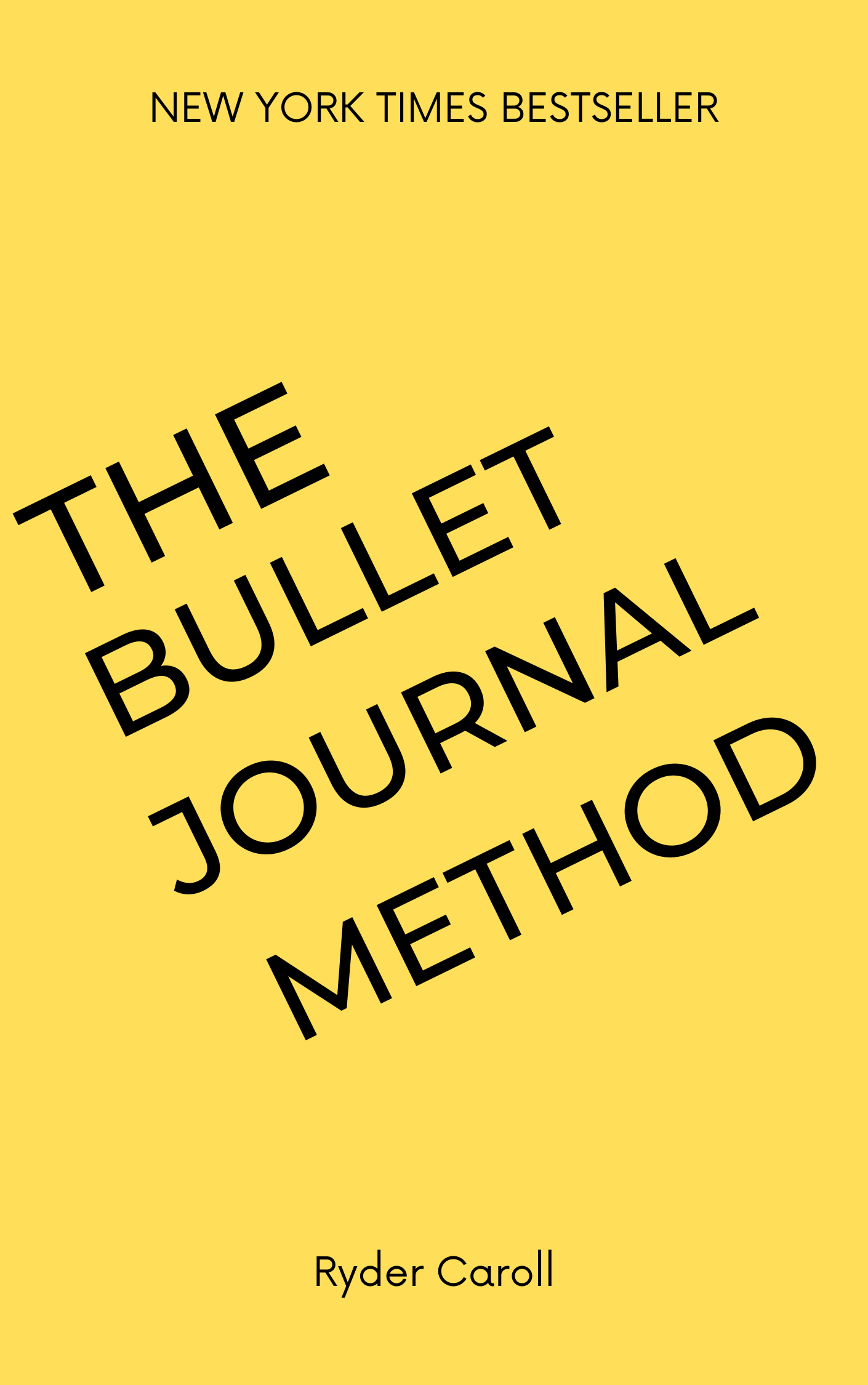
Prefer the print book? Buy on Amazon
As an Amazon Associate, Sumizeit earns from qualifying purchases.
The Bullet Journal Method Book Summary
This The Bullet Journal Method Book Summary covers the key ideas, lessons, and takeaways in about 20 minutes.
The Bullet Journal Method combines capture, reflection, and goal-setting for gr.
Helps with these goals
Want the complete 20-minute summary?
- Full structured summary
- Video Summary
- Podcast Summary
- Audio summary
- Key takeaways
- Exercises
- Quiz
- Highlights and notes
- Ask the book with AI
Want a Free Weekly Read?
Get a free summary every week straight to your mailbox.
Preview the The Bullet Journal Method book summary
Below is a preview of Sumizeit’s comprehensive human-written summary of The Bullet Journal Method by Ryder Caroll. The full summary is 15-20 minutes long and covers the book’s key ideas in text, audio, visual, and video formats. Unlock the full 20 Minute Summary
Ryder Carroll created the Bullet Journal after years of battling overwhelm, scattered thinking, and unreliable digital tools. He struggled to remember deadlines, track ideas, and maintain focus in a world of constant digital interruption. While apps promised organization, they instead produced a never-ending loop of alerts, unread messages, and half-finished notes buried across platforms. Carroll realized he needed a system that placed him—not algorithms—in control. Paper offered something no digital tool could: full attention, silence, and a direct connection between thought and action. When he began keeping everything—tasks, notes, brainstorms, goals—inside one notebook, he noticed immediate clarity. For example, instead of jumping between eight apps to track finances, appointments, habits, and ideas, he had everything in one unified, easily accessible space. Over months and years, he refined his method into a structured yet flexible system that helped him stay focused, make better decisions, and understand his life with far more depth.
Why the System Works in an Age of Infinite Inputs
Carroll argues that modern productivity tools often sabotage true productivity. Digital systems encourage multitasking, which divides attention and reduces memory retention. For example, a person might open their laptop intending to review a document, but within minutes they’re distracted by Slack notifications, calendar reminders, or browser tabs they didn’t mean to open. The brain must constantly rehearse what it was doing before each interruption, creating cognitive fatigue. A Bullet Journal stops this cycle because it exists outside the digital world. Writing by hand forces you to filter before you write. If you start to write “• Start researching new software,” you may instantly realize the task is too vague and instead jot “• Identify top 3 CRM options” or “• Read reviews for Monday.com and HubSpot.” With analog tools, you engage directly with your thoughts, which strengthens comprehension, intentionality, and memory. The journal becomes a calm mental environment where your priorities can finally surface clearly.
The Core Components That Anchor the Method
The Bullet Journal operates around four essential components. The Index acts as your navigation system. Suppose you’re managing a home renovation. You start a “Bathroom Redesign” section on pages 8–9. Months later, you add plumbing notes on page 56 and design sketches on page 104. The index ties all those entries together so you never lose your place. The Future Log is for long-term planning. It stores anything scheduled more than a month away: dentist appointments, quarterly bills, business launches, vacation planning, conference deadlines, family reunions, or even reminders like “Start winter holiday shopping in early November.” It prevents future tasks from disappearing into vague mental space. The Monthly Log gives a clear, practical overview of the next 30 days. A new parent might list baby checkups, sleep training milestones, daycare closures, and personal self-care tasks. A college student could list exam dates, lab deadlines, club events, and budget reminders.
Want the complete 20-minute summary?
- Full structured summary
- Video Summary
- Podcast Summary
- Audio summary
- Key takeaways
- Exercises
- Quiz
- Highlights and notes
- Ask the book with AI
Who should read The Bullet Journal Method?
The Bullet Journal Method is for anyone struggling with digital overwhelm, scattered priorities, or the feeling that productivity apps are creating more chaos than clarity. Whether you're a student juggling multiple deadlines, a professional managing complex projects, a parent coordinating household logistics, or simply someone seeking intentional living, this method offers a practical analog alternative that puts you back in control.
Why does The Bullet Journal Method matter?
In an era of endless digital notifications and fragmented attention, The Bullet Journal Method by Ryder Carroll offers a counter-cultural solution: a single, unified system that eliminates the cognitive cost of jumping between apps. By combining rapid capture, structured reflection, and deliberate migration of tasks, the method helps you distinguish between true priorities and noise, ultimately enabling deeper self-awareness and meaningful progress toward what actually matters to you.
What are the key themes in The Bullet Journal Method?
- Analog simplicity as antidote to digital chaos
- Intentional filtering through migration and reflection
- Flexibility and personalization over rigid systems
- Mindfulness and presence as productivity tools
- Self-awareness through habit tracking and pattern recognition
- Goal-setting rooted in personal meaning, not external pressure
Want the complete 20-minute summary?
- Full structured summary
- Video Summary
- Podcast Summary
- Audio summary
- Key takeaways
- Exercises
- Quiz
- Highlights and notes
- Ask the book with AI
How can you apply ideas from The Bullet Journal Method?
- Start with a minimal setup using any notebook and pen to create sections for Index, Future Log, Monthly Log, and Daily Log without worrying about aesthetic perfection.
- Practice rapid logging daily by using short bullet points with symbols to capture tasks, ideas, and events in minutes rather than lengthy paragraphs that create friction.
- Conduct daily migration reviews where you decide whether incomplete tasks deserve your continued energy, enabling you to break procrastination cycles and clarify true priorities.
- Create custom collections for recurring topics—such as project tracking, meal planning, budget management, or fitness goals—to transform your journal into a personalized command center.
- Schedule monthly reflection time to review entries for patterns in energy, mood, procrastination, and success, revealing insights about what truly energizes and drains you.
- Break annual goals into quarterly sprints with concrete micro-steps, then track progress in your daily logs to maintain momentum and identify obstacles early.
- Add gratitude entries and win celebrations to your daily logs to train your attention toward positivity and build resilience through an intentional record of uplifting moments.
- Use quarterly life reviews to identify which goals are worth pursuing versus which are recurring fantasies, preventing wasted effort on misaligned aspirations.
What common mistakes do readers make with The Bullet Journal Method?
- Prioritizing aesthetic perfection over functionality, which creates friction and abandonment—the method works because it's simple, not because it looks like a Pinterest board.
- Failing to review and migrate tasks regularly, which turns the journal into a static dumping ground rather than a dynamic decision-making tool.
- Treating the system as rigid and unchangeable, rather than evolving it as your life and needs change—collections and structures should adapt to serve you, not constrain you.
- Logging too much detail in daily entries instead of using rapid logging, which defeats the purpose of quick capture and turns the journal into a time-consuming chore.
- Abandoning the practice after initial enthusiasm without giving migration and reflection time to reveal their transformative patterns and insights.
- Creating collections and trackers that look good but don't serve your actual life, adding maintenance burden without real benefit to your clarity or decision-making.
Sumizeit Exercises Apply what you've learned
Turn ideas from The Bullet Journal Method into action with a short guided reflection: identify the biggest takeaway, connect it to your life, and commit to one step you can take in the next 24 hours.
What is the expert analysis of The Bullet Journal Method?
Overview
The Bullet Journal Method is authored by Ryder Carroll, a digital product designer who transformed his personal struggles with attention and organization into a globally influential analog system. The book is significant because it challenges the prevailing dominance of digital productivity tools by advocating a minimalist, handwritten approach that fosters mindfulness, intentionality, and self-awareness. Carroll’s method integrates design thinking, psychology, and Stoic philosophy, positioning the Bullet Journal not merely as a planner but as a comprehensive framework for personal growth and purposeful living.
Core Thesis
Carroll’s central argument is that modern digital productivity tools, while abundant, often fragment attention and induce cognitive fatigue, undermining true productivity and clarity. In contrast, the Bullet Journal—an analog system centered on rapid logging, migration, reflection, and meaningful goal-setting—reclaims control by externalizing thoughts onto paper. This process enhances focus, memory retention, and self-understanding by fostering a calm mental environment where priorities emerge organically. The method’s flexibility allows users to tailor their journals as evolving personal command centers, integrating mindfulness and Stoic principles to cultivate presence, acceptance, and steady growth.
Strengths
- Holistic Integration: The Bullet Journal transcends traditional productivity systems by combining task management with emotional reflection, habit tracking, and values-driven goal setting, making it a tool for both efficiency and personal development.
- Practical Flexibility: The method’s modular design—comprising Index, Future Log, Monthly and Daily Logs, Collections, and Migration—adapts seamlessly to diverse lifestyles, professions, and cognitive styles without imposing rigid structures.
- Mindfulness and Intentionality: By emphasizing handwritten entries and symbolic rapid logging, Carroll encourages users to slow down, clarify vague intentions, and engage deeply with their priorities, counteracting the fragmentation typical of digital environments.
- Philosophical Depth: The incorporation of Stoic ideas about control and acceptance enriches the method, helping users navigate uncertainty and imperfection with resilience rather than frustration.
- Empirical Evidence Through Practice: The method’s emphasis on migration and reflection functions as a continuous feedback loop, enabling users to identify patterns, confront avoidance, and refine their goals based on lived experience.
Critiques & Counterarguments
- Potential Over-Reliance on Analog Tools: While the Bullet Journal’s analog nature is a strength, it may not suit individuals who thrive with digital integrations or require real-time collaboration and synchronization across devices, limiting its applicability in certain professional contexts.
- Time Investment and Consistency: The method demands daily engagement with logging, migration, and reflection, which may be burdensome or unrealistic for highly busy individuals, potentially leading to abandonment or superficial use.
- Limited Empirical Validation: Although Carroll’s approach aligns with cognitive psychology principles about handwriting and memory, comprehensive empirical studies directly comparing the Bullet Journal’s efficacy against digital tools or other analog methods remain sparse.
- Competing Productivity Paradigms: Approaches such as Getting Things Done (GTD) or digital systems like Notion emphasize automation, tagging, and integration with workflows, offering scalability and searchability that the Bullet Journal’s paper format cannot match.
- Risk of Perfectionism and Over-Structuring: Despite Carroll’s encouragement to embrace imperfection, some users may become preoccupied with aesthetic layouts or exhaustive collections, which can paradoxically reduce productivity and increase stress.
Who Should Read This
The Bullet Journal Method is ideally suited for readers seeking a mindful, analog alternative to digital productivity tools—particularly those who feel overwhelmed by constant digital interruptions and crave a tangible, customizable system to organize their lives. It appeals to creative professionals, students, parents, and anyone interested in self-improvement through reflective practice. Additionally, individuals drawn to Stoic philosophy or minimalism will find the book’s philosophical underpinnings enriching. However, those requiring high levels of digital integration or preferring automated systems may find the method less compatible with their needs.
Frequently asked questions about the The Bullet Journal Method book summary
What is The Bullet Journal Method about?
The Bullet Journal Method by Ryder Carroll is a flexible analog system designed to bring clarity, intentionality, and personal growth through simple tools: rapid logging, structured organization via Index, Future Log, Monthly Log, and Daily Log, regular reflection, and deliberate task migration. The method combines productivity with self-awareness, helping you distinguish true priorities from noise and understand your habits, patterns, and values through consistent review and meaningful reflection.
Who should read The Bullet Journal Method?
Anyone feeling overwhelmed by digital tools, scattered across multiple apps, or struggling to distinguish priorities should read this book. It's particularly valuable for students juggling multiple deadlines, professionals managing complex projects, parents coordinating household logistics, creative professionals tracking multiple ideas, or anyone seeking a unified system that puts them back in control. The method works for all ages and lifestyles because it's fundamentally flexible and personal.
What are the main takeaways from The Bullet Journal Method?
The core takeaways are: writing by hand creates clarity through beneficial friction; rapid logging with symbols enables fast capture without friction; migration forces you to ruthlessly filter what truly deserves your energy; regular reflection reveals patterns about your values, energy, and authentic priorities; custom collections transform a planner into a personal command center; and treating goals as meaningful processes rather than external outcomes sustains motivation. Together, these practices transform the journal from a productivity tool into a system for self-knowledge and intentional living.
How do I start a Bullet Journal?
Begin with any notebook and pen you have on hand—aesthetic choices don't matter. Create four core sections: an Index (for navigation), a Future Log (for items scheduled beyond 30 days), a Monthly Log (for the coming 30 days), and a Daily Log (for tasks, events, and notes as they happen). Use rapid logging with short bullet points and simple symbols. Don't worry about perfect layouts; focus on capturing what matters. Within a few days of daily logging, you'll begin to see patterns emerge.
What is migration and why is it important?
Migration is the practice of reviewing incomplete tasks and deciding whether they still deserve your energy—a powerful filter that distinguishes real priorities from perpetual procrastination. Daily migration asks 'Does this still matter?' and forces you to either recommit, break tasks into smaller pieces, or remove them entirely. Monthly and quarterly migration reveal larger patterns about which goals are authentic versus fantasy. Without migration, the journal becomes a static dumping ground; with it, it becomes a dynamic tool for intentional living.
Can I use The Bullet Journal Method digitally?
While the book emphasizes the unique benefits of paper—reduced distraction, improved memory retention, direct connection between thought and action, and freedom from digital notifications—the underlying principles of rapid logging, migration, reflection, and intentional organization can be adapted to digital tools. However, Carroll argues that paper's inherent friction, silence, and resistance to multitasking make it particularly powerful for clarity and focus in an age of constant digital interruption.
How does The Bullet Journal Method differ from traditional planners?
Traditional planners typically impose fixed structures and focus primarily on time management and task completion. The Bullet Journal Method is radically flexible, allowing collections and structures to grow organically with your life, and it moves beyond productivity to include reflection, pattern recognition, goal alignment with personal values, and self-awareness. Migration—the practice of consciously filtering tasks—is a core feature absent from traditional planners. The journal becomes a living archive of your decisions, emotions, and evolution, not just a calendar.
About Sumizeit
Sumizeit is a profitable Scomy LLC company based in Miami, Florida. Our founders, Clemens Raemy and Weina Scott, are successful entrepreneurs with several exits. Sumizeit is a popular book summary app / micro learning app used by busy professionals and entrepreneurs with over 2,500 non-fiction book summaries and 10,000 podcast summaries in text, audio, visual, podcast, and video format. We also have stellar retention tools to make ideas stick - such as flashcards with spaced repetition, quizzes, streaks, highlighting and notes, daily challenges, riddles, mini-courses, meditation, and more. You won't only learn the idea, but also remember it. Over 90% of our users change their habits with Sumizeit.
Upgrade Now
Want the complete 20-minute summary?
- Full structured summary
- Video Summary
- Podcast Summary
- Audio summary
- Key takeaways
- Exercises
- Quiz
- Highlights and notes
- Ask the book with AI
Here's why readers love Sumizeit
Join thousands of learners getting smarter every day
"Great experience. Detailed summaries. Loved the gamification feature. Makes learning fun. Good customer service. I recommend Sumizeit to anyone. You'll learn a lot."
"I always felt busy but still wanting to keep up with the book discussion in my friend group. This was a great supplement to help me keep reading the books I find fun while keeping up with important books."
"I love this website. Instead of scrolling social media, I find myself learning a lot. I use it everyday. I recommend this app for anyone who is too busy and wants to get up to speed with their favorite books."
The Bullet Journal Method Book Summary PDF
Looking for a The Bullet Journal Method Book Summary PDF you can save and revisit offline? Our The Bullet Journal Method Book Summary PDF captures the book’s core ideas in a clean, printable format — the key frameworks, takeaways, and structure without the fluff. Download the The Bullet Journal Method Book Summary PDF when you want a reference you can annotate, share with your team, or review on the go. Get your The Bullet Journal Method Book Summary PDF from the download page below.
Download The Bullet Journal Method Book Summary PDFPeople also liked these summaries
Readers who explored The Bullet Journal Method often enjoyed these titles next.




Want the complete 20-minute summary?
- Full structured summary
- Video Summary
- Podcast Summary
- Audio summary
- Key takeaways
- Exercises
- Quiz
- Highlights and notes
- Ask the book with AI
Featured Book Titles
Popular Book Summaries at sumizeit, leading book summary app