


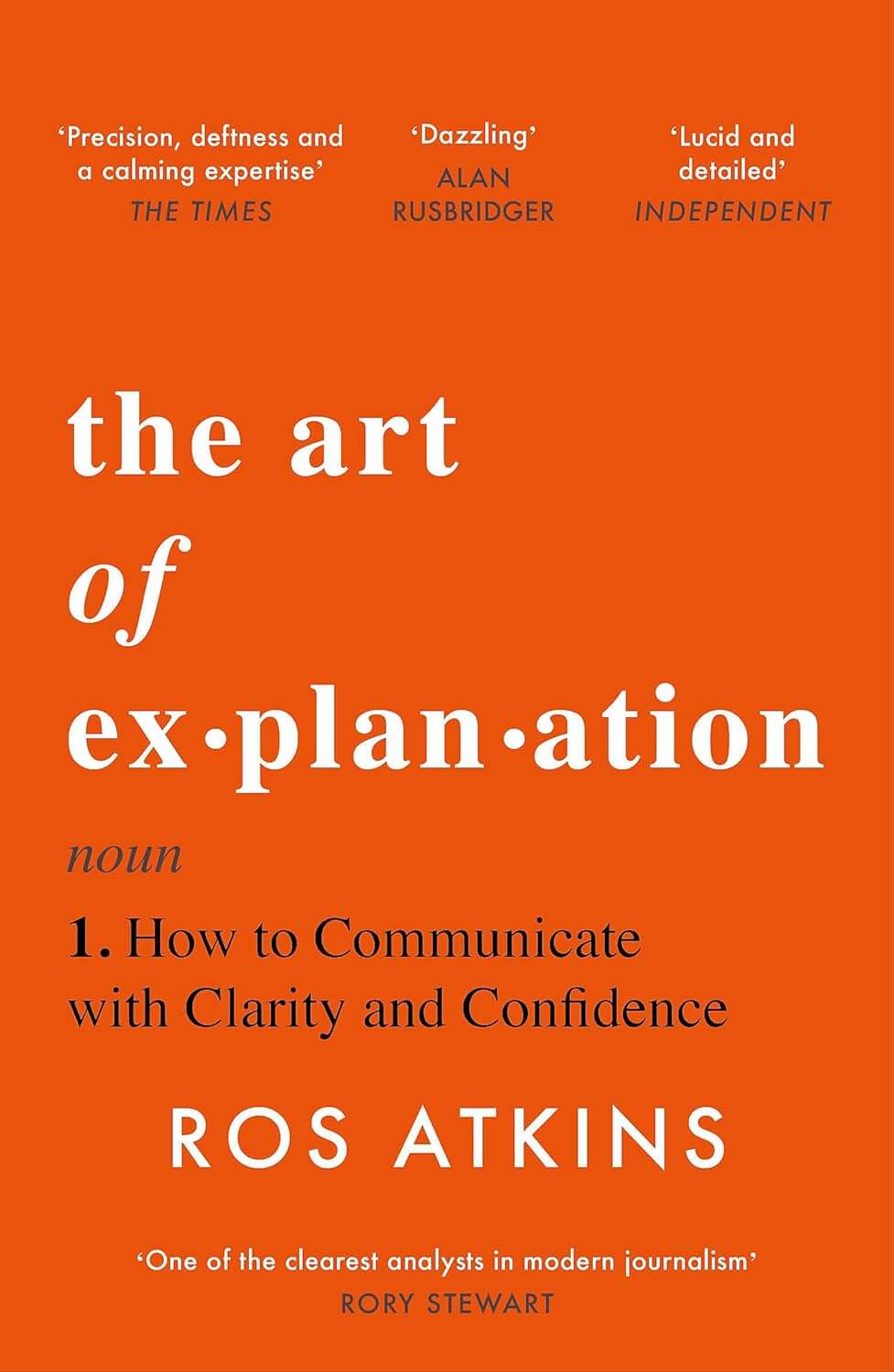
Prefer the print book? Buy on Amazon
As an Amazon Associate, Sumizeit earns from qualifying purchases.
The Art of Explanation Book Summary
This The Art of Explanation Book Summary covers the key ideas, lessons, and takeaways in about 20 minutes.
Short Description:
The Art of Explanation engineers clarity through empathy and structure.
Helps with these goals
Preview the The Art of Explanation book summary
Below is a preview of Sumizeit’s comprehensive human-written summary of The Art of Explanation by Ros Atkins. The full summary is 15-20 minutes long and covers the book’s key ideas in text, audio, visual, and video formats. Unlock the full 20 Minute Summary
In a world where information arrives faster than anyone can comfortably absorb, the ability to clearly convey ideas is a rare competitive advantage. Ros Atkins, a BBC journalist known for producing viral explainer videos, believes explanation is an art built through discipline, structure, and awareness of the audience. His book The Art of Explanation offers a framework for turning complex material into understanding people can absorb, remember, and act on. Rather than treating clarity as a talent bestowed on a lucky few, Atkins presents it as a skill anyone can master with intention and practice. He argues that good explanation doesn’t simply transfer information—it transforms confusion into comprehension, reduces cognitive load, and helps people make better decisions. In fields ranging from business and public speaking to teaching, journalism, and everyday conversation, knowing how to explain well changes outcomes. The book breaks explanation into an actionable methodology while also exploring the psychology, creativity, and neuroscience that sit beneath human understanding.
Why Explanation Matters in Modern Communication
People today face an unprecedented flood of notifications, messages, news reports, and updates. The challenge is not accessing information but making sense of it. When communication is unclear, meetings drag on without resolution, projects derail due to misunderstanding, and people disengage from messages that feel confusing or irrelevant. But a strong explanation pulls listeners toward meaning, reduces uncertainty, builds trust, and saves time. Atkins emphasizes how clarity fuels better decisions. A compelling explanation allows a colleague to act efficiently, a student to grasp a concept more quickly, a reader to feel informed enough to form an opinion, or a viewer to understand a complex event without drowning in context. Explanation has become a foundational skill for anyone who works with ideas and people. It determines whether a presentation lands, whether a proposal convinces, whether a leader inspires, and whether a conversation deepens or dissolves.
The Essence of a Good Explanation
A strong explanation is intentional. It begins with a clear sense of purpose—what needs to be understood, why it matters, and what outcome the explainer hopes to achieve. Atkins argues that clarity begins before writing or speaking; it starts by deciding precisely what should be conveyed. A person who knows their message can express it without rambling, overloading, or wandering off track. Effective explanations simplify without flattening nuance. They separate what is essential from what is merely interesting. They respect the intelligence of the listener while guiding them through context, examples, and structure. The result is understanding—not admiration for vocabulary or performance, but the quiet moment when something complicated suddenly becomes clear.
Understanding Audience as the Foundation
Before building an explanation, Atkins insists that one must know their audience. Different groups require different framing, pacing, and depth. A novice and an expert will not benefit from the same description. Tailoring begins with three core questions: Who is the audience? What do they already know? How do they prefer information delivered?
Want the complete 20-minute summary?
- Full structured summary
- Video Summary
- Podcast Summary
- Audio summary
- Key takeaways
- Exercises
- Quiz
- Highlights and notes
- Ask the book with AI
Who should read The Art of Explanation?
This book is essential for anyone who communicates ideas—business leaders, teachers, journalists, managers, and professionals across fields. Whether you're giving presentations, writing emails, explaining concepts, or leading teams, this book teaches you how to transform confusion into clarity.
Why does The Art of Explanation matter?
In today's information-saturated world, clarity is a competitive advantage. Most people struggle to cut through noise and make ideas stick, but The Art of Explanation by Ros Atkins provides a proven framework for turning complex material into understanding people can remember and act on. Clear communication saves time, builds trust, and drives better decisions in every context.
What are the key themes in The Art of Explanation?
- Clarity as an engineered skill, not an innate talent
- Audience awareness as the foundation of effective communication
- Structure and narrative flow in building understanding
- The discipline of removing excess information
- Connection between clear thinking and clear speaking
- Explanation as a service to the listener
How can you apply ideas from The Art of Explanation?
- Define the purpose of every email, presentation, or conversation before you start communicating
- Ask three questions before explaining: Who is my audience? What do they know? How do they prefer information?
- Use the seven-step framework (clarify purpose, gather info, extract essentials, structure logically, connect with transitions, refine, practice delivery) for important explanations
- Create bullet-point topic blocks for common questions so you can explain quickly and consistently in meetings or unplanned moments
- Read your explanations aloud and time yourself to catch awkward phrasing and sections that drag
- Use concrete examples and analogies to anchor abstract concepts in what people already understand
- Format emails and messages for scanning: lead with the key point, use bullets, make next steps clear
- Seek feedback on your explanations and treat confusion as information about what to refine
What common mistakes do readers make with The Art of Explanation?
- Assuming your audience has background knowledge they don't possess, or alternatively, over-explaining basics
- Including interesting information that doesn't support your core message, cluttering the explanation
- Failing to answer the unspoken question every listener has: 'Why should I care about this?'
- Using jargon or complex language to sound smart rather than to build understanding
Sumizeit Exercises Apply what you've learned
Turn ideas from The Art of Explanation into action with a short guided reflection: identify the biggest takeaway, connect it to your life, and commit to one step you can take in the next 24 hours.
What is the expert analysis of The Art of Explanation?
Overview
The Art of Explanation by Ros Atkins emerges as a vital contribution to the contemporary discourse on communication, authored by a seasoned BBC journalist renowned for his viral explainer videos. Atkins leverages his extensive experience in distilling complex global events into accessible narratives to construct a methodical framework for explanation as a disciplined craft. In an era overwhelmed by information saturation, this book stands out by addressing the critical need for clarity and comprehension across diverse fields such as business, education, journalism, and leadership. Atkins’s dual grounding in journalistic rigor and cognitive science insights lends the work both practical applicability and intellectual depth.
Core Thesis
Atkins’s central argument posits that effective explanation is not an innate talent but a skill that can be systematically developed through intentional practice and structured methodology. He contends that explanation transcends mere information transfer; it is a transformative process that converts confusion into understanding by reducing cognitive load and fostering meaningful connections between new knowledge and prior experience. The book advances the idea that clarity in communication is engineered through a seven-step process—from clarifying purpose and gathering information to refining language and preparing delivery—always with a nuanced awareness of audience needs. Ultimately, Atkins frames explanation as a form of intellectual discipline that enhances thinking itself, empowering individuals to influence, educate, and lead more effectively.
Strengths
- Comprehensive Framework: The seven-step methodology offers a clear, actionable roadmap that demystifies the art of explanation, making it accessible to practitioners across disciplines.
- Audience-Centered Approach: Atkins’s insistence on tailoring explanations to the audience’s prior knowledge and preferences reflects a sophisticated understanding of communication dynamics.
- Integration of Cognitive Science: The incorporation of neuroscience and psychology enriches the book, grounding practical advice in how human brains process and retain information.
- Balance of Theory and Practice: The book skillfully blends conceptual insights with concrete techniques, such as the use of analogies, narrative structuring, and iterative refinement.
- Philosophical Depth: Atkins’s advocacy for an “explanation mindset” elevates the discourse beyond technique, emphasizing humility, empathy, and intellectual responsibility.
Critiques & Counterarguments
- Potential Oversimplification: While advocating simplification, the book risks underestimating the complexity inherent in some topics where nuance is essential and simplification may lead to distortion or loss of critical detail.
- Evidence Base and Empirical Support: The book’s reliance on journalistic experience and cognitive theory could be strengthened by more extensive empirical validation or case studies demonstrating the framework’s efficacy across varied contexts.
- Competing Communication Models: Alternative paradigms such as dialogic communication or constructivist approaches emphasize co-creation of meaning rather than one-way explanation, challenging Atkins’s somewhat linear, sender-focused model.
- Contextual Limitations: The framework may be less adaptable in highly technical or specialized fields where audience expertise varies widely and explanation requires domain-specific scaffolding beyond general principles.
- Real-World Constraints: In fast-paced or high-stakes environments, the luxury of iterative refinement and preparation may be impractical, suggesting a need for complementary strategies for spontaneous or crisis communication.
Who Should Read This
The Art of Explanation is ideally suited for professionals and intellectuals who regularly engage in the transmission of complex ideas—business leaders, educators, journalists, public speakers, and knowledge workers seeking to enhance their communicative clarity and influence. It also benefits students of communication, cognitive science enthusiasts, and anyone invested in improving interpersonal understanding. Readers drawn to the intersection of psychology, philosophy, and practical skill-building will find Atkins’s synthesis both enlightening and empowering, equipping them to navigate and shape the information-rich landscape of the modern world with greater efficacy and grace.
Frequently asked questions about the The Art of Explanation book summary
What is The Art of Explanation about?
The Art of Explanation by Ros Atkins is a guide to turning complex information into clear, memorable understanding. The book presents a seven-step framework and practical techniques for crafting explanations in any context—from business presentations to everyday conversations. It teaches that clarity is an engineered skill built through audience awareness, purposeful structure, ruthless editing, and disciplined practice.
Who should read The Art of Explanation?
Anyone who communicates ideas should read this book. It's valuable for business leaders, teachers, managers, journalists, public speakers, and professionals across industries who need to explain complex concepts, lead meetings, write clearly, or influence others. Whether you're struggling to be understood or want to strengthen your already-strong communication skills, this book provides actionable frameworks.
What are the main takeaways from The Art of Explanation?
The core insight is that clarity is never accidental—it's engineered. The book teaches a seven-step process: clarify purpose, gather knowledge deeply, extract essentials, build logical structure, connect with transitions, refine language, and practice delivery. Beyond technique, readers learn to adopt an 'explanation mindset' that values audience understanding over speaker performance, and to see clear thinking and clear speaking as inseparable skills.
What is Ros Atkins' seven-step framework?
Atkins' framework consists of: (1) Clarify the purpose of your explanation, (2) Gather information thoroughly from multiple sources, (3) Extract only the essential points related to your core message, (4) Build a logical structure audiences can follow, (5) Connect ideas with explicit transitions and signposting, (6) Refine and simplify by cutting jargon and unnecessary complexity, and (7) Prepare for delivery through practice and feedback.
How do I explain complex topics clearly?
Start by defining your purpose and understanding your audience's prior knowledge. Gather broad research, then ruthlessly remove anything not essential to your core message. Organize information into a logical sequence and connect each idea to the next with clear transitions. Use concrete examples and analogies to anchor abstract concepts in what people already know. Finally, edit for clarity and practice your delivery aloud to catch awkward phrasing.
Why is audience understanding so important in explanation?
Understanding your audience—their background knowledge, preferences, and what they already know—is the foundation of effective explanation. Different groups require different framing, pacing, and depth. Without knowing your audience, you risk either wasting time on basics or assuming understanding that isn't there, both of which destroy clarity and engagement.
How can I make my explanations more memorable?
Make information relevant by answering the unspoken question listeners have: 'So what?' Link facts to bigger issues, challenge assumptions, or reveal practical applications. Use concrete examples and analogies to connect new information to what people already know. Remove distracting detail so key ideas stand out. The more clearly you explain, the more likely people will remember your message.
How do I explain quickly in meetings or spontaneous moments?
Build your knowledge into topic blocks—chunks of memorable, teachable points you can access and rearrange as needed. This preparation allows you to jump to what's relevant without rambling. For written communication, lead with the key point, format for scanning, and make next steps obvious. Brief, clear explanations save time and build respect.
About Sumizeit
Sumizeit is a profitable Scomy LLC company based in Miami, Florida. Our founders, Clemens Raemy and Weina Scott, are successful entrepreneurs with several exits. Sumizeit is a popular book summary app / micro learning app used by busy professionals and entrepreneurs with over 2,500 non-fiction book summaries and 10,000 podcast summaries in text, audio, visual, podcast, and video format. We also have stellar retention tools to make ideas stick - such as flashcards with spaced repetition, quizzes, streaks, highlighting and notes, daily challenges, riddles, mini-courses, meditation, and more. You won't only learn the idea, but also remember it. Over 90% of our users change their habits with Sumizeit.
Upgrade Now
Here's why readers love Sumizeit
Join thousands of learners getting smarter every day
"Great experience. Detailed summaries. Loved the gamification feature. Makes learning fun. Good customer service. I recommend Sumizeit to anyone. You'll learn a lot."
"I always felt busy but still wanting to keep up with the book discussion in my friend group. This was a great supplement to help me keep reading the books I find fun while keeping up with important books."
"I love this website. Instead of scrolling social media, I find myself learning a lot. I use it everyday. I recommend this app for anyone who is too busy and wants to get up to speed with their favorite books."
The Art of Explanation Book Summary PDF
Looking for a The Art of Explanation Book Summary PDF you can save and revisit offline? Our The Art of Explanation Book Summary PDF captures the book’s core ideas in a clean, printable format — the key frameworks, takeaways, and structure without the fluff. Download the The Art of Explanation Book Summary PDF when you want a reference you can annotate, share with your team, or review on the go. Get your The Art of Explanation Book Summary PDF from the download page below.
Download The Art of Explanation Book Summary PDFPeople also liked these summaries
Readers who explored The Art of Explanation often enjoyed these titles next.


Ready to read the whole thing?
- Full structured summary
- Video Summary
- Podcast Summary
- Audio summary
- Key takeaways
- Exercises
- Quiz
- Highlights and notes
- Ask the book with AI
Featured Book Titles
Popular Book Summaries at sumizeit, leading book summary app