


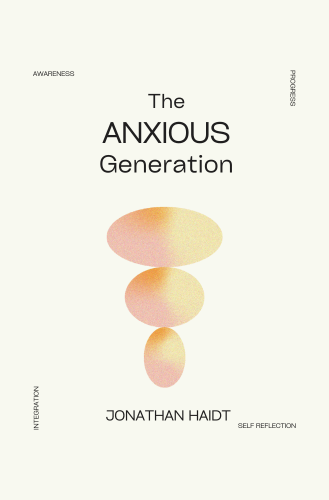
Prefer the print book? Buy on Amazon
As an Amazon Associate, Sumizeit earns from qualifying purchases.
The Anxious Generation Book Summary
This The Anxious Generation Book Summary covers the key ideas, lessons, and takeaways in about 20 minutes.
Short Description:
The Anxious Generation urges resilience and critical thinking for youth.
Haidt calls for a return to the values of resilience and open dialogue, where young people are encouraged to engage with the world, confront challenges, and learn from their mistakes. He also emphasizes the importance of reducing the role of social media in young people’s lives, promoting more meaningful face-to-face interactions, and creating a political and social climate that fosters inclusivity and understanding rather than division. Ultimately, Haidt believes that by addressing these root causes, we can help alleviate the mental health crisis facing today’s youth and create a more resilient and empowered generation.
Helps with these goals
Preview the The Anxious Generation book summary
Below is a preview of Sumizeit’s comprehensive human-written summary of The Anxious Generation by Jonathan Haidt. The full summary is 15-20 minutes long and covers the book’s key ideas in text, audio, visual, and video formats. Unlock the full 20 Minute Summary
The Anxious Generation, authored by social psychologist Jonathan Haidt, delves into the rising levels of anxiety, depression, and mental health challenges experienced by Generation Z, typically defined as those born between the mid-1990s and the early 2010s. Published in 2020, the book examines the underlying causes of this mental health crisis, which began to show dramatic spikes in the early 2010s. Haidt argues that the increasing prevalence of anxiety and depression among young people is not simply a result of individual psychological factors, but stems from broader societal changes, including the rapid rise of social media, changes in parenting styles, and the pressure of living in an increasingly polarized and competitive world.
Haidt presents data and research from psychology, sociology, and education to support his claims, explaining how these shifts have fundamentally altered the social landscape in which today’s youth are growing up. He focuses on three primary factors: overprotection by parents and institutions, the pervasive presence of social media, and the breakdown of traditional social structures that once provided young people with a sense of stability and meaning.
The book also touches on the impact of the political and cultural climate, where identity politics and a focus on emotional safety have inadvertently contributed to heightened anxiety and fragility among young people. Haidt calls for a return to fostering resilience, critical thinking, and independence in children and young adults, offering practical solutions for parents, educators, and society as a whole to help reverse these troubling trends.
The Rise of Social Media and Its Impact on Mental Health
One of the central arguments in The Anxious Generation is the profound effect of social media on the mental health of Generation Z. Haidt explains that the widespread adoption of platforms like Instagram, Facebook, and Snapchat coincides with the sharp increase in anxiety and depression, particularly among teenage girls. He draws on data showing how the pressure to present a curated, idealized version of oneself online has contributed to increased feelings of inadequacy, loneliness, and fear of missing out (FOMO).
Haidt further explores how social media has altered the nature of social interactions, making them more performative and less authentic. The constant comparison to others’ highlight reels has heightened insecurities, while cyberbullying and the spread of misinformation have created additional stress. Haidt discusses the addictive nature of these platforms, noting that the algorithms behind them are designed to keep users engaged by playing on their psychological vulnerabilities, such as the need for social validation.
The book also examines how social media has exacerbated political and cultural polarization, especially in younger generations. Haidt argues that exposure to a constant stream of sensationalized news and divisive content creates an echo chamber effect, amplifying anxiety and a sense of social instability. He concludes that while social media itself isn’t inherently harmful, its overuse and the lack of moderation have had damaging effects on the mental health of young people, particularly those who are already vulnerable to anxiety.
Overprotective Parenting and the Loss of Resilience
Haidt argues…
Want the complete 20-minute summary?
- Full structured summary
- Video Summary
- Podcast Summary
- Audio summary
- Key takeaways
- Exercises
- Quiz
- Highlights and notes
- Ask the book with AI
Who should read The Anxious Generation?
The Anxious Generation is essential reading for parents, educators, and mental health professionals seeking to understand why Generation Z faces unprecedented anxiety and depression. Young adults grappling with their own mental health challenges, as well as anyone curious about the psychological forces shaping modern youth culture, will find actionable insights and evidence-based explanations for the crisis affecting today's teens.
Why does The Anxious Generation matter?
Jonathan Haidt's analysis reveals that the mental health epidemic among Generation Z isn't simply individual weakness but the result of identifiable societal shifts we can address. As anxiety and depression rates continue climbing, understanding the root causes—social media, overprotective parenting, and political polarization—is crucial for parents, schools, and institutions seeking to reverse these troubling trends.
What are the key themes in The Anxious Generation?
- The role of social media algorithms in amplifying anxiety and fragility
- How helicopter parenting has eliminated opportunities for resilience-building
- The paradox of institutional emotional safety reducing actual mental health
- Political polarization and identity politics as sources of generational anxiety
- The necessity of independence, risk-taking, and challenge for psychological growth
- The decline of free-range childhood and its developmental costs
How can you apply ideas from The Anxious Generation?
- Implement clear limits on teenagers' social media use and screen time to reduce comparison anxiety and addictive engagement cycles
- Encourage parents to adopt free-range parenting practices that allow children age-appropriate independence and natural consequences
- Design school policies that emphasize intellectual resilience and engagement with challenging ideas rather than emotional avoidance
- Create community opportunities for unstructured, face-to-face interaction among young people to rebuild authentic social connection
- Train educators to foster critical thinking and tolerance for intellectual discomfort rather than relying solely on content warnings
- Establish family norms that prioritize face-to-face communication and reduce the role of digital performance in self-esteem
- Model and teach the ability to disagree respectfully across political and identity lines without resorting to call-out culture
What common mistakes do readers make with The Anxious Generation?
- Assuming that anxiety in youth is primarily biological or individual rather than exploring the environmental and cultural factors contributing to it
- Believing that emotional safety through avoidance of discomfort protects young people rather than understanding that resilience develops through managed challenge
- Underestimating how much time young people spend on social media and its cumulative effect on their mental health and self-perception
- Failing to set boundaries on device use because parents themselves are struggling with social media addiction and model unhealthy patterns
Sumizeit Exercises Apply what you've learned
Turn ideas from The Anxious Generation into action with a short guided reflection: identify the biggest takeaway, connect it to your life, and commit to one step you can take in the next 24 hours.
What is the expert analysis of The Anxious Generation?
Overview
The Anxious Generation is a timely and incisive exploration of the mental health challenges confronting Generation Z, authored by Jonathan Haidt, a prominent social psychologist renowned for his work on morality, culture, and political psychology. Published in 2020, the book situates the rising tide of anxiety and depression among young people within a broader sociocultural context, moving beyond individual pathology to examine systemic influences such as social media, parenting trends, educational environments, and political polarization. Haidt’s stature as a scholar and public intellectual lends considerable weight to his analysis, making this work a significant contribution to contemporary discussions on youth mental health and societal change.
Core Thesis
Haidt’s central argument is that the mental health crisis afflicting Generation Z is not merely a matter of individual vulnerability but a symptom of profound societal transformations. He identifies three primary drivers: the pervasive influence of social media, which fosters comparison, isolation, and polarization; the rise of overprotective, “helicopter” parenting that undermines resilience by sheltering youth from adversity; and the cultural and political climate marked by identity politics and an emphasis on emotional safety that inadvertently cultivates fragility. Haidt contends that these factors have collectively eroded traditional social structures that once provided stability and coping mechanisms, leading to increased anxiety and depression. His prescription centers on restoring resilience through fostering independence, critical thinking, and open dialogue.
Strengths
- Interdisciplinary Approach: Haidt skillfully weaves insights from psychology, sociology, and education, providing a nuanced, multifaceted understanding of complex phenomena.
- Empirical Foundation: The book is grounded in robust data and research, particularly regarding the correlation between social media usage and mental health trends, lending credibility to its claims.
- Cultural Relevance: By addressing contemporary issues such as “call-out culture,” trigger warnings, and political polarization, Haidt captures the zeitgeist of Generation Z’s lived experience.
- Practical Solutions: Beyond diagnosis, the book offers actionable strategies for parents, educators, and policymakers to cultivate resilience and emotional strength among youth.
- Balanced Perspective: Haidt acknowledges the benefits of technological and cultural shifts while critically assessing their unintended consequences, avoiding simplistic moralizing.
Critiques & Counterarguments
- Oversimplification of Causality: While Haidt identifies key societal factors, the interplay of genetics, neurobiology, and individual psychology in anxiety disorders is underexplored, potentially oversimplifying causation.
- Potential Generational Bias: The framing of Generation Z as uniquely fragile risks pathologizing an entire cohort without fully accounting for historical fluctuations in youth mental health or the adaptive responses to new challenges.
- Debate over Social Media Effects: Competing research suggests that social media’s impact is heterogeneous, with some studies indicating positive social connectivity and identity exploration benefits, challenging Haidt’s predominantly negative portrayal.
- Criticism of Overprotective Parenting: The “helicopter parenting” thesis may overlook socioeconomic and cultural variations, where increased parental involvement can be protective rather than detrimental.
- Universities and Emotional Safety: Some scholars argue that measures like trigger warnings and safe spaces are necessary responses to trauma and marginalization, fostering inclusivity rather than fragility, thus contesting Haidt’s critique of campus culture.
Who Should Read This
- Parents and Caregivers: Those seeking to understand the complex forces shaping their children’s mental health and looking for guidance on nurturing resilience.
- Educators and Academic Leaders: Professionals interested in balancing emotional support with intellectual rigor in educational settings.
- Mental Health Practitioners: Clinicians and counselors aiming to contextualize individual anxiety within broader societal dynamics.
- Policy Makers and Social Scientists: Individuals involved in shaping youth-related policies or studying generational trends.
- General Readers Concerned with Cultural Shifts: Those curious about the psychological and sociopolitical currents defining contemporary youth experience.
Frequently asked questions about the The Anxious Generation book summary
What is The Anxious Generation about?
The Anxious Generation by Jonathan Haidt examines the dramatic rise in anxiety and depression among Generation Z, tracing the causes to social media, overprotective parenting, university policies prioritizing emotional safety over resilience, and political polarization. The book argues that these interconnected societal changes have created unprecedented mental health challenges for young people and offers practical strategies for fostering resilience and rebuilding healthier social structures.
Who should read The Anxious Generation?
Parents, educators, mental health professionals, and young adults themselves should read this book to understand the roots of the youth mental health crisis. Anyone seeking to address anxiety in their children or students, or curious about the psychological forces shaping modern youth culture, will find evidence-based explanations and actionable solutions in Haidt's analysis.
What are the main takeaways from The Anxious Generation?
The primary takeaways are that Generation Z's anxiety epidemic stems from identifiable societal factors rather than generational weakness, and that reversing these trends requires fostering resilience, limiting social media, shifting toward free-range parenting, and prioritizing intellectual diversity in education. Haidt emphasizes that young people need managed challenge and independence, authentic human connection, and open dialogue to develop the emotional and psychological tools needed for a healthy adulthood.
How does social media contribute to anxiety in Generation Z according to Haidt?
Haidt argues that social media algorithms are designed to maximize engagement by exploiting psychological vulnerabilities like the need for social validation, creating cycles of comparison and inadequacy. The curated, idealized presentations of others' lives intensify insecurity, while cyberbullying, permanence of digital conflict, and constant exposure to sensationalized news amplify anxiety, particularly among teenage girls.
What does Haidt say about helicopter parenting and resilience?
Haidt contends that overprotective parenting—where parents shield children from all risk and manage every aspect of their lives—prevents the development of resilience. Young people who haven't faced challenges, failure, and natural consequences lack the emotional tools to handle inevitable adult difficulties, making them more vulnerable to anxiety when obstacles arise.
How have universities contributed to the anxiety crisis, according to The Anxious Generation?
Haidt argues that universities' focus on emotional safety through trigger warnings and safe spaces, though well-intentioned, has created fragility rather than resilience. By shielding students from intellectually challenging or uncomfortable ideas, universities undermine critical thinking development and make students less equipped to handle real-world complexity and disagreement.
What solutions does Haidt propose for reducing anxiety in young people?
Haidt recommends limiting social media use, encouraging parents to adopt free-range parenting that allows independence and risk-taking, shifting educational focus from emotional safety to intellectual resilience, promoting face-to-face interaction, and creating social environments that encourage open dialogue and forgiveness rather than call-out culture. He emphasizes fostering resilience through managed challenge rather than through protection.
About Sumizeit
Sumizeit is a profitable Scomy LLC company based in Miami, Florida. Our founders, Clemens Raemy and Weina Scott, are successful entrepreneurs with several exits. Sumizeit is a popular book summary app / micro learning app used by busy professionals and entrepreneurs with over 2,500 non-fiction book summaries and 10,000 podcast summaries in text, audio, visual, podcast, and video format. We also have stellar retention tools to make ideas stick - such as flashcards with spaced repetition, quizzes, streaks, highlighting and notes, daily challenges, riddles, mini-courses, meditation, and more. You won't only learn the idea, but also remember it. Over 90% of our users change their habits with Sumizeit.
Upgrade Now
Here's why readers love Sumizeit
Join thousands of learners getting smarter every day
"Great experience. Detailed summaries. Loved the gamification feature. Makes learning fun. Good customer service. I recommend Sumizeit to anyone. You'll learn a lot."
"I always felt busy but still wanting to keep up with the book discussion in my friend group. This was a great supplement to help me keep reading the books I find fun while keeping up with important books."
"I love this website. Instead of scrolling social media, I find myself learning a lot. I use it everyday. I recommend this app for anyone who is too busy and wants to get up to speed with their favorite books."
The Anxious Generation Book Summary PDF
Looking for a The Anxious Generation Book Summary PDF you can save and revisit offline? Our The Anxious Generation Book Summary PDF captures the book’s core ideas in a clean, printable format — the key frameworks, takeaways, and structure without the fluff. Download the The Anxious Generation Book Summary PDF when you want a reference you can annotate, share with your team, or review on the go. Get your The Anxious Generation Book Summary PDF from the download page below.
Download The Anxious Generation Book Summary PDFPeople also liked these summaries
Readers who explored The Anxious Generation often enjoyed these titles next.


Ready to read the whole thing?
- Full structured summary
- Video Summary
- Podcast Summary
- Audio summary
- Key takeaways
- Exercises
- Quiz
- Highlights and notes
- Ask the book with AI
Featured Book Titles
Popular Book Summaries at sumizeit, leading book summary app