


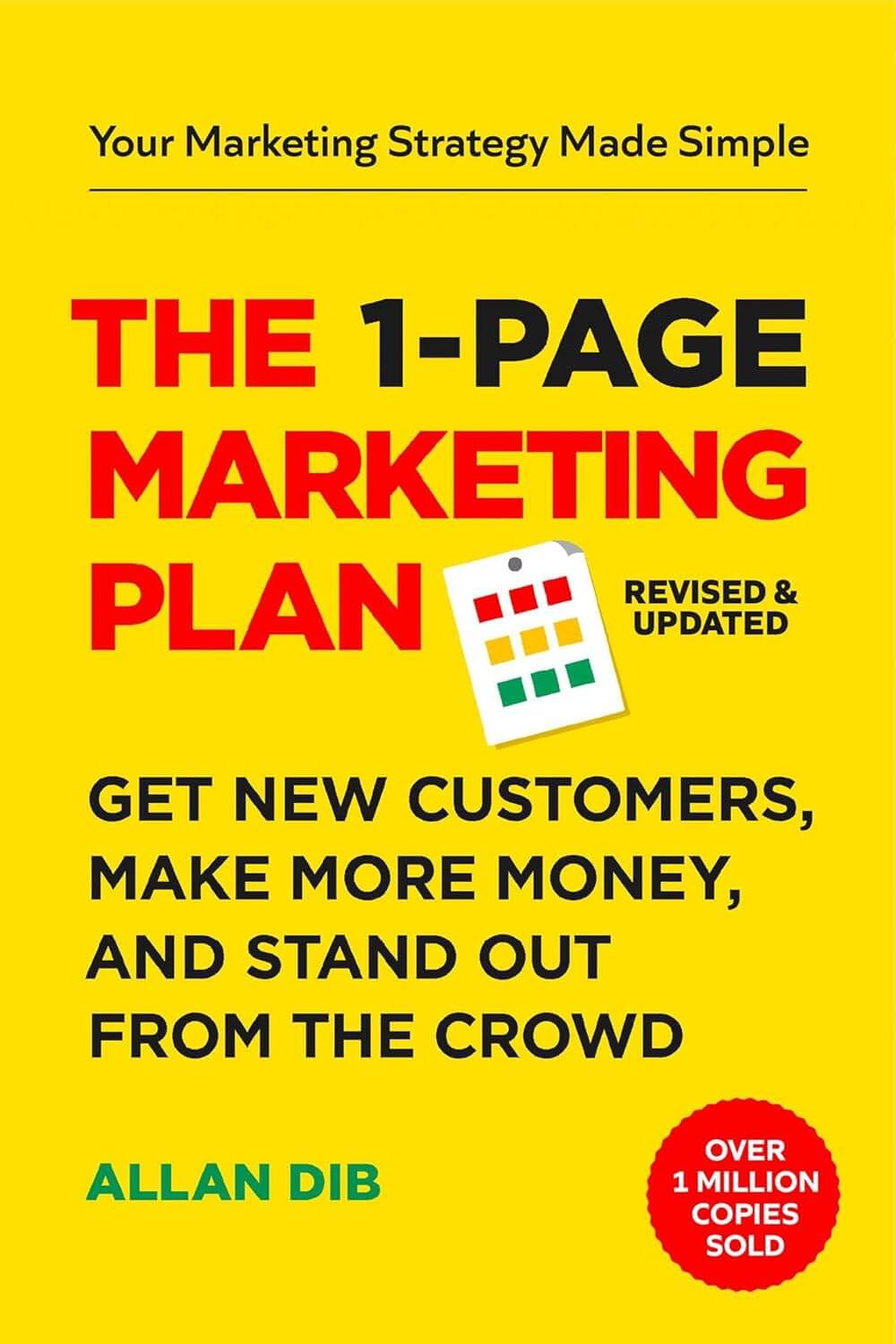
Prefer the print book? Buy on Amazon
As an Amazon Associate, Sumizeit earns from qualifying purchases.
The 1-Page Marketing Plan Book Summary
This The 1-Page Marketing Plan Book Summary covers the key ideas, lessons, and takeaways in about 20 minutes.
Short Description:
The 1-Page Marketing Plan simplifies growth through clear, consistent steps.
Helps with these goals
Preview the The 1-Page Marketing Plan book summary
Below is a preview of Sumizeit’s comprehensive human-written summary of The 1-Page Marketing Plan by Allan Dib. The full summary is 15-20 minutes long and covers the book’s key ideas in text, audio, visual, and video formats. Unlock the full 20 Minute Summary
Allan Dib opens The 1-Page Marketing Plan with a blunt truth that reframes how many people think about entrepreneurship: a business that does not consistently generate profit is not a business at all—it is an expensive pastime. Passion, craftsmanship, and good intentions are not enough. What separates a sustainable company from a struggling one is its ability to reliably attract customers, convert them into buyers, and keep them coming back.
Dib argues that this ability does not come from complex business plans, endless brainstorming sessions, or copying what large corporations do. Instead, it comes from a clear, practical marketing system that guides potential customers from complete unawareness to enthusiastic loyalty. The central promise of the book is that this system can be designed on a single page—simple enough to be used daily, yet powerful enough to drive long-term growth.
Rather than treating marketing as a mysterious art or an overwhelming discipline filled with jargon, Dib strips it down to its essential mechanics. Marketing, in his view, is not about clever slogans or flashy campaigns. It is about engineering predictable outcomes. When done correctly, marketing becomes a controllable process instead of a gamble.
Why Most Small Businesses Struggle With Marketing
Dib observes that many small businesses fail not because their products are bad, but because their owners misunderstand marketing entirely. One common mistake is neglect. Some entrepreneurs hope that word of mouth alone will sustain them, assuming that quality work will automatically lead to growth. While referrals are valuable, they are unreliable when they are not supported by a system. Hope is not a strategy.
Another widespread mistake is imitation. Small business owners often copy the branding-heavy tactics of large corporations—billboards, vague slogans, social media visibility—without realizing that these approaches are designed for companies with massive budgets and long timelines. Big brands can afford to spend millions shaping public perception over years. Small businesses cannot. They need immediate, measurable responses.
Dib emphasizes that marketing failure is rarely caused by laziness. More often, it is caused by confusion. Modern marketing appears complex, fragmented, and constantly changing. New platforms, tools, and trends emerge faster than business owners can keep up. As a result, many either freeze or chase tactics randomly, trying a little of everything without seeing meaningful results.
The solution, Dib argues, is not more complexity but more clarity. By focusing on a few timeless principles of human behavior and decision-making, any business owner can design a marketing plan that is easy to understand, easy to execute, and easy to improve.
Marketing as Leverage, Not Decoration
At its core, marketing is leverage. It is the activity that multiplies the impact of every other effort in a business. Improving operations, customer service, or product quality is important, but none of those matter if no one knows you exist or feels compelled to buy. Marketing is the force that brings customers into the system in the first place.
Dib defines marketing as the strategy a business uses to identify its ideal customers, communicate value…
Want the complete 20-minute summary?
- Full structured summary
- Video Summary
- Podcast Summary
- Audio summary
- Key takeaways
- Exercises
- Quiz
- Highlights and notes
- Ask the book with AI
Who should read The 1-Page Marketing Plan?
The 1-Page Marketing Plan is ideal for small business owners, entrepreneurs, and consultants who struggle to attract consistent customers or feel overwhelmed by marketing complexity. If you have a quality product or service but lack a clear system to reach and convert customers, this book provides a practical framework you can implement immediately.
Why does The 1-Page Marketing Plan matter?
Most small businesses fail not because their products are poor, but because they lack a clear marketing strategy to acquire customers predictably. In today's fragmented media landscape, generic mass-marketing tactics no longer work for bootstrapped businesses—yet many owners waste time and money copying corporate approaches designed for massive budgets. This book cuts through the confusion by showing how to build a marketing system based on human psychology and direct response, turning growth from a gamble into a deliberate, measurable process.
What are the key themes in The 1-Page Marketing Plan?
- Marketing as a system rather than inspiration or luck
- Direct-response marketing over brand awareness for small businesses
- The customer journey from awareness to loyalty
- Strategy before tactics
- Measurable results and continuous refinement
- Simplicity as a competitive advantage
- Building trust through multiple touchpoints
- Differentiation beyond price competition
How can you apply ideas from The 1-Page Marketing Plan?
- Define your precise target market by identifying people you enjoy serving, who value your solution, and who can afford it—then focus all marketing effort on reaching that group
- Create a clear differentiator that goes beyond price by documenting what makes your product, delivery, or customer experience unique in a way competitors cannot easily copy
- Build a lead capture system (email list, contact form, or database) and commit to adding prospects consistently so you have a growing asset to nurture over time
- Develop a nurture sequence of educational content and value-delivery touchpoints that reaches out to leads multiple times before asking for a sale
- Implement a risk-reversal mechanism such as a money-back guarantee, free trial, or transparent pricing to reduce purchase hesitation and signal confidence in your offering
- Design a post-purchase process that guides customers to success and creates moments of delight, ensuring they achieve the results they expected
- Create a systematic referral program with easy mechanisms and rewards that encourage existing customers to recommend you to others
- Select one or two marketing channels where your target audience already pays attention and master those rather than spreading yourself thin across many platforms
What common mistakes do readers make with The 1-Page Marketing Plan?
- Relying on word-of-mouth and reputation alone without building a deliberate system to capture leads and nurture them into customers
- Copying the mass-marketing tactics of large corporations (billboards, vague slogans, broad reach) without recognizing that those approaches are designed for companies with massive budgets and long timelines
- Jumping between tactics and platforms without a clear strategy, chasing every new trend instead of focusing on the approach that works for your specific market
- Stopping marketing efforts after making the first sale and failing to build systems for retention, repeat purchases, and referrals—the most profitable stages
- Competing solely on price instead of creating a differentiation that attracts customers who value quality and are willing to pay accordingly
- Treating marketing as an occasional task or delegating it entirely rather than giving it daily attention as the primary driver of revenue
Sumizeit Exercises Apply what you've learned
Turn ideas from The 1-Page Marketing Plan into action with a short guided reflection: identify the biggest takeaway, connect it to your life, and commit to one step you can take in the next 24 hours.
What is the expert analysis of The 1-Page Marketing Plan?
Overview
The 1-Page Marketing Plan by Allan Dib stands out as a pragmatic guide aimed at demystifying marketing for small business owners and entrepreneurs. Dib, an experienced marketing consultant and business coach, leverages his background in software development and small business consulting to distill complex marketing concepts into a straightforward, actionable framework. The book’s significance lies in its promise to transform marketing from an overwhelming, jargon-filled discipline into a manageable, daily practice that directly drives business growth. By focusing on a one-page plan, Dib offers a tool that balances simplicity with strategic depth, making it accessible without sacrificing effectiveness.
Core Thesis
Dib’s central argument is that sustainable business growth hinges on a clear, systematic marketing process that guides potential customers through a three-phase journey: awareness, familiarity, and enthusiasm. He challenges common misconceptions that marketing is either an art or a guessing game, instead framing it as an engineering discipline focused on predictable, measurable outcomes. The essence of his thesis is that effective marketing is not about flashy campaigns or brand image alone, but about direct-response strategies that attract, convert, and retain customers through clarity, focus, and consistent execution. Crucially, this system can be encapsulated on a single page, making it both practical and scalable for small businesses.
Strengths
- Clarity and Accessibility: Dib excels at breaking down marketing into digestible components, making the subject approachable for readers without prior expertise.
- Practical Framework: The three-phase customer journey and the nine building blocks provide a comprehensive yet concise blueprint that businesses can implement immediately.
- Focus on Execution: Emphasizing action over theory, Dib addresses common psychological barriers such as fear and perfectionism, encouraging iterative progress.
- Direct-Response Emphasis: Advocating for measurable marketing efforts aligns well with the needs of small businesses that require accountability and ROI.
- Timeless Psychological Principles: Grounding marketing strategies in human behavior rather than transient trends ensures the book’s relevance across industries and economic cycles.
Critiques & Counterarguments
- Oversimplification Risk: While the one-page plan enhances usability, it may underrepresent the complexity of certain markets or industries where nuanced strategies are necessary.
- Limited Discussion of Digital Nuances: The book’s treatment of digital marketing channels, though practical, could be seen as dated or insufficiently detailed given the rapid evolution of platforms and algorithms.
- Assumption of Linear Customer Journey: The three-phase model presumes a relatively straightforward path from awareness to loyalty, which may not hold in highly saturated or disruptive markets where customer behavior is less predictable.
- Competing Schools of Thought: Some marketing theorists argue that brand-building and emotional resonance, which Dib downplays, are essential for long-term differentiation and cannot be fully captured by direct-response tactics alone.
- Evidence Base: The book relies heavily on Dib’s consulting experience and anecdotal evidence; it would benefit from more rigorous empirical validation or integration of academic marketing research.
Who Should Read This
The 1-Page Marketing Plan is ideally suited for small business owners, startups, and solo entrepreneurs who seek a no-nonsense, actionable approach to marketing without the luxury of large budgets or dedicated teams. It also appeals to practitioners who feel overwhelmed by the complexity of modern marketing and desire a clear, repeatable system to generate consistent customer acquisition and retention. While seasoned marketers and academics may find the framework somewhat elementary, the book’s emphasis on execution and simplicity offers valuable reminders about the fundamentals often obscured by industry jargon and overcomplication.
Frequently asked questions about the The 1-Page Marketing Plan book summary
What is The 1-Page Marketing Plan about?
The 1-Page Marketing Plan by Allan Dib is a practical guide to building a clear, measurable marketing system that guides customers from awareness through trust to loyalty. The book argues that sustainable business growth comes not from complex plans or copying large corporations, but from a simple framework based on human psychology and direct-response principles that can be implemented on a single page and executed daily.
Who should read The 1-Page Marketing Plan?
Small business owners, entrepreneurs, consultants, and service providers who struggle to attract customers consistently or feel overwhelmed by marketing complexity should read this book. It is designed for anyone with a quality product or service who lacks a clear system to reach and convert their ideal customers into loyal advocates.
What are the main takeaways from The 1-Page Marketing Plan?
The main takeaways include: (1) marketing is a system, not inspiration; (2) strategy must precede tactics; (3) focus on direct-response marketing with measurable results rather than brand awareness; (4) guide customers through three phases—awareness, familiarity, and enthusiasm; and (5) execution and continuous refinement matter more than having a perfect plan. Business growth becomes predictable when you follow a clear framework consistently.
What is the three-phase customer journey in The 1-Page Marketing Plan?
The three phases are awareness (introducing prospects to your business and sparking interest), familiarity (building trust through education and repeated positive interactions), and enthusiasm (delivering exceptional results and generating referrals). Each phase contains three specific actions, creating nine building blocks that form a complete customer acquisition and retention system.
How does direct-response marketing differ from traditional advertising?
Direct-response marketing targets specific audiences with clear calls to action and measurable outcomes, whereas traditional advertising broadcasts vague messages to the general public. Direct-response allows you to track what works and redirect resources accordingly, making it more affordable and ethical. It focuses on reaching people already likely to benefit rather than interrupting those uninterested.
Why does Allan Dib emphasize having a narrow target market?
A narrow, well-defined target market increases marketing relevance and response rates far more than trying to appeal to everyone. When you focus on people you enjoy serving, who value your solution, and who can afford it, your message becomes stronger and your marketing efficiency improves. This focus also allows you to craft specific messaging that resonates rather than generic claims that blend into the background.
What role does customer retention play in The 1-Page Marketing Plan?
Customer retention is emphasized as the most profitable stage of business growth. Existing customers are easier and cheaper to serve, more likely to buy again, and more inclined to refer others. Small improvements in retention, repeat purchases, and referrals compound over time, dramatically increasing revenue without increasing acquisition costs, making this phase critical to sustainable profitability.
How can I implement The 1-Page Marketing Plan in my business?
Start by defining your precise target market, then craft a message that addresses their specific problem and differentiates your solution beyond price. Choose one or two channels where your audience already pays attention, build a system to capture leads and nurture them with value, and implement post-purchase systems to ensure customer success and generate referrals. Begin small, measure results, and refine continuously based on what you learn.
About Sumizeit
Sumizeit is a profitable Scomy LLC company based in Miami, Florida. Our founders, Clemens Raemy and Weina Scott, are successful entrepreneurs with several exits. Sumizeit is a popular book summary app / micro learning app used by busy professionals and entrepreneurs with over 2,500 non-fiction book summaries and 10,000 podcast summaries in text, audio, visual, podcast, and video format. We also have stellar retention tools to make ideas stick - such as flashcards with spaced repetition, quizzes, streaks, highlighting and notes, daily challenges, riddles, mini-courses, meditation, and more. You won't only learn the idea, but also remember it. Over 90% of our users change their habits with Sumizeit.
Upgrade Now
Here's why readers love Sumizeit
Join thousands of learners getting smarter every day
"Great experience. Detailed summaries. Loved the gamification feature. Makes learning fun. Good customer service. I recommend Sumizeit to anyone. You'll learn a lot."
"I always felt busy but still wanting to keep up with the book discussion in my friend group. This was a great supplement to help me keep reading the books I find fun while keeping up with important books."
"I love this website. Instead of scrolling social media, I find myself learning a lot. I use it everyday. I recommend this app for anyone who is too busy and wants to get up to speed with their favorite books."
The 1-Page Marketing Plan Book Summary PDF
Looking for a The 1-Page Marketing Plan Book Summary PDF you can save and revisit offline? Our The 1-Page Marketing Plan Book Summary PDF captures the book’s core ideas in a clean, printable format — the key frameworks, takeaways, and structure without the fluff. Download the The 1-Page Marketing Plan Book Summary PDF when you want a reference you can annotate, share with your team, or review on the go. Get your The 1-Page Marketing Plan Book Summary PDF from the download page below.
Download The 1-Page Marketing Plan Book Summary PDFPeople also liked these summaries
Readers who explored The 1-Page Marketing Plan often enjoyed these titles next.


Ready to read the whole thing?
- Full structured summary
- Video Summary
- Podcast Summary
- Audio summary
- Key takeaways
- Exercises
- Quiz
- Highlights and notes
- Ask the book with AI
Featured Book Titles
Popular Book Summaries at sumizeit, leading book summary app