
Question 1 of 10


Prefer the print book? Buy on Amazon
As an Amazon Associate, Sumizeit earns from qualifying purchases.
Book Summary
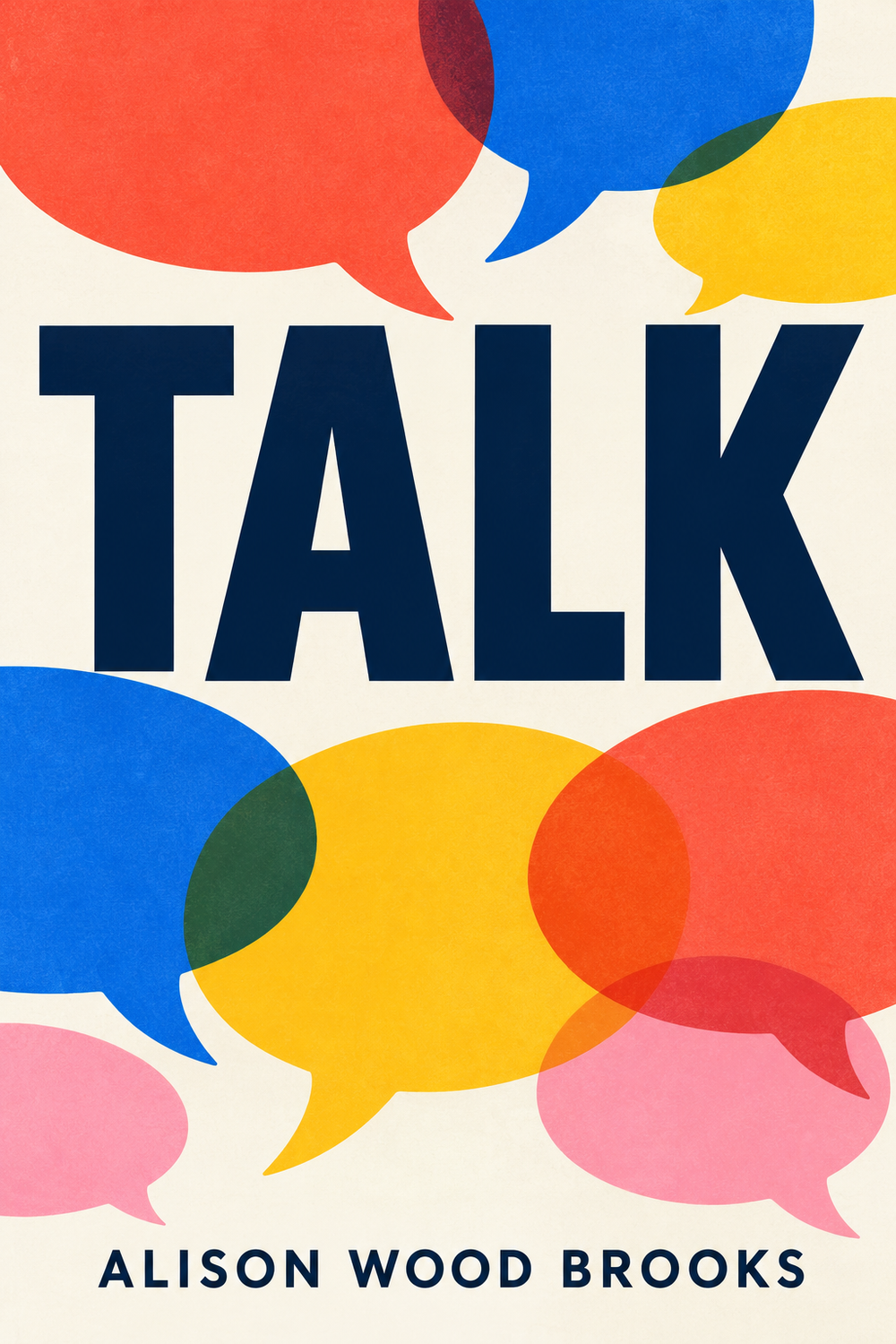
Talk Book Summary
This Talk Book Summary covers the key ideas, lessons, and takeaways in about 20 minutes.
Short Description:
Why talking is hard and how small habits make your conversations better
Conversation feels hard because it is hard, since you're coordinating in real time with a mind you can't predict, but it's also a skill you can get better at with small, deliberate habits. Prepare a few topics, ask follow up questions, bring some lightness, and put the other person's needs first, and your talks will get warmer and more useful. You don't need to be a natural or a perfect talker. You just need to try one small thing in your next conversation and give yourself room to be imperfect.
Helps with these goals
Preview the Talk book summary
Below is a preview of Sumizeit’s comprehensive human-written summary of Talk by Alison Wood Brooks. The full summary is 15-20 minutes long and covers the book’s key ideas in text, audio, visual, and video formats. Unlock the full 20 Minute Summary
You've had thousands of conversations. You still blank at networking events, and you still walk away from important talks wondering if you said the wrong thing. Brooks says that's not a personal flaw. Conversation is one of the most demanding mental tasks we do. You're making thousands of tiny decisions about what to say, how to say it, when to talk, when to listen, which topic to chase and which to drop. Meanwhile the other person is making their own set of decisions at the same time, and you can't predict them.
The good news is that conversation is a skill. Small, deliberate changes make a real difference, and you don't have to give up the loose, improvised feel that makes talking fun.
The four things people want from a conversation
Brooks says people show up wanting different things, and those wants shift mid conversation. She names four modes. Advancing is the informational one, where you gather facts or push a view, like asking when the meeting starts. Connecting is collaborative, where you swap knowledge or solve something together, like trading tips on a kid's nightmares. Protecting is deflecting, where you keep things private or steer away from conflict, like answering "work's fine" when it isn't. Savoring is bonding, where you laugh, reminisce, and enjoy each other.
Trouble starts when you and your partner are in different modes. Say you ask a friend how they're doing and they mention job trouble. You might jump to fixing it, change the subject, or tell your own story, and your friend may want none of those. With all that moving around, Brooks says the surprise isn't that conversations go badly sometimes. It's that they work at all.
Why the old rules don't cut it
The classic advice comes from philosopher Paul Grice, who said good communication is clear, concise, truthful, and relevant. Brooks agrees these rules help when you're trading information. But real people break them all the time, and for good reasons. We tell white lies to protect feelings. We tell off topic stories because they bring us closer. We use jokes, metaphors, and gentle dodges to keep things warm. A conversation that followed Grice perfectly would sound cold and robotic.
So Brooks offers something different. She focuses on specific behaviors that help two people coordinate across all four modes.
The TALK framework
Brooks boils the research down to four areas where small changes pay off most. They are Topics, Asking, Levity, and Kindness. She's clear that these are flexible tools and not a script.
Topics
Most people think a good conversation depends on picking good subjects. Brooks says it depends on managing topics well. She gives three moves.
First, prepare. Most of us assume great talkers are born that way, and we worry that planning makes us fake. Brooks tested this. Even thirty seconds of thinking ahead noticeably improved how conversations went. The reason is simple.
Want the complete 20-minute summary?
- Full structured summary
- Video Summary
- Podcast Summary
- Audio summary
- Key takeaways
- Exercises
- Quiz
- Highlights and notes
- Ask the book with AI
Who should read Talk?
Talk is for anyone who feels awkward at networking events, struggles to keep conversations flowing, or walks away from important talks wondering if they said the right thing. Whether you're an introvert dreading small talk, a professional navigating difficult conversations, or simply someone who wants deeper connections with others, this book offers practical tools grounded in research. You don't need to be naturally gifted at conversation—Brooks shows that talking is a learnable skill.
Why does Talk matter?
In a world where remote work, digital communication, and social anxiety make face-to-face conversation feel increasingly risky, Talk reminds us that genuine connection still matters and that real skill beats natural talent. Alison Wood Brooks draws on decades of research—including studies of thousands of parole hearings and conversation experiments—to show what actually works when we talk. The insights apply everywhere: landing a job, resolving conflict, deepening friendships, and leading teams all come down to how well you coordinate with another mind in real time.
What are the key themes in Talk?
- Conversation is a learnable skill, not an innate talent
- People enter conversations wanting different things: information, collaboration, privacy, or bonding
- Small, deliberate changes in how you talk have outsized impact
- Kindness and attention to the other person's needs transform every conversation
- Status and power dynamics shape group conversations in invisible ways
- Preparation reduces anxiety and frees your attention for the person in front of you
- Hard conversations improve when you shift from persuading to understanding
- Psychological safety—the feeling that you can speak freely without judgment—builds through levity and warmth
How can you apply ideas from Talk?
- Spend 30 seconds before a networking event or meeting thinking of 3–5 interesting topics to explore with others, so you're not scrambling for things to say
- In your next conversation, ask one more follow-up question than you normally would, using phrases like 'How did that change things for you?' to show genuine interest
- When a conversation topic starts losing energy (awkward pauses, polite laughter), consciously switch to a new subject rather than letting it die out
- Before responding in a disagreement, paraphrase what the other person said to ensure you understand the level of conflict and what they actually need
- Use callbacks in group settings—refer to something someone said earlier to show you were listening and to reconnect them to the conversation
- If you're in a position of high status or authority, deliberately invite quieter people to speak and amplify their contributions to unlock better group decisions
- When apologizing, focus on the other person's experience ('Help me understand how this affected you') and commit to a specific change ('I'll check with you before making plans that affect us') rather than defending your intentions
What common mistakes do readers make with Talk?
- Assuming great talkers are born that way and that preparation makes you fake, when research shows even brief preparation frees your attention for the other person
- Staying too long on small talk instead of using it as a stepping stone to more personal and meaningful territory
- Asking boomeranging questions so you can steer the conversation back to yourself, which makes the other person feel unheard despite being asked something
- Focusing on levity as something you need to perform or be funny about, when in reality warmth, callbacks, and genuine compliments work just as well and feel more authentic
Sumizeit Exercises Apply what you've learned
Turn ideas from Talk into action with a short guided reflection: identify the biggest takeaway, connect it to your life, and commit to one step you can take in the next 24 hours.
What is the expert analysis of Talk?
Overview
Talk is a compelling exploration of the intricate dynamics of human conversation, authored by Alison Wood Brooks, a Harvard Business School professor renowned for her research on communication and emotional psychology. Published in 2025, this book stands out by bridging rigorous academic insights with accessible, actionable advice, making it significant for both scholars and practitioners interested in the art and science of interpersonal interaction. Brooks’s expertise lends the work a credible foundation, while her focus on everyday conversational challenges ensures broad relevance.
Core Thesis
At its heart, Talk argues that conversation is one of the most cognitively demanding tasks we undertake, requiring simultaneous coordination with an unpredictable partner. Brooks challenges the conventional wisdom that conversation should be clear, concise, and strictly relevant, as proposed by philosopher Paul Grice, by demonstrating that real-life communication often thrives on flexibility, emotional nuance, and social signaling. The central insight is that conversation is a learnable skill enhanced through deliberate small habits—specifically managing topics, asking thoughtful questions, employing levity, and practicing kindness—summarized in her TALK framework. These elements help interlocutors navigate shifting conversational modes and foster genuine connection.
Strengths
- Empirical grounding: Brooks’s conclusions are supported by robust psychological research, including experimental data and real-world observations, which lend credibility and depth to her claims.
- Practical framework: The TALK framework distills complex social dynamics into four actionable domains, making sophisticated communication strategies accessible without reducing them to rigid scripts.
- Nuanced understanding of conversation modes: By identifying four distinct conversational goals—advancing, connecting, protecting, and savoring—Brooks captures the fluidity of real interactions, offering a richer model than traditional linear approaches.
- Insightful treatment of difficult conversations: The book’s approach to disagreement and apologies is particularly sophisticated, emphasizing empathy, humility, and behavioral change over mere verbal performance.
- Attention to group dynamics: Brooks extends her analysis beyond dyads to the complexities of group conversations, highlighting status effects and the need for conscious stewardship, which is often overlooked in communication literature.
Critiques & Counterarguments
- Potential oversimplification of conversational complexity: While the TALK framework is elegant, real conversations often involve more chaotic and context-dependent variables than a four-part model can fully capture, risking reductionism.
- Limited cultural scope: The research and examples primarily reflect Western, educated, industrialized, rich, and democratic (WEIRD) contexts, which may limit applicability across diverse cultural communication norms that value indirectness or hierarchical speech differently.
- Questioning the universality of levity: Some communication scholars argue that humor and playfulness are culturally contingent and can backfire in high-stakes or formal settings, suggesting Brooks’s emphasis on levity might not translate universally.
- Contrasting views on questioning: While Brooks advocates for increased questioning, other schools of thought warn that excessive questioning can be perceived as intrusive or manipulative, especially in cultures valuing privacy or indirectness.
- Real-world constraints on kindness: The ideal of prioritizing the other’s needs may conflict with power dynamics or professional boundaries, where strategic self-interest or guardedness is necessary, complicating the straightforward application of kindness.
Who Should Read This
Talk is ideally suited for readers who seek to deepen their understanding of interpersonal communication beyond platitudes and generic advice. This includes business leaders, educators, therapists, and anyone engaged in frequent social or professional interactions who wishes to improve their conversational effectiveness with empirical backing. It also appeals to psychologists and social scientists interested in the cognitive and emotional underpinnings of dialogue. Finally, individuals who feel anxious or inadequate in social settings will find Brooks’s compassionate and practical guidance empowering, as it normalizes imperfection and encourages incremental growth.
Discussion questions for Talk Short questions you can actually use in a conversation
Frequently asked questions about the Talk book summary
What is Talk about?
Talk by Alison Wood Brooks is about why conversation feels so hard and how to get better at it through four practical skills: Topics, Asking, Levity, and Kindness. Brooks draws on decades of research to show that conversation is a learnable skill, not an innate talent, and that small, deliberate changes in how you talk transform the connections you build with others.
Who should read Talk?
Talk is for anyone who feels awkward in conversations, struggles at networking events, or wants to build deeper connections with others. It's useful for professionals navigating difficult conversations, introverts dreading small talk, and anyone curious about why some people seem naturally good at talking. You don't need to be naturally gifted—the book shows that talking is a learnable skill.
What are the main takeaways from Talk?
The main takeaways are: conversation is hard because you're coordinating in real time with an unpredictable mind, but it's also a skill you can improve with small habits like preparing topics, asking follow-up questions, bringing warmth, and prioritizing the other person's needs. Most people underrate their own conversation ability, so giving yourself permission to be imperfect actually frees you to take the small social risks that build real connection.
What is the TALK framework?
TALK stands for Topics, Asking, Levity, and Kindness—four flexible tools that help you coordinate across all four conversation modes (Advancing for information, Connecting for collaboration, Protecting for privacy, and Savoring for bonding). Brooks emphasizes these aren't rules or scripts; they're reminders to reach your best instincts when it counts.
How does Alison Wood Brooks approach difficult conversations and apologies?
Brooks shifts the goal from persuading the other person to understanding them, which reduces defensiveness. For apologies specifically, research from thousands of parole hearings showed that focusing on the other person's experience and promising specific future change works far better than explaining your intentions or asking for forgiveness. The question 'How can I make sure this never happens again?' outweighs 'How can I feel better?'
How does Talk address group conversations?
Talk explains that groups are harder than one-on-one conversations because status and power dynamics invisibly shape who speaks and who stays silent. High-status people should step back and invite quieter voices; low-status people can lead through coordination like paraphrasing and asking focus questions. Someone also needs to manage whether the group should break into smaller clusters or gather around one shared discussion.
What role does preparation play in improving conversation?
Brooks found that even thirty seconds of thinking ahead about topics noticeably improves conversations. Preparation isn't fake or robotic; it frees your attention from scrambling for what to say so you can focus on the person in front of you. She also emphasizes that small talk is a pyramid where preparation helps you climb toward more meaningful territory.
How does levity work in conversation according to Talk?
Levity—humor, playfulness, and warmth—keeps emotional energy alive and builds psychological safety, the feeling that people can speak freely without judgment. Levity doesn't require comedy skills; it works through callbacks (referring to something said earlier), light laughter at others' jokes, and genuine compliments. Most laughter in real conversation is social signaling, not a reaction to jokes.
About Sumizeit
Sumizeit is a profitable Scomy LLC company based in Miami, Florida. Our founders, Clemens Raemy and Weina Scott, are successful entrepreneurs with several exits. Sumizeit is a popular book summary app / micro learning app used by busy professionals and entrepreneurs with over 2,500 non-fiction book summaries and 10,000 podcast summaries in text, audio, visual, podcast, and video format. We also have stellar retention tools to make ideas stick - such as flashcards with spaced repetition, quizzes, streaks, highlighting and notes, daily challenges, riddles, mini-courses, meditation, and more. You won't only learn the idea, but also remember it. Over 90% of our users change their habits with Sumizeit.
Upgrade Now
Here's why readers love Sumizeit
Join thousands of learners getting smarter every day
"Great experience. Detailed summaries. Loved the gamification feature. Makes learning fun. Good customer service. I recommend Sumizeit to anyone. You'll learn a lot."
"I always felt busy but still wanting to keep up with the book discussion in my friend group. This was a great supplement to help me keep reading the books I find fun while keeping up with important books."
"I love this website. Instead of scrolling social media, I find myself learning a lot. I use it everyday. I recommend this app for anyone who is too busy and wants to get up to speed with their favorite books."
Talk Book Summary PDF
Looking for a Talk Book Summary PDF you can save and revisit offline? Our Talk Book Summary PDF captures the book’s core ideas in a clean, printable format — the key frameworks, takeaways, and structure without the fluff. Download the Talk Book Summary PDF when you want a reference you can annotate, share with your team, or review on the go. Get your Talk Book Summary PDF from the download page below.
Download Talk Book Summary PDFPeople also liked these summaries
Readers who explored Talk often enjoyed these titles next.


Ready to read the whole thing?
- Full structured summary
- Video Summary
- Podcast Summary
- Audio summary
- Key takeaways
- Exercises
- Quiz
- Highlights and notes
- Ask the book with AI
Featured Book Titles
Popular Book Summaries at sumizeit, leading book summary app
Atomic Habits Book Summary Rich Dad Poor Dad Book Summary The Four Agreements Book Summary The 48 Laws of Power Book Summary When Breath Becomes Air Book Summary Think and Grow Rich Book Summary