


Prefer the print book? Buy on Amazon
As an Amazon Associate, Sumizeit earns from qualifying purchases.
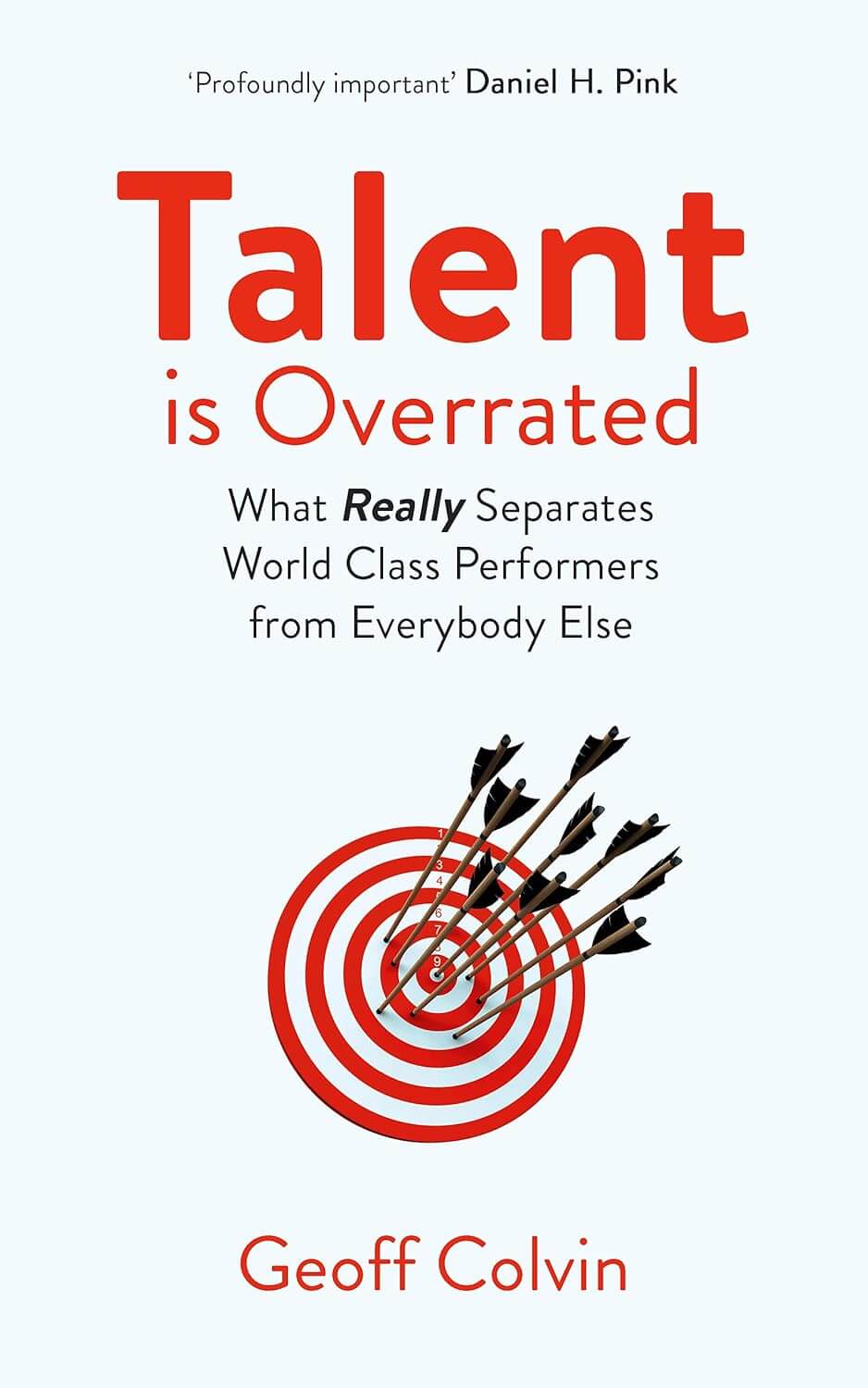
Talent Is Overrated Book Summary
This Talent Is Overrated Book Summary covers the key ideas, lessons, and takeaways in about 20 minutes.
Helps with these goals
Want the complete 20-minute summary?
- Full structured summary
- Video Summary
- Podcast Summary
- Audio summary
- Key takeaways
- Exercises
- Quiz
- Highlights and notes
- Ask the book with AI
Not ready to upgrade?
Get this summary + 2 more picks sent to your inbox, free.
What is in the Talent Is Overrated book summary?
Below is a preview of Sumizeit’s expert-written summary of Talent Is Overrated by Geoff Colvin. The full summary covers the book’s key ideas in text, audio, and video.
In Talent Is Overrated, business journalist Geoff Colvin challenges one of the most deeply held beliefs about success: the idea that extraordinary performance is the result of rare, inborn talent. Society loves this explanation because it feels neat and comforting. It tells us why greatness is uncommon, why it appears early in some people, and why it sometimes seems to run in families. If excellence is something you’re born with, then most of us can stop worrying about why we aren’t exceptional—because we never had a chance to be.
Colvin dismantles this story. Drawing on decades of research in psychology, neuroscience, and performance science, he argues that what separates world-class performers from everyone else is not talent, but training—specifically, a highly structured and mentally demanding form of training known as deliberate practice. According to Colvin, believing in talent doesn’t just misrepresent reality; it actively holds people back. When individuals assume their limits are fixed, they stop pushing themselves. When they believe improvement is possible, they’re far more likely to do the difficult, uncomfortable work required to achieve excellence.
This book reframes success as something fundamentally controllable. Excellence becomes less about luck and more about long-term commitment, focus, and the willingness to repeatedly confront one’s weaknesses. While Colvin acknowledges that biology and circumstance matter, he insists they matter far less than most people think—and far less than the hours of purposeful effort that elite performers consistently invest.
The Myth of Talent and Why It Persists
The belief in natural talent is powerful because it explains both rarity and inequality in performance. If only a few people are born with the right abilities, then it makes sense that only a few reach the top. This belief is reinforced whenever a child prodigy appears or when an elite athlete’s offspring shows promise early in life. Talent appears hereditary, visible, and decisive.
Colvin argues that this interpretation is misleading. When researchers examine the developmental histories of high achievers—musicians, athletes, chess grandmasters, surgeons, or executives—they find remarkably consistent patterns. These individuals almost always undergo years of intense, structured training before reaching exceptional levels. Early signs of brilliance, when they appear at all, are usually the result of early exposure, parental involvement, or structured coaching—not mysterious innate gifts.
The talent narrative also survives because it protects egos. If excellence depends on something you don’t have, then failure isn’t your fault. But Colvin insists this belief comes at a cost. It discourages effort, undermines persistence, and creates a psychological ceiling. People stop striving not because they lack ability, but because they believe striving won’t matter.
By contrast, when people adopt a training-based explanation for excellence, their behavior changes. They become more willing to practice, more resilient in the face of failure, and more committed over the long term. In Colvin’s view, mindset doesn’t just influence motivation—it directly affects outcomes.
Evidence Against Innate Excellence
Colvin devotes significant attention to the research record, noting that clear scientific evidence for innate, domain-specific talent is surprisingly weak.
Want the complete 20-minute summary?
- Full structured summary
- Video Summary
- Podcast Summary
- Audio summary
- Key takeaways
- Exercises
- Quiz
- Highlights and notes
- Ask the book with AI
Who should read Talent Is Overrated?
Talent Is Overrated is essential for anyone who has ever felt limited by their natural abilities or wondered why some people excel while others don't. It's particularly valuable for parents, educators, managers, and ambitious professionals who want to understand the real mechanics of human achievement. If you've accepted that your potential is fixed, or if you're raising or leading others, this book offers a perspective that redefines what's possible.
Why does Talent Is Overrated matter?
In a world obsessed with finding the next prodigy, Geoff Colvin's research-backed argument challenges the comforting myth that excellence is innate and shifts focus to what actually matters: deliberate practice and mindset. This reframing is liberating because it puts achievement within your control rather than leaving it to luck or genetics. Whether you're trying to improve professionally, develop your children, or build high-performing teams, understanding how excellence actually develops is crucial to success.
What are the key themes in Talent Is Overrated?
- Excellence is built through deliberate practice, not inherited through talent
- Mindset shapes behavior and directly influences long-term performance outcomes
- Failure and feedback are essential tools for improvement, not signs of inadequacy
- Deep mastery emerges from years of focused, uncomfortable work in a specific domain
- Biology matters less than sustained commitment and the willingness to confront weaknesses
- Improvement remains possible at any age when approached with the right strategy
Want the complete 20-minute summary?
- Full structured summary
- Video Summary
- Podcast Summary
- Audio summary
- Key takeaways
- Exercises
- Quiz
- Highlights and notes
- Ask the book with AI
How can you apply ideas from Talent Is Overrated?
- Identify one specific weakness in your work or skill and design a targeted practice plan to address it this week, rather than trying to improve everything at once
- Create a feedback mechanism for your daily performance—whether through self-reflection, peer review, or mentor input—to make errors visible and actionable
- Schedule dedicated time for direct practice outside your normal work environment to isolate and improve difficult skills without real-world stakes
- Reframe your internal dialogue from 'I'm not naturally talented at this' to 'I haven't yet committed enough focused effort to this,' and notice how your behavior changes
- Build psychological safety in your team or organization by treating mistakes as learning opportunities rather than failures to punish, and model this approach in your own practice
- Commit to a specific improvement goal with a realistic timeline of months or years rather than weeks, and measure progress against your own previous performance rather than against others
- Record or document your performance regularly and review it objectively to spot patterns you might miss in real time, then adjust your next practice session accordingly
What common mistakes do readers make with Talent Is Overrated?
- Assuming that years of experience automatically lead to excellence, when in fact people can repeat the same behaviors for decades without improving if they never engage in deliberate practice
- Practicing in comfort zones rather than constantly working on weaknesses, which causes performance to plateau once you reach a merely adequate level
- Expecting rapid results from deliberate practice when sustained improvement over months and years is the realistic expectation for genuine advancement
- Giving up on improvement because you didn't start young, when research shows adults can still achieve substantial gains through focused, systematic effort
Sumizeit Exercises Apply what you've learned
Turn ideas from Talent Is Overrated into action with a short guided reflection: identify the biggest takeaway, connect it to your life, and commit to one step you can take in the next 24 hours.
What is the expert analysis of Talent Is Overrated?
Overview
Talent Is Overrated by Geoff Colvin is a seminal work that challenges the pervasive cultural myth that innate talent is the primary driver of extraordinary success. Colvin, a seasoned business journalist and editor-at-large for Fortune magazine, leverages decades of interdisciplinary research spanning psychology, neuroscience, and performance science to argue that deliberate practice, rather than natural ability, underpins elite performance. The book has become influential in reshaping how individuals and organizations conceptualize achievement and potential.
Core Thesis
Colvin’s central argument dismantles the entrenched belief in fixed, hereditary talent as the key to excellence. Instead, he posits that what truly distinguishes world-class performers is a sustained commitment to deliberate practice: a highly structured, focused, and feedback-driven form of training that targets specific weaknesses. This thesis reframes excellence as a controllable outcome, emphasizing mindset, effort, and resilience over innate gifts. By adopting a training mindset, individuals can overcome psychological barriers and unlock potential previously thought inaccessible.
Strengths
- Interdisciplinary Evidence: Colvin synthesizes robust research from diverse fields, lending empirical weight to his claims and moving beyond anecdotal or purely motivational narratives.
- Clear Conceptual Distinctions: The differentiation between deliberate practice and mere repetition is sharply drawn, clarifying why experience alone does not guarantee improvement.
- Psychological Insight: The exploration of mindset—contrasting the talent mindset with the training mindset—offers profound implications for motivation, persistence, and learning culture.
- Practical Framework: The four-step cycle of continuous improvement provides actionable guidance for readers seeking to apply the principles of deliberate practice in real-world contexts.
- Nuanced View of Biology and Environment: While downplaying innate talent, Colvin acknowledges the role of biological traits and environmental factors, avoiding simplistic determinism.
Critiques & Counterarguments
- Oversimplification of Talent: Some critics argue that Colvin underestimates the complexity of genetic and neurobiological contributions to performance. Recent advances in behavioral genetics suggest that innate factors may interact with practice in more intricate ways than the book acknowledges.
- Variability Across Domains: The applicability of deliberate practice varies by field. For example, in domains heavily reliant on physical attributes (e.g., sprinting), innate physiological traits arguably impose more rigid ceilings than Colvin’s framework allows.
- Motivational and Socioeconomic Barriers: The book’s emphasis on individual agency may underplay systemic inequities that limit access to quality training and resources, thus complicating the narrative that anyone can achieve excellence through effort alone.
- Competing Research on Early Specialization: Some studies suggest that early diversification rather than early specialization (implied by intense deliberate practice) may lead to better long-term outcomes in certain fields, challenging the universality of Colvin’s recommendations.
- Psychological Costs of Deliberate Practice: The intense focus on weaknesses and failure, while productive for some, can lead to burnout or diminished intrinsic motivation for others, indicating that the model may not be universally sustainable.
Who Should Read This
Talent Is Overrated is essential reading for a sophisticated audience interested in the science and philosophy of human potential, including educators, coaches, business leaders, psychologists, and serious learners. It offers a paradigm shift for those frustrated by deterministic views of ability and eager to understand how sustained effort and mindset shape achievement. Readers seeking a rigorous, research-based counterpoint to popular notions of “natural talent” will find Colvin’s work both provocative and empowering.
Frequently asked questions about the Talent Is Overrated book summary
What is Talent Is Overrated about?
Talent Is Overrated by Geoff Colvin challenges the widespread belief that excellence is inborn, arguing instead that extraordinary performance is the result of deliberate practice—focused, feedback-driven effort aimed at weaknesses over many years. The book draws on research across psychology, neuroscience, and performance science to show that what separates world-class performers from everyone else is not natural ability, but their commitment to sustained, uncomfortable improvement.
Who should read Talent Is Overrated?
Anyone who has felt limited by their perceived natural abilities should read this book, including parents wanting to understand how to develop their children's potential, educators designing learning environments, managers building high-performing teams, and professionals seeking to advance their careers. The book is particularly valuable for people who have accepted that their potential is fixed or who want to understand the real mechanisms behind human achievement.
What are the main takeaways from Talent Is Overrated?
The core takeaways are: excellence is built through deliberate practice, not inherited; mindset directly influences behavior and outcomes; failure and feedback are essential for improvement; deep mastery requires years of focused, uncomfortable work; and biology matters far less than sustained commitment. Colvin argues that by adopting a training-based mindset instead of a talent-based one, you can achieve far higher levels of performance than you previously thought possible.
Does Geoff Colvin say that biology plays no role in excellence?
No. Colvin acknowledges that general traits like height, reaction time, and memory capacity may influence which domains someone finds accessible or how quickly they progress. His point is that these biological factors determine the starting point, not the destination. What separates elite performers from the rest is the deliberate practice and sustained effort they invest, not their genetics.
How long does it take to reach world-class performance according to Talent Is Overrated?
Colvin argues that excellence almost always requires about a decade of sustained deliberate practice across domains, from music to sports to mathematics to chess. This timeline reflects the limits of human cognition and learning. He cautions against fixating on specific hour counts, as the exact duration varies by field and individual, but emphasizes that consistency, intensity, and long-term commitment are what matter.
What is deliberate practice according to Talent Is Overrated?
Deliberate practice differs fundamentally from ordinary repetition. It involves identifying specific weaknesses, designing exercises to address them, concentrating intensely on performance, and continuously monitoring results using objective feedback. Unlike casual practice, it is mentally demanding, emotionally uncomfortable, and can only be sustained for limited periods even by experts, because it requires constant evaluation and adjustment.
Can adults improve significantly through deliberate practice, or is it only for young people?
Talent Is Overrated argues that age is not a barrier to significant improvement. While starting earlier provides advantages and reaching world-class levels may take longer for adults, meaningful performance gains remain possible at any stage of life through focused, systematic deliberate practice. The training mindset that drives improvement is available to anyone willing to commit, regardless of age.
Does Talent Is Overrated discuss how to actually practice deliberately?
Yes. Colvin outlines a four-step improvement cycle: identify a specific weakness related to a specific task, create a concrete plan to address it, analyze performance using objective feedback, and revise the plan based on what you learn. He also distinguishes between direct practice (training outside real-world pressure) and indirect practice (improving during routine tasks), each suited to different situations and constraints.
About Sumizeit
Sumizeit is a profitable Scomy LLC company based in Miami, Florida. It has been helping readers learn from nonfiction books for 7 years with expert-written summaries in text, audio, podcast, and video.
Want the complete 20-minute summary?
- Full structured summary
- Video Summary
- Podcast Summary
- Audio summary
- Key takeaways
- Exercises
- Quiz
- Highlights and notes
- Ask the book with AI
Here's why readers love Sumizeit
Join thousands of learners getting smarter every day
"Great experience. Detailed summaries. Loved the gamification feature. Makes learning fun. Good customer service. I recommend Sumizeit to anyone. You'll learn a lot."
"I always felt busy but still wanting to keep up with the book discussion in my friend group. This was a great supplement to help me keep reading the books I find fun while keeping up with important books."
"I love this website. Instead of scrolling social media, I find myself learning a lot. I use it everyday. I recommend this app for anyone who is too busy and wants to get up to speed with their favorite books."
Talent Is Overrated Book Summary PDF
Looking for a Talent Is Overrated Book Summary PDF you can save and revisit offline? Our Talent Is Overrated Book Summary PDF captures the book’s core ideas in a clean, printable format — the key frameworks, takeaways, and structure without the fluff. Download the Talent Is Overrated Book Summary PDF when you want a reference you can annotate, share with your team, or review on the go. Get your Talent Is Overrated Book Summary PDF from the download page below.
Download Talent Is Overrated Book Summary PDFPeople also liked these summaries
Readers who explored Talent Is Overrated often enjoyed these titles next.



Want the complete 20-minute summary?
- Full structured summary
- Video Summary
- Podcast Summary
- Audio summary
- Key takeaways
- Exercises
- Quiz
- Highlights and notes
- Ask the book with AI
Featured Book Titles
Popular Book Summaries at sumizeit, leading book summary app