


Prefer the print book? Buy on Amazon
As an Amazon Associate, Sumizeit earns from qualifying purchases.
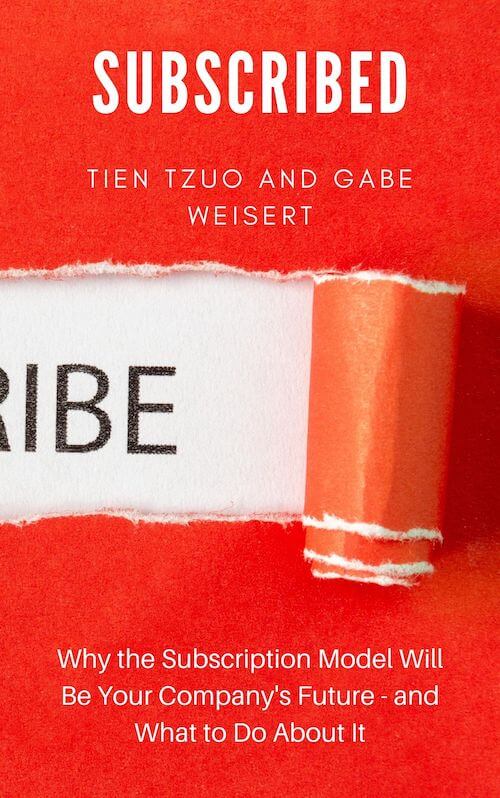
Subscribed Book Summary
This Subscribed Book Summary covers the key ideas, lessons, and takeaways in about 20 minutes.
Short Description:
Subscription models shift business from products to services.
Preview the Subscribed book summary
Below is a preview of Sumizeit’s comprehensive human-written summary of Subscribed by Tien Tzuo with Gabe Weisert. The full summary is 15-20 minutes long and covers the book’s key ideas in text, audio, visual, and video formats. Unlock the full 20 Minute Summary
Eighty-eight percent of the companies on the Fortune 500 list in 1955 are no longer there today. The twelve percent who made the list in 2017 did so because they learned to adapt to the ever-changing business environment. One of the most unparalleled changes in the current market is that people are no longer looking for ownership, they simply want access. In Subscribed: Why the Subscription Model Will Be Your Company’s Future- and What to do About it, the authors Tien Tzou and Gabe Weisert provide the knowledge companies need to understand this new digitally-driven trend and advise on how to capture a share of the billions awaiting those who can make this transformation.
Go Digital or Go Home (i.e. out of business)
The reality is that digital services in business are essential to thriving in today’s market. At its core is the subscription model. Netflix, a subscription-based service, expanded to 100 million users in a decade while Blockbuster, the antitheses of this model, went out of business. IBM, one of the 12 Fortune 500 companies to make the cut rose from being 61st on the list to 32nd, by focusing on IT and business subscription services.
Customers have moved away from wanting to own products. Surprisingly, they don’t want or even need to own cars anymore, as seen by the growth of transportation services such as Uber. Today, demand is access. People would rather pay for access to music than buy music C.D.s; they prefer live streaming from Netflix, Amazon Prime, or HBO than to own or even rent movies. For today’s consumers, the music or movies matter more than the silver disc they are recorded on.
Tzou wrote an article in 2015 for Fortune magazine which asserted that people shouldn’t bother with business school anymore. The reason, he claimed, is that they only teach the students to make a hit product and sell lots of it. The rise of the subscription-based model proves his thesis correct. If a company wants to compete, or even survive, in today’s market, it needs to go digital, and the real profit is in the subscription model.
It’s Still About The Customer
A well-known mantra in many businesses has been, “The Customer is Always Right!” and that is still true. By paying attention to what the customers want, businesses can determine what direction to take their services in the digital market. The key is to slightly change the mantra to say, “The Subscriber is Always Right” and learn what it is customers will sign up for that will bring both profitability and longevity. One example is Fender guitars. Most of their guitars are sold to first-time users (We’ll call them “aspiring musicians.”), but the abandonment rate is extremely high. Fender determined that they could reduce the attrition rate by 10% and double their market size, creating life-long customers, by developing an online service teaching guitar lessons via video.
Another unique approach to the subscription model comes from Hyundai who now sells cars on…
Want the complete 20-minute summary?
- Full structured summary
- Video Summary
- Podcast Summary
- Audio summary
- Key takeaways
- Exercises
- Quiz
- Highlights and notes
- Ask the book with AI
Who should read Subscribed?
Subscribed is essential for business leaders, entrepreneurs, and executives navigating digital transformation in their industries. Whether you run a traditional product-based company or a tech startup, this book is for anyone who needs to understand why the subscription model is reshaping competitive advantage and customer relationships across every sector.
Why does Subscribed matter?
The subscription economy has fundamentally altered how customers want to access goods and services—and companies that fail to adapt face extinction. Subscribed explains why 88% of Fortune 500 companies from 1955 have disappeared and provides a strategic roadmap for the remaining businesses to survive and thrive in a digital-first world where ongoing customer relationships matter more than one-time sales.
What are the key themes in Subscribed?
- The shift from product ownership to service access
- Digital transformation as a survival imperative
- Customer experience as the primary competitive advantage
- Continuous improvement and perpetual beta in subscription services
- Data and IP as core value drivers
- Internal organizational challenges during subscription model transitions
- The Internet of Things enabling future business models
How can you apply ideas from Subscribed?
- Conduct a subscription model audit of your industry to identify whether competitors are already shifting and what your timeline should be
- Map your current customer journey and identify friction points where a subscription or service-based model could improve retention and lifetime value
- Design a pilot subscription offering alongside your existing product business to test market response and learn from real customers
- Restructure your data collection and analytics infrastructure to capture usage patterns and customer feedback that will drive continuous service improvement
- Prepare your organization for the transition by aligning marketing, sales, development, and IT teams around subscription metrics and KPIs rather than one-time sales targets
- Develop a pricing strategy that balances profitability with accessibility, testing models like freemium, usage-based, or tiered pricing to find the optimal fit
- Create feedback loops with subscribers to enable continuous iteration and ensure your service remains in alignment with evolving customer needs
What common mistakes do readers make with Subscribed?
- Underestimating the time and cost of organizational transformation required to successfully shift to a subscription model
- Failing to address internal resistance from teams whose roles and incentives are built around traditional product sales and commissions
- Setting unrealistic expectations about revenue timing and panicking during the inevitable dip before subscriptions reach profitability
- Treating the subscription model as a one-time change rather than committing to continuous improvement and evolution of the service offering
Sumizeit Exercises Apply what you've learned
Turn ideas from Subscribed into action with a short guided reflection: identify the biggest takeaway, connect it to your life, and commit to one step you can take in the next 24 hours.
What is the expert analysis of Subscribed?
Overview
Subscribed: Why the Subscription Model Will Be Your Company’s Future – and What to Do About It is authored by Tien Tzuo, a pioneering figure in the software-as-a-service (SaaS) industry and founder of Zuora, alongside Gabe Weisert, a seasoned content marketer and managing editor at Zuora. This book is significant for its timely and incisive exploration of the subscription economy—a transformative business paradigm reshaping how companies engage with customers and generate revenue in the digital age. Tzuo’s firsthand experience with SaaS and subscription models lends the work both authority and practical insight, situating it as an essential read for business leaders navigating the complexities of digital transformation.
Core Thesis
The central argument of Subscribed is that the future of business lies in embracing subscription-based models rather than traditional ownership or one-time sales. Tzuo posits that consumers increasingly prioritize access over ownership, a shift driven by digital technologies and changing consumer preferences. Companies that adapt by offering subscription services—continuously evolving and deeply customer-centric—will not only survive but thrive. The subscription model, according to the authors, is not merely a pricing strategy but a holistic business transformation that demands rethinking product development, marketing, sales, and customer relationships in a perpetual state of iteration.
Strengths
- Authoritative Perspective: Tzuo’s direct involvement in the SaaS industry and his role in coining the term “Subscription Economy” provide a strong foundation of expertise and credibility.
- Compelling Use of Case Studies: The book effectively employs contemporary examples such as Netflix, Adobe, Hyundai, and Fender to illustrate the practical application and impact of subscription models across diverse industries.
- Forward-Looking Insight: It anticipates the expansion of subscription models into manufacturing and IoT-enabled products, highlighting the ongoing evolution of commerce beyond digital services.
- Customer-Centric Focus: Emphasizing the mantra “The Subscriber is Always Right,” the book underscores the importance of continuous customer feedback and service refinement, aligning with modern marketing and product development philosophies.
- Accessible yet Strategic: The narrative balances strategic business insights with accessible language, making complex digital transformation concepts understandable to a broad professional audience.
Critiques & Counterarguments
- Overemphasis on Subscription as a Panacea: While subscription models offer advantages, the book occasionally presents them as universally superior, overlooking industries or contexts where ownership or hybrid models remain preferable or more profitable.
- Limited Discussion of Market Saturation Risks: The rapid proliferation of subscription services raises concerns about consumer fatigue and churn, which the book touches on but does not deeply analyze.
- Underrepresentation of Counterexamples: The narrative largely celebrates success stories, with minimal exploration of subscription failures or companies that reverted to traditional models due to operational or market challenges.
- Intellectual Pushbacks:
- Behavioral economics research suggests that ownership can confer psychological benefits and perceived value that subscriptions may not fully replicate, complicating the shift to access-based consumption.
- Some scholars argue that subscription models can exacerbate inequality by locking consumers into ongoing payments without asset accumulation, a nuance absent from the book’s largely positive framing.
- Real-world evidence from sectors like automotive leasing and software trials indicates that hybrid models—combining ownership and subscription elements—may offer more sustainable business models than pure subscriptions.
- Competitive dynamics in subscription markets often lead to price wars and margin compression, challenging the assumption that subscription models inherently yield superior profitability.
Who Should Read This
Subscribed is ideally suited for business executives, entrepreneurs, and strategists seeking to understand and implement subscription-based business models in a digitally driven economy. It offers valuable insights for those in technology, manufacturing, retail, and service industries grappling with digital transformation. Additionally, marketing and product development professionals will find its customer-centric approach instructive. However, readers should approach the book as a foundational perspective on subscriptions rather than a definitive blueprint, supplementing it with critical engagement and sector-specific analysis.
Frequently asked questions about the Subscribed book summary
What is Subscribed about?
Subscribed: Why the Subscription Model Will Be Your Company's Future by Tien Tzuo and Gabe Weisert is a guide to understanding why the subscription economy has become the dominant business model of our time. The book explains how consumer preferences have shifted from owning products to accessing services, and provides a strategic roadmap for companies to transform their business models to compete and survive in a digital-first world.
Who should read Subscribed?
Subscribed is essential reading for business executives, entrepreneurs, product leaders, and anyone responsible for strategic direction in their organization. Whether you operate a traditional manufacturing company, software business, or any industry facing digital disruption, this book provides the frameworks needed to understand why subscription models are reshaping competitive advantage across every sector.
What are the main takeaways from Subscribed?
The core takeaways include: consumers now prioritize access over ownership, requiring companies to shift from selling products to delivering ongoing services; digital transformation is non-negotiable for survival; real value lies in customer data and intellectual property rather than physical products; and successful transitions require organization-wide change across all departments, with short-term revenue challenges that lead to long-term growth.
Why did Netflix succeed while Blockbuster failed?
Netflix embraced the subscription model, allowing customers to access movies digitally and conveniently, while Blockbuster remained focused on selling physical rentals through stores. Netflix's approach aligned with changing consumer preferences for access over ownership, enabling the company to scale to 100 million users in a decade while Blockbuster became obsolete.
How does the subscription model differ from traditional product sales?
Traditional product sales focus on making individual hits and maximizing transaction volume, while the subscription model builds ongoing customer relationships with recurring revenue. Subscriptions require companies to continuously improve their offerings, invest in customer understanding, and align profitability around long-term retention rather than one-time purchases.
What challenges do companies face when transitioning to subscription models?
Companies transitioning to subscriptions typically experience short-term revenue dips, internal resistance from teams built around traditional sales, and require wholesale restructuring of marketing, sales, development, and IT departments. Understanding these challenges and committing to the long-term vision—as Adobe did despite a 35% stock drop—is essential for successful transformation.
How will the Internet of Things impact subscription business models?
Smart, connected products will enable manufacturers to gather real-time usage data and customer feedback, allowing them to continuously improve and offer subscription-based services around their IoT products. This will extend subscription economics beyond software and services into manufacturing and traditional industries like automotive.
About Sumizeit
Sumizeit is a profitable Scomy LLC company based in Miami, Florida. Our founders, Clemens Raemy and Weina Scott, are successful entrepreneurs with several exits. Sumizeit is a popular book summary app / micro learning app used by busy professionals and entrepreneurs with over 2,500 non-fiction book summaries and 10,000 podcast summaries in text, audio, visual, podcast, and video format. We also have stellar retention tools to make ideas stick - such as flashcards with spaced repetition, quizzes, streaks, highlighting and notes, daily challenges, riddles, mini-courses, meditation, and more. You won't only learn the idea, but also remember it. Over 90% of our users change their habits with Sumizeit.
Upgrade Now
Here's why readers love Sumizeit
Join thousands of learners getting smarter every day
"Great experience. Detailed summaries. Loved the gamification feature. Makes learning fun. Good customer service. I recommend Sumizeit to anyone. You'll learn a lot."
"I always felt busy but still wanting to keep up with the book discussion in my friend group. This was a great supplement to help me keep reading the books I find fun while keeping up with important books."
"I love this website. Instead of scrolling social media, I find myself learning a lot. I use it everyday. I recommend this app for anyone who is too busy and wants to get up to speed with their favorite books."
Subscribed Book Summary PDF
Looking for a Subscribed Book Summary PDF you can save and revisit offline? Our Subscribed Book Summary PDF captures the book’s core ideas in a clean, printable format — the key frameworks, takeaways, and structure without the fluff. Download the Subscribed Book Summary PDF when you want a reference you can annotate, share with your team, or review on the go. Get your Subscribed Book Summary PDF from the download page below.
Download Subscribed Book Summary PDFPeople also liked these summaries
Readers who explored Subscribed often enjoyed these titles next.

Ready to read the whole thing?
- Full structured summary
- Video Summary
- Podcast Summary
- Audio summary
- Key takeaways
- Exercises
- Quiz
- Highlights and notes
- Ask the book with AI
Featured Book Titles
Popular Book Summaries at sumizeit, leading book summary app