


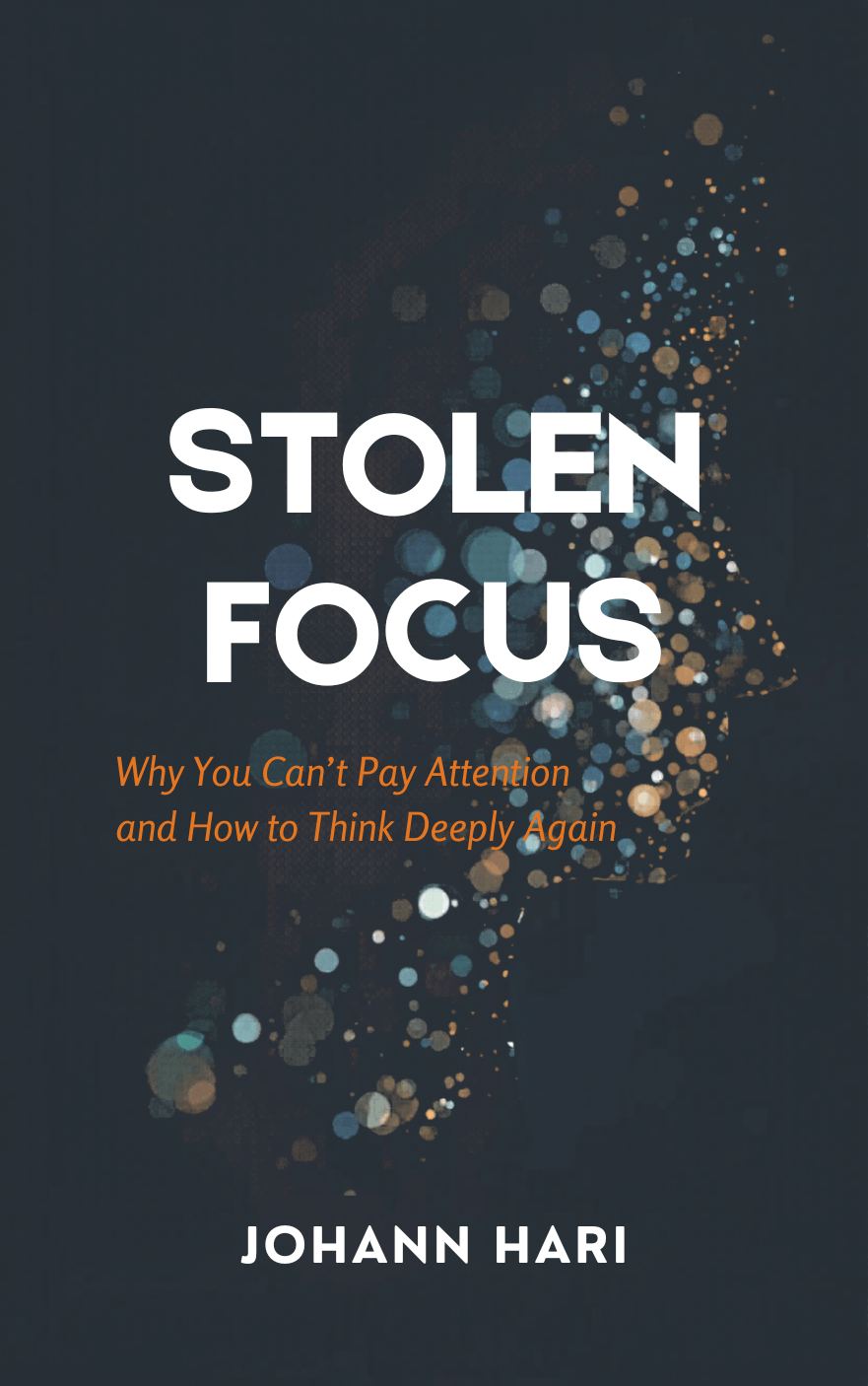
Prefer the print book? Buy on Amazon
As an Amazon Associate, Sumizeit earns from qualifying purchases.
Stolen Focus Book Summary
This Stolen Focus Book Summary covers the key ideas, lessons, and takeaways in about 20 minutes.
The second large takeaway is that recovery is possible but only through collective action. Hari encourages readers to adopt better personal habits, to sleep more, eat more carefully, give their children real time outdoors, and treat their phones with greater suspicion. But he insists that personal reform alone will never restore what has been lost. The same machines, schools, and workplaces that are breaking attention will keep doing so until they are reformed. He asks readers to think of focus as a public resource, like clean water or breathable air, rather than as a private discipline. The goal is not just an individual life with fewer distractions but a society in which everyone has a real chance at the kind of sustained, creative, connected mental life that human beings were built for.
Helps with these goals
Want the complete 20-minute summary?
- Full structured summary
- Video Summary
- Podcast Summary
- Audio summary
- Key takeaways
- Exercises
- Quiz
- Highlights and notes
- Ask the book with AI
Not ready to upgrade?
Get this summary + 2 more picks sent to your inbox, free.
What is in the Stolen Focus book summary?
Below is a preview of Sumizeit’s expert-written summary of Stolen Focus by Johann Hari. The full summary covers the book’s key ideas in text, audio, and video.
Johann Hari's Stolen Focus, released in 2022, takes the widely felt complaint that "I cannot concentrate the way I used to" and turns it into a sweeping investigation. Hari's thesis is that the inability to pay attention is not a moral failing on the part of individuals who lack discipline. It is the predictable outcome of a long list of social, economic, technological, and biological pressures that together have eroded one of the most basic capacities the human mind possesses. Drawing on interviews with scientists, activists, and ordinary people, the book maps the damage, explains the mechanisms behind it, and proposes a response that goes well beyond turning off your phone for a weekend.
The walkthrough below covers Hari's case in detail, including the evidence he gathers for the crisis, the seven causes he identifies, and the two-part remedy he advocates.
Why Concentration Has Become a Vanishing Resource
Hari frames the inability to focus as a crisis worth taking seriously for three connected reasons. On a personal level, no one can move toward what they want in life if they cannot keep their attention on it long enough to make progress. On a societal level, no community can recognize, debate, and respond to its biggest challenges if the public cannot sit still long enough to think about them. And finally, because the conditions that produced the problem were created by human decisions, only further human decisions can reverse them. He insists that fatalism is unwarranted; what people built, people can rebuild.
The book grew out of Hari's own difficulties with concentration. He realized he was dropping books mid-chapter, drifting in conversations, and reaching for his phone reflexively. Rather than blame himself, he set out to investigate what was happening at scale.
Three Symptoms of a Mind That Can No Longer Settle
To make the case that something larger than personal weakness is going on, Hari opens with three observable forms of cognitive deterioration. People are finding it harder to enter states of total absorption, harder to read at length, and harder to think in the patient, exploratory way that produces real insight. Each represents a different layer of attention, and all three are weakening at once.
The Disappearance of Deep Engagement
The deepest version of focus, Hari argues, is the state of complete immersion in a meaningful task. Twentieth-century psychologist Mihaly Csikszentmihalyi gave that state a name: flow. It happens when a person is absorbed in something they care about to the point that hours pass without their noticing. Hari describes three conditions that have to be met for flow to occur. The activity has to be the only thing receiving your attention at that moment. It has to matter to you for its own sake, not because someone is paying you or grading you. And it has to sit in the narrow band where the challenge is high enough to engage your skills but not so high that it crushes your morale.
Skinner, Reward Loops, and the Engineering…
Want the complete 20-minute summary?
- Full structured summary
- Video Summary
- Podcast Summary
- Audio summary
- Key takeaways
- Exercises
- Quiz
- Highlights and notes
- Ask the book with AI
Who should read Stolen Focus?
Stolen Focus is essential for anyone struggling to concentrate in modern life, from office workers and students to parents concerned about their children's attention spans. If you find yourself constantly distracted, unable to finish books, or feeling mentally scattered despite genuine effort, this book offers both validation and a framework for understanding why. It's equally valuable for educators, policymakers, and tech-conscious individuals who want to understand the systemic forces eroding human attention.
Why does Stolen Focus matter?
In an era where distraction feels like a personal failing, Johann Hari reframes the attention crisis as a structural problem rather than an individual weakness. This distinction is crucial because it shifts responsibility from self-blame to understanding the economic, technological, and social systems that deliberately engineer distraction. With sleep deprivation, digital manipulation, information overload, and childhood stress all converging, our capacity for deep work, creativity, and meaningful engagement is under unprecedented siege, making this diagnosis urgent for anyone trying to reclaim control of their mental life.
What are the key themes in Stolen Focus?
- Attention as a public resource, not a private discipline
- The distinction between behavioral conditioning and intrinsic human motivation
- How systemic forces, not personal weakness, erode focus
- The reciprocal relationship between reading and concentration
- Technology designed to hijack attention through engineered reward loops
- The cumulative damage of sleep loss, poor diet, and pollution on cognitive function
- Why personal solutions alone are insufficient against structural problems
Want the complete 20-minute summary?
- Full structured summary
- Video Summary
- Podcast Summary
- Audio summary
- Key takeaways
- Exercises
- Quiz
- Highlights and notes
- Ask the book with AI
How can you apply ideas from Stolen Focus?
- Audit your sleep habits and prioritize 7-9 hours nightly, recognizing sleep as foundational to all other cognitive improvements
- Eliminate processed foods high in additives and glucose spikes in favor of whole foods that support stable energy and brain function
- Design your physical environment to reduce exposure to air pollution and endocrine-disrupting chemicals where possible
- Give children genuine unstructured outdoor time and space to manage their own boredom rather than filling every hour with structured activities
- Advocate for school policies that prioritize exploration and learning over standardized test preparation
- Support legislation banning surveillance capitalism and limiting the design tactics companies use to hijack attention
- Participate in or organize collective action pushing for shorter working hours and worker protection from constant digital demands
What common mistakes do readers make with Stolen Focus?
- Assuming personal willpower and discipline are sufficient to overcome industrial-scale attention engineering designed by teams of engineers
- Framing focus problems as individual moral failures rather than signals of broken systems that need structural change
- Believing that digital detoxes or personal habit changes address the root causes rather than temporary Band-Aids on systemic wounds
- Overlooking how sleep deprivation, poor diet, childhood stress, and environmental toxins compound each other to erode attention capacity
- Thinking that technology companies will voluntarily redesign their platforms when their entire business model depends on capturing and selling your attention
Sumizeit Exercises Apply what you've learned
Turn ideas from Stolen Focus into action with a short guided reflection: identify the biggest takeaway, connect it to your life, and commit to one step you can take in the next 24 hours.
What is the expert analysis of Stolen Focus?
Overview
Stolen Focus is a 2022 work by British journalist Johann Hari, who has established a reputation for connecting individual psychological struggles with broader social and structural dynamics. Building on his prior explorations of addiction and mental health in Chasing the Scream and Lost Connections, Hari here tackles the pervasive crisis of attention in contemporary life. The book’s significance lies in its ambitious synthesis of diverse fields—psychology, neuroscience, sociology, and economics—into a compelling diagnosis of why concentration has become so elusive, and in its call for systemic, collective remedies rather than individual blame or simplistic fixes.
Core Thesis
Hari’s central argument reframes the widespread decline in attention not as a failure of individual discipline but as the predictable consequence of multiple, interacting forces embedded in modern life. These include technological designs engineered to hijack attention, environmental degradation, cultural shifts, educational policies, and economic imperatives that prioritize growth and consumption over wellbeing. The erosion of focus is thus a structural problem, one that manifests in diminished capacity for deep engagement, reading, and creative thought. Hari insists that only coordinated political and social action, coupled with systemic reforms, can restore attention as a public resource.
Strengths
- Interdisciplinary Integration: Hari weaves together insights from behavioral psychology, cognitive science, environmental health, and social theory, providing a comprehensive panorama of the attention crisis.
- Accessible yet Nuanced: The book balances scholarly research with engaging storytelling and vivid examples, making complex concepts like flow and behaviorist conditioning approachable without oversimplification.
- Structural Focus: By shifting responsibility from individuals to systems, Hari challenges prevailing narratives of self-blame and offers a hopeful framework for collective empowerment.
- Practical Proposals: The dual emphasis on structural reforms (e.g., labor policies, digital regulation) and political mobilization grounds the book’s diagnosis in actionable pathways forward.
- Contextualizing Technology: Hari’s analysis of digital platforms as behaviorist machines that commodify attention is particularly timely and resonates with ongoing debates about surveillance capitalism.
Critiques & Counterarguments
- Evidence Scope and Causality: While Hari marshals extensive data, some claims—such as the direct impact of preservatives on ADHD prevalence or the precise causal weight of digital distractions—could benefit from more rigorous, peer-reviewed backing and clearer differentiation between correlation and causation.
- Overgeneralization of ADHD: The treatment of ADHD risks oversimplification by emphasizing environmental stress and medication side effects without fully engaging with the robust neurobiological research supporting its heterogeneity and biological components.
- Technological Determinism: Hari’s critique of digital technology, though persuasive, sometimes leans toward determinism, underestimating users’ agency and the potential for adaptive or mindful technology use documented in some psychological and human-computer interaction studies.
- Alternative Perspectives on Motivation: The tension between behaviorism and intrinsic motivation is well articulated, but some contemporary motivational theories (e.g., self-determination theory) offer more nuanced accounts of how external rewards and internal drives interact, which could complicate Hari’s dichotomy.
- Political Feasibility: The call for an “attention rebellion” and sweeping systemic reform, while inspiring, may underestimate the entrenched economic and political interests sustaining surveillance capitalism and educational paradigms, raising questions about pragmatic pathways to change.
Who Should Read This
Stolen Focus is essential reading for scholars and practitioners in psychology, education, digital media studies, and public health who seek a holistic understanding of attention beyond individual pathology. It also appeals to policymakers, activists, and thoughtful consumers concerned with the societal implications of technology and work culture. Finally, anyone grappling with their own concentration struggles will find in Hari’s work both validation and a call to situate their experience within larger systemic forces, moving beyond self-recrimination toward collective action.
Frequently asked questions about the Stolen Focus book summary
What is Stolen Focus about?
Stolen Focus by Johann Hari investigates why modern people struggle to concentrate and traces this crisis to seven systemic causes rather than individual weakness: mistreated ADHD, lost childhood play, sleep deprivation, poor diet and environmental toxins, addictive digital design, information overload, and the false narrative that personal willpower is the solution. Hari argues that only structural reform and collective political action can restore our capacity for deep attention.
Who should read Stolen Focus?
Anyone struggling with concentration, distraction, or an inability to read books should read Stolen Focus. It's essential for students, office workers, parents concerned about their children's attention, educators designing curricula, and policymakers crafting technology and work regulations. The book is valuable for anyone who wants to understand why focus feels harder and what can actually be done about it.
What are the main takeaways from Stolen Focus?
The two main takeaways are: (1) your attention crisis reflects structural problems—sleep loss, digital manipulation, poor diet, environmental toxins, and childhood stress—not personal weakness, and (2) recovery requires collective political action to reform these systems, not just personal habit changes. Hari argues that focus should be treated as a public resource like clean air or water, requiring systemic solutions rather than individual discipline.
What does Johann Hari mean by flow and why is it important?
Flow, a term from psychologist Mihaly Csikszentmihalyi, is the state of complete immersion in a meaningful task where hours pass unnoticed. It requires undivided attention, intrinsic motivation, and a challenge perfectly matched to your skill level. Hari argues that flow is essential for creativity, satisfaction, and genuine learning, but modern life has become systematically hostile to all three conditions required for it.
How does social media design deliberately damage attention?
Social media platforms use reward loops descended from B.F. Skinner's behavioral psychology—likes, streaks, notifications, and tailored algorithms—to condition compulsive use. Because attention is the product sold to advertisers, every additional second you spend on screen is more valuable to the company. Algorithms favor enraging content because anger hijacks the nervous system and keeps people engaged longer.
What does Hari propose as a solution to the attention crisis?
Hari proposes two-part solutions: structural reforms including shorter working hours, restored childhood play, and most importantly outlawing surveillance capitalism; and coordinated political movements large enough to force these changes. He argues personal habits matter but are insufficient against forces this large, and that only collective action matching the scale of past successful social movements can drive necessary systemic change.
How does sleep deprivation affect focus and concentration?
Sleep loss damages focus through multiple mechanisms: it reduces memory consolidation, weakens emotional processing, allows metabolic waste to accumulate in the brain, and creates 'attentional blinks' where regions briefly shut down during waking hours. The modern person sleeps roughly one hour less per night than a century ago, partly due to artificial light and partly because the economy benefits from keeping people awake.
What is the difference between external rewards and intrinsic motivation?
External rewards like money or grades can actually decrease genuine motivation and engagement, as shown in studies of college students. Intrinsic motivation—the drive to do something for its own sake—depends on autonomy, competence, and connection to others. Digital platforms use external rewards to manufacture engagement, but this approach corrodes the deeper, more sustainable forms of attention that flow requires.
About Sumizeit
Sumizeit is a profitable Scomy LLC company based in Miami, Florida. It has been helping readers learn from nonfiction books for 7 years with expert-written summaries in text, audio, podcast, and video.
Want the complete 20-minute summary?
- Full structured summary
- Video Summary
- Podcast Summary
- Audio summary
- Key takeaways
- Exercises
- Quiz
- Highlights and notes
- Ask the book with AI
Here's why readers love Sumizeit
Join thousands of learners getting smarter every day
"Great experience. Detailed summaries. Loved the gamification feature. Makes learning fun. Good customer service. I recommend Sumizeit to anyone. You'll learn a lot."
"I always felt busy but still wanting to keep up with the book discussion in my friend group. This was a great supplement to help me keep reading the books I find fun while keeping up with important books."
"I love this website. Instead of scrolling social media, I find myself learning a lot. I use it everyday. I recommend this app for anyone who is too busy and wants to get up to speed with their favorite books."
Stolen Focus Book Summary PDF
Looking for a Stolen Focus Book Summary PDF you can save and revisit offline? Our Stolen Focus Book Summary PDF captures the book’s core ideas in a clean, printable format — the key frameworks, takeaways, and structure without the fluff. Download the Stolen Focus Book Summary PDF when you want a reference you can annotate, share with your team, or review on the go. Get your Stolen Focus Book Summary PDF from the download page below.
Download Stolen Focus Book Summary PDFPeople also liked these summaries
Readers who explored Stolen Focus often enjoyed these titles next.


Want the complete 20-minute summary?
- Full structured summary
- Video Summary
- Podcast Summary
- Audio summary
- Key takeaways
- Exercises
- Quiz
- Highlights and notes
- Ask the book with AI
Featured Book Titles
Popular Book Summaries at sumizeit, leading book summary app