


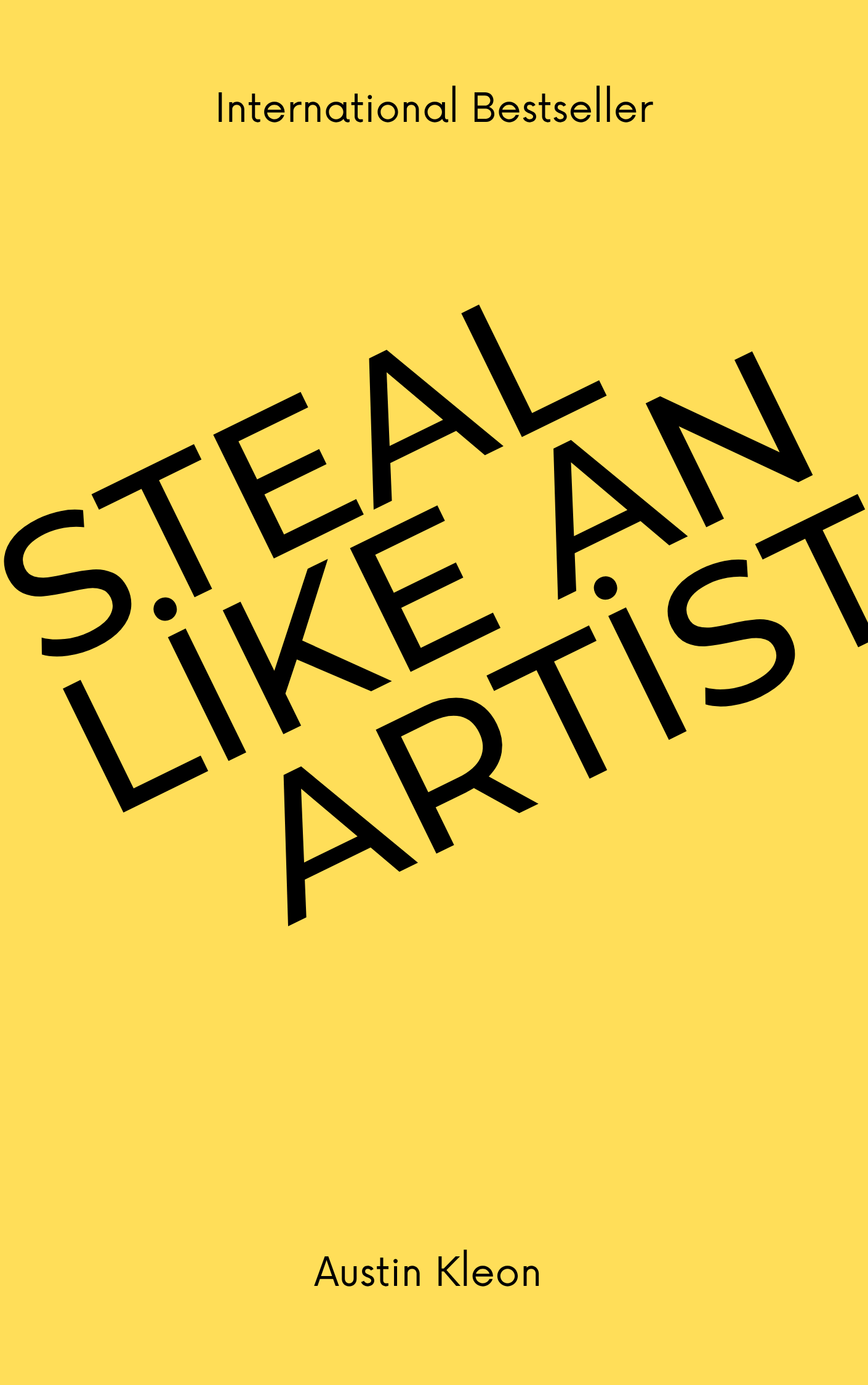
Prefer the print book? Buy on Amazon
As an Amazon Associate, Sumizeit earns from qualifying purchases.
Steal Like an Artist Book Summary
This Steal Like an Artist Book Summary covers the key ideas, lessons, and takeaways in about 20 minutes.
Short Description:
Steal Like an Artist shows creativity thrives on influence, sharing, and routin.
Helps with these goals
Want a Free Weekly Read?
Get a free summary every week straight to your mailbox.
Preview the Steal Like an Artist book summary
Below is a preview of Sumizeit’s comprehensive human-written summary of Steal Like an Artist by Austin Kleon . The full summary is 15-20 minutes long and covers the book’s key ideas in text, audio, visual, and video formats. Unlock the full 20 Minute Summary
Austin Kleon begins Steal Like an Artist by dismantling one of the most damaging myths about creativity—the belief that true originality means inventing something entirely new. He argues that every creative idea is born from the ideas that came before it. Rather than pursuing an impossible fantasy of originality, the most successful creators treat creativity as a process of collecting, studying, transforming, and combining existing material into something personal. Creativity is less like a magical revelation and more like a well-curated collage.
Kleon recommends becoming a dedicated collector of inspiration. He encourages artists to maintain a “swipe file”—a personal archive containing anything that sparks interest or admiration. This could include photographs, quotes, lyrics, paintings, book excerpts, video stills, typography layouts, architectural details, unusual color palettes, marketing campaigns, scientific concepts, or even bizarre overheard conversations. The purpose of the swipe file is not copying in a literal sense but building a vocabulary of ideas that stimulate new thoughts. For example, a fashion designer might collect images of traditional costumes from different cultures, Pinterest boards of street style, vintage magazine covers, and textile patterns. Later, these references might inspire a runway collection that blends cultural craftsmanship with modern materials.
Kleon advises studying creative heroes deeply and intentionally rather than admiring them superficially. He suggests treating their body of work like a curriculum—examining everything they produced, researching their influences, understanding what shaped their worldview, and learning how their style evolved. For instance, someone who admires the musician Kendrick Lamar might study Tupac, Miles Davis, jazz improvisation, and West Coast hip-hop history. A filmmaker inspired by Wes Anderson might analyze French New Wave cinema, the illustrations of Jacques Tati, or the symmetrical compositions of Renaissance painting. By tracing influence backward, one uncovers the creative genealogy behind great art and recognizes that even icons built on foundations laid by others.
He emphasizes that being influenced is not theft unless the artist merely copies without transformation. Picasso famously said, “Good artists copy; great artists steal,” meaning that mediocre artists imitate the surface style of their inspirations, whereas great artists internalize the essence and then reinvent it. For example, the Beatles drew heavily from American rhythm and blues, gospel harmonies, and Indian classical music, yet transformed those influences into an entirely new sound. Steve Jobs borrowed ideas from calligraphy classes, Zen Buddhism, and Xerox PARC computer research to create Apple’s sleek design aesthetic. Creativity is therefore an act of selective transformation—from influence to interpretation.
Start Before You Feel Ready
One of Kleon’s central messages is that creators must begin working long before they feel confident. Many aspiring artists hesitate because they believe they must fully understand their personal voice, build mastery, or assemble the right resources before starting. However, waiting for confidence is counterproductive because confidence arises only through repetition. Instead of trying to discover who you are before creating, identity forms through the process of creating repeatedly over time.
Kleon discusses imposter syndrome—the persistent belief that one is not talented enough and will soon be exposed…
Want the complete 20-minute summary?
- Full structured summary
- Video Summary
- Podcast Summary
- Audio summary
- Key takeaways
- Exercises
- Quiz
- Highlights and notes
- Ask the book with AI
Who should read Steal Like an Artist?
Steal Like an Artist is for anyone who believes they lack originality or are waiting for the perfect moment to start creating. Whether you're a struggling writer, aspiring designer, entrepreneur, or simply someone who wants to unlock your creative potential, this book demolishes the myths holding you back. It's especially valuable for people paralyzed by perfectionism, imposter syndrome, or the false belief that true creativity requires inventing something entirely new.
Why does Steal Like an Artist matter?
In a world obsessed with originality and perfection, Austin Kleon's message is liberating: creativity is not about creating in a vacuum but about thoughtfully collecting, studying, and remixing existing ideas into something personal. This perspective matters because it makes creative work accessible to everyone, removing the psychological barriers that prevent most people from starting. In an era of constant comparison and digital pressure, Kleon offers a practical, humane approach to building a sustainable creative life rooted in curiosity, community, and consistent practice rather than burnout or genius.
What are the key themes in Steal Like an Artist?
- Originality is a myth; great art builds on what came before
- Starting imperfectly beats waiting for readiness
- Personal curiosity, not market demand, should drive your work
- Analog practices unlock deeper thinking than digital shortcuts
- Community and generosity fuel creative ecosystems more than competition
- Routine and constraints spark innovation
- Sharing work in progress builds connection and growth
How can you apply ideas from Steal Like an Artist?
- Start a daily creative practice of just 15 minutes, marking off each day on a calendar to build momentum and accountability
- Create a physical or digital swipe file by saving inspiring images, quotes, colors, designs, and ideas whenever you encounter them
- Set up dual workspaces: one analog zone for brainstorming and messy drafting, one digital zone for editing and refinement
- Choose one creative hero and study their entire body of work, influences, and evolution as if it were a curriculum
- Identify something you wish existed but can't find, then commit to making it—whether a product, story, or service—as your next project
- Share your creative work in progress on social media or with trusted peers rather than waiting for perfection
- Establish a routine around a creative activity you enjoy, treating it with the same discipline as a gym habit or work schedule
- Take on a creative side project purely for joy, with no expectation of profit or recognition, as an experiment in playful innovation
What common mistakes do readers make with Steal Like an Artist?
- Waiting for the perfect moment, right resources, or complete confidence before starting—resulting in never beginning at all
- Viewing influence as theft and fearing that borrowing ideas means lacking originality, when great artists actually internalize and transform influences
- Performing all creative work on screens, leading to premature perfectionism and loss of the physical discovery that analog methods unlock
- Isolating your creative work and avoiding sharing until it's flawless, missing opportunities for feedback, connection, and momentum that early sharing provides
Sumizeit Exercises Apply what you've learned
Turn ideas from Steal Like an Artist into action with a short guided reflection: identify the biggest takeaway, connect it to your life, and commit to one step you can take in the next 24 hours.
What is the expert analysis of Steal Like an Artist?
Overview
Steal Like an Artist is a seminal work by Austin Kleon, a writer and illustrator known for blending visual art with creative philosophy. This book stands out in the crowded field of creativity literature by dismantling the myth of pure originality and instead celebrating creativity as a process of influence, transformation, and consistent practice. Kleon's accessible yet profound approach appeals not only to traditional artists but to anyone seeking to cultivate creativity in their professional or personal life. His background in blackout poetry and analog collage informs the book’s distinctive style, making it both a practical guide and a manifesto for modern creators navigating the digital age.
Core Thesis
Kleon's central argument is that creativity is not about inventing something entirely new but about "stealing"—in the sense of collecting, remixing, and transforming existing ideas into something uniquely personal. He reframes originality as a myth and positions creativity as a lineage-based, cumulative process. By embracing influence, starting before feeling ready, engaging physically with the creative process, and fostering community through sharing, creators can build sustainable, authentic work. Importantly, Kleon highlights the role of routine, constraints, and side projects as catalysts for innovation, advocating for a balanced creative life grounded in stability and self-care.
Strengths
- Demystification of Creativity: Kleon effectively dismantles the intimidating myth of originality, making creativity accessible and less daunting for readers.
- Practical and Actionable Advice: The book is rich with concrete strategies—such as maintaining a swipe file, embracing analog methods, and starting before feeling ready—that readers can implement immediately.
- Interdisciplinary Examples: Kleon draws on a wide array of creators across music, literature, technology, and visual arts, illustrating his points with compelling real-world stories.
- Balanced Emphasis on Process and Mindset: The integration of psychological insights (e.g., imposter syndrome, fake it till you make it) with practical routines offers a holistic approach to creativity.
- Community and Sharing: The encouragement to share work openly and build connections resonates deeply in the digital era, fostering collaboration and reducing isolation.
Critiques & Counterarguments
- Risk of Oversimplification: While the notion that all creativity is derivative is compelling, it may underplay the role of genuine innovation and the occasional emergence of radically new paradigms that do not neatly fit into lineage-based models.
- Evidence Base and Depth: The book relies heavily on anecdotal examples rather than rigorous empirical research, which may limit its appeal to readers seeking academic grounding or scientific validation of creative processes.
- Potential Neglect of Structural Barriers: Kleon’s emphasis on individual agency and mindset might overlook systemic factors—such as socioeconomic constraints or institutional gatekeeping—that affect creative opportunities and access.
- Competing Schools of Thought: Some creativity theorists emphasize the importance of solitude, deep focus, and originality as distinct from influence and remixing. For example, Teresa Amabile’s research on intrinsic motivation and Mihaly Csikszentmihalyi’s concept of flow highlight dimensions less foregrounded in Kleon’s work.
- Digital vs. Analog Dichotomy: The valorization of analog methods may undervalue the creative potentials unlocked by digital tools, artificial intelligence, and collaborative online platforms, which are increasingly central to contemporary creativity.
Who Should Read This
Steal Like an Artist is ideal for aspiring creators, professionals in creative industries, and anyone interested in cultivating a more creative approach to work and life. Its accessible style and practical guidance make it particularly valuable for those who feel intimidated by the myth of originality or struggle with starting and sustaining creative projects. Educators, entrepreneurs, and hobbyists alike will find inspiration in Kleon’s emphasis on routine, community, and playful experimentation. However, readers seeking a deep theoretical or scientific exploration of creativity might consider this book a starting point rather than a comprehensive resource.
Frequently asked questions about the Steal Like an Artist book summary
What is Steal Like an Artist about?
Steal Like an Artist by Austin Kleon is a practical guide that redefines creativity as a lifelong practice grounded in collecting ideas, studying influences, remixing them boldly, and working consistently. Rather than chasing impossible originality, Kleon argues that the most powerful creative work comes from thoughtfully borrowing, transforming, and building on what came before—like how the Beatles remixed American blues into their own sound, or how Steve Jobs combined calligraphy and Zen Buddhism into Apple's design aesthetic.
Who should read Steal Like an Artist?
Anyone who feels stuck, paralyzed by perfectionism, or waiting for the "right moment" to create should read this book. It's valuable for aspiring writers, designers, entrepreneurs, musicians, and anyone—professional or amateur—who wants to unlock their creative potential and build a sustainable creative life. Kleon's message is especially powerful for people trapped by imposter syndrome or the false belief that true creativity requires inventing something entirely new.
What are the main takeaways from Steal Like an Artist?
The core takeaways are: start before you feel ready, build a daily creative practice, collect and study your influences deeply, share work in progress, use analog methods to unlock thinking, pursue side projects for joy, embrace constraints as sparks for innovation, and support a community rather than compete. Kleon emphasizes that creativity is accessible through consistent practice, thoughtful influence, physical engagement, and the courage to begin imperfectly.
How can I start stealing like an artist without plagiarizing?
Kleon distinguishes between copying (surface imitation) and stealing (internalizing the essence and transforming it). To steal properly, study your creative heroes deeply—understand their influences, their worldview, how their style evolved—then remix what you've learned into something distinctly yours. For example, start a swipe file of inspiring ideas across disciplines, let them marinate, then combine them in unexpected ways that reflect your unique experiences and perspective.
What does Kleon say about imposter syndrome?
Kleon reveals that imposter syndrome affects high achievers across all fields—famous actors, Nobel-winning scientists, successful entrepreneurs—not just beginners. The key insight is that imposter syndrome never fully disappears through waiting; it dissolves through action. Confidence comes from doing the work repeatedly, so the solution is to "fake it until you make it" by acting as the creator you aspire to be until the evidence catches up.
Why does Austin Kleon recommend using analog methods?
Analog practices like handwriting, sketching, and collage activate sensory pathways that unlock deeper thinking and quiet the inner critic in ways digital screens don't. Handwriting slows your mind enough to think creatively, cutting and pasting physical materials reveals unexpected connections, and tactile prototyping reveals spatial relationships that software can't. Kleon suggests separating analog brainstorming spaces from digital refinement zones to prevent over-editing early ideas.
How should I approach sharing my creative work?
Kleon advocates sharing your work and process openly—posting sketches, drafts, experiments, failures, and behind-the-scenes reflections—rather than waiting until projects feel perfect. Sharing your journey invites community interaction and inspiration while building your reputation. Include vulnerability by showing revisions and failures, because audiences connect with honesty more than polished perfection. However, protect yourself by creating a "praise file" of positive messages to revisit when doubt surfaces.
About Sumizeit
Sumizeit is a profitable Scomy LLC company based in Miami, Florida. Our founders, Clemens Raemy and Weina Scott, are successful entrepreneurs with several exits. Sumizeit is a popular book summary app / micro learning app used by busy professionals and entrepreneurs with over 2,500 non-fiction book summaries and 10,000 podcast summaries in text, audio, visual, podcast, and video format. We also have stellar retention tools to make ideas stick - such as flashcards with spaced repetition, quizzes, streaks, highlighting and notes, daily challenges, riddles, mini-courses, meditation, and more. You won't only learn the idea, but also remember it. Over 90% of our users change their habits with Sumizeit.
Upgrade Now
Here's why readers love Sumizeit
Join thousands of learners getting smarter every day
"Great experience. Detailed summaries. Loved the gamification feature. Makes learning fun. Good customer service. I recommend Sumizeit to anyone. You'll learn a lot."
"I always felt busy but still wanting to keep up with the book discussion in my friend group. This was a great supplement to help me keep reading the books I find fun while keeping up with important books."
"I love this website. Instead of scrolling social media, I find myself learning a lot. I use it everyday. I recommend this app for anyone who is too busy and wants to get up to speed with their favorite books."
Steal Like an Artist Book Summary PDF
Looking for a Steal Like an Artist Book Summary PDF you can save and revisit offline? Our Steal Like an Artist Book Summary PDF captures the book’s core ideas in a clean, printable format — the key frameworks, takeaways, and structure without the fluff. Download the Steal Like an Artist Book Summary PDF when you want a reference you can annotate, share with your team, or review on the go. Get your Steal Like an Artist Book Summary PDF from the download page below.
Download Steal Like an Artist Book Summary PDFPeople also liked these summaries
Readers who explored Steal Like an Artist often enjoyed these titles next.


Ready to read the whole thing?
- Full structured summary
- Video Summary
- Podcast Summary
- Audio summary
- Key takeaways
- Exercises
- Quiz
- Highlights and notes
- Ask the book with AI
Featured Book Titles
Popular Book Summaries at sumizeit, leading book summary app