


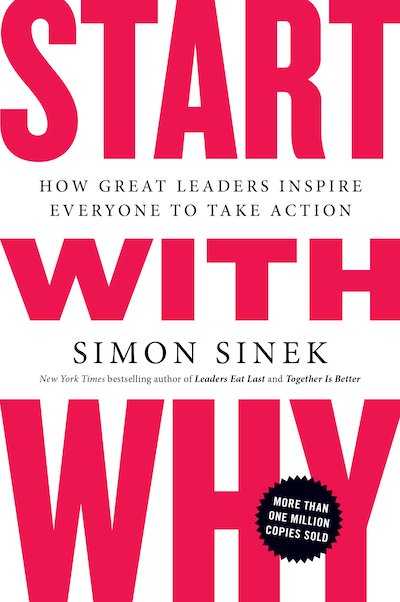
Prefer the print book? Buy on Amazon
As an Amazon Associate, Sumizeit earns from qualifying purchases.
Start With Why Book Summary
This Start With Why Book Summary covers the key ideas, lessons, and takeaways in about 20 minutes.
Short Description:
Start with Why shows leaders inspire by communicating their purpose clearly.
Helps with these goals
Want the complete 20-minute summary?
- Full structured summary
- Video Summary
- Podcast Summary
- Audio summary
- Infographic
- Key takeaways
- Exercises
- Quiz
- Highlights and notes
- Ask the book with AI
Want a Free Weekly Read?
Get a free summary every week straight to your mailbox.
Preview the Start With Why book summary
Below is a preview of Sumizeit’s comprehensive human-written summary of Start With Why by Simon Sinek. The full summary is 15-20 minutes long and covers the book’s key ideas in text, audio, visual, and video formats. Unlock the full 20 Minute Summary
The difference between leaders and those who lead is that leaders are a placeholder in positions of power. We follow those who lead because we choose to and not out of obligation. When we choose who we follow, we’ve done so because we’ve aligned our values with the ‘why’ of the leader: we’ve emotionally connected and formed our logic (the ‘what’) around our emotional connection. Those who lead, focus on the ‘Why’; leaders simply focus on ‘What’.
Born in Wimbledon, London, Simon Sinek is a motivational speaker, author and organizational consultant. After working for the New York ad agencies Euro RSCG and Ogilvy & Mather, Sinek embarked on his own entrepreneurial endeavors and started his own company, Sinek Partners. In addition to Start with Why, Sinek also authored Leaders Eat Last, among other books. He has given talks for the United Nations and has presented at the TEDx conference.
Chapter 1
Looking at the bigger picture helps us focus more on long-term gains.
An example of this is the American vs. Japanese auto manufacturer approach to assembly line production. American auto manufacturers apply final fixes to vehicle door components at the end of the assembly line. Japanese auto manufacturers design the doors to fit from the onset of production and don’t rely on last-minute fixes to make them work.
The two types of leaders are those who manipulate and those who inspire.
Chapter 2
Two ways to attract customers based on the carrot-and-stick model: either inspire the carrot or manipulate the stick.
True leadership means being able to inspire.
True leadership means instilling within others a sense of purpose.
Those who lead genuinely inspire their following and are fulfilled by the act of inspiring, in and of itself.
Behavior is influenced in two ways:
Examples of manipulation include sales, advertisements, promotions, and marketing.
Manipulation works because they employ fear (i.e. FOMO- Fear Of Missing Out), shame and guilt to coerce a person into making a specific decision.
Manipulations do not work in the long run; manipulation does not sustain for years because there is no sense of loyalty to the relationship behind the manipulation.
Chapter 3
The ‘How’, ‘What’ and ‘Why’ represent a 3-dimensional circle representing the core of a business’s model and operations.
The three tiers that distinguish the motivations behind an organization’s leadership decisions are:
All organizations know what they do. Some know how they do it. Few know why they do it.
“What is the company’s purpose and why should anyone care?” According to Sinek, organizations must first address the ‘Why’ in order to lead by inspiration.
An example of a company that starts with ‘Why’: Apple.
Apple stresses that they seek to challenge the status quo in everything that they do. This gains the customer’s emotional buy-in.
The ‘How’ for Apple is by developing aesthetically-pleasing, user-friendly technology devices.
The ‘What’ for Apple is that they sell great computers.
Companies that start with ‘What’ may generate some interest in the company’s products or services, but starting with…
Want the complete 20-minute summary?
- Full structured summary
- Video Summary
- Podcast Summary
- Audio summary
- Infographic
- Key takeaways
- Exercises
- Quiz
- Highlights and notes
- Ask the book with AI
Who should read Start With Why?
Start With Why is essential for entrepreneurs, business leaders, and managers who want to inspire rather than manipulate their teams and customers. It's also valuable for anyone seeking to understand why certain companies and leaders create devoted followings while others struggle to build lasting loyalty.
Why does Start With Why matter?
In today's crowded marketplace, companies compete on products and price, but true differentiation comes from clarity of purpose. Simon Sinek's framework reveals why some organizations build movements while others fade away, offering a timeless approach to leadership and business strategy that applies whether you're launching a startup or leading a Fortune 500 company.
What are the key themes in Start With Why?
- The Golden Circle: Why, How, and What
- Inspiration vs. Manipulation
- The Role of Biology in Decision-Making
- Building Trust Through Authentic Values
- Leadership as a Belief System
Want the complete 20-minute summary?
- Full structured summary
- Video Summary
- Podcast Summary
- Audio summary
- Infographic
- Key takeaways
- Exercises
- Quiz
- Highlights and notes
- Ask the book with AI
How can you apply ideas from Start With Why?
- Define your organization's Why in a single belief statement and use it to guide hiring, product development, and marketing decisions
- Apply the Celery Test to eliminate initiatives, partnerships, or features that don't align with your core purpose
- Train leaders to communicate Why before How or What in every customer interaction and internal presentation
- Use symbols and imagery to communicate your Why when words fail, reinforcing your brand's emotional connection
- Pair visionary Why leaders with practical How leaders to balance ambition with execution
- Measure success by how well your organization stays true to its original Why rather than by outperforming competitors
- Create rituals or stories that reinforce your Why, helping employees and customers feel part of a larger movement
What common mistakes do readers make with Start With Why?
- Leading with What instead of Why, causing products to blend into a crowded market with no emotional differentiation
- Using manipulation tactics (fear, guilt, promotions) that generate short-term sales but destroy long-term loyalty and brand reputation
- Losing sight of the original Why as the company grows, shifting focus to beating competitors rather than serving customers
- Mistaking energy or charisma for authentic leadership, failing to recognize that true influence comes from clarity of belief
Sumizeit Exercises Apply what you've learned
Turn ideas from Start With Why into action with a short guided reflection: identify the biggest takeaway, connect it to your life, and commit to one step you can take in the next 24 hours.
What is the expert analysis of Start With Why?
Overview
Start With Why is a seminal work by Simon Sinek, a British-American author and motivational speaker known for his expertise in leadership and organizational behavior. The book has gained widespread acclaim for its accessible yet profound exploration of what distinguishes truly inspirational leaders from mere figureheads. Sinek’s background in marketing and consulting, combined with his engaging storytelling and TED Talk fame, has positioned this work as a cornerstone in leadership literature, influencing business leaders, entrepreneurs, and change-makers worldwide.
Core Thesis
Sinek’s central argument revolves around the concept of the “Golden Circle,” which prioritizes the question of “Why” before “How” and “What.” He posits that successful leaders and organizations inspire loyalty and drive lasting success by clearly communicating their purpose—their “Why”—which resonates emotionally with followers and customers. This emotional connection precedes rational justification (“What”) and operational execution (“How”). In essence, leadership is not about authority or position but about inspiring belief and trust through a shared sense of purpose.
Strengths
- Clarity and Simplicity: Sinek distills complex leadership dynamics into an intuitive framework that is easy to grasp and apply, making the book accessible to a broad audience.
- Emphasis on Emotional Resonance: The book insightfully highlights the neurological basis for decision-making, linking the limbic brain’s role in emotions to leadership effectiveness, which adds scientific credibility to his thesis.
- Practical Examples: Using well-known companies like Apple and real-world analogies such as the Law of Diffusion of Innovations, Sinek grounds his ideas in recognizable contexts that enhance understanding and relevance.
- Focus on Authenticity: The insistence on leaders and organizations staying true to their core beliefs encourages ethical leadership and long-term trust-building.
- Inspiration Over Manipulation: The distinction between inspiring and manipulating followers underscores a more sustainable and humane approach to leadership and marketing.
Critiques & Counterarguments
- Over-Simplification: The Golden Circle framework, while elegant, risks oversimplifying the complexities of organizational success and leadership by attributing disproportionate influence to the “Why.” Many successful companies thrive through operational excellence or innovation without explicitly articulating a profound “Why.”
- Limited Empirical Evidence: Sinek’s arguments rely heavily on anecdotal examples and intuitive neuroscience rather than rigorous, peer-reviewed research, which may weaken the scientific robustness of his claims.
- Neglect of Contextual Factors: The book underplays external variables such as market conditions, competition, and economic forces that critically shape organizational outcomes independent of leadership’s inspirational qualities.
- Competing Theories: Contrasting leadership models, such as transactional leadership or contingency theory, emphasize different mechanisms—like reward systems or situational adaptability—that challenge the primacy of purpose-driven leadership.
- Real-World Contradictions: Some organizations with ambiguous or profit-driven “Why” statements have achieved remarkable success, suggesting that clarity of purpose is not the sole determinant of leadership efficacy or business performance.
Who Should Read This
Start With Why is ideal for aspiring leaders, entrepreneurs, and organizational strategists who seek to cultivate authentic leadership and foster deep emotional connections with their teams and customers. It is particularly valuable for those interested in the intersection of psychology, business ethics, and marketing, as well as for anyone looking to inspire rather than coerce action. While the book’s accessible style makes it suitable for a general readership, its insights resonate most with readers who appreciate the philosophical and psychological dimensions of leadership beyond mere tactics and metrics.
Frequently asked questions about the Start With Why book summary
What is Start With Why about?
Start With Why by Simon Sinek introduces the Golden Circle framework—a model showing that exceptional leaders and organizations begin with their purpose (Why) before explaining how they operate (How) or what they do (What). The book argues that this approach creates emotional connection and lasting loyalty, rather than reliance on manipulation or incentives.
Who should read Start With Why?
Start With Why is essential for entrepreneurs, executives, managers, and anyone in a leadership position who wants to inspire teams and build loyal customer bases. It's also valuable for individuals seeking to understand their personal purpose or why certain organizations seem to have devoted followings.
What are the main takeaways from Start With Why?
The core takeaways include: (1) Lead with your Why—your purpose or belief—not your What or How; (2) Inspiration, not manipulation, builds loyalty; (3) Your Why must align with your How and What to earn trust; (4) Early adopters driven by shared values become your evangelists; (5) Discipline to maintain your Why is harder and more important than discovering it.
What is the Golden Circle?
The Golden Circle is a three-layer model where Why (purpose) sits at the center, How (method) in the middle, and What (product or service) on the outside. Most organizations communicate from the outside in, but Sinek argues that exceptional leaders start from the inside out, leading with purpose to create emotional connection before explaining their approach and offerings.
How does biology support the Why, How, What framework?
The limbic brain—which controls emotions and decision-making—processes Why and How, while the neocortex handles rational analysis of What. By leading with Why, you engage the limbic brain first, making people feel before they think, which creates stronger emotional bonds and more authentic decision-making.
What is the difference between charisma and energy?
Energy excites people temporarily but fades quickly, while charisma—rooted in clarity of purpose and genuine belief in a cause bigger than yourself—commands lasting loyalty and influence. Charismatic leaders inspire action; energetic leaders simply pump up a room.
What is the Celery Test?
The Celery Test is a decision-making filter that asks whether an opportunity aligns with your Why. Not everything good for your business is good for your purpose; filter all options through your Why to identify what truly matters—the 'celery'—and eliminate distractions that drain resources without advancing your mission.
How do I discover my Why?
Your Why is not invented through market research or strategic planning—it's discovered by looking inward at what genuinely motivates you and aligns with your core beliefs. The challenge isn't finding it; it's staying disciplined to your Why once you've identified it, especially when facing pressure or competition.
About Sumizeit
Sumizeit is a profitable Scomy LLC company based in Miami, Florida. Our founders, Clemens Raemy and Weina Scott, are successful entrepreneurs with several exits. Sumizeit is a popular book summary app / micro learning app used by busy professionals and entrepreneurs with over 2,500 non-fiction book summaries and 10,000 podcast summaries in text, audio, visual, podcast, and video format. We also have stellar retention tools to make ideas stick - such as flashcards with spaced repetition, quizzes, streaks, highlighting and notes, daily challenges, riddles, mini-courses, meditation, and more. You won't only learn the idea, but also remember it. Over 90% of our users change their habits with Sumizeit.
Upgrade Now
Want the complete 20-minute summary?
- Full structured summary
- Video Summary
- Podcast Summary
- Audio summary
- Infographic
- Key takeaways
- Exercises
- Quiz
- Highlights and notes
- Ask the book with AI
Here's why readers love Sumizeit
Join thousands of learners getting smarter every day
"Great experience. Detailed summaries. Loved the gamification feature. Makes learning fun. Good customer service. I recommend Sumizeit to anyone. You'll learn a lot."
"I always felt busy but still wanting to keep up with the book discussion in my friend group. This was a great supplement to help me keep reading the books I find fun while keeping up with important books."
"I love this website. Instead of scrolling social media, I find myself learning a lot. I use it everyday. I recommend this app for anyone who is too busy and wants to get up to speed with their favorite books."
Start With Why Book Summary PDF
Looking for a Start With Why Book Summary PDF you can save and revisit offline? Our Start With Why Book Summary PDF captures the book’s core ideas in a clean, printable format — the key frameworks, takeaways, and structure without the fluff. Download the Start With Why Book Summary PDF when you want a reference you can annotate, share with your team, or review on the go. Get your Start With Why Book Summary PDF from the download page below.
Download Start With Why Book Summary PDFPeople also liked these summaries
Readers who explored Start With Why often enjoyed these titles next.


Want the complete 20-minute summary?
- Full structured summary
- Video Summary
- Podcast Summary
- Audio summary
- Infographic
- Key takeaways
- Exercises
- Quiz
- Highlights and notes
- Ask the book with AI
Featured Book Titles
Popular Book Summaries at sumizeit, leading book summary app