


Prefer the print book? Buy on Amazon
As an Amazon Associate, Sumizeit earns from qualifying purchases.
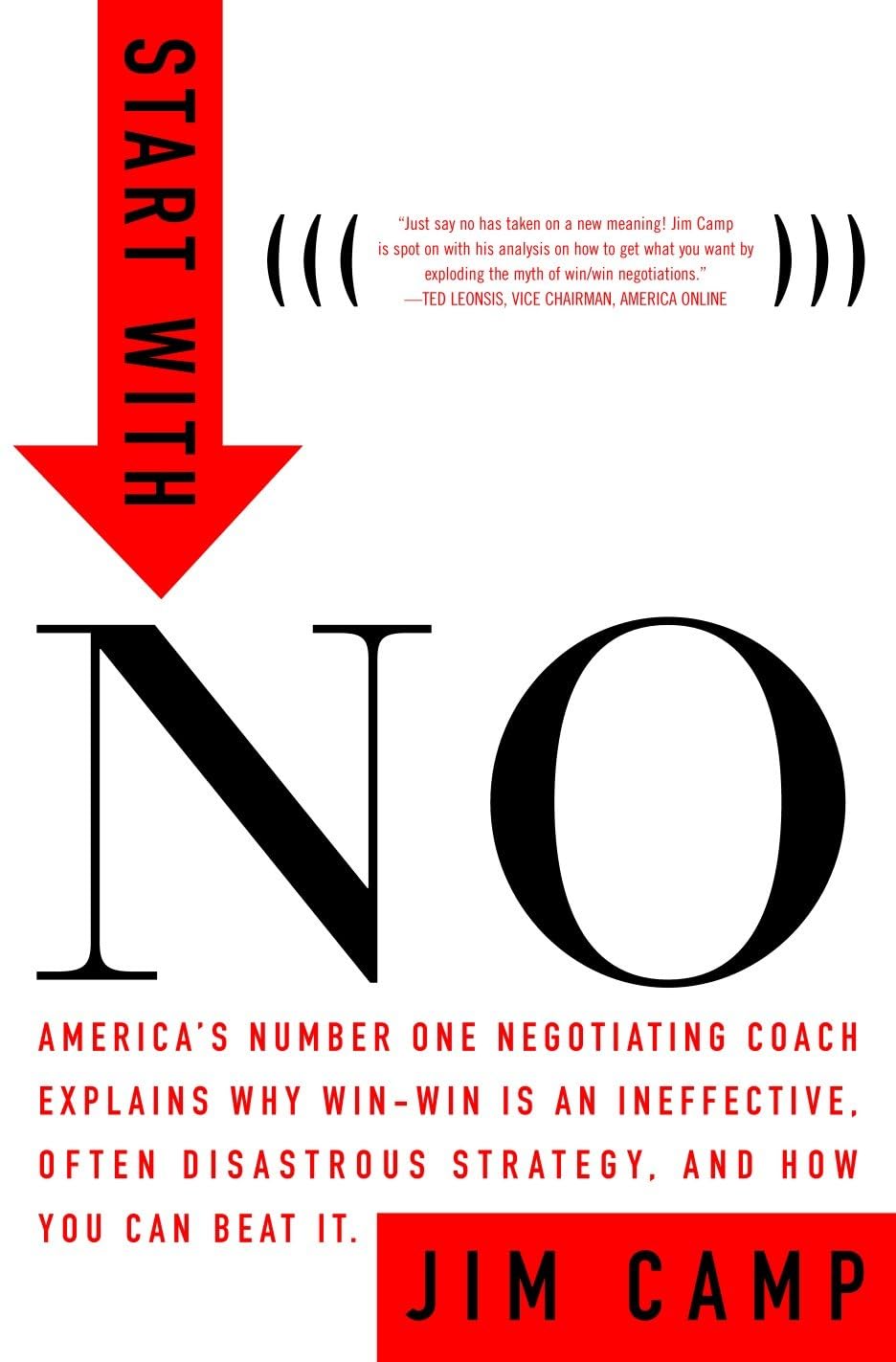
Start with No Book Summary
This Start with No Book Summary covers the key ideas, lessons, and takeaways in about 20 minutes.
Short Description:
Camp’s negotiation system wins by embracing “no” and emotional discipline.
If you chase agreement, you become vulnerable: you concede too early, accept vague terms, and telegraph neediness. But if you become comfortable with “no”—your own and theirs—you create safety, reduce pressure, and gain access to the truth underneath positions. “No” slows things down, forces clarity, and turns negotiations into problem-solving instead of approval-seeking.
Camp’s system can be summarized like this:
- Detach from outcome so you can think clearly.
- Use “no” to resist pressure and prevent rushed deals.
- Invite them to say “no” to lower defenses and get honest information.
- Ask simple, open-ended questions to uncover real needs and constraints.
- Control your investment so you can walk away without regret.
- Prepare agendas and identify decision-makers so you don’t negotiate in the dark.
When you do this, you don’t need tricks. You win by being the calmest person in the room—and by refusing to trade long-term value for short-term agreement.
Helps with these goals
Preview the Start with No book summary
Below is a preview of Sumizeit’s comprehensive human-written summary of Start with No by Jim Camp. The full summary is 15-20 minutes long and covers the book’s key ideas in text, audio, visual, and video formats. Unlock the full 20 Minute Summary
Jim Camp’s Start With No is built on a blunt observation: most negotiators are terrified of losing the deal, so they chase agreement the way a thirsty person chases water. They rush, compromise early, and accept vague terms because they mistake “getting to yes” for winning. Camp argues that this habit creates a steady stream of quietly bad outcomes—agreements that look fine on paper, feel friendly in the room, and then turn into resentment, scope creep, or regret later.
His solution is not to become aggressive or cold. It’s to become emotionally unhooked from the outcome and structurally prepared for the process. In Camp’s world, “no” is not an insult. It’s a stabilizer. It slows the negotiation down, removes pressure, and forces clarity. He wants you to become comfortable with refusal—your own and the other person’s—because comfort with “no” is the foundation of real leverage.
What makes Camp’s approach different is that he treats negotiation less like persuasion and more like decision-making under psychological stress. He assumes people don’t decide logically first—they decide emotionally and justify later. So the negotiator who can keep emotions low, ask the right questions, and avoid acting needy will consistently outperform the person who tries to be “reasonable” and collaborative too soon.
The “Win-Win” Trap: When Friendly Compromise Becomes Quiet Self-Sabotage
Camp challenges the almost sacred business idea that the best deal is one where both parties “meet in the middle.” He says win-win often becomes a social performance: both sides want to appear fair, so they concede in ways they didn’t need to.
Imagine you ask for $95,000 and the employer offers $80,000. A typical win-win response is: “Let’s split the difference at $87,500.” It feels mature. It feels fair. But Camp would ask: Why did you concede at all? Did they prove $80,000 is their max? Did you confirm the budget? Did you explore non-salary value (bonus, equity, review timeline, remote work, benefits)? You might have “won” a middle number while losing thousands more in total compensation because you moved first without understanding their constraints.
A freelancer quotes $6,000 for a project. The client says, “That’s a bit high—can you do $4,500?” A win-win reflex says, “How about $5,250?” Camp would say this is how people train clients to push. If you offer concessions before you even map the project’s true scope, timeline, and risk, you’re negotiating blind—and you’re teaching the other party that pressure works.
Camp’s deeper claim: fairness is not an objective measurement. People define fair based on their situation, emotions, and incentives. A client who’s under pressure may think “fair” means “as cheap as possible.” A candidate who’s anxious may think “fair” means “any job offer.” Win-win language can hide those mismatched definitions until after the contract is signed.
Why Speed Is Dangerous: Fast Agreements Create Invisible Landmines
Camp warns against treating “closing quickly” as a virtue. Quick deals often contain unstated assumptions—and assumptions are where most negotiations later break.
You agree fast on the…
Want the complete 20-minute summary?
- Full structured summary
- Video Summary
- Podcast Summary
- Audio summary
- Key takeaways
- Exercises
- Quiz
- Highlights and notes
- Ask the book with AI
Who should read Start with No?
Start with No is for anyone who negotiates regularly—salespeople, job seekers, business owners, freelancers, and leaders who struggle with giving ground too quickly or accepting bad deals to avoid conflict. If you find yourself rushing to agreement, second-guessing your terms, or feeling resentful after closing a deal, this book will reshape how you approach negotiation fundamentally.
Why does Start with No matter?
Most negotiators sabotage themselves by chasing "yes" instead of building strong agreements. Jim Camp's Start with No reveals why speed, friendliness, and compromise often create silent disasters—scope creep, regret, and broken trust that emerge months later. In a business world obsessed with "win-win," Camp's focus on emotional discipline and strategic refusal offers a counterintuitive path to genuinely better outcomes.
What are the key themes in Start with No?
- Emotional detachment as a negotiating asset
- The danger of neediness and how it signals weakness
- No as a tool for clarity rather than rejection
- Win-win rhetoric masking poor agreements
- Speed creates invisible problems and unstated assumptions
- Process discipline beats charm and collaboration
- Walking away as your greatest leverage
How can you apply ideas from Start with No?
- When you receive a salary offer, resist the urge to negotiate immediately—ask clarifying questions first to understand their budget, flexibility on benefits, and non-monetary options before moving on price.
- In vendor negotiations, instead of accepting the first pushback on price, ask what constraints (budget cycle, approval process, risk concerns) are driving their position so you can address root causes, not symptoms.
- When closing a contract, build in a brief delay before signing—use that time to surface unstated assumptions and confirm both parties have the same expectations on scope, timeline, and success metrics.
- Use silence strategically after quoting a price or presenting your position; resist the urge to fill the quiet with discounts or justifications—let them process and respond first.
- Before major negotiations, set limits on your time investment and decision criteria in advance (e.g., "I'll do two planning meetings, then we need commitment or I pause") so fatigue doesn't force concessions.
- Frame requests as invitations to say no—"Would it be a bad idea to try a shorter contract first?" instead of "Can you do a six-month term?"—to lower defensiveness and get honest feedback.
- When you hear no, respond with curiosity, not pushback—ask what specifically is the concern, then listen without offering concessions until you truly understand their constraint.
What common mistakes do readers make with Start with No?
- Moving first with a concession (e.g., offering to split the difference immediately) teaches the other side that pressure works and leaves thousands on the table.
- Treating speed as a virtue—rushing to close to feel relief—creates agreements with unstated assumptions that turn into resentment and conflict months later.
- Broadcasting neediness through fast speech, excessive politeness, or over-explaining—subtle signals that telegraph desperation and invite the other side to hold firm.
- Investing so much time and emotion upfront (free consulting, multiple revisions, weeks of meetings) that you feel trapped into accepting bad final terms to avoid wasting prior effort.
- Assuming win-win means both parties should concede equally, without first proving what each side's true constraints and alternatives are—leading to unnecessary compromise.
- Negotiating with messengers or blockers instead of identifying and engaging the actual decision-maker, resulting in wasted effort and fatigue-based capitulation.
Sumizeit Exercises Apply what you've learned
Turn ideas from Start with No into action with a short guided reflection: identify the biggest takeaway, connect it to your life, and commit to one step you can take in the next 24 hours.
What is the expert analysis of Start with No?
Overview
Start With No by Jim Camp stands as a provocative and counterintuitive contribution to negotiation literature. Camp, a seasoned negotiation coach and former U.S. Air Force pilot, challenges the prevailing orthodoxy that successful negotiation hinges on securing a quick "yes" or finding a win-win compromise. Instead, he advocates for embracing "no" as a strategic tool, emphasizing emotional detachment and process discipline over persuasion or friendliness. His approach, known as The Camp System of Negotiation, draws on decades of experience coaching professionals and corporate clients in high-stakes environments, making this work significant for those seeking a psychologically grounded, pragmatic framework for negotiation.
Core Thesis
Camp’s central argument is that the fear of rejection and the rush to agreement undermine negotiation outcomes. Rather than chasing premature consensus, negotiators should become comfortable with refusal—both their own and the counterpart’s—as a means to reduce pressure, clarify true needs, and gain leverage. Negotiation is reframed not as a battle of persuasion but as decision-making under psychological stress, where emotional control and structured inquiry unlock better deals. The willingness to say "no" functions as a protective firewall against neediness and poor concessions, transforming negotiation into a deliberate, calm process of problem-solving rather than approval-seeking.
Strengths
- Psychological Realism: Camp’s insight that decisions are made emotionally and justified logically resonates with contemporary behavioral research, providing a robust foundation for his methods.
- Practical Framework: The book offers actionable tactics such as inviting "no," controlling investment, and preparing agendas, which are immediately applicable and help negotiators maintain control.
- Rejection of Win-Win Myth: By exposing the pitfalls of premature compromise and the social performance of fairness, Camp challenges readers to rethink conventional wisdom that often leads to suboptimal outcomes.
- Emphasis on Emotional Discipline: Highlighting neediness as a costly emotional state and teaching how to mask or eliminate it addresses a subtle but critical dimension of negotiation dynamics.
- Use of Concrete Examples: Real-world scenarios—salary negotiations, vendor discounts, client contracts—illustrate principles vividly, enhancing comprehension and relevance.
Critiques & Counterarguments
- Potential Oversimplification of "No": While "no" can be a stabilizer, in some cultural or relational contexts it may be perceived as a hard stop, risking deadlock or damaged rapport. The book underplays the complexity of reading and responding to refusals in nuanced social environments.
- Limited Engagement with Collaborative Models: Camp’s skepticism toward "win-win" solutions may discount scenarios where mutual value creation and trust-building are not only possible but essential, such as long-term partnerships or team-based negotiations.
- Evidence Base: The book’s reliance on anecdotal and experiential evidence, rather than systematic empirical research, may limit its generalizability across diverse industries and cultures.
- Emotional Detachment Risks: Advocating emotional unhooking might lead some negotiators to appear aloof or uninvested, potentially undermining relationship capital critical in many negotiations.
- Competing Schools of Thought: Approaches like principled negotiation (Fisher and Ury) emphasize joint problem-solving and separating people from the problem, which can sometimes yield more sustainable agreements than Camp’s more guarded, process-controlled style.
Who Should Read This
Start With No is ideally suited for professionals engaged in high-stakes, complex negotiations where emotional pressure and asymmetrical information are prevalent. This includes sales executives, entrepreneurs, lawyers, procurement officers, and anyone who frequently negotiates contracts or deals under stress. Readers seeking to deepen their psychological insight into negotiation mechanics and develop a disciplined, process-oriented mindset will find Camp’s work invaluable. However, those looking for a collaborative, relationship-focused approach or empirical negotiation theory may need to supplement this book with other perspectives.
Frequently asked questions about the Start with No book summary
What is Start with No about?
Start with No by Jim Camp is a negotiation guide that challenges the popular "win-win" and "get to yes" frameworks. Camp argues that most negotiators sabotage themselves by chasing agreement too eagerly, which leads to rushed deals, vague terms, and quiet regret. Instead, he teaches emotional discipline, comfort with refusal, and a structured process focused on clarity—showing how the willingness to say no (and hear no) is the foundation of real negotiating power.
Who should read Start with No?
Anyone who negotiates regularly should read this book—salespeople, job seekers, business owners, freelancers, managers, and leaders. It's especially valuable if you struggle with giving ground too quickly, accepting deals you later resent, or feeling pressured to close before you understand the full picture. If you find yourself being too nice, too fast, or too eager to please in negotiations, this book will reshape your approach.
What are the main takeaways from Start with No?
The core takeaways are: (1) detach emotionally from the outcome and control the process instead of chasing yes; (2) use no—your own and theirs—to slow things down, prevent pressure, and force clarity; (3) avoid neediness at all costs, as it signals weakness and undermines your position; (4) convert needs into wants so you appear calm and have real alternatives; (5) set investment limits upfront so fatigue doesn't force bad compromises; (6) prepare with clear agendas and identify true decision-makers; and (7) focus on their stakes and losses, not your desperation, to build real leverage.
How does Jim Camp define the win-win trap?
Camp argues that win-win language often masks poor agreements. When both parties feel pressure to appear fair and collaborative, they concede unnecessarily without proving the other side's real constraints. Two people meeting in the middle may both be giving away more than needed, leaving value on the table. Camp says fairness is subjective—defined by the person's situation and emotions—so splitting differences often means both sides compromise when the right structure could satisfy both at different points.
Why does Jim Camp say speed in negotiations is dangerous?
Fast agreements replace specificity with assumptions. When people close quickly—because they're afraid to lose the deal or eager to feel relief—they leave critical details unstated. Those unstated expectations (about scope, timeline, repairs, deliverables, etc.) later become conflict when both parties realize they had different pictures. Camp teaches that slowing down and forcing clarity prevents the invisible landmines that explode into resentment and regret.
What does Jim Camp mean by converting needs into wants?
Camp suggests reframing your internal story. Instead of "I need this job" (which narrows your options and triggers desperation), shift to "I want this job, but I can survive without it" or "I have other options." This psychological shift makes you appear calmer, more credible, and less willing to accept bad terms. It doesn't mean you don't care—it means you're not hostage to any single outcome, which paradoxically increases your actual leverage.
How can I use silence as a negotiating tool according to Start with No?
After you quote a price, present an offer, or say no, stay quiet and let them respond first. Silence communicates confidence and forces the other person to fill the gap—often with information or concessions. Many people panic in silence and start discounting or over-explaining, which undermines their position. Camp teaches that comfort with silence is a sign of emotional discipline and shifts the pressure onto the other side.
What does Camp mean by inviting someone to say no?
Instead of asking "Does this work for you?" (which pushes them to commit), Camp prefers questions like "Would it be a bad idea to explore this?" or "Do you want to say no to that?" When people feel permission to refuse, they relax, feel more in control, and often become more willing to talk openly. Permission triggers honesty; pressure triggers defensiveness. Getting them to say no early can actually open deeper conversation than pushing for yes.
About Sumizeit
Sumizeit is a profitable Scomy LLC company based in Miami, Florida. Our founders, Clemens Raemy and Weina Scott, are successful entrepreneurs with several exits. Sumizeit is a popular book summary app / micro learning app used by busy professionals and entrepreneurs with over 2,500 non-fiction book summaries and 10,000 podcast summaries in text, audio, visual, podcast, and video format. We also have stellar retention tools to make ideas stick - such as flashcards with spaced repetition, quizzes, streaks, highlighting and notes, daily challenges, riddles, mini-courses, meditation, and more. You won't only learn the idea, but also remember it. Over 90% of our users change their habits with Sumizeit.
Upgrade Now
Here's why readers love Sumizeit
Join thousands of learners getting smarter every day
"Great experience. Detailed summaries. Loved the gamification feature. Makes learning fun. Good customer service. I recommend Sumizeit to anyone. You'll learn a lot."
"I always felt busy but still wanting to keep up with the book discussion in my friend group. This was a great supplement to help me keep reading the books I find fun while keeping up with important books."
"I love this website. Instead of scrolling social media, I find myself learning a lot. I use it everyday. I recommend this app for anyone who is too busy and wants to get up to speed with their favorite books."
Start with No Book Summary PDF
Looking for a Start with No Book Summary PDF you can save and revisit offline? Our Start with No Book Summary PDF captures the book’s core ideas in a clean, printable format — the key frameworks, takeaways, and structure without the fluff. Download the Start with No Book Summary PDF when you want a reference you can annotate, share with your team, or review on the go. Get your Start with No Book Summary PDF from the download page below.
Download Start with No Book Summary PDFPeople also liked these summaries
Readers who explored Start with No often enjoyed these titles next.


Ready to read the whole thing?
- Full structured summary
- Video Summary
- Podcast Summary
- Audio summary
- Key takeaways
- Exercises
- Quiz
- Highlights and notes
- Ask the book with AI
Featured Book Titles
Popular Book Summaries at sumizeit, leading book summary app