


As an Amazon Associate, Sumizeit earns from qualifying purchases.
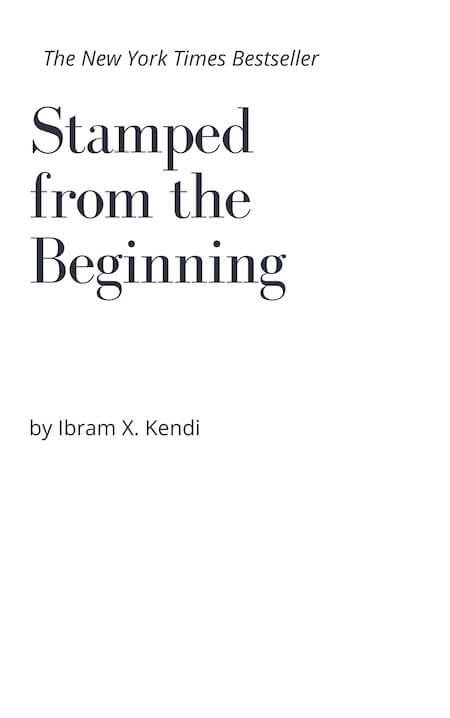
Stamped From the Beginning Book Summary
This Stamped From the Beginning Book Summary covers the key ideas, lessons, and takeaways in about 20 minutes.
Although there are many who believe America’s racist tendencies are in its past, its ideologies continue to live on in today’s society. The election of a Black president does not absolve America of all racial injustices.
The use of racial rhetoric by politicians and lawmakers has had a direct impact on Black communities. The War on Drugs and mass incarcerations continue to have lasting impacts. The justice system disproportionately harms Blacks.
Willful ignorance of the disparities is part of the problem. Critical readings of policies and statistics are essential. Until institutional racism in America is properly addressed, racial inequalities will continue.
Helps with these goals
Want the complete 20-minute summary?
- Full structured summary
- Video Summary
- Podcast Summary
- Audio summary
- Key takeaways
- Exercises
- Quiz
- Highlights and notes
- Ask the book with AI
What is in the Stamped From the Beginning book summary?
Below is a preview of Sumizeit’s expert-written summary of Stamped From the Beginning by Ibram X. Kendi. The full summary covers the book’s key ideas in text, audio, and video.
At the start of 2008, many people believed racism in America had come to an end. With the election of President Barack Obama, there was a belief that this was proof of a new beginning in America’s history.
However, the underlying foundations of America have been built upon racism and discrimination. These practices cannot simply die out with the election of one man.
As politicians from both parties continue to chase the racist vote, the negative impacts on Black communities continue. The practice of false narratives and skewing of statistical data has created an ingrained prejudice that is not easy to erase.
Racism, overt or implicit, is used for political appeals.
Imagine you are watching a movie and the main character has just entered a dangerous neighborhood. What would that neighborhood look like? More specifically what would the people look like in this dangerous neighborhood?
In all likelihood, they would not be white. The fact is that the common perception of a dangerous neighborhood in America is one that is predominantly Black, even though statistics prove this is not the case. It is a false narrative.
In recent history, American political campaigns have relied on unspoken racism to appeal to voters. By portraying Black neighborhoods as dangerous places, they speak to unfounded fears in the hope to gain the white voter who believes that Black neighborhoods are somehow much worse than white ones.
This technique has been used by numerous politicians from both parties over the years. You might wonder why it is so successful. The answer is that it speaks to the views that many white Americans hold without realizing they are racist.
By building upon these fears, political campaigns have successfully created an image of Black America that supports these views. What this means to you is that by creating fear of a community, presidents and politicians hope to get the vote of white America.
Policies from the Reagan administration continue to disproportionate impact Blacks.
During the 1980s President Reagan created policies and economic plans that severely impacted middle and low-income families. You may not realize it, but the impact of those policies is still being felt today.
Significant cuts to social programs as a way to balance tax cuts for higher incomes were devastating to many families who relied on them. If you were from a middle or low-income family, you experienced a significant drop to your income. Black families were some of the hardest hit.
When the administration began its war on drugs it was during a time when drug-related crimes were relatively low. Nevertheless, the campaign continued and by the middle of the 1980s it was apparent there was a racial bias in who was prosecuted.
If you were a Black American in 1986 you were experiencing higher unemployment rates than white Americans. In addition to this, you were more likely to be prosecuted for narcotics abuse than white Americans. Your chances of achieving the American dream under the Reagan administration were severely limited.
Mass…
Want the complete 20-minute summary?
- Full structured summary
- Video Summary
- Podcast Summary
- Audio summary
- Key takeaways
- Exercises
- Quiz
- Highlights and notes
- Ask the book with AI
Who should read Stamped From the Beginning?
Stamped From the Beginning is essential for anyone seeking to understand the historical roots and ongoing reality of racism in America. This book speaks to educators, policymakers, activists, and informed citizens who recognize that contemporary racial disparities cannot be separated from systemic policies and political strategies spanning decades. Whether you're new to studying American racial history or looking to deepen your understanding, Kendi's work provides crucial context for recognizing how racism has been deliberately constructed and maintained.
Why does Stamped From the Beginning matter?
In a society where many believe racism belongs to the past, Stamped From the Beginning reveals that racial inequality remains embedded in American institutions and political discourse today. Kendi demonstrates how policies from Reagan through Clinton—and the rhetoric that justified them—continue to shape Black communities, making this historical analysis vital for understanding current disparities in criminal justice, economics, and political representation. Understanding this history is essential for anyone committed to addressing systemic racism rather than ignoring or denying its existence.
What are the key themes in Stamped From the Beginning?
- Racism as a deliberate political tool rather than an accident of history
- How statistics and narratives are manipulated to create false justifications for racial bias
- The lasting impact of the War on Drugs and mass incarceration on Black communities
- The myth of colorblindness and why ignoring race perpetuates inequality
- Economic disparities rooted in discriminatory policies, not individual responsibility
- Police presence and prosecution disparities as reflections of systemic racism
What are the key lessons from the Stamped From the Beginning book summary?
Racism is structural, not accidental
Racism has been deliberately embedded into American institutions through policy decisions, not simply inherited from the past. Understanding racism as a constructed system clarifies why electing a Black president does not eliminate racial inequality.
Political campaigns exploit racial fears strategically
Politicians from both parties have used implicit and explicit racial rhetoric to appeal to white voters by portraying Black neighborhoods as inherently dangerous. This tactic has remained remarkably consistent across decades and administrations.
Statistics can be weaponized to support false narratives
The same data can tell different stories depending on how it is presented and contextualized. Higher arrest rates in Black neighborhoods reflect police presence, not higher crime rates, yet this distinction is often obscured in political messaging.
Reagan-era policies created cascading harm
Cuts to social programs combined with the War on Drugs disproportionately devastated Black families and communities in ways that continue to impact outcomes today. These policies were not race-neutral economic decisions but targeted attacks on vulnerable populations.
Mass incarceration perpetuates political disadvantage
The prison system not only removes Black Americans from communities but also strips them of voting rights, preventing them from voting for policy changes that would address their circumstances. This creates a self-reinforcing cycle of political powerlessness.
Crack versus powder cocaine enforcement reveals racial bias
The disparities in prosecution and sentencing between crack and powder cocaine offenses expose how the justice system applied different standards based on which drug was associated with Black versus white users. Drug use rates were nearly equal, but Black offenders received sentences at double the rate of white offenders.
Media representation shapes public perception and policy
News stories portraying Black Americans as criminals and drug addicts were not reflections of reality but propaganda that justified discriminatory policies. These narratives became the basis for continued political appeals and public support for harmful legislation.
Personal responsibility rhetoric masks systemic failure
The argument that Black Americans should simply work harder ignores the structural barriers created by discriminatory policies and unequal resource distribution. This framing allows systemic racism to be rebranded as individual shortcoming.
Colorblindness perpetuates inequality
The idea that ignoring race eliminates racism is itself a form of racial bias that prevents meaningful discussion of disparities. By refusing to acknowledge race, society allows racist systems to continue operating without scrutiny.
Crime is driven by economics, not race
Dangerous neighborhoods are products of economic disinvestment and inequality, not racial characteristics. The conflation of race with danger obscures the true root causes and misdirects solutions.
Black neighborhoods face reduced investment due to false stigma
The perception of Black neighborhoods as dangerous reduces property values and attracts less investment, creating actual economic disparities that reflect the imposed stigma rather than inherent characteristics. This becomes a self-fulfilling prophecy.
Bias in sentencing reveals systemic racism in action
When identical or similar drug offenses result in different sentences based on the race of the offender, the injustice is undeniable. The criminal justice system did not apply rules equally, demonstrating deliberate racial discrimination.
Implicit bias operates alongside explicit racism
Even when overt racism is not stated, unconscious racial prejudices shape decisions in politics, law enforcement, and policy-making. Both explicit and implicit forms of racism have been mobilized for political gain.
Three-strikes legislation targeted Black communities disproportionately
Policies designed to reduce crime through harsh sentencing for repeat offenders ended up mass-incarcerating Black Americans for nonviolent offenses at rates far exceeding those of white offenders convicted of similar crimes.
Democratic and Republican tactics on race are fundamentally similar
While approaching the issue from different angles, both major political parties have employed racial rhetoric and policies that harm Black communities, showing that racism is not isolated to one party but embedded in American politics broadly.
Recognizing racism requires critical analysis of history
Surface-level understanding of American history misses how racial inequality was deliberately created and maintained. Critical examination of policies, their effects, and their justifications is necessary to understand how racism operates.
Disparities in arrest rates reflect policy choices, not crime rates
Increased police presence in certain neighborhoods leads to more arrests in those areas, creating data that appears to validate targeting them with more enforcement. This circular logic has perpetuated racial disparities in the criminal justice system.
Historical racism cannot be erased by symbolic representation
One Black president or successful Black individual does not dismantle systems that continue to disadvantage the Black community as a whole. Symbolic progress obscures the persistence of structural inequality.
Willful ignorance of disparities enables their continuation
Refusing to acknowledge or discuss racial disparities is not neutrality but complicity. Addressing racism requires actively learning about and confronting how it operates in current systems and policies.
Understanding racism requires examining power and policy, not just ideology
Racism is not merely a matter of individual prejudice but a system of power maintained through laws, policies, and institutions. Addressing it requires structural change, not individual attitude adjustment alone.
Want the complete 20-minute summary?
- Full structured summary
- Video Summary
- Podcast Summary
- Audio summary
- Key takeaways
- Exercises
- Quiz
- Highlights and notes
- Ask the book with AI
How can you apply ideas from Stamped From the Beginning?
- Evaluate statistical claims made in political campaigns and media by asking who is being policed or prosecuted more heavily, and whether enforcement disparities reflect actual behavioral differences or selective targeting
- Examine local criminal justice statistics and sentencing data to assess whether similar crimes receive similar sentences across racial groups, and advocate for reform where disparities exist
- Research the origins of current neighborhood conditions and crime rates by examining historical disinvestment policies rather than accepting present-day circumstances as inevitable
- Question narratives about dangerous communities by examining police presence patterns and arrest rates in context, recognizing that enforcement intensity shapes data interpretation
- Advocate for policy changes that address root economic causes of crime and neighborhood decline rather than supporting harsh enforcement that perpetuates mass incarceration
- Teach others to recognize how media portrayals of different racial groups shape unconscious biases and voting behavior, building critical media literacy
- Support organizations and politicians that actively address systemic racism rather than those who claim colorblindness or deny that racism persists in modern America
What common mistakes do readers make with Stamped From the Beginning?
- Believing that the election of a Black president or the absence of explicit racial slurs signals that racism has been solved or is no longer a significant problem in America
- Accepting crime statistics at face value without considering how police presence, prosecution decisions, and sentencing disparities shape what data represents
- Attributing racial disparities primarily to cultural or individual failures while ignoring the specific policies and systemic barriers that created those disparities
- Assuming that being colorblind or race-neutral is progressive, when in fact ignoring race prevents meaningful discussion of how racism operates through institutions and policies
- Viewing racism as a relic of the distant past rather than recognizing how specific 20th-century policies continue to shape contemporary inequality in criminal justice, economics, and politics
Sumizeit Exercises Apply what you've learned
Turn ideas from Stamped From the Beginning into action with a short guided reflection: identify the biggest takeaway, connect it to your life, and commit to one step you can take in the next 24 hours.
What is the expert analysis of Stamped From the Beginning?
Overview
Stamped From the Beginning is a seminal work by Ibram X. Kendi, an acclaimed historian and scholar in African American studies. Kendi’s expertise and academic rigor, combined with his role as founding director of the Boston University Center for Antiracist Research, position him uniquely to dissect the enduring legacy of racism in America. The book’s significance lies in its comprehensive historical narrative that traces the evolution of racist ideas from the nation’s inception to contemporary times, challenging the pervasive myth that racism is a relic of the past.
Core Thesis
Kendi’s central argument is that racism is not merely a series of isolated incidents or outdated prejudices but a deeply embedded and persistent force in American society. He contends that racist ideas have been deliberately constructed and weaponized to justify discrimination and maintain power structures. Political actors across the spectrum have exploited these ideas to garner support, often by perpetuating false narratives about Black communities. The book asserts that systemic racism continues to shape policies, social attitudes, and institutional practices, making the election of a Black president insufficient to eradicate racial inequality.
Strengths
- Historical Depth and Scholarly Rigor: Kendi meticulously chronicles centuries of racist ideology, grounding his analysis in extensive historical evidence that connects past and present.
- Interdisciplinary Approach: The book synthesizes insights from history, politics, sociology, and economics, providing a holistic understanding of racism’s multifaceted nature.
- Clarity in Exposing False Narratives: Kendi effectively deconstructs common misconceptions, such as the portrayal of Black neighborhoods as inherently dangerous, illustrating how these myths serve political ends.
- Relevance to Contemporary Issues: By linking historical policies like the War on Drugs and Reagan-era reforms to ongoing disparities in incarceration and voting rights, the book offers critical context for current debates on racial justice.
- Engaging and Accessible Prose: Despite its scholarly foundation, the narrative remains accessible to a broad audience without sacrificing complexity.
Critiques & Counterarguments
- Potential Oversimplification of Political Motivations: While Kendi highlights bipartisan complicity in racialized politics, some critics argue that the book occasionally reduces complex political dynamics to a singular focus on racism, overlooking other factors such as economic interests or ideological differences.
- Limited Engagement with Counter-Narratives: The book might benefit from a more nuanced discussion of perspectives that emphasize individual agency or cultural factors within Black communities, which some scholars argue also influence social outcomes.
- Debate over the Role of “Colorblindness”: Kendi critiques the notion of being “blind to race” as a form of denial that perpetuates racism. However, some philosophical and psychological schools advocate for colorblind policies as a means to reduce bias, suggesting a contested terrain that the book could explore more fully.
- Competing Research on Crime and Economics: While Kendi attributes crime rates primarily to economic conditions rather than race, alternative research emphasizes the interplay of cultural, familial, and community factors, indicating that the causes of crime are multifactorial and resist singular explanations.
- Historical Evolution of Racial Attitudes: Some historians might argue that the book underrepresents progress made over time and the complexity of shifting racial attitudes, which could provide a more balanced view of change alongside continuity.
Who Should Read This
This book is essential reading for scholars, students, and practitioners in history, sociology, political science, and African American studies seeking a rigorous and comprehensive examination of racism’s roots and persistence in America. It is also invaluable for policymakers, activists, and informed citizens committed to understanding systemic inequality and crafting informed responses. Those interested in the intersections of race, politics, and social justice will find Kendi’s work both enlightening and challenging, offering a vital framework for confronting entrenched racial disparities.
Frequently asked questions about the Stamped From the Beginning book summary
What is Stamped From the Beginning about?
Stamped From the Beginning by Ibram X. Kendi is a historical examination of how racism has been deliberately constructed and maintained throughout American history. The book traces racist policies and political strategies from the Reagan era forward, revealing how mass incarceration, the War on Drugs, and manipulated statistics have been used to perpetuate racial inequality and mobilize political power. Kendi argues that racism remains embedded in American institutions today despite common beliefs that it belongs only to the past.
Who should read Stamped From the Beginning?
Anyone seeking to understand the historical roots of contemporary racial disparities should read this book, including educators, policymakers, activists, and informed citizens. It is particularly valuable for those who believe racism is solved, who work in criminal justice or policy, or who want to move beyond surface-level understanding of American racial history. The book serves both newcomers to racial justice studies and those deepening existing knowledge.
What are the main takeaways from Stamped From the Beginning?
The main takeaways are that racism is structural and deliberately maintained through policies rather than accidental or historical, that politicians exploit racial fears and statistics to gain power, that the War on Drugs and mass incarceration have devastated Black communities in lasting ways, and that denying or ignoring racism perpetuates it. Kendi emphasizes that symbolic progress like electing a Black president does not dismantle systemic racism, and that meaningful change requires critically examining institutions and policies.
How does Stamped From the Beginning explain mass incarceration?
Kendi traces mass incarceration to deliberate policy choices beginning with Reagan's War on Drugs, which targeted Black communities despite nearly equal drug use rates across racial groups. He shows how Black offenders received prison sentences at twice the rate of white offenders for similar crimes, how the three-strikes rule disproportionately imprisoned Black Americans, and how incarceration strips prisoners of voting rights, preventing them from voting for change. The book reveals mass incarceration as a tool of political control, not a neutral response to crime.
What does Stamped From the Beginning say about statistics and crime?
Kendi argues that statistics can be manipulated to support false narratives about crime and Black communities. Higher arrest rates in Black neighborhoods reflect police presence rather than higher crime rates, yet this distinction is obscured in political messaging. He demonstrates that the same data can tell completely different stories depending on contextualization, and that this manipulation has justified policies that perpetuate racial disparities while appearing to be based on objective facts.
How does Stamped From the Beginning address colorblindness?
Kendi critiques colorblindness as a form of racial bias that prevents meaningful discussion of racism rather than solving it. He argues that ignoring race allows racist systems to continue operating without scrutiny or challenge, and that true progress requires actively acknowledging and addressing how race shapes access to resources, justice, and opportunity. The book shows that colorblindness is complicity rather than neutrality.
What does the book say about the War on Drugs?
Stamped From the Beginning traces the War on Drugs from Reagan through Clinton, showing how it was pursued with racist intentions and effects despite relatively low drug crime rates when it began. The book documents how this campaign led to disproportionate prosecution of Black Americans, created false media narratives about Black drug addiction, and established mass incarceration as the primary response to drug use. Kendi shows this legacy continues affecting Black communities today through ongoing criminal justice disparities.
Does Stamped From the Beginning argue that both political parties are complicit in racism?
Yes, Kendi demonstrates that both Democratic and Republican politicians have employed racial rhetoric and policies that harm Black communities, showing that racism is not isolated to one party but embedded in American politics broadly. He traces racist tactics across multiple administrations of both parties, revealing that while their approaches differ, both have mobilized racial fear and inequitable policies for political gain. This shows systemic racism transcends party affiliation.
About Sumizeit
Sumizeit is a profitable Scomy LLC company based in Miami, Florida. It has been helping readers learn from nonfiction books for 7 years with expert-written summaries in text, audio, podcast, and video.
Want the complete 20-minute summary?
- Full structured summary
- Video Summary
- Podcast Summary
- Audio summary
- Key takeaways
- Exercises
- Quiz
- Highlights and notes
- Ask the book with AI
Here's why readers love Sumizeit
Join thousands of learners getting smarter every day
"Great experience. Detailed summaries. Loved the gamification feature. Makes learning fun. Good customer service. I recommend Sumizeit to anyone. You'll learn a lot."
"I always felt busy but still wanting to keep up with the book discussion in my friend group. This was a great supplement to help me keep reading the books I find fun while keeping up with important books."
"I love this website. Instead of scrolling social media, I find myself learning a lot. I use it everyday. I recommend this app for anyone who is too busy and wants to get up to speed with their favorite books."
Stamped From the Beginning Book Summary PDF
Looking for a Stamped From the Beginning Book Summary PDF you can save and revisit offline? Our Stamped From the Beginning Book Summary PDF captures the book’s core ideas in a clean, printable format — the key frameworks, takeaways, and structure without the fluff. Download the Stamped From the Beginning Book Summary PDF when you want a reference you can annotate, share with your team, or review on the go. Get your Stamped From the Beginning Book Summary PDF from the download page below.
Download Stamped From the Beginning Book Summary PDFPeople also liked these summaries
Readers who explored Stamped From the Beginning often enjoyed these titles next.



Want the complete 20-minute summary?
- Full structured summary
- Video Summary
- Podcast Summary
- Audio summary
- Key takeaways
- Exercises
- Quiz
- Highlights and notes
- Ask the book with AI
Featured Book Titles
Popular Book Summaries at sumizeit, leading book summary app