


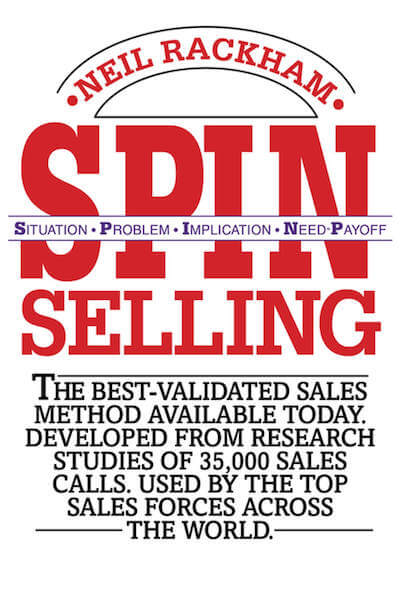
Prefer the print book? Buy on Amazon
As an Amazon Associate, Sumizeit earns from qualifying purchases.
Spin Selling Book Summary
This Spin Selling Book Summary covers the key ideas, lessons, and takeaways in about 20 minutes.
Short Description:
SPIN Selling teaches asking questions to uncover needs and close sales.
Helps with these goals
Preview the Spin Selling book summary
Below is a preview of Sumizeit’s comprehensive human-written summary of Spin Selling by Neil Rackham. The full summary is 15-20 minutes long and covers the book’s key ideas in text, audio, visual, and video formats. Unlock the full 20 Minute Summary
Business is complicated.
And, making sales is not always a piece of cake.
But, with the help of Neil Rackham and his SPIN method, you could be closing deals left and right!
“SPIN Selling” is a book designed to help you ask the right questions in order to secure a sale and put more money into your bank account. Rackham insists that you must begin a sale on the right foot. And, with his method, you are bound for success from the start!
“Successful people ask a lot more questions during sales calls than do their less successful colleagues. We found that these less successful people tend to do most of the talking.”- Neil Rackham
This is what you need to know about the SPIN method that will help you seal deals with confidence and grace!
Four Stages Of A Sales Pitch
Every sales pitch has four stages that work together to secure a sale. These steps are…
Now, think of these four stages in terms of selling candy bars for a baseball team fundraiser in order to raise money for new jerseys. The preliminary would be explaining that you are helping the baseball to sell candy bars, the demonstration would be giving the customer a free sample, and the commitment would be getting the customer to purchase the candy.
But, where is the investigation aspect? If you use an investigating hook such as in this example, “Aren’t you hungry?” it cuts out the extra stages and secures the sale that much sooner.
What Makes A Successful Sales Strategy?
Many people may think that closing a deal is what makes it successful. However, the strategy is where the success lies.
A popular closing technique is asking the customer a question about the use or delivery of the product before they have agreed to buy it. For example, “When would you like us to install it?”. This technique works with items that are lower priced and not life changing, such as a washing machine or a printer.
However, this is a bad move when faced with a big deal such as a car or a house because the readiness may deter clients. Those bigger deals take more for the client to think over and salespeople should be respectful of that.
The sales strategy must be well thought-out. And, big sales sometimes take longer than small sales and require many steps such as phone calls and emails.
Help Your Customer
A lot of times when people are set out to buy something, they are not quite sure what they need. Say, you’re in the market for a computer. Wouldn’t it be helpful to have a salesperson assist you and help you find exactly what you need for the tasks you need to complete?
Salespeople must know their customers. When a customer comes in saying they think they would like a bigger screen because it will be easier for them to see, make it a priority.
Want the complete 20-minute summary?
- Full structured summary
- Video Summary
- Podcast Summary
- Audio summary
- Key takeaways
- Exercises
- Quiz
- Highlights and notes
- Ask the book with AI
Who should read Spin Selling?
SPIN Selling is essential for sales professionals, business development managers, and anyone responsible for closing complex or high-value deals. Whether you're new to sales or looking to refine your approach, this book teaches a methodology proven to work across industries and deal sizes. It's particularly valuable for those who want to move beyond aggressive closing techniques and instead build genuine customer relationships.
Why does Spin Selling matter?
In today's competitive market, customers are more informed and skeptical than ever, making outdated hard-sell tactics ineffective and counterproductive. Neil Rackham's SPIN method, backed by research on 35,000 sales calls, provides a science-based framework that works in complex B2B environments where deals take longer and involve multiple decision-makers. Understanding how to ask the right questions rather than push features can dramatically improve your close rates and customer satisfaction simultaneously.
What are the key themes in Spin Selling?
- The power of strategic questioning over talking
- Understanding customer needs before presenting solutions
- Building trust through consultative selling
- Tailoring benefits to individual customer situations
- Prevention of objections through proper discovery
- Balancing formality and approachability in sales conversations
How can you apply ideas from Spin Selling?
- Prepare discovery questions aligned to the SPIN framework before every sales call to guide conversations intentionally
- Create a benefits matrix for your product that maps each feature to multiple customer scenarios and priorities
- Practice rephrasing customer objections as clarifying questions to uncover the real concern beneath the surface
- Document your customer's situation in writing during or immediately after discovery calls to ensure you're tailoring your pitch accurately
- Adjust your closing approach based on deal complexity and value rather than using the same technique for all sales
- Build a library of implication questions specific to your industry that help customers recognize the consequences of their problems
- Role-play the SPIN method with colleagues to develop fluency and confidence in asking follow-up questions
What common mistakes do readers make with Spin Selling?
- Focusing on product features and advantages rather than translating them into customer-specific benefits
- Talking more than listening, especially early in the sales process when understanding is critical
- Using assumptive closing techniques prematurely on complex deals, which can alienate rather than convert
- Failing to develop customer dissatisfaction adequately, leaving them unmotivated to change from their current situation
- Skipping the investigation stage and jumping straight to demonstrations, missing the opportunity to uncover real needs
Sumizeit Exercises Apply what you've learned
Turn ideas from Spin Selling into action with a short guided reflection: identify the biggest takeaway, connect it to your life, and commit to one step you can take in the next 24 hours.
What is the expert analysis of Spin Selling?
Overview
Spin Selling by Neil Rackham stands as a seminal work in the domain of sales methodology, distinguished by its empirical foundation and practical orientation. Rackham, a psychologist and seasoned researcher, revolutionized sales theory through a comprehensive study of over 35,000 sales calls across multiple countries, culminating in a method that transcends traditional, often anecdotal sales advice. His academic rigor and consultancy experience lend the book both credibility and applicability, making it a cornerstone text for professionals seeking to refine their consultative selling skills in complex, high-value transactions.
Core Thesis
At the heart of Spin Selling lies the argument that successful selling is less about aggressive closing tactics and more about strategic questioning and understanding customer needs. Rackham introduces the SPIN acronym—Situation, Problem, Implication, and Need-Payoff—as a structured framework to guide sales conversations. This method prioritizes diagnosing the customer’s context and challenges before demonstrating how a product or service can deliver tailored benefits, thereby facilitating a more natural and effective path to closing sales, especially in complex or high-stakes environments.
Strengths
- Empirical Foundation: The book’s strength is its data-driven approach, grounded in extensive research rather than intuition or anecdote, which lends robustness to its claims.
- Structured Framework: The SPIN model provides a clear, replicable process that sales professionals can internalize and apply systematically.
- Focus on Consultative Selling: By emphasizing understanding customer needs and guiding them through problem recognition, Rackham elevates the salesperson’s role to that of a trusted advisor rather than a mere vendor.
- Applicability to Complex Sales: The method is particularly well-suited to high-value, multi-step sales processes where building rapport and trust is essential.
- Practical Guidance: The book offers actionable advice on everything from opening lines to handling objections, making it a comprehensive manual for sales practitioners.
Critiques & Counterarguments
- Potential Oversimplification: While the SPIN framework is elegant, some critics argue it may understate the nuanced interpersonal dynamics and emotional intelligence required in real-world sales interactions.
- Limited Scope for Transactional Sales: The method is less applicable to quick, low-stakes sales where extensive questioning may be impractical or unwelcome.
- Evolution of Buyer Behavior: Since its publication, buyer behavior has evolved with digital transformation and information accessibility, potentially diminishing the relative advantage of salesperson-led questioning.
- Competing Sales Methodologies: Alternative frameworks such as Challenger Sale or Solution Selling emphasize assertiveness and insight-driven selling, which sometimes conflict with SPIN’s consultative questioning approach.
- Empirical Context: The original research, while extensive, was conducted decades ago; shifts in market dynamics and cultural differences may limit universal applicability.
Who Should Read This
Spin Selling is essential reading for sales professionals engaged in complex, consultative, or high-value transactions who seek a methodical approach to understanding and addressing client needs. It is equally valuable for sales managers and trainers aiming to instill a disciplined sales process within their teams. Additionally, business strategists and entrepreneurs interested in the psychology of persuasion and customer engagement will find Rackham’s insights illuminating. However, those focused primarily on transactional or low-cost sales may find the approach less directly relevant.
Frequently asked questions about the Spin Selling book summary
What is Spin Selling about?
SPIN Selling by Neil Rackham is a sales methodology book that teaches a structured approach to consultative selling. The SPIN acronym stands for Situation, Problem, Implication, and Need-Payoff—four types of strategic questions that help salespeople uncover customer needs and drive deals forward. The book is grounded in Rackham's 12-year research study of 35,000 sales calls across multiple countries.
Who should read Spin Selling?
Sales professionals, business development managers, and anyone involved in complex or high-value deal negotiations should read SPIN Selling. It's valuable for both experienced salespeople looking to refine their approach and new sales professionals seeking a proven framework. The methodology is particularly effective in B2B environments where sales cycles are longer and customer relationships are crucial.
What are the main takeaways from Spin Selling?
The main takeaways are: successful sellers ask more questions and listen more than unsuccessful ones; every sale follows four stages that can be deliberately structured; the SPIN questioning framework uncovers real customer needs more effectively than traditional closing techniques; benefits tailored to individual customers drive decisions better than features; and prevention of objections through thorough discovery is more effective than handling resistance reactively.
How does the SPIN method improve sales performance?
The SPIN method improves performance by shifting from aggressive selling to consultative partnership. By asking strategic questions aligned to Situation, Problem, Implication, and Need-Payoff, salespeople uncover genuine customer motivations and build trust. This approach reduces objections, increases deal sizes, and creates stronger customer relationships, all of which correlate directly with higher close rates.
What's the difference between advantages and benefits in SPIN Selling?
Advantages are general features or broad appeals of a product (like saving money or convenience), while benefits are specific outcomes tailored to an individual customer's unique situation and priorities. Benefits are far more persuasive because they directly address what matters to that particular customer, whereas advantages are generic statements that could apply to anyone.
Why does SPIN Selling recommend preventing objections instead of overcoming them?
Preventing objections is more efficient and effective than trying to overcome them after they arise. By thoroughly exploring customer needs through SPIN questions and focusing on tailored benefits rather than features, salespeople reduce resistance before it forms. When objections do emerge, they're easier to address because the foundation of trust and understanding is already established.
Can SPIN Selling work for small deals or just large ones?
SPIN Selling works for both, but the depth of application varies. For smaller, lower-risk purchases, you may move through the stages quickly and use assumptive closing techniques effectively. For larger or more complex deals, the SPIN method shines because it respects the customer's need for thorough evaluation and builds the relationship foundation necessary for significant commitments. Neil Rackham emphasizes adapting your approach to the deal's size and stakes.
About Sumizeit
Sumizeit is a profitable Scomy LLC company based in Miami, Florida. Our founders, Clemens Raemy and Weina Scott, are successful entrepreneurs with several exits. Sumizeit is a popular book summary app / micro learning app used by busy professionals and entrepreneurs with over 2,500 non-fiction book summaries and 10,000 podcast summaries in text, audio, visual, podcast, and video format. We also have stellar retention tools to make ideas stick - such as flashcards with spaced repetition, quizzes, streaks, highlighting and notes, daily challenges, riddles, mini-courses, meditation, and more. You won't only learn the idea, but also remember it. Over 90% of our users change their habits with Sumizeit.
Upgrade Now
Here's why readers love Sumizeit
Join thousands of learners getting smarter every day
"Great experience. Detailed summaries. Loved the gamification feature. Makes learning fun. Good customer service. I recommend Sumizeit to anyone. You'll learn a lot."
"I always felt busy but still wanting to keep up with the book discussion in my friend group. This was a great supplement to help me keep reading the books I find fun while keeping up with important books."
"I love this website. Instead of scrolling social media, I find myself learning a lot. I use it everyday. I recommend this app for anyone who is too busy and wants to get up to speed with their favorite books."
Spin Selling Book Summary PDF
Looking for a Spin Selling Book Summary PDF you can save and revisit offline? Our Spin Selling Book Summary PDF captures the book’s core ideas in a clean, printable format — the key frameworks, takeaways, and structure without the fluff. Download the Spin Selling Book Summary PDF when you want a reference you can annotate, share with your team, or review on the go. Get your Spin Selling Book Summary PDF from the download page below.
Download Spin Selling Book Summary PDFPeople also liked these summaries
Readers who explored Spin Selling often enjoyed these titles next.

Ready to read the whole thing?
- Full structured summary
- Video Summary
- Podcast Summary
- Audio summary
- Key takeaways
- Exercises
- Quiz
- Highlights and notes
- Ask the book with AI
Featured Book Titles
Popular Book Summaries at sumizeit, leading book summary app