


Prefer the print book? Buy on Amazon
As an Amazon Associate, Sumizeit earns from qualifying purchases.
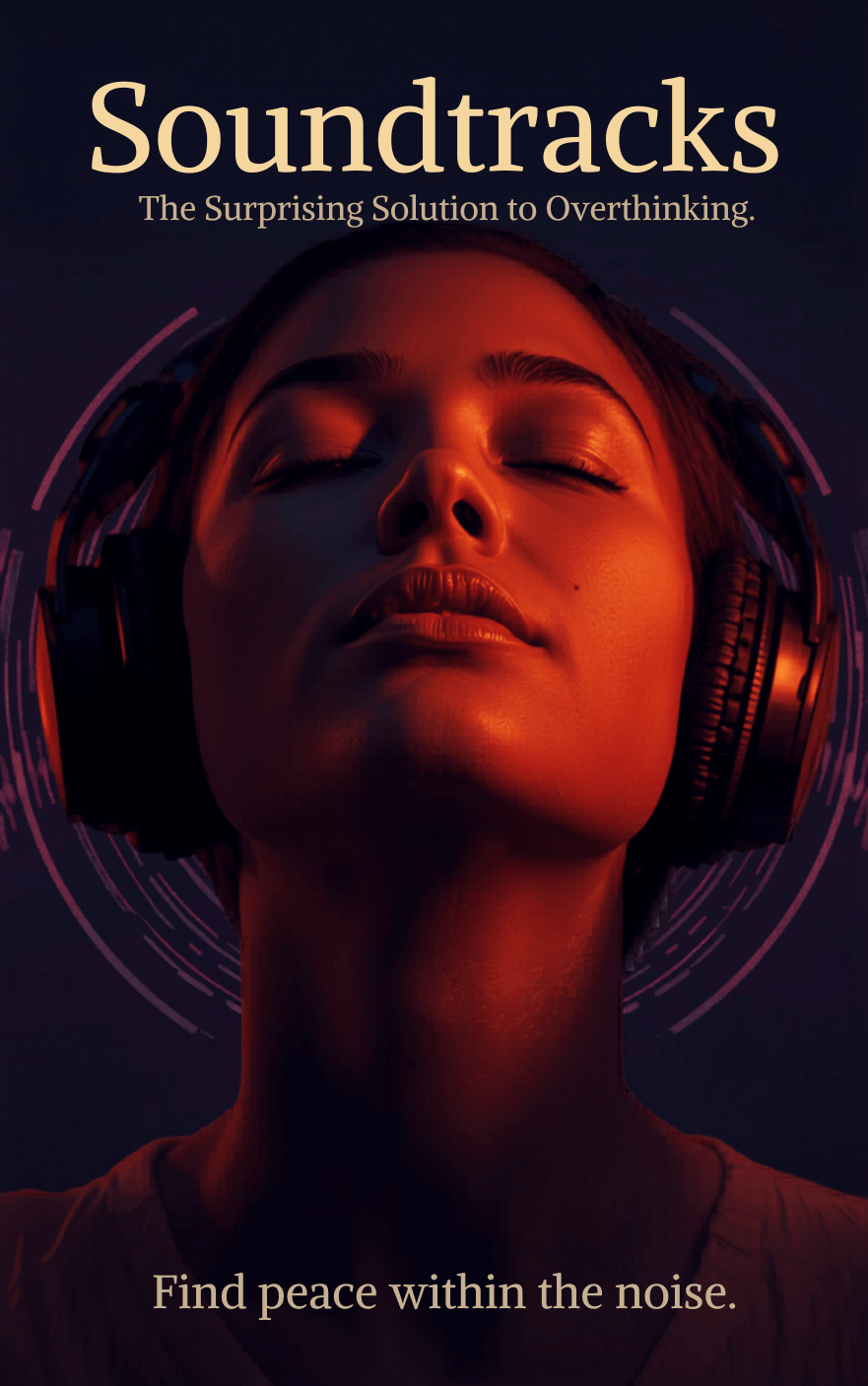
Soundtracks Book Summary
This Soundtracks Book Summary covers the key ideas, lessons, and takeaways in about 20 minutes.
The second takeaway is that thoughts and behavior have to be looped together for either to stick. A new mental phrase without action collapses into wishful thinking. Action without a supportive mental phrase is exhausting and easy to abandon. Acuff's most practical contribution is to insist that the two reinforce each other: the words give you the courage to take the action, and the action gives you the evidence to believe the words. Pair them, repeat them, surround them with rituals and reminders, and you can climb out of patterns that may have felt permanent. The approach is humble and accessible rather than dramatic, which is much of why it works for ordinary readers trying to change ordinary lives.
Helps with these goals
Want the complete 20-minute summary?
- Full structured summary
- Video Summary
- Podcast Summary
- Audio summary
- Key takeaways
- Exercises
- Quiz
- Highlights and notes
- Ask the book with AI
Not ready to upgrade?
Get this summary + 2 more picks sent to your inbox, free.
What is in the Soundtracks book summary?
Below is a preview of Sumizeit’s expert-written summary of Soundtracks by Jon Acuff. The full summary covers the book’s key ideas in text, audio, and video.
Jon Acuff's Soundtracks, released in 2021, treats overthinking as a force that can either drag a person down or push a person forward, depending entirely on what kind of repeated thoughts you allow to play in your head. Acuff's central image is the "soundtrack," the looping internal phrase or belief that quietly shapes how you feel and what you do. He argues that most people walk through life with old, unhelpful soundtracks playing in the background and only notice them when they have already done their damage. The book lays out a three-step framework for swapping these tracks for newer, more useful ones: pause the harmful thinking, build constructive replacements, and repeat the replacements often enough that they take root.
The summary below covers the book's core arguments, examples, and recommended techniques in detail.
The Mental Loops That Run in the Background of Your Life
Acuff opens by reframing what most readers assume is a bad habit. Overthinking, in his view, is not always the enemy. The brain is going to repeat thoughts whether you like it or not. The question is which thoughts it repeats. If your mind keeps returning to your weaknesses and the worst possible outcomes, you have a problem. If your mind keeps returning to your strengths and the next useful step, you have an asset. The metaphor he reaches for is the way music behind a movie scene determines how viewers feel about what they are watching. The same set of images, with different music underneath, produces different emotional responses. The phrases your brain plays on repeat work the same way. They quietly tilt how every situation lands.
This framing already suggests his prescription. You do not need to stop thinking; you need to choose better material for your mind to chew on.
Why Anxious Thinking Sabotages Your Goals
The downside of unchecked rumination is that, over time, the brain begins to treat the negative thoughts as fact. The more often you tell yourself that you are not ready, not qualified, not safe, or not wanted, the more thoroughly you start to believe those statements. Eventually the belief becomes so entrenched that you stop attempting things you are perfectly capable of attempting, because the loop in your head has already declared the attempt a waste of time.
Acuff illustrates this with a hypothetical career scenario. Imagine you have spent years dreaming of becoming a sushi chef. You finally screw up the courage to apply at several restaurants and, against your own expectations, the one you most wanted hires you as a trainee. Instead of celebrating, you spend the days before your first shift running mental footage of yourself fumbling with knives in front of an unimpressed senior staff. By the time the morning of the shift arrives, the imagined humiliation is so vivid that you decide not to show up. The opportunity dissolves, not because you were unqualified, but because the soundtrack in your head told you that you were.
The Biology That Tilts…
Want the complete 20-minute summary?
- Full structured summary
- Video Summary
- Podcast Summary
- Audio summary
- Key takeaways
- Exercises
- Quiz
- Highlights and notes
- Ask the book with AI
Who should read Soundtracks?
Soundtracks is for anyone who finds their own thoughts sabotaging their goals and opportunities. If you catch yourself replaying worst-case scenarios, doubting your abilities despite evidence to the contrary, or feeling paralyzed by overthinking, this book offers practical tools to redirect your internal narrative. It's equally valuable for high achievers whose perfectionism has become counterproductive and for people simply tired of their brain working against them.
Why does Soundtracks matter?
In a world of constant distraction and information overload, the battle for mental clarity has become one of the most important personal development challenges. Most self-help approaches try to eliminate negative thinking; Jon Acuff's Soundtracks reframes the problem entirely—you can't stop your brain from repeating thoughts, but you can choose which thoughts to repeat. This shift is both liberating and actionable, making it relevant to anyone struggling with anxiety, self-doubt, or the gap between their potential and their performance.
What are the key themes in Soundtracks?
- Your internal monologue shapes your reality more than circumstances do
- Overthinking is inevitable; the solution is choosing better material for your mind
- Confirmation bias can work for or against you depending on what belief you seed
- Thoughts and actions must reinforce each other to create lasting change
- The brain has a negativity bias—recognizing this is the first step to countering it
Want the complete 20-minute summary?
- Full structured summary
- Video Summary
- Podcast Summary
- Audio summary
- Key takeaways
- Exercises
- Quiz
- Highlights and notes
- Ask the book with AI
How can you apply ideas from Soundtracks?
- Interrupt anxious thoughts about an upcoming challenge by asking if they're true, productive, or kind—then redirect to a solution-focused phrase
- Create a personal soundtracks library by collecting phrases from books, mentors, songs, and successful people, then customize the ones that resonate
- Reverse a recurring negative self-talk phrase into its opposite to instantly generate a tailored replacement aligned to a real challenge
- Build rituals around a goal—like wearing specific workout gear or a particular playlist—to make the behavior enjoyable enough to repeat consistently
- Keep a simple wins journal to document small accomplishments daily, reinforcing the belief that you're someone who finishes what starts
- Place visual reminders (bracelets, sticky notes, special shoes) in spaces where you need the most mental support to jog your memory back to your new soundtracks
- Pair every new internal phrase with a concrete action that same day or week so your brain collects real evidence that the phrase is true
What common mistakes do readers make with Soundtracks?
- Trying to eliminate overthinking entirely instead of redirecting it—your brain will repeat thoughts no matter what, so the goal is choosing better material
- Creating feel-good affirmations disconnected from real behavior, turning soundtracks into wishful thinking that collapses when reality sets in
- Saying your new phrases only silently instead of speaking them aloud, which reduces their impact and makes it easier to abandon the practice
- Expecting new soundtracks to stick after one or two repetitions rather than understanding that internalization requires weeks of consistent practice
Sumizeit Exercises Apply what you've learned
Turn ideas from Soundtracks into action with a short guided reflection: identify the biggest takeaway, connect it to your life, and commit to one step you can take in the next 24 hours.
What is the expert analysis of Soundtracks?
Overview
Soundtracks by Jon Acuff, published in 2021, offers a compelling exploration of overthinking through the innovative metaphor of mental "soundtracks"—the repetitive internal dialogues that shape emotions and behaviors. Acuff, an established author and speaker renowned for his accessible and humorous approach to personal development, extends his oeuvre by addressing a universal psychological challenge with practical, actionable strategies. His work is significant for its synthesis of cognitive psychology concepts with everyday self-improvement techniques, making complex mental processes approachable for a broad audience seeking to overcome internal barriers to success.
Core Thesis
Acuff’s central argument reframes overthinking not as a pathological flaw but as an inevitable mental activity that can be harnessed for positive change. The key insight is that while individuals cannot control the mere presence of repetitive thoughts, they can influence which thoughts dominate their internal soundtrack. By identifying, interrupting, and replacing harmful mental loops with constructive, goal-oriented phrases—and reinforcing these with consistent behaviors and rituals—people can reprogram their subconscious narratives to foster motivation, resilience, and progress. This triadic process of pause, replace, and repeat forms the backbone of Acuff’s methodology.
Strengths
- Innovative Metaphor: The use of "soundtracks" as a metaphor for internal dialogue vividly captures the emotional and behavioral influence of repetitive thoughts, making abstract cognitive patterns tangible.
- Practical Framework: The three-step process—interrupting negative loops, substituting with tailored positive phrases, and reinforcing through repetition and behavior—is clear, actionable, and grounded in psychological principles such as confirmation bias and negativity bias.
- Accessibility and Tone: Acuff’s conversational, often humorous style lowers barriers for readers who might otherwise find cognitive-behavioral concepts daunting, thereby broadening the book’s appeal.
- Integration of Behavior and Cognition: Emphasizing the symbiotic relationship between thought and action, Acuff’s insistence on pairing mental reframing with concrete behaviors addresses a common pitfall in self-help literature—wishful thinking without follow-through.
- Use of Diagnostic Questions: The three tests for evaluating thoughts (accuracy, productivity, generosity) provide readers with a simple yet effective tool for critical self-reflection and cognitive restructuring.
Critiques & Counterarguments
- Evidence Base and Research Transparency: While Acuff references a commissioned study supporting repetition of constructive phrases, he candidly notes its unpublished status and methodological limitations. This reliance on anecdotal and preliminary evidence may undermine the book’s scientific rigor for discerning readers.
- Oversimplification of Complex Cognitive Processes: The model may understate the complexity of entrenched negative thought patterns, particularly in clinical conditions such as anxiety disorders or depression, where intrusive thoughts resist simple interruption or replacement.
- Potential Underestimation of Emotional Depth: The book’s emphasis on cognitive reframing and behavioral rituals may insufficiently address the emotional and existential dimensions of overthinking, which sometimes require deeper therapeutic engagement beyond self-coaching techniques.
- Competing Psychological Frameworks: Approaches like Acceptance and Commitment Therapy (ACT) advocate for mindfulness and acceptance of thoughts rather than active interruption and replacement, suggesting an alternative paradigm that values cognitive flexibility over control.
- Contextual and Cultural Variability: The book’s strategies may not translate seamlessly across diverse cultural contexts where internal dialogue and self-perception are shaped by differing norms and values, potentially limiting universal applicability.
Who Should Read This
Soundtracks is ideally suited for readers who recognize that their own thought patterns are obstacles to personal or professional growth but who seek a pragmatic, non-clinical approach to mental change. It appeals to ambitious individuals—professionals, creatives, and goal-oriented readers—who appreciate a blend of humor, storytelling, and cognitive insight. Those new to psychological self-help will find Acuff’s framework accessible and immediately applicable, while readers familiar with cognitive-behavioral techniques may appreciate the fresh metaphor and practical rituals. However, individuals grappling with severe anxiety or depressive disorders should consider this book a complementary tool rather than a substitute for clinical intervention.
Frequently asked questions about the Soundtracks book summary
What is Soundtracks about?
Soundtracks by Jon Acuff is about the internal phrases and beliefs—your mental 'soundtracks'—that quietly shape how you feel and what you do. The book argues that overthinking is inevitable, but you can choose which thoughts your brain repeats. Acuff offers a three-step framework to interrupt harmful thinking patterns, replace them with constructive phrases tied to your actual goals, and repeat those phrases until they become your default mindset.
Who should read Soundtracks?
Anyone struggling with self-doubt, anxiety, or the gap between their potential and performance will benefit from Soundtracks. It's especially valuable for people who find their own thoughts sabotaging their opportunities, perfectionist high achievers whose inner critic has become counterproductive, and anyone tired of their brain working against them. You don't need a diagnosed anxiety disorder to benefit; if your internal monologue frequently holds you back, this book is for you.
What are the main takeaways from Soundtracks?
The primary takeaway is that you can't stop your brain from repeating thoughts, but you can deliberately choose which thoughts to repeat. Second, you must pair new mental phrases with concrete actions—thoughts and behavior must reinforce each other for lasting change. Finally, the cumulative effect of small, repeated phrases and consistent small actions over weeks and months quietly remodels your inner monologue in powerful ways. The work is unglamorous, but it works.
How do I interrupt a negative thought pattern?
Acuff recommends using three diagnostic questions to test whether a thought deserves your attention: Is it true? Is it productive? Would I say this to a friend? If the thought fails any test, dismiss it. If it passes but still won't quit, physically step away from the task—take a walk, shower, or listen to music—to give your brain a different stimulus and let the grip loosen naturally.
How do I create effective replacement soundtracks?
Create phrases that point specifically at the outcome you want and the behavior that supports it. 'I speak clearly under pressure' is more effective than generic 'I'm good at my job.' You can reverse negative phrases (turn 'I'll never finish this' into 'I finish what I start'), borrow from books and mentors, or collect from songs and successful people. The key is anchoring each phrase to concrete action taken the same day or week so you build real evidence.
How often do I need to repeat my soundtracks for them to work?
Repetition is the price of internalization. There's no magic number, but Acuff stresses that a new soundtrack becomes operational because you say it many times, not because you said it once. Speaking it aloud is more effective than silent self-talk, and pairing it with consistent action accelerates the process. Most meaningful changes emerge over weeks and months of regular practice.
Does Soundtracks offer scientific evidence?
Acuff draws on established cognitive science—negativity bias, confirmation bias, the effectiveness of self-talk and repetition on learning—to build his case. He commissioned a study on the effects of repeated constructive phrases, though he acknowledges that study hasn't been formally published yet. The broader principles about how repetition aids learning, motivation, and habit formation are well supported in existing research.
About Sumizeit
Sumizeit is a profitable Scomy LLC company based in Miami, Florida. It has been helping readers learn from nonfiction books for 7 years with expert-written summaries in text, audio, podcast, and video.
Want the complete 20-minute summary?
- Full structured summary
- Video Summary
- Podcast Summary
- Audio summary
- Key takeaways
- Exercises
- Quiz
- Highlights and notes
- Ask the book with AI
Here's why readers love Sumizeit
Join thousands of learners getting smarter every day
"Great experience. Detailed summaries. Loved the gamification feature. Makes learning fun. Good customer service. I recommend Sumizeit to anyone. You'll learn a lot."
"I always felt busy but still wanting to keep up with the book discussion in my friend group. This was a great supplement to help me keep reading the books I find fun while keeping up with important books."
"I love this website. Instead of scrolling social media, I find myself learning a lot. I use it everyday. I recommend this app for anyone who is too busy and wants to get up to speed with their favorite books."
Soundtracks Book Summary PDF
Looking for a Soundtracks Book Summary PDF you can save and revisit offline? Our Soundtracks Book Summary PDF captures the book’s core ideas in a clean, printable format — the key frameworks, takeaways, and structure without the fluff. Download the Soundtracks Book Summary PDF when you want a reference you can annotate, share with your team, or review on the go. Get your Soundtracks Book Summary PDF from the download page below.
Download Soundtracks Book Summary PDFPeople also liked these summaries
Readers who explored Soundtracks often enjoyed these titles next.

Want the complete 20-minute summary?
- Full structured summary
- Video Summary
- Podcast Summary
- Audio summary
- Key takeaways
- Exercises
- Quiz
- Highlights and notes
- Ask the book with AI
Featured Book Titles
Popular Book Summaries at sumizeit, leading book summary app