


Prefer the print book? Buy on Amazon
As an Amazon Associate, Sumizeit earns from qualifying purchases.
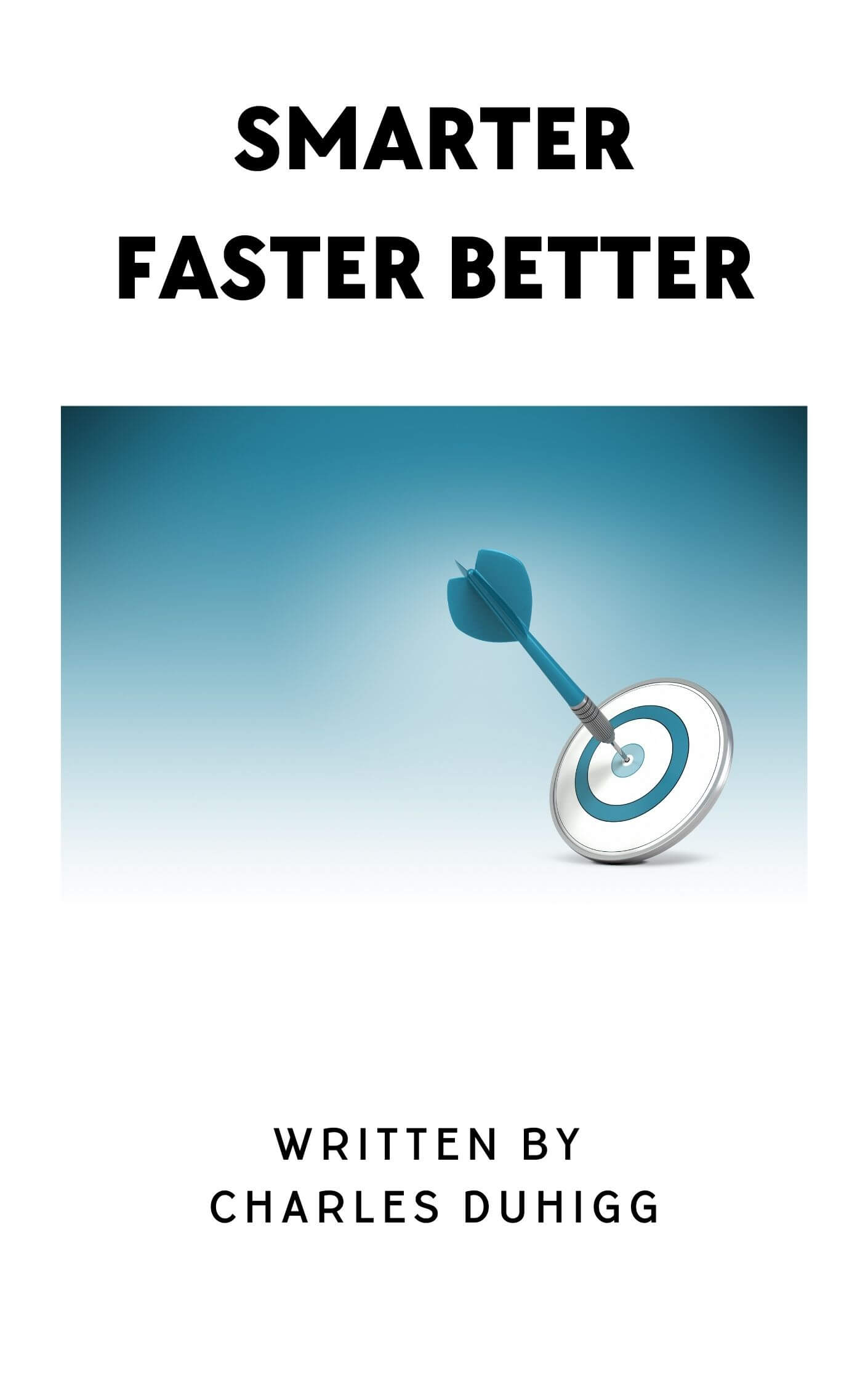
Smarter Faster Better Book Summary
This Smarter Faster Better Book Summary covers the key ideas, lessons, and takeaways in about 20 minutes.
Short Description:
Productivity requires focus, preparation, and embracing old
It is important to stay prepared for any distractions that may come your way to stop you from working towards a goal. And when you make the right choices, it is not only good for you but also the company you work for.
As a team, it is all about feeling safe and committed to success. And as a company, a culture of commitment is the way to survive and succeed in the long run.
Remember that you don’t have to reinvent the wheel. Instead, taking old ideas and finding new ways to utilize them can help you find success. Approaching things from a new angle can be all it takes to make a groundbreaking discovery and achieve larger goals.
Helps with these goals
Preview the Smarter Faster Better book summary
Below is a preview of Sumizeit’s comprehensive human-written summary of Smarter Faster Better by Charles Duhigg. The full summary is 15-20 minutes long and covers the book’s key ideas in text, audio, visual, and video formats. Unlock the full 20 Minute Summary
In Smarter Faster Better, Charles Duhigg uses some of the latest findings in the worlds of behavioral economics, psychology, and neuroscience to help people be more productive. This book is a look at how managing your thinking can be more beneficial than looking at what you are thinking about.
At the heart of Smarter Faster Better is eight key concepts for achieving maximum productivity, no matter what you are working on. Everything from finding focus and setting goals, to improving motivation and even making the best decisions is looked at in an effort to be the most effective when it comes to productivity.
And what makes a person or business successful? It is the way they view the world and the choices that they make, which are different from so many other people.
To be a more productive person, you must stick to your goals
The most productive people are the ones who have goals and stick with them. No matter what is happening in their lives, they are meeting their deadlines and goals.
While many people are not like this, that doesn’t mean we can’t change our habits in order to be more goal-oriented and focused on being productive.
Even if the world throws things in your way to distract you, with the help of Smarter Faster Better, you can learn the best way to stick to a plan.
Reminders of long-terms goals and making choices can actually help you stay motivated
When you start a new project, do you find yourself excited by the prospect of success? Over time, do you feel that excitement waning? This is something that happens often for a lot of people.
In order to maintain your motivation levels, it can be important to make choices that might be a benefit to you or the project you are working on. When you feel like you have more control over a project or situation, not only does it excite you, but it also gives you a greater feeling of motivation.
Even when you deal with setbacks, having a greater sense of control will help you recover quickly.
This means that making choices can be a great motivator, even when you have a task that you don’t want to handle. When you have a task that needs to be done, but that you may not be looking forward to, make a decision that allows you to push past the task. An example of this might have to do with going through a large number of emails. Instead of going through them all at once, pick a specific number of emails and then go back and look at the rest later.
While making a choice can be a great motivator, it may not always work depending on the task. You also need to remind yourself of your goals and what your choices will do to help contribute to your productivity and success.
Staying motivated can be a lot about remembering the big picture.
Want the complete 20-minute summary?
- Full structured summary
- Video Summary
- Podcast Summary
- Audio summary
- Key takeaways
- Exercises
- Quiz
- Highlights and notes
- Ask the book with AI
Who should read Smarter Faster Better?
Smarter Faster Better is for professionals, entrepreneurs, and anyone seeking to boost their productivity and decision-making skills. Whether you're managing a team, working on ambitious projects, or simply want to accomplish more with your time, this book provides science-backed strategies to help you succeed. It's particularly valuable for leaders and managers who want to understand the psychology behind high performance.
Why does Smarter Faster Better matter?
In today's fast-paced world, productivity isn't just about working harder—it's about working smarter by understanding how your mind actually works. Charles Duhigg's research in behavioral economics, psychology, and neuroscience reveals that the most successful people and organizations share common thinking patterns and decision-making approaches. By learning these evidence-based strategies, you can dramatically improve your effectiveness and help those around you do the same.
What are the key themes in Smarter Faster Better?
- Goal-setting and sustained focus
- Motivation through choice and autonomy
- Building psychological safety in teams
- Organizational commitment culture
- Creative problem-solving with existing ideas
- Decision-making for maximum impact
- Managing distractions and mental preparation
- Emotional intelligence in leadership
How can you apply ideas from Smarter Faster Better?
- Apply SMART goal frameworks to your next project to break down overwhelming objectives into achievable milestones
- Create mental models for recurring challenges in your work to prepare responses in advance and reduce reactive stress
- Establish team norms that explicitly encourage idea-sharing and mistake-reporting to build psychological safety
- Design company hiring and onboarding processes around cultural fit and shared values to build commitment culture
- Use autonomy and choice in task design—let team members decide how to approach work rather than dictating methods
- Conduct regular retrospectives where you examine how old ideas might be applied in new ways to solve current problems
- Build reflection time into your schedule to reconnect with larger goals and understand how daily work contributes to them
What common mistakes do readers make with Smarter Faster Better?
- Setting vague goals without specific metrics or timelines, making it impossible to track progress or celebrate wins
- Attempting to maintain motivation through willpower alone rather than building autonomy and choice into your work design
- Ignoring team dynamics and psychological safety, assuming performance depends only on individual talent and skills
- Trying to innovate by starting completely from scratch instead of creatively reimagining existing solutions
- Failing to anticipate common distractions and obstacles, leaving yourself vulnerable to derailment when they inevitably occur
Sumizeit Exercises Apply what you've learned
Turn ideas from Smarter Faster Better into action with a short guided reflection: identify the biggest takeaway, connect it to your life, and commit to one step you can take in the next 24 hours.
What is the expert analysis of Smarter Faster Better?
Overview
Smarter Faster Better is a compelling exploration of productivity authored by Charles Duhigg, a Pulitzer Prize-winning journalist known for his incisive investigations into human behavior and organizational dynamics. Building on his previous success with The Power of Habit, Duhigg synthesizes contemporary research from behavioral economics, psychology, and neuroscience to present a nuanced framework for enhancing personal and collective effectiveness. The book’s significance lies in its interdisciplinary approach and practical orientation, making complex cognitive and motivational processes accessible to a broad audience seeking to optimize performance in varied contexts.
Core Thesis
Duhigg’s central argument posits that productivity is less about the quantity of effort and more about the quality of decision-making and mental management. He contends that by mastering how we think—through goal setting, motivation, focus, and team dynamics—we can dramatically improve outcomes. The book distills productivity into eight key concepts that emphasize the importance of mental models, choice architecture, and emotional engagement as drivers of sustained high performance. Rather than prescribing rigid techniques, Duhigg advocates for cultivating adaptive thinking patterns that enable individuals and organizations to navigate complexity and interruptions effectively.
Strengths
- Interdisciplinary Integration: The book excels at weaving insights from diverse fields into a coherent narrative, offering readers a multifaceted understanding of productivity.
- Actionable Frameworks: Concepts like SMART goals, mental models, and commitment culture provide tangible tools that readers can apply immediately to improve focus and motivation.
- Emphasis on Psychological Mechanisms: By highlighting the role of choice, control, and emotional investment, Duhigg moves beyond superficial productivity hacks to address deeper cognitive and motivational structures.
- Balanced Focus on Individual and Team Dynamics: The discussion extends productively from personal habits to organizational culture, underscoring the social dimensions of productivity.
- Engaging Storytelling: Duhigg’s journalistic background enriches the text with vivid case studies and narratives that illustrate abstract concepts in relatable ways.
Critiques & Counterarguments
- Overgeneralization of Productivity Principles: While the eight concepts are broadly applicable, the book sometimes glosses over contextual nuances that affect how these principles function in different industries or cultures.
- Limited Engagement with Contradictory Research: The book tends to privilege studies that support its thesis without sufficiently addressing conflicting findings, such as research highlighting the limits of goal-setting or the downsides of excessive focus.
- Potential Oversimplification of Motivation: The portrayal of motivation as primarily a function of choice and control may understate the complexity of intrinsic versus extrinsic motivators and the role of systemic factors like socioeconomic status.
- Reliance on Anecdotal Evidence: Although compelling, many examples are anecdotal or drawn from high-profile cases, which may not generalize to everyday productivity challenges faced by most readers.
- Competing Schools of Thought: Alternative perspectives, such as mindfulness-based productivity approaches or critiques from critical management studies, suggest that productivity gains may also require structural changes rather than solely cognitive reframing.
Who Should Read This
Smarter Faster Better is ideally suited for professionals, managers, entrepreneurs, and knowledge workers who seek a scientifically informed yet practical guide to enhancing productivity. It appeals to readers interested in the psychology of performance, behavioral change, and organizational effectiveness. Additionally, those who appreciate a narrative-driven approach to self-improvement and business strategy will find Duhigg’s style engaging. However, readers looking for deeply technical or radically innovative productivity methods may find the book’s approach more foundational than revolutionary.
Frequently asked questions about the Smarter Faster Better book summary
What is Smarter Faster Better about?
Smarter Faster Better by Charles Duhigg is a science-based guide to achieving maximum productivity by understanding how your mind works. The book presents eight key concepts—from goal-setting and motivation to team dynamics and decision-making—all grounded in behavioral economics, psychology, and neuroscience. Rather than focusing on what you're thinking about, Duhigg emphasizes how managing your thinking itself leads to greater effectiveness in both personal and professional contexts.
Who should read Smarter Faster Better?
Smarter Faster Better is ideal for professionals, entrepreneurs, team leaders, and anyone looking to enhance their productivity and decision-making. The book is particularly valuable for managers who want to build high-performing teams and for individuals seeking science-backed strategies to accomplish ambitious goals. Whether you're struggling with focus, motivation, or team dynamics, this book provides practical insights applicable to your situation.
What are the main takeaways from Smarter Faster Better?
The core takeaways include: productivity thrives when you set clear goals and stick to them despite distractions; choice and autonomy fuel motivation more effectively than external pressure; breaking ambitious goals into SMART objectives creates momentum through repeated wins; and teams perform best in psychologically safe environments where members feel valued. Additionally, Duhigg emphasizes that innovation often comes from applying old ideas in new ways, and that organizational commitment culture—built on trust and emotional connection—drives long-term success.
How can I use mental models to improve my focus?
Mental models are positive mental stories that prepare you for challenges and distractions before they occur. By anticipating obstacles and mentally rehearsing how you'll handle them step-by-step, you build resilience against stress and interruptions. This proactive approach is far more effective than reactive crisis management, as it allows you to maintain momentum toward your goals even when life inevitably throws obstacles your way.
What does Smarter Faster Better say about team productivity?
Smarter Faster Better emphasizes that team success depends on psychological safety—team members must feel safe expressing ideas, admitting mistakes, and challenging the status quo without fear of ridicule. Leaders build this safety through respect, showing team members they are valued, and handling conflicts openly with empathy. Organizations that foster this environment along with a commitment culture built on trust and shared vision significantly outperform traditional hierarchical structures.
How does the book define productivity differently than other approaches?
Unlike books that focus on time management or grinding harder, Smarter Faster Better argues that real productivity comes from managing how you think and make decisions. The book draws on behavioral science to show that the way you approach goals, maintain motivation, build teams, and solve problems matters far more than the number of hours you work. It's about working smarter by understanding the psychology of high performance.
Can the concepts in Smarter Faster Better apply to both individual and organizational success?
Yes, absolutely. Smarter Faster Better covers strategies for personal productivity and goal achievement as well as organizational culture and team leadership. The principles of choice, goal-setting, psychological safety, and commitment culture apply across individual, team, and company levels. Leaders can use these concepts to transform their organizations while individuals can apply the same frameworks to their own work and projects.
About Sumizeit
Sumizeit is a profitable Scomy LLC company based in Miami, Florida. Our founders, Clemens Raemy and Weina Scott, are successful entrepreneurs with several exits. Sumizeit is a popular book summary app / micro learning app used by busy professionals and entrepreneurs with over 2,500 non-fiction book summaries and 10,000 podcast summaries in text, audio, visual, podcast, and video format. We also have stellar retention tools to make ideas stick - such as flashcards with spaced repetition, quizzes, streaks, highlighting and notes, daily challenges, riddles, mini-courses, meditation, and more. You won't only learn the idea, but also remember it. Over 90% of our users change their habits with Sumizeit.
Upgrade Now
Here's why readers love Sumizeit
Join thousands of learners getting smarter every day
"Great experience. Detailed summaries. Loved the gamification feature. Makes learning fun. Good customer service. I recommend Sumizeit to anyone. You'll learn a lot."
"I always felt busy but still wanting to keep up with the book discussion in my friend group. This was a great supplement to help me keep reading the books I find fun while keeping up with important books."
"I love this website. Instead of scrolling social media, I find myself learning a lot. I use it everyday. I recommend this app for anyone who is too busy and wants to get up to speed with their favorite books."
Smarter Faster Better Book Summary PDF
Looking for a Smarter Faster Better Book Summary PDF you can save and revisit offline? Our Smarter Faster Better Book Summary PDF captures the book’s core ideas in a clean, printable format — the key frameworks, takeaways, and structure without the fluff. Download the Smarter Faster Better Book Summary PDF when you want a reference you can annotate, share with your team, or review on the go. Get your Smarter Faster Better Book Summary PDF from the download page below.
Download Smarter Faster Better Book Summary PDFPeople also liked these summaries
Readers who explored Smarter Faster Better often enjoyed these titles next.


Ready to read the whole thing?
- Full structured summary
- Video Summary
- Podcast Summary
- Audio summary
- Key takeaways
- Exercises
- Quiz
- Highlights and notes
- Ask the book with AI
Featured Book Titles
Popular Book Summaries at sumizeit, leading book summary app