


As an Amazon Associate, Sumizeit earns from qualifying purchases.
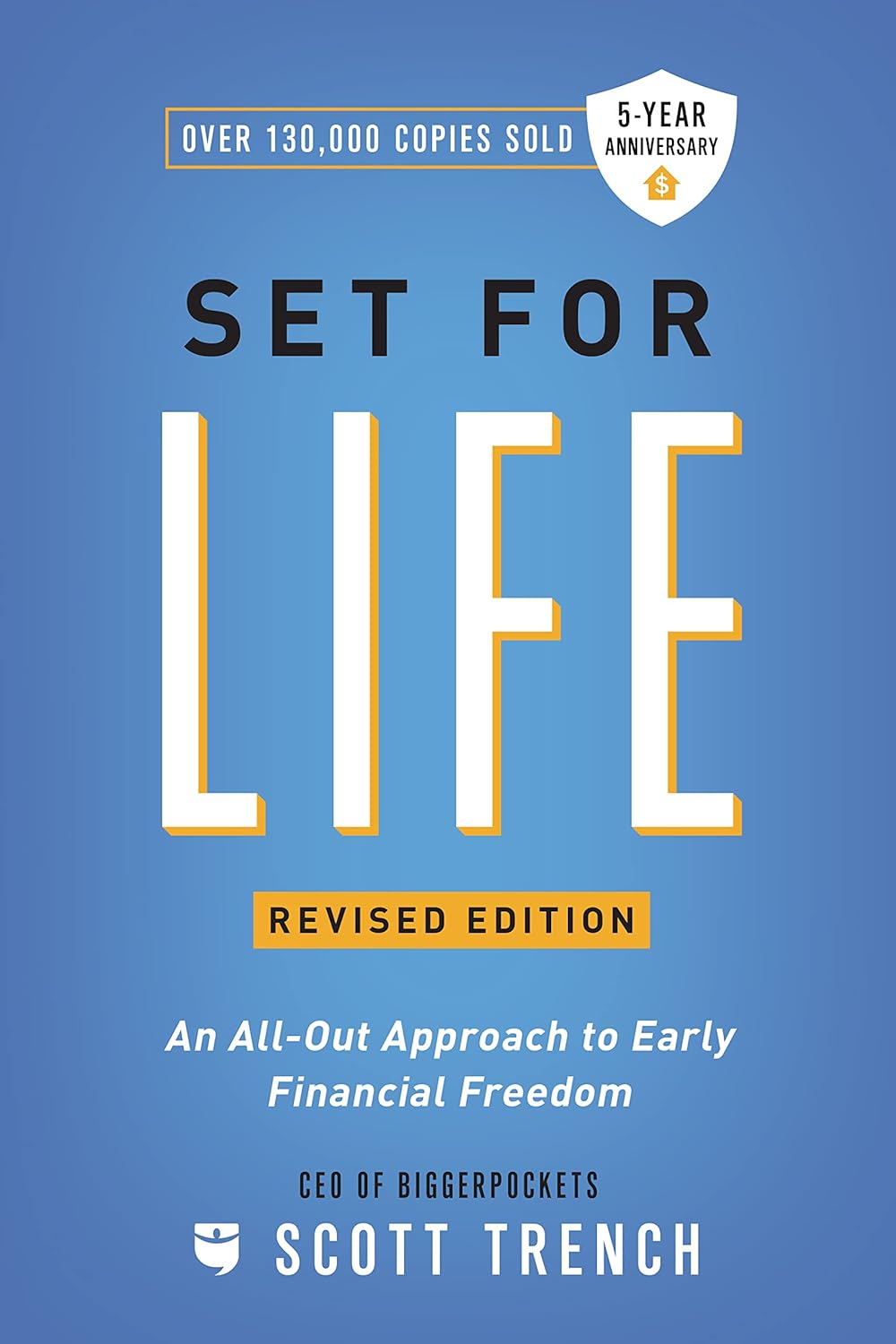
Set For Life Book Summary
This Set For Life Book Summary covers the key ideas, lessons, and takeaways in about 20 minutes.
Trench’s roadmap can be summarized as three reinforcing phases. First, crush your cost of living and track your finances obsessively. By living far below your means—especially in your 20s and 30s—you free up a huge percentage of your income for wealth building. You learn to distinguish genuine needs from convenience and social pressure, and you anchor your lifestyle at a level that’s easy to support with future investment income.
Second, use that lean lifestyle and growing savings to take smart risks in your career and housing. Turn your home into a source of profit through house hacking. Pursue jobs where your effort and skill can dramatically increase your income. Build complementary side hustles that monetize what you already know. In this phase, your active income climbs while your expenses remain controlled, causing your savings rate—and thus your investable capital—to explode.
Third, convert that capital into assets that generate cash flow: broad index funds and rental properties. Treat your principal as untouchable and reinvest much of your returns. Focus effort where you have real influence—on properties and businesses you can manage intelligently—rather than on trying to outguess markets. Gradually, your assets begin to cover your lean cost of living. At that point, you’ve achieved what Trench calls being “set for life”: you can choose work, projects, and experiences based on meaning and enjoyment rather than financial necessity.
What makes the book distinctive is not just its tactics—many of which echo sound personal finance principles—but its insistence on urgency and intentional design. Instead of drifting through decades of work and hoping things turn out, you consciously engineer your lifestyle, career, and investments to reach autonomy as quickly as possible. It’s a blueprint for trading consumer comforts today for freedom, time, and options tomorrow.
Helps with these goals
Want the complete 20-minute summary?
- Full structured summary
- Video Summary
- Podcast Summary
- Audio summary
- Key takeaways
- Exercises
- Quiz
- Highlights and notes
- Ask the book with AI
What is in the Set For Life book summary?
Below is a preview of Sumizeit’s expert-written summary of Set For Life by Scott Trench. The full summary covers the book’s key ideas in text, audio, and video.
Most people imagine financial security as something that happens after four or five decades in the workforce: you put in your 40 hours a week, save a little, and hope that someday the numbers in your retirement account are big enough that you can stop working. In Set for Life, Scott Trench turns this idea upside down. He argues that ordinary people in their 20s and 30s—especially single, middle-income earners with modest savings—can reach financial independence in a fraction of the usual time.
Instead of treating retirement as a destination at age 65, Trench defines “set for life” as reaching a point where your assets reliably produce more income than your living expenses. At that moment, you no longer need a traditional job to survive. You can still choose to work, but your decisions are no longer driven by the fear of running out of money. The essence of the book is a three-step path to that point: slash costs, boost income, and invest aggressively in assets that generate cash flow.
His approach is intentionally bold. It’s aimed at people willing to live far below their means, make unconventional housing choices, and use their working years strategically rather than passively following the standard career script. Yet even if you’re older, married, or already on a more traditional track, the principles—measuring your finances precisely, prioritizing big wins over small sacrifices, and channeling savings into productive assets—can still dramatically improve your financial position and flexibility.
The Three Numbers That Drive Your Freedom
Before jumping into tactics, Trench insists that you build a clear dashboard of your financial life. He focuses on three numbers: net worth, spending, and income. These metrics show where you are today and how quickly you’re moving toward freedom.
Net worth is your assets minus your liabilities. Trench takes a strict view of what counts as an asset. In his framework, only things that produce income or reliably increase in value belong in the asset column: rental properties, businesses, investments, and similar holdings. Items like your personal residence, cars, and retirement accounts that are hard to access or don’t directly put cash in your pocket should be mentally separated from the core wealth you intend to live off. This mindset pushes you to focus on assets that can feed you, not just look good on paper.
Next is spending. Because financial independence ultimately means your passive income exceeds your cost of living, you must know what that cost really is. Trench recommends tracking every dollar that leaves your accounts using software that automatically categorizes your transactions. He distinguishes between fixed expenses—like rent, insurance, and loan payments—and variable expenses such as groceries, entertainment, and shopping. By reviewing these categories regularly, you can see not only what you’re spending, but what level of lifestyle you’re designing for yourself.
The third metric is income: how much money flows into your life and from where. Trench separates income into two buckets—active and passive.
Want the complete 20-minute summary?
- Full structured summary
- Video Summary
- Podcast Summary
- Audio summary
- Key takeaways
- Exercises
- Quiz
- Highlights and notes
- Ask the book with AI
Who should read Set For Life?
Set For Life is ideal for people in their 20s and 30s—especially single earners or couples with modest incomes—who want to escape the traditional 40-year career path and achieve financial independence much sooner. It's also valuable for anyone feeling trapped by high expenses, debt, or the sense that financial freedom is impossibly far away. Even older readers or those already on a conventional financial path can apply Trench's core principles to dramatically accelerate their wealth-building and gain more control over their time.
Why does Set For Life matter?
In an era of rising living costs, stagnant wages, and uncertainty about retirement, Set For Life offers a concrete, achievable roadmap for ordinary people to stop trading their lives for paychecks and instead build genuine financial autonomy. The book challenges the assumption that financial independence requires high income or decades of passive waiting, showing instead that aggressive saving, strategic career moves, and smart asset ownership can compress the timeline dramatically. For anyone feeling stuck or overwhelmed by money stress, Trench's framework provides both hope and actionable direction.
What are the key themes in Set For Life?
- Financial independence is achievable in years, not decades, for disciplined savers
- Cutting expenses is often more powerful than chasing higher income
- Only income-producing assets should count toward true wealth
- Housing and transportation are the leverage points for reducing lifestyle costs
- House hacking transforms your largest expense into an income-generating asset
- Career strategy matters as much as investment strategy
- Time and effort should focus on what you can directly control and influence
- Compounding and reinvestment create exponential wealth growth over time
What are the key lessons from the Set For Life book summary?
Track Three Core Numbers Obsessively
Master your net worth (income-producing assets minus liabilities), monthly spending, and income sources. These three metrics reveal your true financial position and how fast you're moving toward freedom, far better than looking at salary alone.
Distinguish Between Good and Bad Debt
High-interest debt like credit cards is toxic and should be eliminated quickly, while lower-interest debt like mortgages is less urgent. The key is having a deliberate payoff strategy rather than ignoring either type.
Build Your Emergency Fund Before Investing
Start with $1,000-$2,000 to absorb unexpected shocks, then create a larger cash cushion (a year's lean expenses) that transforms your relationship with work by giving you the freedom to take calculated risks.
Cut Big Expenses First, Not Small Ones
Focus ruthlessly on housing, transportation, food, and insurance—the four categories that dominate most budgets. These big levers matter far more than skipping occasional coffee or streaming services.
Live on 'Good Enough,' Not Premium
Solid, functional versions of almost anything deliver nearly the same satisfaction as luxury versions for a fraction of the cost. Training yourself to default to good-enough options shrinks spending without sacrificing real quality of life.
Make Smart Purchases That Lower Future Costs
Invest upfront in durable tools, energy-efficient appliances, or reusable items that reduce your monthly expenses for years, rather than buying cheap items that require constant replacement.
House Hacking Turns Housing From Cost to Profit
Buy a multi-unit property, live in one unit, and rent the others so tenant payments cover most or all of your mortgage, allowing you to build equity while living for free or nearly free.
Seek Jobs Where Income Scales With Performance
Roles like sales, commission-based work, or entrepreneurial positions inside companies allow your earnings to grow much faster than traditional salary tracks if you're willing to hustle and develop valuable skills.
Build Side Income in Your Area of Expertise
Monetize skills you already have—such as freelance accounting, marketing, or consulting—to create additional income streams with low startup costs and high margins.
Treat Invested Principal as Untouchable Workers
Once you invest capital, think of it as workers you've sent out into the world; live off the profits they generate, not the workers themselves, and let the principal remain invested to compound.
Reinvest Most of Your Investment Returns
Spend only 25-30% of your investment returns and reinvest the remainder so your wealth compounds faster, creating a snowball effect where larger assets generate larger returns.
Concentrate Capital When Your Net Worth Is Small
When building initial wealth, focus on a few high-quality asset classes like index funds and carefully chosen real estate rather than spraying tiny amounts across many holdings, which dilutes potential returns.
Separate Investing From Speculation
True investments produce cash or create real value (businesses, rental property, stock index funds), while speculation hopes someone will pay more later regardless of intrinsic worth; the latter is unreliable for building lasting freedom.
Use Index Funds to Compete Fairly With Professionals
Low-cost index funds let you own hundreds of companies at once, compete with professionals you can't beat, and historically outperform most active stock pickers while requiring minimal effort.
Real Estate Offers Multiple Wealth-Building Channels
Rental properties generate cash flow from rent, build equity through mortgage paydown, appreciate in value, and give you direct control over returns through smart management—making them powerful wealth accelerators.
Use Leverage Carefully to Amplify Returns
Borrowed money lets you control a larger asset with a small down payment, magnifying returns if investments perform well, but it also magnifies losses, so conservative assumptions and walkaway discipline are essential.
Focus Effort on What You Can Directly Influence
Spend time on assets you can manage directly—rental properties and businesses—rather than obsessing over tiny information advantages in stock picking where professionals have better tools.
Think in Absolute Dollars, Not Just Percentages
A simple strategy executed on a large base of capital often beats a hyper-optimized strategy on tiny amounts; don't waste days of analysis squeezing a few percentage points from small investments when the opportunity cost is too high.
Designing Your Lifestyle Is Designing Your Freedom
The lower your cost of living, the smaller the nest egg required to support you indefinitely; by anchoring your lifestyle at a lean but comfortable level now, you make future financial independence much easier and sooner.
Tax-Free Wins Beat Taxed Income
A dollar you don't spend keeps 100% of its value, while additional income is reduced by taxes before you see it; this is why cutting expenses often accelerates wealth-building faster than chasing higher earnings.
Want the complete 20-minute summary?
- Full structured summary
- Video Summary
- Podcast Summary
- Audio summary
- Key takeaways
- Exercises
- Quiz
- Highlights and notes
- Ask the book with AI
How can you apply ideas from Set For Life?
- Track your spending in detail using software to automatically categorize transactions and identify your true cost of living
- Reduce housing costs by choosing modest neighborhoods, getting roommates, or pursuing house hacking through a multi-unit property purchase
- Replace car ownership with walking, biking, or public transit, or drive a used, fuel-efficient vehicle instead of buying new on credit
- Cook at home with inexpensive ingredients as your default, treating restaurant meals and delivery as deliberate treats rather than habits
- Invest early savings in a small emergency fund ($1,000-$2,000), then aggressively pay down high-interest debt before building a larger cash cushion
- Seek high-income roles where compensation ties to performance, or develop valuable skills (coding, trades, specialized technical expertise) that increase your market value
- Build a portfolio of low-cost index funds that own hundreds of companies at once, then let compounding work over decades with minimal effort
- Purchase rental properties with positive cash flow where rent covers mortgage and expenses, gradually converting real estate holdings into a passive income stream
What common mistakes do readers make with Set For Life?
- Obsessing over tiny savings (cutting daily coffee) while ignoring major expense categories (housing, transportation) that dwarf minor indulgences
- Treating a high salary as progress without tracking whether net worth is actually growing or if spending has scaled up equally
- Attempting to beat professional investors through individual stock picking instead of using low-cost index funds that historically outperform most active managers
- Speculating on assets that produce no intrinsic value (purely price-driven cryptocurrency or commodity bets) rather than investing in cash-generating businesses and properties
- Neglecting to build an emergency fund before investing, leaving yourself vulnerable to debt when unexpected expenses occur
- Diversifying investment capital too widely too early, spraying tiny amounts across many holdings instead of concentrating on high-quality assets when building initial wealth
Sumizeit Exercises Apply what you've learned
Turn ideas from Set For Life into action with a short guided reflection: identify the biggest takeaway, connect it to your life, and commit to one step you can take in the next 24 hours.
What is the expert analysis of Set For Life?
Overview
Set For Life by Scott Trench emerges as a compelling and pragmatic contribution to the personal finance genre, distinguished by its focus on accelerated financial independence for ordinary earners. Trench, a seasoned real estate investor and CEO of BiggerPockets, leverages his firsthand experience and community leadership to craft a blueprint that challenges conventional retirement timelines. His approach is particularly significant for younger adults who seek autonomy from traditional career constraints without relying on extraordinary income or inheritance. The book’s significance lies in its synthesis of frugality, strategic income enhancement, and disciplined investing, presented with an urgency and clarity that resonate in today’s economic landscape.
Core Thesis
Trench’s central argument reframes financial independence not as a distant endpoint but as an achievable state attainable within years rather than decades. He defines being “set for life” as the moment when passive income from assets surpasses one’s living expenses, liberating individuals from the necessity of traditional employment. This is pursued through a tripartite strategy: radical cost reduction, aggressive income growth, and focused investment in cash-flowing assets. The thesis emphasizes intentional lifestyle design, prioritizing high savings rates and leveraging real estate and index funds to build sustainable wealth. Underpinning this is a mindset shift that treats money as a tool for freedom rather than consumption.
Strengths
- Practical Framework: The book offers a clear, actionable roadmap with quantifiable targets and measurable metrics (net worth, spending, income) that empower readers to track progress rigorously.
- Behavioral Insights: Trench’s emphasis on mindset—embracing “good enough,” DIY skills, and smart purchases—adds psychological depth to traditional financial advice, encouraging sustainable habits.
- Innovative Housing Strategy: The “house hacking” concept effectively transforms a major expense into an income source, blending real estate investing with everyday living in a way accessible to many.
- Balanced Investment Philosophy: Advocating for index funds alongside hands-on real estate investing strikes a pragmatic balance between passive and active wealth building, acknowledging different risk profiles and effort levels.
- Urgency and Intentionality: The book’s call to accelerate financial independence disrupts complacency, motivating readers to take control early rather than deferring decisions.
Critiques & Counterarguments
- Oversimplification of Income Growth: While Trench advocates aggressively boosting income, the pathways suggested—such as sales roles or side hustles—may not be universally accessible or scalable, especially for those in less flexible labor markets or with caregiving responsibilities.
- Housing Market Variability: The house hacking strategy assumes availability of affordable multi-unit properties and stable rental demand, which may not hold in high-cost urban centers or volatile markets, potentially limiting applicability.
- Risk Underestimation: The recommendation to concentrate investments early on contrasts with traditional diversification wisdom aimed at risk mitigation. Critics might argue this exposes novices to outsized losses, especially if market downturns coincide with early-stage investing.
- Behavioral Challenges: The extreme frugality and lifestyle constraints required may not be psychologically sustainable for all readers, risking burnout or social isolation, which the book addresses less explicitly.
- Alternative Financial Philosophies: Opposing schools, such as those advocating for moderate saving combined with balanced consumption to maximize life satisfaction, might critique Trench’s approach as sacrificing present well-being for uncertain future gains.
Who Should Read This
Set For Life is ideally suited for young professionals and middle-income earners who are motivated to achieve financial independence significantly earlier than traditional retirement age. It appeals to readers willing to adopt disciplined financial habits, embrace unconventional housing solutions, and actively manage investments. Entrepreneurs, aspiring real estate investors, and those disillusioned with the standard career trajectory will find particular value in Trench’s strategies. Additionally, individuals seeking a structured, no-nonsense framework to escape paycheck dependency and gain autonomy over their time and choices will benefit from this book’s blend of practical tactics and philosophical reframing of money’s role in life.
Frequently asked questions about the Set For Life book summary
What is Set For Life about?
Set For Life by Scott Trench is a guide to achieving financial independence in years rather than decades through a three-step system: aggressively cutting expenses, dramatically increasing income, and investing in cash-generating assets. The book argues that ordinary people in their 20s and 30s can reach a point where investment returns exceed living expenses, allowing them to stop working for money and make choices based on meaning rather than financial necessity.
Who should read Set For Life?
Set For Life is ideal for people in their 20s and 30s—especially single earners or modest-income households—who want to escape the traditional 40-year career and achieve financial independence sooner. It's also valuable for anyone feeling trapped by high expenses or debt, or for older readers who want to accelerate wealth-building using Trench's core principles of cost reduction, strategic career moves, and smart asset investing.
What are the main takeaways from Set For Life?
The main takeaways are: (1) Track three numbers obsessively—net worth, spending, and income—to see your true financial position; (2) Crush costs by targeting big expenses like housing and transportation, then boost income through strategic career moves and side hustles; (3) Convert accumulated capital into income-producing assets like rental properties and index funds, reinvesting returns to compound wealth; and (4) Financial independence is achievable for disciplined savers willing to live below their means and invest strategically, often decades earlier than conventional retirement timelines.
How does house hacking work in Set For Life?
House hacking involves buying a multi-unit property like a duplex or triplex, living in one unit, and renting out the others. If structured correctly, tenant rents cover most or all of the mortgage, property taxes, insurance, and maintenance, allowing you to build equity while living for free or nearly free. The strategy turns your largest expense into an income-generating asset and accelerates wealth-building early in your career.
What investment strategy does Scott Trench recommend?
Trench recommends focusing on low-cost index funds for stock market exposure (which let you own hundreds of companies at once without trying to beat professional investors) and carefully selected rental properties where you have direct control over returns. He emphasizes treating invested principal as untouchable, reinvesting most returns, focusing effort on assets you can directly influence, and avoiding speculation in favor of true investments that produce cash or real value.
Can you achieve financial independence with a modest income?
Yes, according to Set For Life. Scott Trench argues that financial independence is more about the gap between income and expenses than the absolute income level. By aggressively reducing costs (especially housing and transportation), maintaining a high savings rate, and strategically increasing earnings through career moves and side hustles, people with modest incomes can build wealth and reach financial independence much faster than conventional wisdom suggests.
What is the difference between good debt and bad debt according to Set For Life?
In Set For Life, bad debt is high-interest borrowing like credit cards and payday loans, which is toxic to wealth-building and should be eliminated quickly once you have an emergency fund. Good debt includes lower-interest obligations like mortgages and student loans, which are less urgent but still require a strategic payoff plan. Trench emphasizes having a deliberate strategy for both rather than ignoring either type.
About Sumizeit
Sumizeit is a profitable Scomy LLC company based in Miami, Florida. It has been helping readers learn from nonfiction books for 7 years with expert-written summaries in text, audio, podcast, and video.
Want the complete 20-minute summary?
- Full structured summary
- Video Summary
- Podcast Summary
- Audio summary
- Key takeaways
- Exercises
- Quiz
- Highlights and notes
- Ask the book with AI
Here's why readers love Sumizeit
Join thousands of learners getting smarter every day
"Great experience. Detailed summaries. Loved the gamification feature. Makes learning fun. Good customer service. I recommend Sumizeit to anyone. You'll learn a lot."
"I always felt busy but still wanting to keep up with the book discussion in my friend group. This was a great supplement to help me keep reading the books I find fun while keeping up with important books."
"I love this website. Instead of scrolling social media, I find myself learning a lot. I use it everyday. I recommend this app for anyone who is too busy and wants to get up to speed with their favorite books."
Set For Life Book Summary PDF
Looking for a Set For Life Book Summary PDF you can save and revisit offline? Our Set For Life Book Summary PDF captures the book’s core ideas in a clean, printable format — the key frameworks, takeaways, and structure without the fluff. Download the Set For Life Book Summary PDF when you want a reference you can annotate, share with your team, or review on the go. Get your Set For Life Book Summary PDF from the download page below.
Download Set For Life Book Summary PDFPeople also liked these summaries
Readers who explored Set For Life often enjoyed these titles next.

Want the complete 20-minute summary?
- Full structured summary
- Video Summary
- Podcast Summary
- Audio summary
- Key takeaways
- Exercises
- Quiz
- Highlights and notes
- Ask the book with AI
Featured Book Titles
Popular Book Summaries at sumizeit, leading book summary app