


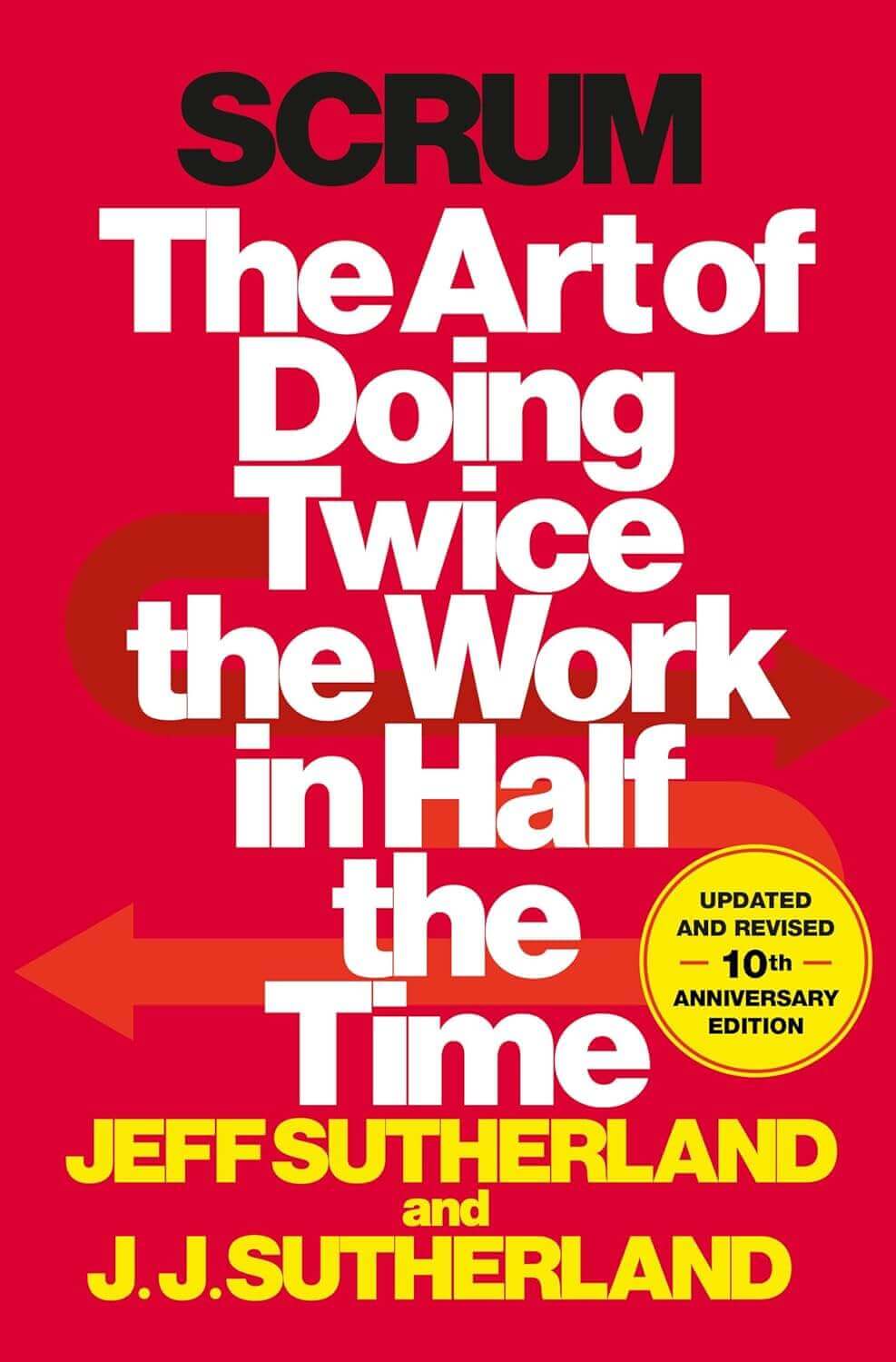
Prefer the print book? Buy on Amazon
As an Amazon Associate, Sumizeit earns from qualifying purchases.
Scrum Book Summary
This Scrum Book Summary covers the key ideas, lessons, and takeaways in about 20 minutes.
Short Description:
Scrum boosts productivity through transparency and rapid learning cycles.
Scrum proves that by breaking work into small increments, inspecting progress frequently, adjusting based on real feedback, and focusing on outcomes rather than activity, teams can achieve extraordinary results. Real-world examples—from saving premature infants, to modernizing the FBI’s systems, to improving student learning—show that Scrum is not just a process change but a transformation in mindset. Ultimately, Scrum teaches that uncertainty is inevitable, but failure is not; success comes from how quickly we learn and adapt. It offers a roadmap to deliver better results faster, more sustainably, and with greater human satisfaction — truly doing twice the work in half the time.
Helps with these goals
Want a Free Weekly Read?
Get a free summary every week straight to your mailbox.
Preview the Scrum book summary
Below is a preview of Sumizeit’s comprehensive human-written summary of Scrum by Jeff Sutherland. The full summary is 15-20 minutes long and covers the book’s key ideas in text, audio, visual, and video formats. Unlock the full 20 Minute Summary
Scrum: The Art of Doing Twice the Work in Half the Time by Jeff Sutherland presents a complete rethinking of how work should be organized, executed, and delivered. Sutherland argues that most organizations operate under outdated systems designed for industrial-era predictability, not modern complexity. These legacy systems assume that detailed planning up front leads to predictable outcomes. However, in reality, most plans collapse when confronted with uncertainty, evolving priorities, and human limitations.
Scrum provides a framework that replaces rigid control with adaptability, prediction with experimentation, and bureaucracy with transparency. It is a management and workflow method built around short cycles of work, constant feedback, rapid iteration, and continuous improvement. Instead of waiting until the end of a months- or years-long project to learn whether something works, Scrum encourages early delivery of working components so real data can guide decisions.
Scrum was originally created for software development, but Sutherland demonstrates how it has since transformed healthcare, education, the military, manufacturing, and even personal life. The book argues that most teams are capable of far more than they produce — not because they lack skill or motivation, but because traditional systems restrict their ability to perform.
Why Traditional Project Management Fails
Sutherland explains why so many projects miss deadlines, exceed budgets, and disappoint users. The traditional Waterfall approach assumes that every requirement can be known at the beginning and predicts completion through Gantt charts and long planning documents. Once the plan is approved, teams march forward believing prediction equals control.
However, research and empirical data reveal the opposite:
Only about 10% of large software projects finish on time
Over 80% go over budget
More than half of features requested are never used or add no value
Teams spend enormous time fixing mistakes caused by unclear communication
Sutherland describes the Cone of Uncertainty, a model showing that at the beginning of a project, estimates can be off by 4x to 16x. Yet organizations routinely act as if initial estimates are precise scientific forecasts. This leads to overly optimistic projections followed by blame and panic as reality diverges from plan.
He explains that companies promote leaders who sound confident — even if that confidence is based on fantasy. The illusion of certainty leads people to hide problems and delay warnings until failure becomes unavoidable.
Scrum rejects fictional planning in favor of fast feedback, continuous inspection, transparency, and short, controlled cycles of delivery.
Real Example: The FBI Virtual Case File Project
Sutherland shares one of the most striking examples: the FBI’s failed Virtual Case File system. After 5 years and $170 million spent, the project delivered nothing usable. Documentation and planning consumed the majority of resources, with no working product built until near the end — far too late to adapt.
When the FBI restarted the initiative using Scrum, the new team delivered a functioning system in small increments every few weeks.
Want the complete 20-minute summary?
- Full structured summary
- Video Summary
- Podcast Summary
- Audio summary
- Key takeaways
- Exercises
- Quiz
- Highlights and notes
- Ask the book with AI
Who should read Scrum?
Scrum is essential for anyone involved in managing projects, leading teams, or delivering products in complex environments. Whether you're in software development, healthcare, manufacturing, education, or any field facing uncertainty and tight deadlines, this book offers a proven framework to work smarter. It's equally valuable for executives seeking to transform organizational productivity, team leaders wanting to improve collaboration, and individual contributors interested in better work practices.
Why does Scrum matter?
Traditional project management methods fail at alarming rates—only 10% of large software projects finish on time, and over 80% exceed budget—yet most organizations still rely on these outdated approaches. In today's rapidly changing world, the ability to adapt quickly, learn continuously, and deliver value incrementally separates high performers from the rest. Scrum by Jeff Sutherland provides a battle-tested alternative that has transformed outcomes across industries from the FBI to hospitals to aerospace, proving that productivity comes not from working harder but from working differently.
What are the key themes in Scrum?
- Rapid iteration and feedback loops replace long-term prediction and rigid planning
- Self-organizing teams outperform command-and-control hierarchies
- Transparency and continuous inspection enable faster adaptation to change
- Eliminating waste and limiting work in progress dramatically improve output
- Small incremental improvements compound into exponential gains over time
- Adaptability and learning matter more than certainty and control in complex work
How can you apply ideas from Scrum?
- Organize your work into 1-4 week sprints with clear goals and fixed scope to force prioritization and prevent endless refinement
- Implement daily 15-minute standups focused on removing obstacles, not reporting status, to surface problems when they're cheap to fix
- Create a visible backlog ranked by customer value and customer impact, reviewing and reprioritizing it before each sprint based on new learning
- Limit work in progress by completing tasks fully before starting new ones, and track visible metrics like burndown charts to make progress undeniable
- Hold sprint reviews where you demonstrate working increments to stakeholders every few weeks, gathering real feedback instead of relying on promises made months earlier
- Run retrospectives after each sprint to identify one or two concrete improvements to implement immediately in the next cycle, treating small gains as compounding investments
- Build cross-functional teams with all skills needed to deliver, eliminating handoffs and approval delays between departments
What common mistakes do readers make with Scrum?
- Treating Scrum as a process checklist rather than a cultural transformation—going through the motions of standups and sprints without truly embracing transparency, self-organization, and continuous learning
- Keeping work estimates overly detailed upfront instead of accepting the Cone of Uncertainty and learning as you go, leading to false precision that disguises actual risk
- Overloading sprints with more work than the team can realistically complete, destroying morale and creating the illusion that commitment equals pressure rather than ownership
- Skipping retrospectives or treating them as complaining sessions rather than structured opportunities to identify and implement specific improvements each cycle
Sumizeit Exercises Apply what you've learned
Turn ideas from Scrum into action with a short guided reflection: identify the biggest takeaway, connect it to your life, and commit to one step you can take in the next 24 hours.
What is the expert analysis of Scrum?
Overview
Scrum: The Art of Doing Twice the Work in Half the Time is authored by Jeff Sutherland, a seminal figure in the Agile movement and co-creator of the Scrum framework. This book is significant because it distills decades of practical experience and research into a transformative management methodology that challenges traditional project management paradigms. Sutherland’s background as a fighter pilot, medical researcher, and technology leader uniquely positions him to address complexity and uncertainty in organizational workflows. The book transcends its software development origins, illustrating Scrum’s applicability across diverse fields including healthcare, education, manufacturing, and even personal productivity.
Core Thesis
Sutherland’s central argument is that legacy management systems—rooted in industrial-era predictability and rigid planning—are fundamentally ill-suited for today’s complex, dynamic work environments. Instead of exhaustive upfront planning and command-and-control structures, Scrum advocates for short iterative cycles, transparency, continuous feedback, and self-organizing teams. This approach harnesses adaptability and rapid learning to deliver higher value more efficiently. By breaking work into small increments and embracing uncertainty rather than resisting it, organizations can dramatically improve productivity, quality, and morale, effectively doing “twice the work in half the time.”
Strengths
- Empirical and Practical Foundation: The book is grounded in real-world case studies—from the FBI’s failed Virtual Case File project to life-saving improvements in neonatal care—that vividly demonstrate Scrum’s effectiveness.
- Cross-Disciplinary Insights: Drawing on military strategy (OODA loops), lean manufacturing, and team dynamics research, Sutherland integrates diverse intellectual traditions into a coherent framework.
- Clear Articulation of Values and Roles: The emphasis on commitment, focus, openness, respect, and courage provides a cultural blueprint that complements Scrum’s procedural elements, highlighting the human factors critical to success.
- Universal Applicability: By showcasing Scrum’s impact beyond software—such as in education, special operations, and family life—the book convincingly argues for its broad relevance to complex problem-solving.
- Focus on Continuous Improvement: The retrospective process and incremental gains underscore a sustainable model for long-term organizational learning and innovation.
Critiques & Counterarguments
- Overgeneralization of Scrum’s Universality: While Scrum’s principles are powerful, the book sometimes glosses over contexts where Scrum may be less effective, such as highly regulated industries or projects requiring extensive upfront compliance documentation.
- Limited Engagement with Alternative Methodologies: The critique of traditional Waterfall methods is well-founded, yet the book underrepresents other Agile frameworks (e.g., Kanban, Lean Startup) that may better suit certain organizational cultures or project types.
- Potential Underestimation of Organizational Resistance: The book emphasizes values and culture but may understate the entrenched power dynamics and structural inertia that impede Scrum adoption, especially in large, hierarchical enterprises.
- Evidence Selection Bias: The success stories are compelling but predominantly highlight positive outcomes. There is less discussion of failed Scrum implementations or contexts where Scrum’s iterative approach led to scope creep or stakeholder frustration.
- Competing Research on Multitasking and Productivity: Although multitasking is generally detrimental, some cognitive psychology studies suggest that task switching can be managed effectively with certain strategies, which the book does not explore.
Who Should Read This
This book is ideal for managers, team leaders, and organizational change agents seeking to modernize workflows and enhance productivity in complex environments. It is especially valuable for those in software development, product management, healthcare administration, education, and innovation-driven sectors. Additionally, executives interested in fostering adaptive cultures and reducing waste will find Sutherland’s insights compelling. While accessible to newcomers, the book also offers depth for seasoned Agile practitioners aiming to deepen their understanding of Scrum’s philosophical and practical foundations.
Frequently asked questions about the Scrum book summary
What is Scrum about?
Scrum by Jeff Sutherland is a management framework for organizing work into short cycles called sprints, enabling teams to deliver value incrementally, learn quickly from feedback, and adapt to change. Rather than relying on detailed upfront planning and command-and-control management, Scrum uses transparency, self-organizing teams, and continuous improvement to dramatically accelerate productivity. The framework originated in software development but has been successfully applied across healthcare, manufacturing, education, aerospace, and many other fields.
Who should read Scrum?
Scrum is essential for project managers, team leaders, executives, and anyone involved in delivering products or solving problems in complex, uncertain environments. It's especially valuable for those frustrated with traditional project management methods that routinely miss deadlines and budgets. Whether you work in technology, healthcare, manufacturing, education, or any field requiring collaboration and adaptation, this book provides a proven framework to work smarter and deliver faster.
What are the main takeaways from Scrum?
The core insight of Scrum by Jeff Sutherland is that productivity comes from improving how we work, not how much we work. Key takeaways include: traditional planning fails because estimates are fundamentally unreliable; small incremental deliveries with frequent feedback beat long cycles; self-organizing teams outperform command-and-control structures; eliminating waste and multitasking multiplies output; and continuous small improvements compound into exponential gains. Real-world examples from the FBI, hospitals, and aerospace show Scrum transforms outcomes across industries by replacing prediction with learning and rigidity with adaptation.
How do Scrum sprints improve productivity?
Scrum sprints use timeboxing to force focus and eliminate waste. Fixed deadlines pressure teams to prioritize ruthlessly, preventing endless refinement and scope creep. A 30-day sprint accomplishes nearly as much output as a 6-month cycle because shorter timelines eliminate unnecessary meetings, approvals, and bureaucracy. The sprint rhythm also provides frequent learning loops—every few weeks the team inspects real working results and adjusts strategy based on actual feedback, not predictions.
What is the role of the Scrum Master?
The Scrum Master is a servant-leader and facilitator whose job is to remove obstacles, protect the team from outside interference, and coach the group in Scrum principles—not to assign tasks or command the work. Their success is measured by team performance and productivity, not personal authority. This inverts traditional management structures where the boss decides everything, instead empowering the team to self-organize while the Scrum Master removes the barriers that slow them down.
Why does Scrum work when traditional project management fails?
Traditional project management assumes initial estimates are reliable and that detailed upfront planning provides control. In reality, estimates can be off by 4x to 16x (the Cone of Uncertainty), and most plans collapse when confronted with real-world complexity. Only 10% of large software projects finish on time and over 80% exceed budget under traditional methods. Scrum succeeds by replacing prediction with frequent inspection and feedback, breaking work into small increments so learning and adaptation happen continuously rather than at the very end when it's too late to respond.
Can Scrum be applied outside of software development?
Yes. Scrum by Jeff Sutherland demonstrates through real-world examples that the framework applies anywhere uncertainty and complexity exist. Hospitals have used Scrum to reduce infant mortality by 40%, the FBI rebuilt a failed $170 million system in 18 months using Scrum principles, and schools have improved student learning outcomes by organizing classrooms around Scrum cycles. The underlying principles of transparency, rapid feedback, and continuous improvement work equally well in healthcare, manufacturing, education, military operations, and even personal life.
About Sumizeit
Sumizeit is a profitable Scomy LLC company based in Miami, Florida. Our founders, Clemens Raemy and Weina Scott, are successful entrepreneurs with several exits. Sumizeit is a popular book summary app / micro learning app used by busy professionals and entrepreneurs with over 2,500 non-fiction book summaries and 10,000 podcast summaries in text, audio, visual, podcast, and video format. We also have stellar retention tools to make ideas stick - such as flashcards with spaced repetition, quizzes, streaks, highlighting and notes, daily challenges, riddles, mini-courses, meditation, and more. You won't only learn the idea, but also remember it. Over 90% of our users change their habits with Sumizeit.
Upgrade Now
Here's why readers love Sumizeit
Join thousands of learners getting smarter every day
"Great experience. Detailed summaries. Loved the gamification feature. Makes learning fun. Good customer service. I recommend Sumizeit to anyone. You'll learn a lot."
"I always felt busy but still wanting to keep up with the book discussion in my friend group. This was a great supplement to help me keep reading the books I find fun while keeping up with important books."
"I love this website. Instead of scrolling social media, I find myself learning a lot. I use it everyday. I recommend this app for anyone who is too busy and wants to get up to speed with their favorite books."
Scrum Book Summary PDF
Looking for a Scrum Book Summary PDF you can save and revisit offline? Our Scrum Book Summary PDF captures the book’s core ideas in a clean, printable format — the key frameworks, takeaways, and structure without the fluff. Download the Scrum Book Summary PDF when you want a reference you can annotate, share with your team, or review on the go. Get your Scrum Book Summary PDF from the download page below.
Download Scrum Book Summary PDFPeople also liked these summaries
Readers who explored Scrum often enjoyed these titles next.

Ready to read the whole thing?
- Full structured summary
- Video Summary
- Podcast Summary
- Audio summary
- Key takeaways
- Exercises
- Quiz
- Highlights and notes
- Ask the book with AI
Featured Book Titles
Popular Book Summaries at sumizeit, leading book summary app