


As an Amazon Associate, Sumizeit earns from qualifying purchases.
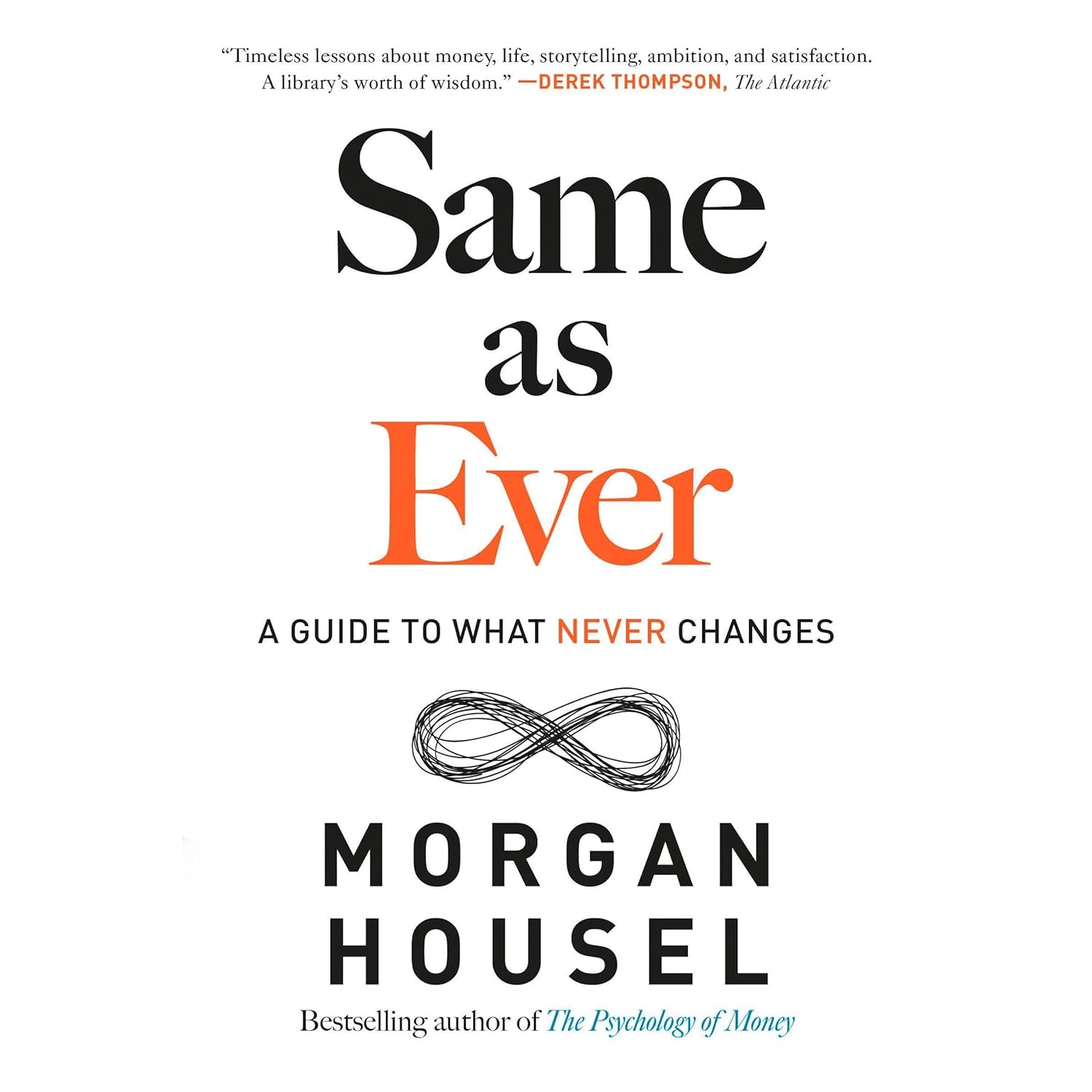
Same as Ever Book Summary
This Same as Ever Book Summary covers the key ideas, lessons, and takeaways in about 20 minutes.
The book encourages a shift from seeking certainty to building resilience. Instead of asking what will happen, ask how people will respond. Instead of optimizing for efficiency, optimize for survival. Instead of chasing the next trend, invest in principles that have endured for centuries. In a world obsessed with change, Housel reminds us that understanding what stays the same is the most powerful advantage of all.
Helps with these goals
Want the complete 20-minute summary?
- Full structured summary
- Video Summary
- Podcast Summary
- Audio summary
- Key takeaways
- Exercises
- Quiz
- Highlights and notes
- Ask the book with AI
What is in the Same as Ever book summary?
Below is a preview of Sumizeit’s expert-written summary of Same as Ever by Morgan Housel. The full summary covers the book’s key ideas in text, audio, and video.
In Same as Ever, Morgan Housel dismantles a deeply comforting illusion: the belief that the future can be reliably predicted if we just gather enough data, apply enough intelligence, or listen to the right experts. Instead of promising foresight, Housel offers something more durable—an understanding of what doesn’t change.
The book argues that while technology, markets, and headlines evolve rapidly, the forces that drive human behavior remain stubbornly stable. Fear, greed, insecurity, hope, incentives, ego, and social belonging have shaped decisions for centuries and will continue to do so long after current trends fade. The future, Housel suggests, is unknowable in its details but familiar in its structure.
Rather than chasing forecasts, Housel invites readers to study patterns. Instead of predicting events, he urges us to prepare for reactions. The result is not a roadmap to certainty, but a toolkit for resilience—one that applies equally to investing, careers, relationships, leadership, and personal decision-making.
This summary explores the core ideas of Same as Ever by reframing its insights in fresh language and structure. The goal is not to repeat Housel’s arguments, but to reinterpret them—revealing how timeless human behavior shapes risk, progress, success, failure, and long-term outcomes.
The Illusion of Prediction
Human beings crave certainty. We want to know what will happen next year, next decade, and ideally tomorrow. Entire industries are built around forecasting—economic outlooks, political predictions, market targets, trend reports. Yet history shows that the most consequential events are rarely foreseen.
Housel’s central claim is blunt: prediction fails not because people lack intelligence, but because reality is more complex than our models. The future is shaped by interactions between millions of decisions, incentives, accidents, and feedback loops. Small causes can trigger massive effects, while large efforts sometimes vanish without impact.
The problem is not randomness alone—it is our inability to recognize what we don’t know. We plan around visible risks and familiar scenarios, while the most damaging events often come from blind spots. By the time they appear, it’s too late to prepare.
The mistake, Housel argues, is trying to forecast outcomes rather than designing systems that survive surprise.
Why Risk Is Invisible Until It Isn’t
Risk is often misunderstood as something measurable and obvious. In reality, the greatest dangers tend to be unimagined. Crises rarely emerge from the scenarios people spend the most time worrying about. They emerge from assumptions no one thought to question.
Because unseen risks attract no preparation, they cause disproportionate damage. When systems are optimized for efficiency rather than durability, even small disruptions can cascade into catastrophe. This applies not only to financial markets, but also to careers, supply chains, governments, and personal lives.
Housel emphasizes that safety does not come from perfect prediction. It comes from excess capacity. Savings beyond what seems necessary. Time buffers. Flexibility. Redundancy. The ability to absorb shocks without collapsing.
Preparation, in this framework, is less about accuracy and more about humility—accepting that the world will surprise you, and planning accordingly.
Innovation Never Looks Important at First
Want the complete 20-minute summary?
- Full structured summary
- Video Summary
- Podcast Summary
- Audio summary
- Key takeaways
- Exercises
- Quiz
- Highlights and notes
- Ask the book with AI
Who should read Same as Ever?
Same as Ever is for anyone frustrated by the impossibility of predicting the future or tired of following experts who claim certainty they don't have. Whether you're an investor, entrepreneur, parent, or professional seeking a more durable framework for decision-making, this book offers practical wisdom rooted in unchanging human behavior rather than fleeting trends.
Why does Same as Ever matter?
In an era obsessed with forecasting and control, Morgan Housel's Same as Ever reminds us that understanding what doesn't change is more valuable than chasing what does. As technology accelerates and uncertainty multiplies, the ability to recognize timeless patterns of human behavior—fear, greed, incentives, storytelling—becomes your most reliable guide. This book replaces the false promise of prediction with the durable strength of resilience.
What are the key themes in Same as Ever?
- Prediction fails; understanding human behavior succeeds
- Risk is invisible until catastrophe strikes
- Small decisions compound into massive consequences
- Incentives drive behavior more reliably than intelligence or facts
- Stories defeat statistics in shaping belief and action
- Resilience matters more than optimization
- Timeless human patterns repeat across generations
- Complacency in success sows seeds of future crisis
What are the key lessons from the Same as Ever book summary?
The Illusion of Prediction
Forecasting fails not because people lack intelligence, but because reality is too complex—shaped by millions of interactions, accidents, and feedback loops that no model can capture. The solution is not better predictions but building systems that survive surprises.
Risk Hides in Blind Spots
The greatest dangers are rarely the ones we worry about; they emerge from assumptions we never thought to question. Safety comes not from perfect prediction but from excess capacity, flexibility, and the ability to absorb shocks.
Innovation Emerges Quietly
Breakthroughs rarely announce themselves dramatically; they accumulate silently through small overlapping advances until they reshape society. By the time their importance becomes obvious, the chance to predict them has passed.
Trivial Decisions Can Redirect History
Small choices—a delayed schedule, a casual conversation, a minor shortcut—can trigger irreversible chains of events because systems are nonlinear and causes rarely produce proportional effects. This unpredictability reinforces the need for resilience over control.
Significance Is Rarely Obvious in Real Time
Influential ideas often come from unexpected individuals operating outside traditional power centers, combining knowledge across domains or noticing overlooked problems. Their contributions shape the future invisibly until suddenly their value becomes clear.
Anticipate Behavior, Not Events
While predicting what happens is futile, you can reliably anticipate how people respond—through fear, opportunity, incentives, and storytelling. This shift from asking 'What will happen?' to 'How will people behave?' transforms uncertainty into a manageable condition.
Incentives Explain Almost Everything
Human behavior follows incentives with mechanical consistency—not just financial rewards but status, belonging, and identity. Understanding incentives clarifies seemingly irrational behavior and reveals why people cling to flawed beliefs that protect their social standing.
Narratives Outperform Data
People make sense of the world through compelling stories rather than spreadsheets; a good story feels true even when false, while nuanced explanations struggle for traction. Recognizing narrative power helps you resist persuasion based on emotion over evidence.
Experience Reshapes Belief
Direct exposure transforms perception in ways no theory can. Plans collapse when emotions intervene, risk tolerance changes after loss, and trauma influences future decisions—which is why people with identical information often behave entirely differently.
Greatness and Flaws Are Bundled Together
The same intensity that drives achievement can fuel obsession; discipline hardens into inflexibility; confidence becomes arrogance. Accepting role models as complete systems—strengths and weaknesses inseparable—creates more realistic standards and healthier relationships.
Invisible Costs Hide Behind Visible Success
Public narratives showcase outcomes while concealing private burdens; this asymmetry fuels comparison and dissatisfaction. Understanding that every achievement carries unseen costs reduces envy and reveals that setbacks are not proof of inadequacy but evidence of participation.
Expectations Shape Happiness More Than Outcomes
Satisfaction depends less on what you achieve than on the gap between expectation and reality; frustration follows when expectations rise faster than circumstances. Moderating expectations through realistic hope reduces emotional volatility without lowering ambition.
Hardship Is Essential, Not Accidental
Progress often emerges from struggle; comfort breeds complacency while stress sharpens focus and forces creativity. Reframing hardship as a cost of admission rather than an obstacle reveals that endurance is the process through which meaningful results are earned.
Balance Optimism With Realism
Blind optimism collapses under adversity while pure pessimism paralyzes action; the winning approach combines confidence in long-term progress with acceptance of short-term pain. This rare balance sustains resilience through both setbacks and success.
Certainty Is the Enemy of Clear Thinking
People prefer confident answers even when wrong because probabilities feel unsatisfying compared to definitive claims. Thinking in ranges rather than absolutes reflects reality more accurately and improves judgment without eliminating uncertainty.
Compounding Works Invisibly Until Suddenly It Doesn't
Meaningful change accumulates slowly while setbacks strike abruptly, distorting perception so we underestimate gradual progress and overreact to short-term losses. Patience and persistence matter far more than intensity when benefiting from compounding.
Long-Term Thinking Is Rare and Highly Rewarded
Few sustain long-term strategies through inevitable difficulty; those who do often outperform because they endure when others quit. Long-term thinking requires commitment to direction rather than speed and flexibility rather than rigid timelines.
Simplicity Beats Complexity
Complex systems feel sophisticated but introduce fragility; simple rules scale better and fail more gracefully. Focusing on core drivers rather than exhaustive optimization prevents complexity from obscuring what actually matters.
Slack Enables Resilience
Systems optimized for maximum efficiency leave no room for error; unused capacity often mistaken for waste is actually essential for durability. Allowing margin and imperfection protects against surprise in finances, schedules, and organizations.
Complacency in Success Seeds Future Crisis
Periods of stability often sow the seeds of breakdown as comfort reduces vigilance and risk increases unnoticed. Maintaining caution even during prosperity through continuous adaptation prevents the stagnation that invites collapse.
Want the complete 20-minute summary?
- Full structured summary
- Video Summary
- Podcast Summary
- Audio summary
- Key takeaways
- Exercises
- Quiz
- Highlights and notes
- Ask the book with AI
How can you apply ideas from Same as Ever?
- Build financial buffers and excess capacity into budgets rather than optimizing for maximum efficiency, allowing you to absorb unexpected shocks without catastrophic failure
- When facing disagreement, investigate the other person's experience and incentives rather than assuming ignorance; their history anchors their interpretation differently than yours
- Replace specific forecasts with scenario planning that explores how people typically behave during uncertainty—panic, follow narratives, rationalize self-serving decisions—and prepare for those reactions
- Examine your own incentives honestly: if your beliefs would change if your status or rewards changed, you may be rationalizing rather than reasoning
- Invest in timeless principles and compound results over decades rather than chasing the next big trend; persistence through difficulty outperforms intensity over short bursts
- Structure decisions to survive if your assumptions prove wrong; design systems that fail gracefully rather than catastrophically when surprises arrive
- Communicate through compelling narratives that resonate emotionally while remaining true rather than relying on data alone to persuade; stories drive behavior more reliably than statistics
What common mistakes do readers make with Same as Ever?
- Treating confident predictions as reliable forecasts instead of recognizing that the most consequential events are rarely foreseen and always arrive as surprises
- Optimizing systems for maximum efficiency and cutting all slack, leaving no capacity to absorb shocks or adapt when reality deviates from the plan
- Assuming your beliefs are objective when they actually reflect your incentives; failing to ask whether your opinions would change if your status or rewards changed
- Underestimating how much people respond to stories and emotions rather than facts, then being surprised when misleading narratives spread faster than accurate information
Sumizeit Exercises Apply what you've learned
Turn ideas from Same as Ever into action with a short guided reflection: identify the biggest takeaway, connect it to your life, and commit to one step you can take in the next 24 hours.
What is the expert analysis of Same as Ever?
Overview
Same as Ever by Morgan Housel stands as a significant contribution to contemporary literature on decision-making, risk, and human behavior. Housel, renowned for his incisive exploration of behavioral finance in The Psychology of Money, extends his inquiry beyond markets into the broader realm of human nature and resilience. His reputation as a thoughtful financial writer and behavioral thinker lends considerable weight to this work, which challenges prevailing assumptions about prediction and control in an uncertain world.
Core Thesis
At the heart of Same as Ever lies a profound skepticism toward the reliability of forecasting and a compelling argument for embracing the constancy of human behavior amid change. Housel contends that while technologies, markets, and external circumstances evolve rapidly, the psychological and social drivers of human action—fear, greed, incentives, ego, and belonging—remain remarkably stable. This constancy offers a more dependable framework for navigating uncertainty than attempts to predict specific outcomes. The book advocates shifting focus from forecasting events to anticipating human reactions, thereby fostering resilience through humility, preparation, and an appreciation for enduring patterns rather than transient trends.
Strengths
- Timeless Psychological Insight: Housel’s emphasis on immutable human traits provides a durable lens through which to understand risk and decision-making beyond fleeting market or technological changes.
- Interdisciplinary Approach: By weaving together elements of psychology, economics, history, and sociology, the book transcends narrow disciplinary boundaries, enriching its analysis and applicability.
- Practical Wisdom on Resilience: The advocacy for redundancy, flexibility, and humility in the face of uncertainty offers actionable guidance that resonates across domains—from investing to personal growth.
- Compelling Narrative Style: Housel’s use of relatable stories and historical examples effectively illustrates complex concepts, making abstract ideas accessible without oversimplification.
- Reframing of Innovation and Progress: The recognition that major breakthroughs often arise from unnoticed, incremental advances challenges the hype-driven narratives common in business and technology discourse.
Critiques & Counterarguments
- Potential Oversimplification of Prediction: While Housel rightly critiques the hubris of precise forecasting, some readers may find his dismissal of predictive models too categorical, overlooking advances in probabilistic forecasting and scenario planning that have practical utility.
- Limited Engagement with Complexity Science: The book could benefit from deeper integration with complexity theory and systems thinking, which offer nuanced frameworks for understanding nonlinear dynamics and emergent phenomena that Housel touches upon but does not fully explore.
- Underrepresentation of Structural Factors: The focus on individual psychology and behavior risks underestimating the role of institutional, technological, and environmental structures that also shape outcomes and can be subject to strategic intervention.
- Competing Schools of Thought: Rationalist perspectives in economics and decision theory emphasize optimization under uncertainty, which contrasts with Housel’s emphasis on humility and resilience; this tension invites debate about the balance between prediction and preparation.
- Empirical Validation: Some assertions, such as the inevitability of hardship as a feature of progress, could be challenged by examples of innovation driven by collaborative, low-conflict environments or by empirical studies highlighting the benefits of stability and incremental improvement.
Who Should Read This
Same as Ever is ideally suited for readers who seek a sophisticated yet accessible exploration of uncertainty and human behavior. It will resonate with investors, business leaders, policymakers, and anyone interested in the psychological underpinnings of decision-making. Those fatigued by the endless quest for predictive certainty will find solace and practical guidance in Housel’s call for resilience and humility. Additionally, readers of behavioral economics, philosophy of risk, and self-improvement literature will appreciate the book’s interdisciplinary richness and its challenge to conventional wisdom about control and foresight.
Frequently asked questions about the Same as Ever book summary
What is Same as Ever about?
Same as Ever by Morgan Housel argues that while technology, markets, and events change constantly, the patterns of human behavior that drive decisions remain remarkably stable across centuries. Rather than promising to predict the future, the book teaches readers to understand what doesn't change—incentives, fear, greed, storytelling, and social belonging—and use that knowledge to build resilience and make better decisions across investing, careers, relationships, and life.
Who should read Same as Ever?
Same as Ever is for anyone frustrated by failed forecasts and expert predictions, including investors, entrepreneurs, leaders, and professionals seeking a more durable decision-making framework. The book appeals to readers tired of chasing trends who want practical wisdom rooted in timeless human behavior rather than fleeting certainty.
What are the main takeaways from Same as Ever?
The main takeaways include: prediction fails because reality is too complex; risk hides in invisible blind spots until catastrophe strikes; small decisions compound into massive consequences; incentives and stories drive behavior more reliably than facts; resilience matters more than optimization; and understanding what doesn't change is more valuable than chasing what does. The book shifts focus from seeking certainty to building systems that survive surprise.
How does Morgan Housel explain why predictions fail?
Housel argues that prediction fails not because people lack intelligence, but because reality is shaped by millions of interactions, incentives, accidents, and feedback loops that no model can accurately capture. Small causes trigger massive effects while large efforts sometimes vanish without impact, making it impossible to reliably identify which decisions will matter most or what the future will bring.
What does Same as Ever say about risk and resilience?
Same as Ever explains that the greatest risks are invisible until they strike because they emerge from assumptions no one questioned. Safety comes not from perfect prediction but from excess capacity, flexibility, and redundancy that allow you to absorb shocks. Building buffers and slack into systems—financial, organizational, or personal—creates durability where optimization creates fragility.
How do incentives shape behavior according to Same as Ever?
Housel argues that incentives explain almost everything about human behavior—not just financial rewards but status, belonging, identity, and reputation often exert stronger influence. People respond to incentives with mechanical consistency, which means understanding what rewards or threatens someone's social standing clarifies why they cling to certain beliefs or defend particular ideas, even when those beliefs are demonstrably false.
What is the difference between predicting events and anticipating behavior?
Same as Ever argues that while predicting what will happen is futile because outcomes depend on too many variables, you can reliably anticipate how people will behave in response—through fear, greed, following narratives, and responding to incentives. This shift from asking 'What will happen?' to 'How will people respond?' transforms uncertainty from an unmanageable threat into a navigable condition.
Does Same as Ever recommend being pessimistic about the future?
No; Housel advocates balancing optimism with realism—confidence in long-term progress combined with acceptance of short-term pain and inevitable difficulty. This approach sustains resilience through both setbacks and success because you expect challenges without surrendering hope, prepare for difficulty without assuming defeat, and endure when others quit.
About Sumizeit
Sumizeit is a profitable Scomy LLC company based in Miami, Florida. It has been helping readers learn from nonfiction books for 7 years with expert-written summaries in text, audio, podcast, and video.
Want the complete 20-minute summary?
- Full structured summary
- Video Summary
- Podcast Summary
- Audio summary
- Key takeaways
- Exercises
- Quiz
- Highlights and notes
- Ask the book with AI
Here's why readers love Sumizeit
Join thousands of learners getting smarter every day
"Great experience. Detailed summaries. Loved the gamification feature. Makes learning fun. Good customer service. I recommend Sumizeit to anyone. You'll learn a lot."
"I always felt busy but still wanting to keep up with the book discussion in my friend group. This was a great supplement to help me keep reading the books I find fun while keeping up with important books."
"I love this website. Instead of scrolling social media, I find myself learning a lot. I use it everyday. I recommend this app for anyone who is too busy and wants to get up to speed with their favorite books."
Same as Ever Book Summary PDF
Looking for a Same as Ever Book Summary PDF you can save and revisit offline? Our Same as Ever Book Summary PDF captures the book’s core ideas in a clean, printable format — the key frameworks, takeaways, and structure without the fluff. Download the Same as Ever Book Summary PDF when you want a reference you can annotate, share with your team, or review on the go. Get your Same as Ever Book Summary PDF from the download page below.
Download Same as Ever Book Summary PDFPeople also liked these summaries
Readers who explored Same as Ever often enjoyed these titles next.

Want the complete 20-minute summary?
- Full structured summary
- Video Summary
- Podcast Summary
- Audio summary
- Key takeaways
- Exercises
- Quiz
- Highlights and notes
- Ask the book with AI
Featured Book Titles
Popular Book Summaries at sumizeit, leading book summary app