


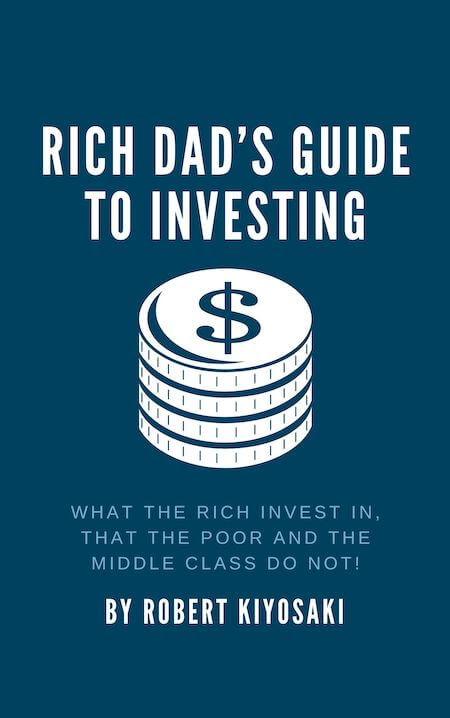
Prefer the print book? Buy on Amazon
As an Amazon Associate, Sumizeit earns from qualifying purchases.
Rich Dad’s Guide to Investing Book Summary
This Rich Dad’s Guide to Investing Book Summary covers the key ideas, lessons, and takeaways in about 20 minutes.
Rich Dad’s Guide teaches financial literacy and asset building.
At the end of the day, Kiyosaki urges readers to make a choice: do you want to be comfortable, secure, or rich? It may not be possible to be all three.
Helps with these goals
Want the complete 20-minute summary?
- Full structured summary
- Video Summary
- Podcast Summary
- Key takeaways
- Exercises
- Quiz
- Highlights and notes
- Ask the book with AI
Want a Free Weekly Read?
Get a free summary every week straight to your mailbox.
Preview the Rich Dad’s Guide to Investing book summary
Below is a preview of Sumizeit’s comprehensive human-written summary of Rich Dad’s Guide to Investing by Robert Kiyosaki. The full summary is 15-20 minutes long and covers the book’s key ideas in text, audio, visual, and video formats. Unlock the full 20 Minute Summary
Drawing heavily from the influence of his “rich dad”, a family friend who was highly successful in amassing wealth, author Robert Kiyosaki explains how the decisions made by people who are monetarily prosperous are significantly different from the choices of the poor and middle-class communities. He provides a detailed account of how the ways in which an individual approaches financial decision making directly impact the final result.
The Richest 10 Percent
We all know that there’s inequality in the world, but some of us may be less aware of how much of an economic disparity actually exists. The facts are startling: ten percent of the world’s population holds ninety percent of its wealth. This principle remains true even when you separate out various industries, such as athletes, musicians, actors, and investors. In each of these sub-groups, the numbers hold: ten percent holds ninety percent of the capital overall.
So, how does this happen?
For starters, investing is not even an option when you are poor.
Sure, there are legitimate reasons for not letting people who lack funds to make investments that could end up putting them in an even worse position later on. However, these rules also prevent the poor from the possibility of investing successfully and coming out on top.
In order to illustrate some investment ‘rules’, let’s take a look at an example. You may want to invest in a fund that has huge payout potential. However, the opportunity requires an initial investment of 100k. If you are unable to meet this minimum requirement, you lose your chance to reap the possible benefits of this high risk/high reward investment.
Similarly, in order to qualify for certain investment opportunities, you may need your total household earnings to be above a certain threshold.
If you are not wealthy, you are automatically excluded from these opportunities. However, you still have the ability to participate in less risky--but also less profitable--investment opportunities, because there is not likely to be a significant cost upfront.
You may have heard the saying, “the rich get richer.” It is because wealth is a cycle. If you are not rich, you inherently have less ability to access the avenues that could provide additional wealth.
Think Like the Rich
We know that the rich dress differently and act differently, but it is perhaps less obvious to the casual observer that the rich think differently than the rest of us as well.
The rich tend to make assertions like this:
“Get an education, work hard, save money. Then you’ll be fine.”
While this advice is well-intended, it fails to account for the privilege. People in middle to upper-class families are told this sort of thing, while folks in lower-income households are more likely to be told they just need to get a job, whatever it is. Less emphasis is placed on the rest of it.
People who come from lower-income households are less likely to own their businesses at any point in life.
Want the complete 20-minute summary?
- Full structured summary
- Video Summary
- Podcast Summary
- Key takeaways
- Exercises
- Quiz
- Highlights and notes
- Ask the book with AI
Who should read Rich Dad’s Guide to Investing?
Rich Dad's Guide to Investing is ideal for entrepreneurs, business owners, and individuals seeking to build wealth through strategic investment rather than traditional employment. This book appeals to anyone frustrated with conventional financial advice and ready to understand how the wealthy actually think and operate financially.
Why does Rich Dad’s Guide to Investing matter?
In an economy where wealth concentration continues to widen, understanding investment principles and financial literacy has become essential for anyone serious about building lasting wealth. Robert Kiyosaki's framework reveals why traditional paths—saving, working hard, and relying on pensions—often fail to create significant financial growth, making this knowledge increasingly critical in today's uncertain economic climate.
What are the key themes in Rich Dad’s Guide to Investing?
- The fundamental difference between how the rich and poor think about money
- Financial literacy and understanding assets versus liabilities
- The power of starting businesses as wealth-building vehicles
- The importance of sales, communication, and leadership skills
- Strategic use of leverage and tax knowledge to maximize returns
- Building systems and teams rather than working alone
Want the complete 20-minute summary?
- Full structured summary
- Video Summary
- Podcast Summary
- Key takeaways
- Exercises
- Quiz
- Highlights and notes
- Ask the book with AI
How can you apply ideas from Rich Dad’s Guide to Investing?
- Audit your personal finances to identify what you own that generates positive cash flow (assets) versus what drains money (liabilities), then shift your purchasing toward income-generating assets
- Calculate your debt-to-equity ratio to understand your current leverage position and make informed decisions about whether to take on more or less debt
- Start a side business in your area of expertise while maintaining employment to test market demand before making a full-time commitment
- Develop a sales training program or course for yourself and any team members to build communication skills and overcome rejection sensitivity
- Study tax law and corporate structure options available in your jurisdiction to understand how sophisticated investors legally minimize taxes and maximize returns
- Build a team around your business mission by identifying gaps in your knowledge and hiring specialists rather than trying to be expert at everything
- Evaluate potential investments using cash-on-cash return and return on equity metrics rather than emotional or superficial reasoning
What common mistakes do readers make with Rich Dad’s Guide to Investing?
- Confusing liabilities with assets, such as considering a primary residence an asset when it primarily drains cash through mortgage, taxes, and maintenance
- Relying exclusively on employment income and savings without building business or investment income streams, which severely limits wealth-building potential
- Avoiding business ownership due to fear of risk while accepting the greater structural risk of depending on a single employer for income
- Neglecting to develop sales and communication skills, which are essential for business success regardless of product quality or technical expertise
Sumizeit Exercises Apply what you've learned
Turn ideas from Rich Dad’s Guide to Investing into action with a short guided reflection: identify the biggest takeaway, connect it to your life, and commit to one step you can take in the next 24 hours.
What is the expert analysis of Rich Dad’s Guide to Investing?
Overview
Rich Dad’s Guide to Investing is authored by Robert Kiyosaki, a prominent figure in personal finance education known for his accessible and provocative approach to wealth-building. Building on the success of his earlier works, Kiyosaki leverages the persona of his “rich dad” to distill complex financial concepts into practical advice. This book is significant for its focus on the mindset and strategies that differentiate the wealthy from the poor and middle class, emphasizing financial literacy, investment acumen, and entrepreneurial thinking as cornerstones of wealth accumulation.
Core Thesis
Kiyosaki’s central argument is that wealth is not merely a function of income or hard work but fundamentally a result of how individuals think about and approach money, investing, and business. He posits that the rich operate under a distinct set of principles—such as prioritizing assets over liabilities, leveraging financial education, and adopting entrepreneurial risk-taking—that enable them to access and grow wealth. The book underscores the systemic barriers that limit investment opportunities for the poor and middle class and advocates for cultivating financial literacy and a strategic mindset to break into the cycle of wealth creation.
Strengths
- Accessible Financial Education: Kiyosaki breaks down complex financial metrics and investment concepts (e.g., debt-to-equity ratio, cash-on-cash return) into digestible explanations, making them approachable for readers without formal finance backgrounds.
- Mindset Emphasis: The book compellingly highlights the psychological and behavioral distinctions between different economic classes, encouraging readers to rethink conventional wisdom about work, saving, and investing.
- Pragmatic Entrepreneurial Advice: By profiling real-world examples such as Michael Dell and Jeff Bezos, Kiyosaki provides tangible inspiration for starting businesses incrementally and leveraging them as assets.
- Holistic Approach: The integration of leadership, communication skills, and sophisticated investor strategies enriches the financial narrative, illustrating that wealth-building is multifaceted.
Critiques & Counterarguments
- Oversimplification of Wealth Dynamics: Kiyosaki’s binary framing of “rich” versus “poor” thinking risks glossing over the nuanced socio-economic factors and structural inequalities that influence financial outcomes beyond individual mindset.
- Limited Empirical Support: The book relies heavily on anecdotal evidence and the “rich dad” archetype rather than rigorous data or peer-reviewed research, which may weaken the generalizability of its claims.
- Risk Underestimation: The encouragement to embrace entrepreneurship and investment may underplay the risks and failures that many face, especially without adequate safety nets or capital, potentially leading to unrealistic expectations.
- Contrasting Financial Theories: Behavioral economists emphasize that cognitive biases and systemic barriers often inhibit wealth accumulation irrespective of mindset, challenging the notion that thinking like the rich is sufficient.
- Alternative Wealth-Building Models: Other schools of thought advocate for structural reforms, social safety nets, and progressive taxation as essential to addressing wealth inequality, perspectives largely absent from Kiyosaki’s individualistic framework.
Who Should Read This
This book is ideal for aspiring investors, entrepreneurs, and individuals seeking an introductory yet motivational guide to financial literacy and wealth-building strategies. It particularly suits readers who appreciate a mindset-focused approach and are open to reexamining conventional financial advice. However, those looking for rigorous academic analysis or comprehensive socio-economic critiques may find the book’s approach somewhat limited. Ultimately, it serves as a useful starting point for readers eager to cultivate a proactive financial mindset and explore entrepreneurial avenues.
Frequently asked questions about the Rich Dad’s Guide to Investing book summary
What is Rich Dad's Guide to Investing about?
Rich Dad's Guide to Investing by Robert Kiyosaki explains how wealthy individuals think differently about money, assets, and business compared to the poor and middle class. The book provides practical frameworks for understanding financial concepts like leverage, return on equity, and cash-on-cash return, while emphasizing that building wealth requires entrepreneurship, communication skills, and strategic financial knowledge rather than traditional employment alone.
Who should read Rich Dad's Guide to Investing?
This book is ideal for entrepreneurs, business owners, and anyone seeking to build wealth beyond traditional employment income. It's particularly valuable for those frustrated with conventional financial advice and ready to understand wealth-building strategies used by the wealthy, including how to start businesses, leverage assets, and develop the mindset required for significant financial growth.
What are the main takeaways from Rich Dad's Guide to Investing?
Key takeaways include understanding the difference between assets and liabilities, recognizing that the wealthy have access to exclusive investment opportunities unavailable to others, and realizing that starting a business offers greater wealth-building potential than traditional employment. Kiyosaki emphasizes that financial success requires developing sales and communication skills, building strong teams, understanding financial metrics like return on equity, and making the choice to pursue wealth rather than mere comfort or security.
Why do the rich get richer according to Kiyosaki?
According to Rich Dad's Guide to Investing, wealth is cyclical because the wealthy have access to high-return investment opportunities with high minimum requirements that exclude the poor and middle class. Once you have initial capital, you can access exclusive investments and use leverage strategically, creating compounding advantages. Meanwhile, less wealthy individuals are limited to lower-return options, making it structurally easier for the rich to accumulate more wealth.
What financial metrics does Kiyosaki emphasize for evaluating investments?
Kiyosaki highlights several key metrics: debt-to-equity ratio (showing leverage risk), return on equity (typically 15-20% is solid), and cash-on-cash return (the percentage of your investment returned annually in cash flow). Understanding these metrics allows investors to evaluate opportunities objectively rather than emotionally and to understand whether an investment truly generates the returns it claims.
How does Kiyosaki recommend starting a business with limited capital?
Kiyosaki suggests starting a business as a side hustle while maintaining your current job, as demonstrated by entrepreneurs like Michael Dell and Jeff Bezos. This approach allows you to test market demand, validate your business idea, and generate initial revenue without the financial pressure of immediate profitability, significantly reducing the risk of business failure.
What role does communication play in building wealth according to Rich Dad's Guide to Investing?
Communication and sales skills are described as absolutely essential for wealth building and entrepreneurial success. Kiyosaki emphasizes that entrepreneurs and their teams must develop the ability to communicate product value and overcome fear of rejection, suggesting formal sales training programs as critical investments in business success.
About Sumizeit
Sumizeit is a profitable Scomy LLC company based in Miami, Florida. Our founders, Clemens Raemy and Weina Scott, are successful entrepreneurs with several exits. Sumizeit is a popular book summary app / micro learning app used by busy professionals and entrepreneurs with over 2,500 non-fiction book summaries and 10,000 podcast summaries in text, audio, visual, podcast, and video format. We also have stellar retention tools to make ideas stick - such as flashcards with spaced repetition, quizzes, streaks, highlighting and notes, daily challenges, riddles, mini-courses, meditation, and more. You won't only learn the idea, but also remember it. Over 90% of our users change their habits with Sumizeit.
Upgrade Now
Want the complete 20-minute summary?
- Full structured summary
- Video Summary
- Podcast Summary
- Key takeaways
- Exercises
- Quiz
- Highlights and notes
- Ask the book with AI
Here's why readers love Sumizeit
Join thousands of learners getting smarter every day
"Great experience. Detailed summaries. Loved the gamification feature. Makes learning fun. Good customer service. I recommend Sumizeit to anyone. You'll learn a lot."
"I always felt busy but still wanting to keep up with the book discussion in my friend group. This was a great supplement to help me keep reading the books I find fun while keeping up with important books."
"I love this website. Instead of scrolling social media, I find myself learning a lot. I use it everyday. I recommend this app for anyone who is too busy and wants to get up to speed with their favorite books."
Rich Dad’s Guide to Investing Book Summary PDF
Looking for a Rich Dad’s Guide to Investing Book Summary PDF you can save and revisit offline? Our Rich Dad’s Guide to Investing Book Summary PDF captures the book’s core ideas in a clean, printable format — the key frameworks, takeaways, and structure without the fluff. Download the Rich Dad’s Guide to Investing Book Summary PDF when you want a reference you can annotate, share with your team, or review on the go. Get your Rich Dad’s Guide to Investing Book Summary PDF from the download page below.
Download Rich Dad’s Guide to Investing Book Summary PDFPeople also liked these summaries
Readers who explored Rich Dad’s Guide to Investing often enjoyed these titles next.


Want the complete 20-minute summary?
- Full structured summary
- Video Summary
- Podcast Summary
- Key takeaways
- Exercises
- Quiz
- Highlights and notes
- Ask the book with AI
Featured Book Titles
Popular Book Summaries at sumizeit, leading book summary app