

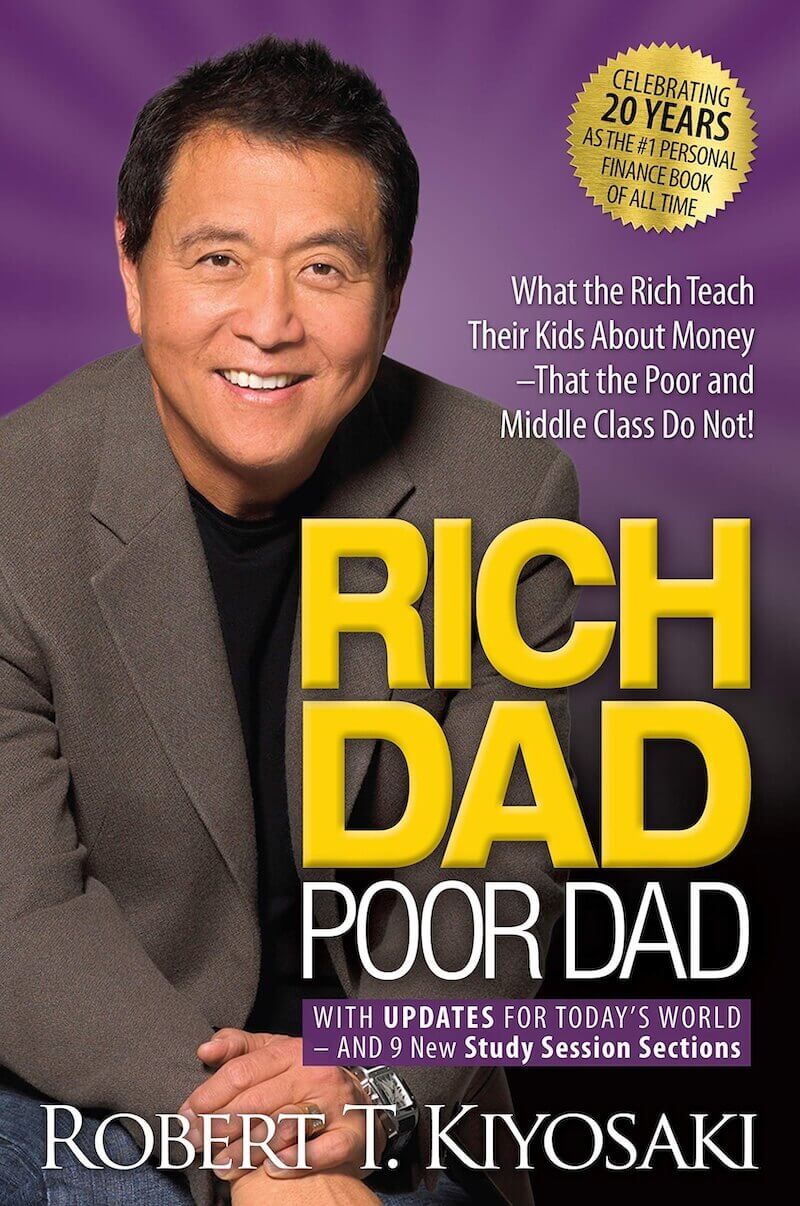
"Rich Dad Poor Dad" is a personal finance book written by Robert Kiyosaki. The book shares Kiyosaki's experiences growing up with two fathers: his real father (poor dad) and the father of his best friend (rich dad). Through contrasting their different approaches to money and wealth, Kiyosaki imparts valuable financial lessons.
In "Rich Dad Poor Dad," Kiyosaki challenges conventional wisdom about money and highlights the importance of financial literacy and building assets. He encourages readers to adopt a mindset that focuses on creating passive income through investments and entrepreneurship, rather than relying solely on a paycheck.
The book covers various topics, including the importance of financial education, the difference between assets and liabilities, and the power of taking calculated risks. Kiyosaki emphasizes the value of financial independence and escaping the "rat race" of working for money.
"Rich Dad Poor Dad" serves as a motivational guide, providing readers with insights and strategies to change their mindset and approach to money. By embracing the principles outlined in the book, readers can gain a better understanding of how to achieve financial success and create a more secure future.
Helps with these goals
As an Amazon Associate, Sumizeit earns from qualifying purchases.
What do rich parents teach their children that the poor don’t? Robert Kiyosaki uncovers this difference through a series of parables based on his own boyhood. The unnamed main character’s father, known as Poor Dad, teaches him little about money. But when he lands a summer job at a small restaurant owned by a friend’s father, he gains another father figure in his boss, known as Rich Dad. Rich Dad teaches the boys about the value of financial smarts. Through these lessons, the boy learns about the ways rich people pass on their wisdom and set their children up for financial success.
Many parents trust the school system to teach their children financial literacy. In reality, schools primarily teach children traditional middle-class values: stay in school, get good grades, and go to college. Kiyosaki notes that this sort of mentality may help students find work eventually, but it hardly teaches them anything about how to escape financial struggle altogether.
Even the students who follow these guidelines exactly may end up living paycheck to paycheck, unable to grow their money, or save for important future goals like retirement. In fact, nearly 50% of people in the United States are without a pension, while up to 80% have ineffective pension plans. What can we do to break out of this cycle?
Kiyosaki explains that the first step to growing the rich is taking financial education into our own hands. We must not be afraid to transcend traditional thinking and seek out better resources. Self-education can mean a lot of things; it could mean reading the ideas from books like this one, seeking out mentors who grew their wealth, or watching lectures. Kiyosaki advises us to take time to teach ourselves about accounting, economics, investing, and tax law. In carefully learning as much as we can about each of these subjects, we expose ourselves to the reality of money in this day and age.
Kiyosaki explains that in order to know the state of our finances, we have to understand that everything is split into two categories: assets and liabilities. Many people don’t know how to differentiate the two, and therefore have little idea of how their money is working for them.
So what is the difference? An asset is something that puts money into our accounts. This could be everything from an investment portfolio to a nice computer that allows you to work without interruption. A liability, on the other hand, is something that takes money from our accounts. This could include debts like student loans, owed taxes, or credit card bills.
Rich people understand that the more assets they have, the more their money is going to grow in the long run. They focus on growing their assets while reducing their liabilities as much as possible. Kiyosaki recommends that everyone appraise their finances to find out how much of the money they have in each category. From this point, he says, we can start thinking of them as rich people do.
He notes that assets don’t necessarily have to be in the form of money— they can also be things like lifestyle or mindsets that help us grow. According to Kiyosaki, the most important asset a person can have is financial education. To be sure, nothing makes you more money in the long run than solid financial know-how.
When appraising our finances we may find that some things we thought were assets may secretly be liabilities. Kiyosaki gives an example of houses with mortgages. When the hefty mortgage, taxes, and upkeep fees are totaled, a house may be costing us more than a rental. By looking closely at what’s swallowing our money, we can avoid these mistakes.
According to Kiyosaki, money problems can be traced back to four personality flaws. These flaws are natural to most of us but should be kept in check to avoid a harmful mentality towards our money. By admitting how these flaws affect our money, we can address them and then continue towards success.
The first flaw is laziness. Think about why you’ve avoided certain responsibilities related to your money. It’s likely because it seemed too complicated at first glance, and it was easier to take the less effective path. By avoiding these seemingly difficult inquiries, we cannot break out of our old and unfulfilling ways. Think about what you’re avoiding out of laziness: maybe it’s starting a business or learning about stock trading. This avoidance could be the difference between a life of financial struggle and a wealthy one. Stop avoiding these steps toward improvement. Once you get up and start learning, you will notice that finances aren’t as complicated as they seem.
Arrogance also stands in the way of improvement. Kiyosaki defines arrogance as an equation: ignorance + ego. By refusing to admit that we do not know enough, we deny ourselves opportunities to grow. To see the reality of our finances we must investigate them truthfully and understand there is always a lot left to learn.
The third personality flaw is fear. Many people look at stocks and remember the stock market crashes throughout their lives: they fear that if they invest, the money will disappear. Kiyosaki says that this fear holds us back from trying methods that have made many people wealthy. By educating ourselves, we can counter fear by demystifying things like compound interest or retirement accounts. Although there may be a risky element to investing, no one ever got rich without taking these sorts of risks.
The final flaw is greed. When our incomes increase, we feel tempted to start spending on exciting status symbols. But Kiyosaki warns that purchasing more and more things drains the money from our lives that could’ve been invested into assets, bringing us closer to financial independence. Instead of wanting more and more material things, we should spend our money mindfully, for the sake of improving our lives rather than accumulating more stuff.
Becoming wealthy takes a long time and is often a process that takes decades. Kiyosaki advises that the earlier we start the better (starting at 20 makes us far more likely to become millionaires than starting at 30). But as the years pass, we may feel discouraged in the face of setbacks or doubts. To avoid this burn-out, we can form a solid understanding of why we want to become wealthy in the first place.
Wealth doesn’t necessarily mean having millions in our bank accounts. It could mean having the freedom to travel or work fewer hours. In general, the goal of financial independence is to maximize our well-being and the ability to do the things we love without barriers.
To understand what we want, Kiyosaki recommends writing a list of financial wants and don’t-wants to articulate financial goals. Wants could involve paying off debt in the next three years or investing in real estate while don’t-wants could be avoiding living paycheck to paycheck or having enough money to spend more time on art projects. In times of trouble, reference this list to keep you motivated.
After setting these goals, start building your financial intelligence around them. If you want more money to live comfortably in your city, read books about how to double your income, or about how investing can produce a passive income stream. If you don’t want to take on a damaging mortgage, start reading about what the most sensible plans for buying a house are.
Another way to stay motivated is by learning to treat yourself for all your hard work. Kiyosaki details a practice called “paying yourself”, where once you receive a paycheck, you first buy something you’d really like before paying off your bills or sending money to our assets. In doing this, we invest in our well-being. We also learn more about what sorts of things we’d like to afford in order to live well and whether we are on-track to affording them.
Finally, choose your friends wisely. Friends who also understand the importance of money will help us feel supported in difficult times and also give us a place to share the things we learn. Learning and growing are always better in good company.
We may think of day jobs as our ticket to making money, but wealthy people know that this isn’t the only way to create income for ourselves. To grow what we already have, we have to invest in a business.
A business doesn’t necessarily mean owning a restaurant or a start-up. It could simply mean the basket of assets we maintain that grow our money through increasing value, like a stock or real estate portfolio. Rich people know to continue to invest in their assets because they treat the growth of their assets as a business.
Think of your profession as paying both your bills and funding your personal business. After expenses are paid, move leftover income towards purchasing more assets or growing a side hustle. Most wealthy people made their wealth by trying different business ideas. Eventually, a business can generate more income than our professions ever would.
When considering which jobs to take, the salary and benefits are often the first things we look to. But rich people know that this may not be the smartest priority.
Recall Kiyosaki’s assertion that education is the most important asset. He asks us to consider that the information learned on a job may be a larger asset in the long run. Taking an internship to learn about industry fit may prevent disappointment when committing hours to an unfulfilling job, or expose us to smart and inspiring people. Working with a startup versus at an established company may allow us to wear many hats and grow rapidly as multi-talented workers, despite the pay cut required to take the job.
The main character of Rich Dad Poor Dad learned this lesson himself when working low wages at his summer job but being exposed to the invaluable wisdom from Rich Dad on a daily basis.
All financially independent people got to that point by taking risks. Rich people teach their children to take risks often, especially when they are young. In youth, if a risk doesn’t pay off, recovery is a matter of brushing yourself off and trying something else.
Risk-taking can start with ceasing to live in fear of investments, and instead of investigating what the market looks like right now. Only those who take risks have a chance to grow their money this way, where people who leave their money in checking and savings accounts don’t have the opportunity to experience returns that are nearly as high.
Risk-taking also involves always looking for interesting opportunities on the horizon. This could involve looking for business opportunities that seem exciting but under-explored or investing your money into a small company you believe in. Rich people tend to see opportunities where no one else sees them because they are willing to try. In being brave, we open ourselves up to many possibilities and financial futures which don’t exist in the safety of traditional thinking.
The main difference between rich and poor people shows up in their thinking and the lessons they bestow on their children. In order to become financially independent, you must decide on your financial goals, overcome a fear of failure, and begin to build financial intelligence. Learn about accounting, investing, real estate, and tax law. When continuing towards wealth, don’t be afraid of risk-taking and stay motivated as the journey is long. Remain a lifelong student of economics and finance, looking for learning opportunities in every job or experience that comes your way.
Robert Kiyosaki is a best-selling author and businessman. He founded Rich Global LLC and Rich Dad Company, a private education company that provides financial education through books and videos. He also created multiple educational software games on financial and business ideas and is the author of more than 26 books.
Looking for a Rich Dad Poor Dad Book Summary PDF you can save and revisit offline? Our Rich Dad Poor Dad Book Summary PDF captures the book’s core ideas in a clean, printable format — the key frameworks, takeaways, and structure without the fluff. Download the Rich Dad Poor Dad Book Summary PDF when you want a reference you can annotate, share with your team, or review on the go. Get your Rich Dad Poor Dad Book Summary PDF from the download page below.
Download Rich Dad Poor Dad Book Summary PDFGet full access to 2,500+ book summaries with audio and video
Start Free Trial →