


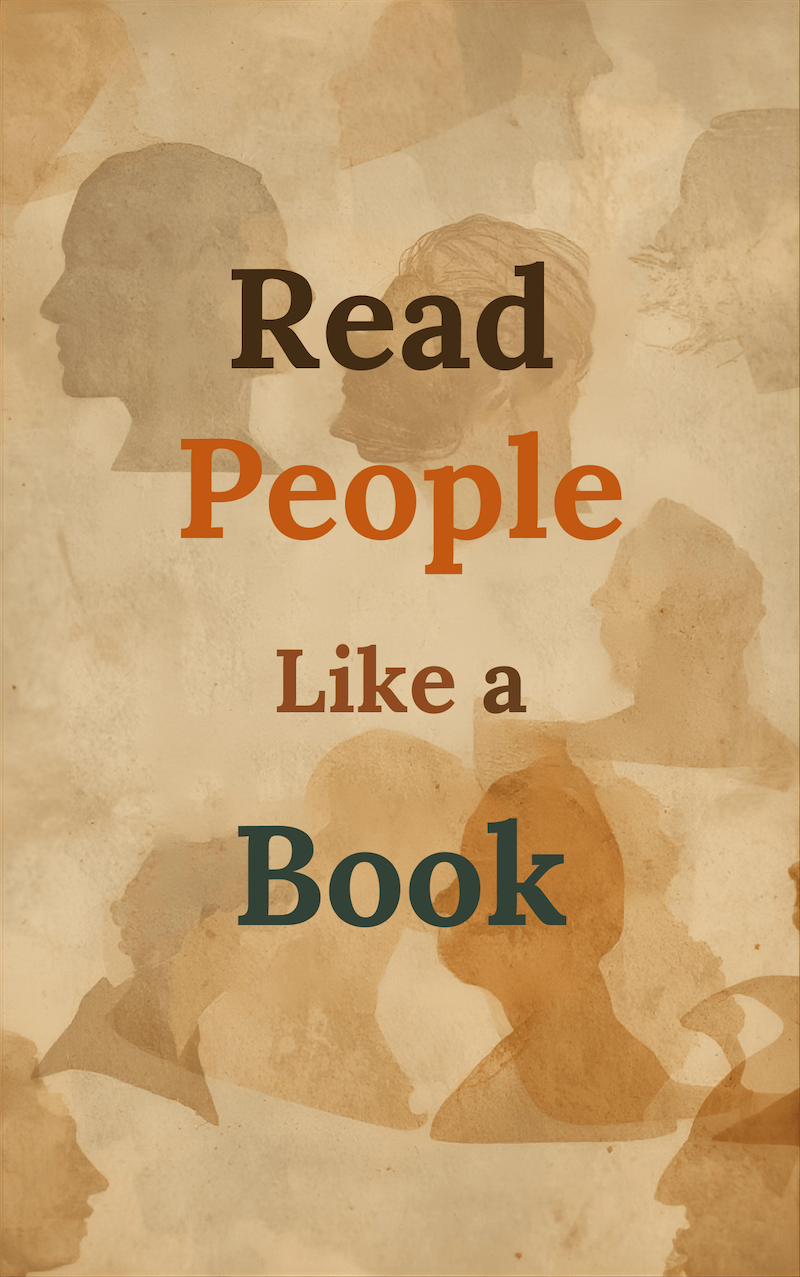
Prefer the print book? Buy on Amazon
As an Amazon Associate, Sumizeit earns from qualifying purchases.
Read People Like a Book Book Summary
This Read People Like a Book Book Summary covers the key ideas, lessons, and takeaways in about 20 minutes.
Short Description:
Learn how to decode body language, motives, and lies to understand people better.
Reading people effectively requires patience and humility. No single gesture or statement reveals the truth about someone. Instead, accurate interpretation emerges from recognizing patterns across multiple signals—body language, speech, emotional tone, and situational context. By paying attention to these clues while remaining aware of personal biases, anyone can improve their ability to understand others.
Helps with these goals
Preview the Read People Like a Book book summary
Below is a preview of Sumizeit’s comprehensive human-written summary of Read People Like a Book by Patrick King. The full summary is 15-20 minutes long and covers the book’s key ideas in text, audio, visual, and video formats. Unlock the full 20 Minute Summary
Read People Like a Book by Patrick King explains how people reveal their thoughts, emotions, and motivations through subtle signals in their behavior, speech, and appearance. The book explores how to interpret these signals to better understand others, navigate social situations, build relationships, and detect dishonesty.
Rather than claiming people can literally know someone’s mind, King argues that careful observation and psychological insight allow us to make informed interpretations about what others are thinking or feeling. Human beings constantly communicate information—often unconsciously—and those who learn to notice patterns can become significantly better at understanding others.
This summary explores the core ideas of the book, including how to avoid common mistakes in judging others, the psychological forces that shape behavior, how personality influences actions, how to interpret nonverbal communication, and how to detect deception.
Why Reading People Is Harder Than It Seems
Most individuals believe they are good at judging character. However, the reality is that people frequently misinterpret others’ behavior. We often make snap judgments based on limited evidence and fill in gaps with assumptions.
King explains that interpreting another person accurately requires patience and attention to several key principles.
First, every person has a behavioral baseline—their normal way of speaking, moving, and reacting. Without knowing this baseline, unusual behavior can be misread. For example, a highly energetic person may appear excited about something when they are simply behaving normally.
Second, accurate interpretation requires multiple pieces of evidence. A single gesture or statement rarely provides enough information to determine what someone is thinking or feeling. Observers should collect multiple signals over time before forming conclusions.
Third, behavior must always be interpreted within its context. A restless individual might appear anxious, but the cause could be as simple as being cold or uncomfortable. Situational factors can drastically change how actions should be interpreted.
Finally, the observer must recognize their own biases. Personal beliefs, stereotypes, and emotional reactions often distort our interpretation of others. If someone tends to distrust people, they may incorrectly interpret neutral behaviors as suspicious.
Learning to read people effectively therefore begins with humility. Instead of assuming we already understand others, we must carefully observe patterns, context, and evidence before forming conclusions.
The Hidden Forces Behind Human Behavior
To understand why people act the way they do, King argues we must examine the motivations operating beneath the surface. Behavior is rarely random; it is usually driven by psychological needs and internal desires.
Several key forces influence human action.
The Influence of Hidden Desires
One of the deepest sources of motivation lies within the subconscious. Many desires, fears, and insecurities operate outside conscious awareness, yet they still influence behavior.
Psychologist Carl Jung described this hidden dimension as the shadow, which contains thoughts and urges people prefer not to acknowledge. These might include creative ambitions, feelings of inadequacy, resentment, or hidden aspirations.
Because individuals suppress these impulses, they often emerge indirectly. Someone who secretly wants recognition as an artist might criticize another person’s creative success.
Want the complete 20-minute summary?
- Full structured summary
- Video Summary
- Podcast Summary
- Audio summary
- Key takeaways
- Exercises
- Quiz
- Highlights and notes
- Ask the book with AI
Who should read Read People Like a Book?
Read People Like a Book by Patrick King is ideal for anyone who wants to understand others more deeply—whether in professional settings, relationships, or everyday interactions. This book benefits managers, salespeople, therapists, and anyone seeking to improve their emotional intelligence and communication skills. If you frequently find yourself misinterpreting others' intentions or struggle to navigate social dynamics, this guide offers practical tools to sharpen your observation abilities.
Why does Read People Like a Book matter?
In an increasingly complex social world, the ability to accurately read others has become essential for success and healthy relationships. Patrick King's approach cuts through stereotypes and snap judgments by teaching evidence-based observation techniques rooted in psychology. Understanding the hidden motivations and behavioral patterns behind human action helps you respond more empathetically, negotiate more effectively, and build genuine connections rather than relying on guesswork.
What are the key themes in Read People Like a Book?
- Behavioral baselines and pattern recognition
- Unconscious motivations and hidden desires
- Nonverbal communication and microexpressions
- The psychology of human needs and self-image protection
- Personality traits and their impact on behavior
- Emotional intelligence through careful observation
- Deception detection through behavioral inconsistencies
- Context and bias in interpreting human behavior
How can you apply ideas from Read People Like a Book?
- In job interviews and hiring decisions, establish each candidate's baseline behavior early, then watch for consistent patterns rather than first-impression reactions
- During negotiations, pay attention to nonverbal cues and emotional tone to identify your counterpart's real priorities beneath stated positions
- In relationships, recognize when your partner's defensive reaction reflects self-image protection rather than hostility, allowing you to address their dignity while discussing the issue
- When managing conflict, adapt your communication style to the other person's personality—facts for analytical types, emotional appeal for empathetic types, reassurance for cautious types
- In sales and persuasion, observe which of your customer's needs (security, belonging, esteem, fulfillment) is currently most pressing, then address that specific motivation
- When someone seems dishonest, ask open-ended questions and listen extensively rather than confronting directly—liars struggle more when forced to provide elaborate details
What common mistakes do readers make with Read People Like a Book?
- Assuming a single gesture or facial expression is definitive proof of dishonesty or deception without considering the person's baseline and situational context
- Making snap judgments about character based on appearance, clothing, or a single interaction rather than collecting multiple signals over time
- Failing to account for situational factors—someone may appear nervous because they're cold, tired, or naturally anxious, not because they're lying
- Projecting your own biases onto neutral behavior and interpreting ambiguous signals through your personal beliefs rather than considering alternative explanations
Sumizeit Exercises Apply what you've learned
Turn ideas from Read People Like a Book into action with a short guided reflection: identify the biggest takeaway, connect it to your life, and commit to one step you can take in the next 24 hours.
What is the expert analysis of Read People Like a Book?
Overview
Read People Like a Book is authored by Patrick King, a seasoned writer and social skills coach known for his practical approach to communication and emotional intelligence. This book stands out in the crowded field of social psychology and interpersonal skills literature by offering a comprehensive guide to decoding human behavior through observation of verbal and nonverbal cues. King's work synthesizes psychological theory with actionable strategies, aiming to empower readers to better understand and engage with others in diverse social contexts. Its significance lies in bridging academic insights with everyday applicability, making complex psychological dynamics accessible to a broad audience.
Core Thesis
At the heart of King's argument is the assertion that while direct mind-reading is impossible, humans constantly communicate their inner states through subtle behavioral signals. By cultivating patience, contextual awareness, and an understanding of psychological motivations, individuals can interpret these signals to gain meaningful insights into others' thoughts, emotions, and intentions. The book emphasizes that accurate interpretation depends on recognizing behavioral baselines, collecting multiple data points, and accounting for situational variables and observer biases. Ultimately, King advocates for a humble, evidence-based approach to reading people that transcends snap judgments and superficial assessments.
Strengths
- Comprehensive Framework: King offers a multifaceted model incorporating psychological needs, personality patterns, nonverbal communication, and linguistic analysis, providing readers with a robust toolkit for understanding human behavior.
- Integration of Psychological Theory: The book draws effectively on established concepts such as Maslow's hierarchy of needs and Jung’s shadow archetype, grounding practical advice in well-regarded psychological frameworks.
- Practical Application: The inclusion of concrete examples—ranging from microexpressions to conversational tactics for detecting deception—makes the material actionable and relevant for real-world social interactions.
- Balanced Perspective on Deception: King avoids simplistic "tell" signs of lying and instead promotes a holistic, nuanced approach to identifying dishonesty, acknowledging the complexity and variability of human behavior.
- Emphasis on Empathy and Humility: The book encourages readers to approach social perception with openness and self-awareness, highlighting the importance of minimizing bias and respecting individual differences.
Critiques & Counterarguments
- Potential Oversimplification: While the book covers many psychological concepts, some explanations risk flattening complex phenomena into digestible but reductive summaries, potentially overlooking nuances in motivation and behavior.
- Limited Empirical Validation: The practical techniques, especially those related to lie detection and microexpression reading, have mixed support in scientific literature, with some studies questioning their reliability and consistency across contexts.
- Contextual Variability Underemphasized: Although King stresses context, the book may understate cultural and individual variability in nonverbal cues and communication styles, which can lead to misinterpretation when applied universally.
- Competing Schools of Thought: Alternative approaches in social psychology, such as the emphasis on situational behaviorism or the critique of personality trait permanence, challenge the book’s assumptions about stable personality patterns dictating responses.
- Real-World Complexity of Deception: Research in forensic psychology highlights that deception detection remains an elusive skill even for trained professionals, suggesting that King's strategies, while useful, should be applied with caution and not over-relied upon.
Who Should Read This
This book is ideally suited for readers seeking to enhance their interpersonal effectiveness across personal and professional domains. It appeals to those interested in psychology, communication, leadership, negotiation, and social dynamics who desire a practical yet psychologically informed guide to understanding others. Additionally, individuals in fields requiring acute social perception—such as counseling, sales, management, or education—will find King's insights valuable. However, readers should approach the material with a critical mindset, recognizing the limits of behavioral interpretation and the importance of contextual sensitivity.
Frequently asked questions about the Read People Like a Book book summary
What is Read People Like a Book about?
Read People Like a Book by Patrick King teaches how to interpret the subtle signals people reveal through behavior, speech, body language, and appearance to better understand their thoughts, emotions, and motivations. The book explains that while mind-reading is impossible, careful observation of patterns combined with understanding of underlying psychological forces allows you to make informed, accurate interpretations about others.
Who should read Read People Like a Book?
This book benefits anyone seeking to improve their interpersonal skills and emotional intelligence, including managers, salespeople, therapists, coaches, and people navigating relationships. It's valuable for those who frequently misinterpret others' intentions, struggle with conflict resolution, or want to communicate more effectively in both personal and professional contexts.
What are the main takeaways from Read People Like a Book?
Key takeaways include the importance of establishing behavioral baselines, collecting multiple signals before concluding, considering context, recognizing your own biases, and understanding the psychological forces behind behavior—from hidden desires to unmet needs to self-image protection. The book emphasizes that nonverbal communication often reveals truth more reliably than words, and that accurate reading requires patience and evidence rather than snap judgments.
How can I detect if someone is lying according to Read People Like a Book?
Patrick King cautions that detecting deception is difficult because different people react to lies differently. Rather than searching for universal tells, he recommends watching for clusters of behavioral inconsistencies, encouraging detailed explanations that strain a liar's cognitive resources, and noting emotional mismatches—like describing a joyful event with a flat expression—that indicate internal conflict or fabrication.
What role does nonverbal communication play in reading people?
Nonverbal signals—including body language, facial expressions, microexpressions, and tone of voice—often reveal genuine emotions more truthfully than spoken words because they're controlled by primitive brain regions and harder to fake. Microexpressions lasting fractions of a second show authentic feelings before conscious control takes over, making them valuable for understanding what someone truly feels.
How does understanding Maslow's hierarchy help me read people?
Maslow's hierarchy explains that people's behavior shifts based on which need currently dominates their thinking—from basic survival and safety to belonging, esteem, and self-fulfillment. Understanding which level someone prioritizes helps you address their real concerns; for example, offering job security reassurance works better than praise for someone worried about financial stability.
What is a behavioral baseline and why does it matter?
A behavioral baseline is someone's normal way of speaking, moving, reacting, and expressing emotion. Understanding someone's baseline is essential because the same behavior can mean different things for different people—what looks like excitement in an energetic person is just their natural state. Without knowing baselines, you risk misinterpreting normal personality traits as signs of deception or emotional distress.
How can I improve my ability to read people according to Patrick King?
King recommends starting with humility, recognizing your own biases, gathering multiple pieces of evidence over time, considering situational context, paying attention to nonverbal cues, and adapting your communication style to others' personality types and current needs. Rather than relying on isolated signals, focus on recognizing patterns and inconsistencies that emerge from careful, patient observation.
About Sumizeit
Sumizeit is a profitable Scomy LLC company based in Miami, Florida. Our founders, Clemens Raemy and Weina Scott, are successful entrepreneurs with several exits. Sumizeit is a popular book summary app / micro learning app used by busy professionals and entrepreneurs with over 2,500 non-fiction book summaries and 10,000 podcast summaries in text, audio, visual, podcast, and video format. We also have stellar retention tools to make ideas stick - such as flashcards with spaced repetition, quizzes, streaks, highlighting and notes, daily challenges, riddles, mini-courses, meditation, and more. You won't only learn the idea, but also remember it. Over 90% of our users change their habits with Sumizeit.
Upgrade Now
Here's why readers love Sumizeit
Join thousands of learners getting smarter every day
"Great experience. Detailed summaries. Loved the gamification feature. Makes learning fun. Good customer service. I recommend Sumizeit to anyone. You'll learn a lot."
"I always felt busy but still wanting to keep up with the book discussion in my friend group. This was a great supplement to help me keep reading the books I find fun while keeping up with important books."
"I love this website. Instead of scrolling social media, I find myself learning a lot. I use it everyday. I recommend this app for anyone who is too busy and wants to get up to speed with their favorite books."
Read People Like a Book Book Summary PDF
Looking for a Read People Like a Book Book Summary PDF you can save and revisit offline? Our Read People Like a Book Book Summary PDF captures the book’s core ideas in a clean, printable format — the key frameworks, takeaways, and structure without the fluff. Download the Read People Like a Book Book Summary PDF when you want a reference you can annotate, share with your team, or review on the go. Get your Read People Like a Book Book Summary PDF from the download page below.
Download Read People Like a Book Book Summary PDFPeople also liked these summaries
Readers who explored Read People Like a Book often enjoyed these titles next.


Ready to read the whole thing?
- Full structured summary
- Video Summary
- Podcast Summary
- Audio summary
- Key takeaways
- Exercises
- Quiz
- Highlights and notes
- Ask the book with AI
Featured Book Titles
Popular Book Summaries at sumizeit, leading book summary app