
Question 1 of 10


Prefer the print book? Buy on Amazon
As an Amazon Associate, Sumizeit earns from qualifying purchases.
Book Summary
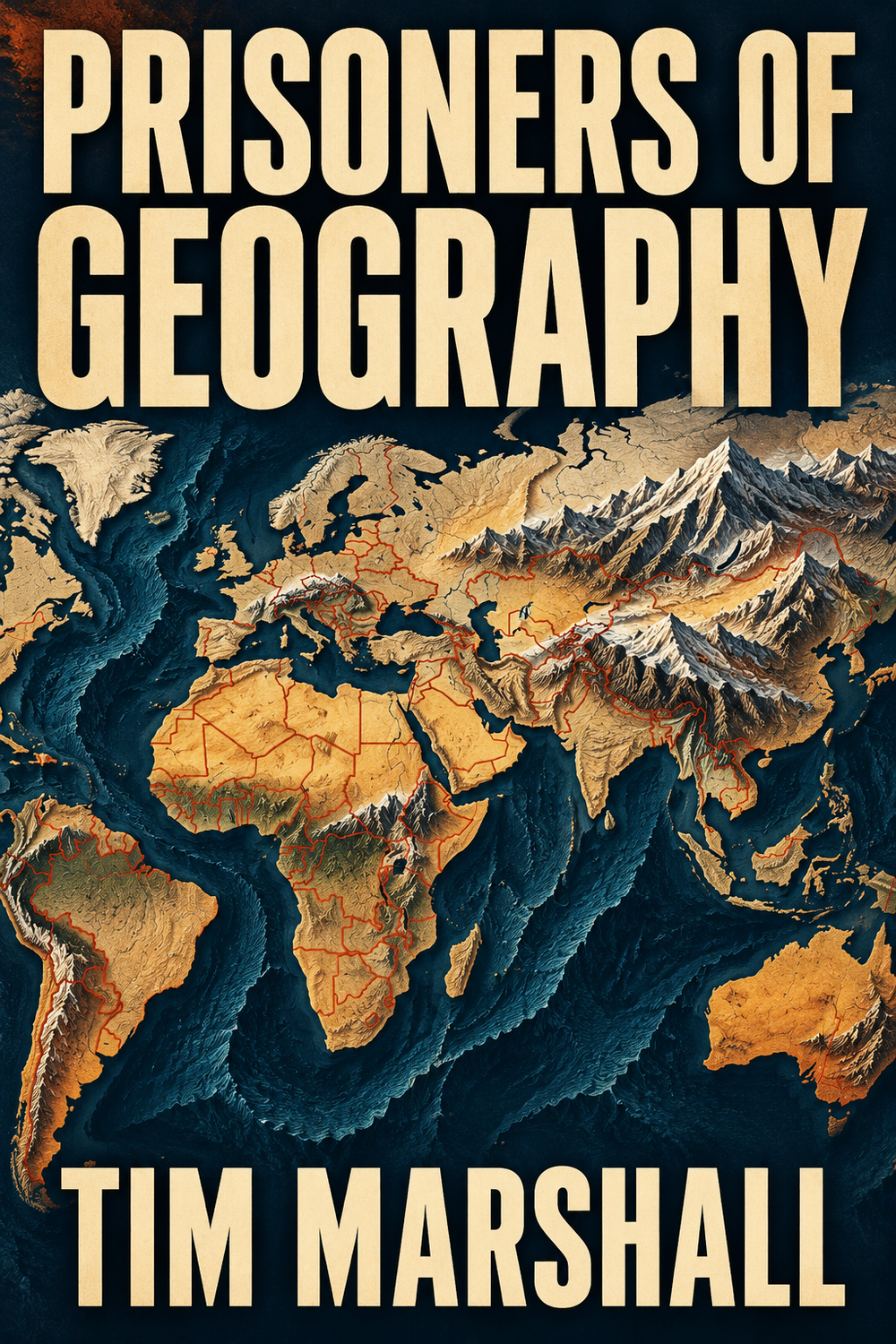
Prisoners of Geography Book Summary
This Prisoners of Geography Book Summary covers the key ideas, lessons, and takeaways in about 20 minutes.
Short Description:
How mountains, rivers and coastlines shape the fate and politics of nations
Prisoners of Geography teaches that you cannot understand world politics without looking at the map. Rivers, mountains, coastlines, farmland and fuel set limits and offer chances to every nation, and leaders keep running into those limits no matter how modern the world feels. Technology and climate change are shifting some of the lines, but the pull of geography is still strong. The next time you read about a border dispute, a pipeline deal or a naval standoff, ask what the land and sea around it have to say about it.
Helps with these goals
Preview the Prisoners of Geography book summary
Below is a preview of Sumizeit’s comprehensive human-written summary of Prisoners of Geography by Tim Marshall. The full summary is 15-20 minutes long and covers the book’s key ideas in text, audio, visual, and video formats. Unlock the full 20 Minute Summary
Why do some countries grow rich and stay stable while others fight with poverty and conflict for generations? Tim Marshall says the answer starts with geography. Mountains, rivers, coastlines, farmland and fuel under the ground shape what a nation can do, who it fights with, and who it needs as a friend.
Marshall wrote the book in 2015 for general readers. He is a journalist with more than 20 years of experience covering wars and international affairs, and his goal is to help you understand today's headlines by looking at the map behind them. He compares a nation's geography to the starting hand in a card game. A country dealt good land, useful resources and strong natural borders has an easier path. A country dealt poor soil, enemies next door and awkward borders has a harder one.
The book looks first at how geography shapes life inside a nation. Then it looks at how geography shapes the way nations deal with each other.
How geography shapes development
Nations with plenty of natural resources, safe trade routes and borders that are easy to defend tend to grow faster and stay safer. Nations without those things grow slowly and face more unrest.
Marshall points to Europe. Northern countries like France and Germany have more and better farmland than southern neighbors like Italy and Greece. He argues that this helped northern economies grow stronger, while southern ones have been more prone to recession and unemployment.
Resources can also bring trouble. Africa's rough terrain made invasion hard, yet European powers colonized it anyway because of its gold, gems and other riches. Wealth under the ground can draw in outsiders as easily as it can build a country up.
Trade routes and weak borders
Safe ways to move goods matter a great deal. Marshall uses Latin America as an example. Outside the coastal strips, much of the region has few resources, and its interior is hard to cross and full of disease carrying mosquitoes. So the big cities grew up on the coast, cut off from each other and from the land behind them.
Defense matters too. Countries with weak natural protection get invaded again and again, and each invasion breaks their progress. Korea sits between Japan, China and Russia. The peninsula has few natural barriers against attack by land or sea, and it has been invaded and colonized many times as a result.
People, groups and borders
Geography is also about where people live. When religious or ethnic groups with a history of conflict share the same land, trouble often follows. It gets worse when a country takes over territory held by a different group, because that group will push for self rule. Marshall points to China's control of Xinjiang, where the Uighur Muslims have protested for years and have demanded the right to govern themselves.
The same groups can become a tool for outsiders. Marshall says Russia often cites a wish to protect Russian minorities in other countries as a way to get…
Want the complete 20-minute summary?
- Full structured summary
- Video Summary
- Podcast Summary
- Audio summary
- Key takeaways
- Exercises
- Quiz
- Highlights and notes
- Ask the book with AI
Who should read Prisoners of Geography?
Prisoners of Geography is essential for anyone who wants to understand global politics, international conflicts, and why nations behave as they do. Whether you're a news consumer, student of international affairs, or simply curious about world events, this book provides the geographic framework missing from most political analysis. If you've ever wondered why certain countries are rivals, why resources spark conflict, or how a nation's location determines its destiny, this book answers those questions.
Why does Prisoners of Geography matter?
In an era of rising geopolitical tensions, climate change, and shifting global alliances, understanding geography is more critical than ever. Tim Marshall shows that many conflicts and policy decisions that seem random or ideological actually follow predictable patterns rooted in terrain, resources, and location. By reading the map behind the headlines, you gain insight into everything from trade disputes to military buildups to energy politics—knowledge that helps you make sense of our interconnected world.
What are the key themes in Prisoners of Geography?
- Geography as destiny: how terrain and resources shape national development
- Natural resources and competition: why countries fight over energy and commodities
- Trade routes and power: controlling shipping lanes means controlling influence
- Borders and conflict: artificial boundaries create lasting tension between ethnic and religious groups
- Defense and expansion: nations seek safer borders and strategic territory
- Technology vs. geography: how innovation can overcome or mask geographic constraints
- Climate change as a reshaper of the map: melting ice, rising seas, and new opportunities
- Energy independence and foreign policy: how a nation's fuel needs drive its diplomacy
How can you apply ideas from Prisoners of Geography?
- When reading news about international conflict, ask what geography might be driving it—what resources, borders, or trade routes are at stake
- Evaluate a country's foreign policy by examining its geographic vulnerabilities: energy needs, port access, border security, and trade route dependence
- Assess climate change risks in specific regions by understanding sea level threats to coastal powers and new opportunities emerging in the Arctic
- Predict geopolitical tensions by identifying shared borders, contested resources, and strategic trade chokepoints between nations
- Understand why certain alliances form by tracing the geographic interests that nations share or the threats they face together
- Analyze infrastructure projects like pipelines, ports, and rail networks as geographic strategies for securing resources and influence
- Recognize when military buildups or border disputes reflect genuine security concerns rooted in indefensible terrain versus opportunistic expansion
What common mistakes do readers make with Prisoners of Geography?
- Assuming geopolitical conflicts are primarily driven by ideology or personality rather than underlying geographic constraints and resource competition
- Viewing technology and globalization as having eliminated geography's relevance, when in fact they have only changed its expression
- Overlooking how a nation's lack of natural resources or access to the sea fundamentally limits its options regardless of leadership quality
- Treating borders as permanent and natural when many were artificially drawn by colonial powers without regard for terrain or population
- Focusing on short-term diplomatic statements while ignoring long-term geographic pressures that will outlast any individual leader or agreement
Sumizeit Exercises Apply what you've learned
Turn ideas from Prisoners of Geography into action with a short guided reflection: identify the biggest takeaway, connect it to your life, and commit to one step you can take in the next 24 hours.
What is the expert analysis of Prisoners of Geography?
Overview
Prisoners of Geography is a compelling work by Tim Marshall, a seasoned British journalist with over two decades of experience covering international conflicts and geopolitical affairs. Published in 2015, the book has garnered significant attention for its accessible yet incisive exploration of how geography fundamentally shapes the political and economic destinies of nations. Marshall’s expertise and journalistic clarity make complex geopolitical dynamics understandable to a broad audience, positioning the book as a vital resource for readers seeking to grasp the underpinnings of global affairs beyond surface-level news coverage.
Core Thesis
At its core, Prisoners of Geography advances the argument that physical geography—mountains, rivers, coastlines, natural resources, and climate—serves as the primary determinant of a nation's political behavior, economic development, and security challenges. Marshall posits that these immutable geographic factors constrain and enable national strategies, alliances, and conflicts. While technology and climate change introduce some shifts, geography remains a persistent and often underappreciated force shaping the global order. The book emphasizes that understanding international relations requires acknowledging the "starting hand" that geography deals each country.
Strengths
- Clarity and Accessibility: Marshall’s journalistic background ensures a lucid and engaging narrative style that demystifies complex geopolitical issues for general readers without sacrificing nuance.
- Comprehensive Geographic Scope: The book covers a wide array of regions—from Europe and Asia to Africa and Latin America—offering concrete examples that illustrate the pervasive influence of geography on diverse political contexts.
- Integration of History and Current Affairs: By linking historical invasions, colonial legacies, and contemporary geopolitical tensions, Marshall provides a dynamic view of how geography’s impact unfolds over time.
- Insightful Use of Metaphors: Comparing geography to a "starting hand" in a card game effectively conveys the idea of structural constraints and opportunities, helping readers conceptualize the deterministic elements of geopolitics.
- Timely Consideration of Technology and Climate Change: The discussion of how modern energy developments and melting polar ice caps alter geopolitical realities adds a forward-looking dimension to the analysis.
Critiques & Counterarguments
- Deterministic Overemphasis: While geography undeniably influences national trajectories, Marshall’s thesis risks underplaying the roles of culture, political institutions, leadership, and human agency. Critics from political science and economics argue that governance quality and policy choices can mitigate or exacerbate geographic disadvantages.
- Selective Evidence and Simplification: Some examples, such as the economic disparities between northern and southern Europe, may oversimplify complex socio-economic factors like EU integration, industrial policy, and historical development patterns that also shape outcomes.
- Limited Engagement with Competing Theories: The book largely sidelines alternative frameworks such as constructivist approaches in international relations, which emphasize ideas and identities over material geography, or the role of globalization in diminishing geographic constraints.
- Technological Optimism vs. Reality: Although acknowledging technology’s potential to alter geography’s impact, Marshall may underestimate the uneven diffusion of technology and persistent infrastructural challenges that continue to tether many nations to geographic limitations.
- Geopolitical Change and Fluidity: The dynamic nature of borders and alliances in the modern era sometimes challenges the notion of geography as a fixed determinant. For instance, cyber warfare and economic interdependence introduce new dimensions less tied to physical geography.
Who Should Read This
Prisoners of Geography is ideally suited for readers seeking a foundational understanding of geopolitics framed through the lens of physical geography. It benefits students and professionals in international relations, political science, and global history, as well as informed general readers who wish to contextualize current events within deeper structural forces. Its accessible prose makes it a valuable primer for those new to the subject, while its broad scope and insightful examples provide a useful reference for anyone interested in the enduring influence of geography on world affairs.
Discussion questions for Prisoners of Geography Short questions you can actually use in a conversation
Frequently asked questions about the Prisoners of Geography book summary
What is Prisoners of Geography about?
Prisoners of Geography by Tim Marshall explains how geography—terrain, climate, natural resources, and location—shapes every nation's development, foreign policy, and conflicts. Marshall argues that understanding the map is essential to understanding world politics, as geographic constraints and opportunities create predictable patterns in how countries behave toward each other and within their own borders.
Who should read Prisoners of Geography?
Anyone seeking to understand global politics, international conflicts, and current events benefits from this book. It's ideal for news consumers who want to grasp the why behind headlines, students of international affairs, and general readers curious about how location shapes destiny. No prior expertise is required; Marshall writes for a broad audience.
What are the main takeaways from Prisoners of Geography?
The core insight is that geography is destiny: a nation's terrain, resources, and location determine its possibilities and constraints. Key takeaways include the importance of trade routes and port access to power, how artificial borders create conflict, why energy independence shapes foreign policy, and how technology and climate change are reshaping but not eliminating geographic influence. Understanding these patterns reveals that most major international tensions follow predictable geographic logic.
Does Prisoners of Geography explain current geopolitical conflicts?
Yes. Marshall uses contemporary examples like Russia's annexation of Crimea, China's expansion in Tibet and the South China Sea, India-Pakistan tensions over Kashmir, and competition for Arctic resources to illustrate how geography drives modern conflict. By explaining the geographic stakes, the book makes seemingly irrational actions appear as logical responses to geographic constraints.
How does Tim Marshall view technology's impact on geography?
Marshall argues that technology can overcome or temporarily mask geographic limitations but cannot eliminate them. He cites U.S. shale gas production reducing oil dependence and new Arctic shipping routes created by climate change as examples of how innovation reshapes geopolitical advantage. However, fundamental geographic realities—lacking ports, landlocked borders, resource scarcity—persist despite technological progress.
What role does climate change play in Prisoners of Geography?
Climate change is presented as an active reshaper of the geographic map. Melting polar ice opens new shipping routes and creates territorial competition in the Arctic, while rising sea levels threaten coastal cities globally. Marshall shows that geographic advantage and disadvantage are not permanent; environmental shifts create new winners and losers in geopolitical competition.
Does the book discuss why some countries are richer than others?
Yes. Prisoners of Geography traces wealth disparities to geography, showing how access to fertile farmland, navigable rivers, defensible borders, and valuable resources shaped each nation's development path. Marshall demonstrates that northern European nations with better agricultural land developed stronger economies than southern neighbors, and that geographic advantages or disadvantages compound over centuries.
About Sumizeit
Sumizeit is a profitable Scomy LLC company based in Miami, Florida. Our founders, Clemens Raemy and Weina Scott, are successful entrepreneurs with several exits. Sumizeit is a popular book summary app / micro learning app used by busy professionals and entrepreneurs with over 2,500 non-fiction book summaries and 10,000 podcast summaries in text, audio, visual, podcast, and video format. We also have stellar retention tools to make ideas stick - such as flashcards with spaced repetition, quizzes, streaks, highlighting and notes, daily challenges, riddles, mini-courses, meditation, and more. You won't only learn the idea, but also remember it. Over 90% of our users change their habits with Sumizeit.
Upgrade Now
Here's why readers love Sumizeit
Join thousands of learners getting smarter every day
"Great experience. Detailed summaries. Loved the gamification feature. Makes learning fun. Good customer service. I recommend Sumizeit to anyone. You'll learn a lot."
"I always felt busy but still wanting to keep up with the book discussion in my friend group. This was a great supplement to help me keep reading the books I find fun while keeping up with important books."
"I love this website. Instead of scrolling social media, I find myself learning a lot. I use it everyday. I recommend this app for anyone who is too busy and wants to get up to speed with their favorite books."
Prisoners of Geography Book Summary PDF
Looking for a Prisoners of Geography Book Summary PDF you can save and revisit offline? Our Prisoners of Geography Book Summary PDF captures the book’s core ideas in a clean, printable format — the key frameworks, takeaways, and structure without the fluff. Download the Prisoners of Geography Book Summary PDF when you want a reference you can annotate, share with your team, or review on the go. Get your Prisoners of Geography Book Summary PDF from the download page below.
Download Prisoners of Geography Book Summary PDFPeople also liked these summaries
Readers who explored Prisoners of Geography often enjoyed these titles next.


Ready to read the whole thing?
- Full structured summary
- Video Summary
- Podcast Summary
- Audio summary
- Key takeaways
- Exercises
- Quiz
- Highlights and notes
- Ask the book with AI
Featured Book Titles
Popular Book Summaries at sumizeit, leading book summary app
Atomic Habits Book Summary Rich Dad Poor Dad Book Summary The Four Agreements Book Summary The 48 Laws of Power Book Summary When Breath Becomes Air Book Summary Think and Grow Rich Book Summary