


As an Amazon Associate, Sumizeit earns from qualifying purchases.
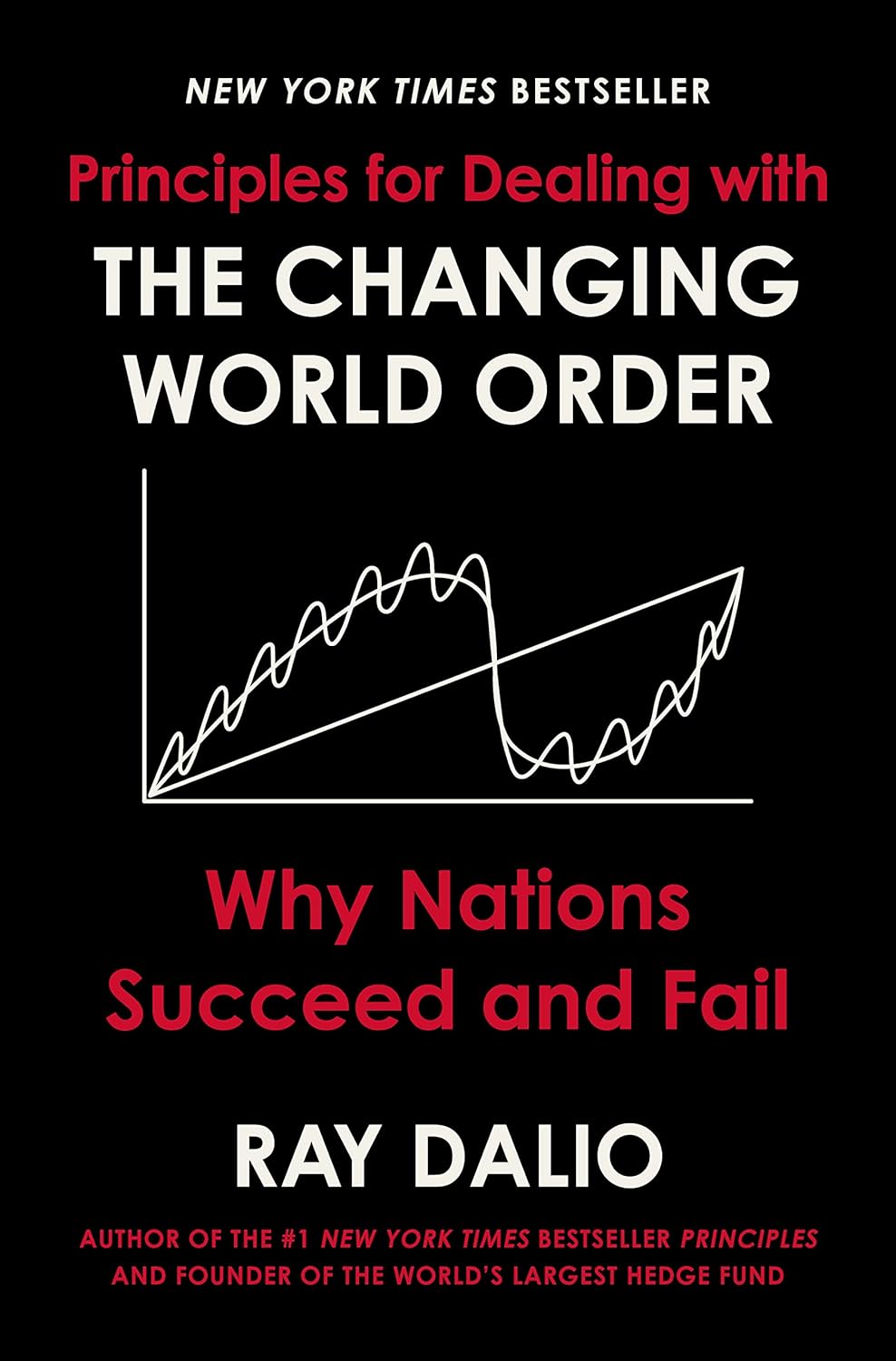
Principles for Dealing with the Changing World Order Book Summary
This Principles for Dealing with the Changing World Order Book Summary covers the key ideas, lessons, and takeaways in about 20 minutes.
But Dalio isn’t arguing for fatalism. He’s arguing for preparedness and clearer thinking. The practical value of his framework is that it pushes you to watch a small set of big signals—debt and money stability, domestic cohesion, innovation capacity, and geopolitical rivalry—rather than getting lost in daily headlines. Then, instead of betting everything on one forecast, you build resilience: keep financial and personal buffers, diversify across exposures, and stay flexible enough to adapt when reality contradicts your plan.
Helps with these goals
Want the complete 20-minute summary?
- Full structured summary
- Video Summary
- Podcast Summary
- Audio summary
- Key takeaways
- Exercises
- Quiz
- Highlights and notes
- Ask the book with AI
What is in the Principles for Dealing with the Changing World Order book summary?
Below is a preview of Sumizeit’s expert-written summary of Principles for Dealing with the Changing World Order by Ray Dalio. The full summary covers the book’s key ideas in text, audio, and video.
Ray Dalio’s goal in Principles for Dealing with the Changing World Order is practical: he wants a dependable way to interpret big historical shifts so he can make smarter decisions—especially as an investor, but also as a citizen and lifelong learner. He argues that the “world order” (the mix of dominant powers, trade rules, money systems, alliances, and norms) has flipped many times before and will flip again. Instead of treating each era as totally unique, he says the broad storylines repeat in recognizable patterns—history “rhymes”—because human incentives and constraints don’t change much.
Dalio built his framework by studying the rise, high point, and decline of more than a dozen major empires, especially across the last ~500 years, and turning those observations into a cause-and-effect model. Importantly, he doesn’t present this as a crystal ball that can “predict” the future with certainty. He presents it as a disciplined template for noticing signals early—so you’re less surprised when the world begins to reorganize.
The Big Idea: Cycles Repeat, But Progress Accumulates
A key move in Dalio’s thinking is separating repeatable cycles from long-run progress. In his view, cycles are the recurring sequences that carry empires upward, stall them out, and pull them down. Those cycles drive the familiar swings humans keep living through—peace vs. war, boom vs. bust, stability vs. upheaval, wealth concentrated here vs. wealth concentrated there.
But Dalio also argues that, across many cycles, humanity still tends to stack improvements. He calls this “evolution”: the lasting gains we keep after each cycle ends. The engine behind that upward trend is human inventiveness—our built-in urge to improve tools, systems, and technology. So while each era can feel like “everything is falling apart,” he thinks the larger arc still bends upward because innovation keeps pushing living standards, capabilities, and knowledge forward.
A simple way to picture it: the world doesn’t move in a straight line, and it doesn’t move in a perfect circle. It moves like a spiral staircase. You revisit similar problems (debt binges, class resentment, power rivalry), but usually at a different level of technology and complexity than last time.
Why Wealth and Power Are Always at the Center
Dalio’s model is blunt: people and nations keep colliding because they compete over the resources that make life safe and prosperous—fertile land, food supplies, energy, trade routes, strategic geography, and increasingly, technology and capital. If a group gains an advantage (geographic, financial, technological, or military), it can accumulate wealth, build stronger defenses, and expand influence. That creates a self-reinforcing loop: advantage leads to more advantage.
He also emphasizes the emotional fuel behind the competition: fear, greed, jealousy, and status drives. That matters because it means these cycles aren’t just spreadsheets and treaties—they’re human nature at scale. Even if the surface issues change (oil yesterday, chips today, AI tomorrow), the underlying motives often remain familiar.
Phase One: How a New Power Gets Strong
Dalio argues that new “orders” usually rise out of disorder.
Want the complete 20-minute summary?
- Full structured summary
- Video Summary
- Podcast Summary
- Audio summary
- Key takeaways
- Exercises
- Quiz
- Highlights and notes
- Ask the book with AI
Who should read Principles for Dealing with the Changing World Order?
This book is for investors, policymakers, business leaders, and engaged citizens who want to understand how the world order shifts and make better long-term decisions amid global change. If you're concerned about geopolitical tensions, economic instability, or your own financial resilience, Dalio's framework offers a practical lens for interpreting big historical patterns rather than getting lost in daily noise.
Why does Principles for Dealing with the Changing World Order matter?
The global order is fundamentally unstable when rising powers challenge declining ones while debt and internal division deepen—and we appear to be in such a moment. Ray Dalio's Principles for Dealing with the Changing World Order gives you a tested model for recognizing the signals early, so you're less surprised when systems reorganize and better prepared to protect your interests. In an era of US-China rivalry, mounting debt, and political polarization, understanding these cycles isn't academic—it's practical insurance.
What are the key themes in Principles for Dealing with the Changing World Order?
- History repeats through recognizable cycles driven by competition for wealth and power
- Rising powers build strength through capable leadership, productive innovation, trade, and financial sophistication
- Success breeds weakness: debt, inequality, complacency, and elite entrenchment erode competitive advantage
- Financial stress collides with social division to trigger system-wide restructuring and conflict
- Resilience comes from diversification, buffers, and humility about forecasts, not from perfect prediction
What are the key lessons from the Principles for Dealing with the Changing World Order book summary?
World orders shift through repeatable patterns, not random events
Empires rise, peak, and decline following a cause-and-effect sequence shaped by human nature and incentives. Understanding these patterns helps you recognize where you are in the cycle and prepare accordingly.
Cycles recur, but progress accumulates across them
While societies replay similar problems—debt binges, class conflict, power rivalry—technology and knowledge still advance. The world moves like a spiral staircase: familiar challenges at higher levels of complexity.
Wealth and power competition is the engine of world order change
Nations clash over fertile land, resources, trade routes, technology, and capital because these determine security and prosperity. Fear, greed, jealousy, and status drives fuel the competition at a human level.
Rising powers combine strong institutions, productive wealth-creation, and trade leadership
New orders emerge from disorder and succeed when capable leaders build rules that reward effort, merchants and inventors scale industries, trade expands, banks mature, and eventually one power supplies the reserve currency.
Debt cycles are the first pressure point in decline
Prosperity encourages optimism and borrowing, but debt burdens grow until shocks arrive and can't be serviced. Countries then face default, restructuring, or money printing—often choosing the latter and fueling inflation.
Widening inequality becomes politically explosive when growth slows
Early-stage empires reward competence and effort broadly, but success lets wealth concentrate. When mobility falls and resentment rises, cooperation fractures and populist or authoritarian movements gain ground.
Peak power erodes through complacency, not sudden incompetence
Prosperity creates comfort, which breeds complacency. Elites protect their status rather than out-innovate, competitiveness fades, techniques diffuse to rivals, and the culture that built the system atrophies.
Imperial overreach weakens the reserve-currency holder most
Maintaining global dominance becomes costly, and holding the reserve currency tempts leaders into fiscal sloppiness—borrowing more, building liabilities, and leaning on status rather than productivity.
Internal breakdown accelerates when debt stress hits social strain
Economic shocks + high debt + visible inequality + loss of legitimacy = a cascade. Capital flees, resentment explodes into identity and value clashes, and the political system can become too polarized to reform peacefully.
Great-power conflict escalates through multiple arenas before military clash
Trade wars, technology restrictions, supply-chain battles, capital-flow disputes, and territorial tensions are all forms of rivalry. Understanding this escalation ladder helps you see brewing conflicts early.
The money-and-credit machine is the first dimension to watch
Economies expand through debt-driven growth and contract when borrowing can't keep pace with obligations. Tracking debt levels, currency stability, and credit stress reveals economic fragility before headlines catch up.
Internal cohesion is the second dimension to watch
Societies move from harmony (people buy into the rules, prosperity shared broadly) to disharmony (class resentment, value clashes, blame wars). Measuring political polarization and social trust signals whether a nation can reform or is heading toward breakdown.
Global power balance is the third dimension to watch
With no true world government, the international system is shaped by power balances and interests. When a rising power challenges a declining one while both face internal strain, accidents and miscalculations become more dangerous.
Resilience beats forecasting precision
No model predicts perfectly, and reality contains surprises. The practical value lies in building buffers, diversifying across countries and asset types, and staying flexible enough to adapt when your forecast breaks.
Holding reserves and safe stores of value insures against disruption
Families and businesses that keep backup resources—whether in stable currencies, tangible assets, or diversified geographies—endure shocks that wipe out those running lean with no margin for error.
Geographical and sectoral diversification protects against concentration risk
One nation's problems shouldn't sink your entire plan. Spreading exposure across industries, countries, and asset types means that even if one region experiences crisis, your base remains stable.
Testing your thinking against capable skeptics improves your models
Clinging to a single narrative guarantees blindness. Learning from others who think rigorously about futures, comparing frameworks, and updating your views in real time keeps you adaptive and less surprised.
The current US-China rivalry mirrors historical power-transition risks
A financially stretched, internally divided leading power facing a challengers with stronger economic momentum creates instability. Both nations have incentives to compete across trade, tech, and geopolitics—raising the odds of costly accidents.
Innovation is the engine of long-run progress across cycles
Even as empires rise and fall, human inventiveness keeps pushing capabilities, living standards, and knowledge upward. The next order will likely be built on technologies the current one hasn't fully imagined.
Humility about forecasts is as important as having a framework
Dalio's principles help you think clearly and prepare, but they don't predict the future with certainty. The goal is resilience and flexibility, not betting everything on a single outcome.
Want the complete 20-minute summary?
- Full structured summary
- Video Summary
- Podcast Summary
- Audio summary
- Key takeaways
- Exercises
- Quiz
- Highlights and notes
- Ask the book with AI
How can you apply ideas from Principles for Dealing with the Changing World Order?
- Build financial buffers and hold emergency reserves in stable currencies or tangible assets so you can endure years of disruption without panic selling
- Diversify your career skills across multiple industries and sectors so your earning power doesn't depend on one employer or field collapsing
- Spread household or business investments across different countries, currencies, and asset types to avoid concentration risk when one region faces crisis
- Monitor the 'Big Three' signals—debt and currency strength, domestic polarization and cohesion, innovation capacity—rather than chasing daily headlines to stay ahead of structural shifts
- Develop a personal decision-making framework informed by history so you can evaluate geopolitical or economic news through a cause-and-effect model instead of reacting emotionally
- Regularly test your assumptions against thoughtful people with different perspectives to update your worldview before reality forces the correction
- Plan for a 'bad scenario' year—whether economic shock, political upheaval, or supply disruption—by ensuring your business or household can survive without external support
What common mistakes do readers make with Principles for Dealing with the Changing World Order?
- Assuming that because you survived one crisis, the next one will follow the same playbook—reality surprises you, and buffering for diverse scenarios beats betting on a single forecast
- Concentrating all wealth, career skills, or exposure in one country, currency, or asset so that one nation's problems or one sector's collapse wipes you out entirely
- Ignoring the political and social dimensions of decline and focusing only on economic metrics—division and loss of legitimacy can trigger system reorganization faster than spreadsheets suggest
- Treating current geopolitical tensions as isolated events rather than recognizing them as symptoms of a power-transition cycle where rising and falling powers naturally clash
- Underestimating how quickly financial stress plus social division can cascade into breakdown—the interaction accelerates when both hit simultaneously
Sumizeit Exercises Apply what you've learned
Turn ideas from Principles for Dealing with the Changing World Order into action with a short guided reflection: identify the biggest takeaway, connect it to your life, and commit to one step you can take in the next 24 hours.
What is the expert analysis of Principles for Dealing with the Changing World Order?
Overview
Principles for Dealing with the Changing World Order is authored by Ray Dalio, a preeminent investor and founder of Bridgewater Associates, one of the world’s largest hedge funds. Dalio’s stature in finance and his methodical, principles-based approach to complex systems lend this work considerable weight. The book’s significance lies in its ambitious attempt to decode the recurring patterns of global power shifts over centuries, offering a structured framework to anticipate and navigate geopolitical and economic upheavals. By synthesizing history, economics, and human psychology, Dalio provides a lens through which investors, policymakers, and informed citizens can better understand the dynamics shaping the 21st century.
Core Thesis
Dalio’s central argument is that the global order evolves through identifiable, repeatable cycles driven by the interplay of wealth, power, and human nature. He posits that while history never repeats exactly, it “rhymes” due to persistent human incentives and constraints. These cycles encompass the rise, peak, and decline of dominant powers, shaped by economic, social, and geopolitical forces. Crucially, Dalio separates cyclical patterns from long-term progress, emphasizing that despite recurring upheavals, human innovation propels an upward spiral of development. His framework highlights how success inherently sows the seeds of decline through debt accumulation, inequality, and institutional decay, culminating in periods of internal breakdown and external conflict, particularly when a rising power challenges an established hegemon.
Strengths
- Interdisciplinary Synthesis: Dalio masterfully integrates history, economics, psychology, and geopolitics into a coherent model, making complex global phenomena accessible without oversimplification.
- Empirical Breadth: The book draws on over five centuries of data from multiple empires and nations, providing a robust empirical foundation for its cyclical theory.
- Practical Framework: Rather than deterministic prophecy, Dalio offers a disciplined template for early signal detection and risk management, emphasizing humility and adaptability in decision-making.
- Nuanced View of Progress: The spiral staircase metaphor elegantly captures the tension between recurring challenges and cumulative human advancement, avoiding fatalistic or overly optimistic extremes.
- Actionable Advice: The recommendations for diversification, maintaining buffers, and collaborative thinking transcend finance, offering valuable guidance for personal and organizational resilience.
Critiques & Counterarguments
- Potential Oversimplification of Complex Dynamics: While Dalio’s cyclical model is compelling, it risks underestimating the uniqueness of contemporary global challenges such as climate change, technological disruption, and ideological fragmentation, which may not fit neatly into historical patterns.
- Determinism vs. Contingency: The framework’s emphasis on cause-and-effect cycles might underplay the role of contingent events, individual agency, and emergent phenomena that can abruptly alter trajectories in unpredictable ways.
- Selective Historical Analogies: Critics may argue that the choice of empires and periods studied reflects a Western-centric perspective, potentially overlooking non-Western or less documented power shifts that could nuance or challenge the model.
- Debate on US-China Rivalry Predictions: Dalio’s characterization of the US as late-cycle and China as ascendant is plausible but contested; some scholars emphasize China’s internal vulnerabilities, demographic challenges, and governance issues that complicate a straightforward rise narrative.
- Alternative Theories of Global Order: Competing schools, such as liberal institutionalism or constructivism in international relations, stress the transformative potential of international norms, cooperation, and ideas, which Dalio’s materialist and power-centric model may insufficiently address.
Who Should Read This
This book is essential reading for investors, policymakers, historians, and intellectually curious readers seeking a systematic understanding of the forces shaping global power dynamics. Its interdisciplinary approach benefits those interested in the intersection of economics, history, and geopolitics, particularly in an era marked by uncertainty and rapid change. Additionally, individuals committed to strategic foresight and resilience—whether in finance, business, or civic life—will find Dalio’s principles and pragmatic advice invaluable for navigating complexity without succumbing to fatalism or complacency.
Frequently asked questions about the Principles for Dealing with the Changing World Order book summary
What is Principles for Dealing with the Changing World Order about?
Principles for Dealing with the Changing World Order is Ray Dalio's framework for understanding how the global order shifts through repeatable historical cycles. Dalio argues that empires rise through capable leadership, productive innovation, and trade strength; peak in power and wealth; then decline through debt buildup, inequality, complacency, and elite entrenchment. When financial stress collides with social division, systems reorganize—sometimes peacefully, sometimes violently. The book teaches you to recognize these patterns and prepare for disruption rather than be blindsided by it.
Who should read Principles for Dealing with the Changing World Order?
Investors, business leaders, policymakers, and engaged citizens who want to understand global instability and make better long-term decisions should read this book. It's especially relevant for anyone concerned about US-China tensions, debt, political polarization, or their own financial resilience. You don't need to be wealthy or powerful—anyone seeking to build buffers and diversify risk in an uncertain world will find practical guidance here.
What are the main takeaways from Principles for Dealing with the Changing World Order?
The main takeaways are: (1) world orders shift through predictable cause-and-effect cycles, not random events, because competition for wealth and power is constant; (2) rising powers succeed through strong institutions, productive innovation, and financial sophistication, but success breeds weakness—debt, inequality, and complacency; (3) when financial stress hits social division, systems break fast and conflict rises; and (4) resilience comes from buffers, diversification across countries and sectors, and testing your thinking against skeptics, not from perfect forecasts. Dalio emphasizes humility: history rhymes, but it also surprises you, so prepare for 'bad scenario' years rather than betting everything on one outcome.
How does Ray Dalio explain the rise and fall of empires?
Dalio uses a three-phase model: rise (capable leadership builds institutions, merchants and inventors scale industries, trade grows, financial markets mature, one power becomes the reserve-currency holder); peak (success creates comfort and complacency); and decline (debt piles up, inequality fuels resentment, elites entrench, competitiveness fades, rivals copy techniques, costs of dominance rise). The decline accelerates when economic shocks hit high debt while society is already polarized. His point is that these phases follow a predictable pattern across centuries and geographies because human incentives and psychology don't change much.
What should I do to prepare for a changing world order?
Dalio recommends building financial buffers so you can endure disruption years without panic; diversifying across countries, industries, and asset types so one region's problems don't sink you; monitoring debt, political cohesion, and innovation capacity instead of daily headlines; and testing your thinking against capable skeptics to update your worldview. The goal is resilience and flexibility: don't bet everything on one forecast, don't build your career on one fragile skill, don't let one nation or platform control your fate. Prepare for 'bad scenario' years while hoping they don't arrive.
What does Ray Dalio say about the US and China?
Dalio sees the US as a major power late in its cycle—financially stretched (high debt threatens the dollar's long-term strength), internally polarized, and facing meaningful risks of severe crisis within 10–15 years. He sees China as earlier in its cycle—more unified, economically dynamic, and with stronger fundamentals in key dimensions, though facing its own challenges. He frames US-China competition as already playing out across trade, technology, geopolitics, and capital flows, with Taiwan as a potential flashpoint. His deeper message: when a leading power is financially divided while a challenger gains capacity, the global system becomes more unstable and accidents become more dangerous.
Does Ray Dalio predict the future in this book?
No—Dalio is explicit that his framework doesn't predict the future with certainty. He presents it as a disciplined template for recognizing signals early and noticing patterns, not as a crystal ball. His emphasis is on building resilience and humility: history rhymes, but it also contains surprises that rewrite expectations. The value lies in thinking clearly about cycles and preparing for disruption, not in betting your life on a single outcome. Reality always surprises you, so the practical goal is flexibility and buffers, not perfect forecasting.
About Sumizeit
Sumizeit is a profitable Scomy LLC company based in Miami, Florida. It has been helping readers learn from nonfiction books for 7 years with expert-written summaries in text, audio, podcast, and video.
Want the complete 20-minute summary?
- Full structured summary
- Video Summary
- Podcast Summary
- Audio summary
- Key takeaways
- Exercises
- Quiz
- Highlights and notes
- Ask the book with AI
Here's why readers love Sumizeit
Join thousands of learners getting smarter every day
"Great experience. Detailed summaries. Loved the gamification feature. Makes learning fun. Good customer service. I recommend Sumizeit to anyone. You'll learn a lot."
"I always felt busy but still wanting to keep up with the book discussion in my friend group. This was a great supplement to help me keep reading the books I find fun while keeping up with important books."
"I love this website. Instead of scrolling social media, I find myself learning a lot. I use it everyday. I recommend this app for anyone who is too busy and wants to get up to speed with their favorite books."
Principles for Dealing with the Changing World Order Book Summary PDF
Looking for a Principles for Dealing with the Changing World Order Book Summary PDF you can save and revisit offline? Our Principles for Dealing with the Changing World Order Book Summary PDF captures the book’s core ideas in a clean, printable format — the key frameworks, takeaways, and structure without the fluff. Download the Principles for Dealing with the Changing World Order Book Summary PDF when you want a reference you can annotate, share with your team, or review on the go. Get your Principles for Dealing with the Changing World Order Book Summary PDF from the download page below.
Download Principles for Dealing with the Changing World Order Book Summary PDFPeople also liked these summaries
Readers who explored Principles for Dealing with the Changing World Order often enjoyed these titles next.


Want the complete 20-minute summary?
- Full structured summary
- Video Summary
- Podcast Summary
- Audio summary
- Key takeaways
- Exercises
- Quiz
- Highlights and notes
- Ask the book with AI
Featured Book Titles
Popular Book Summaries at sumizeit, leading book summary app