


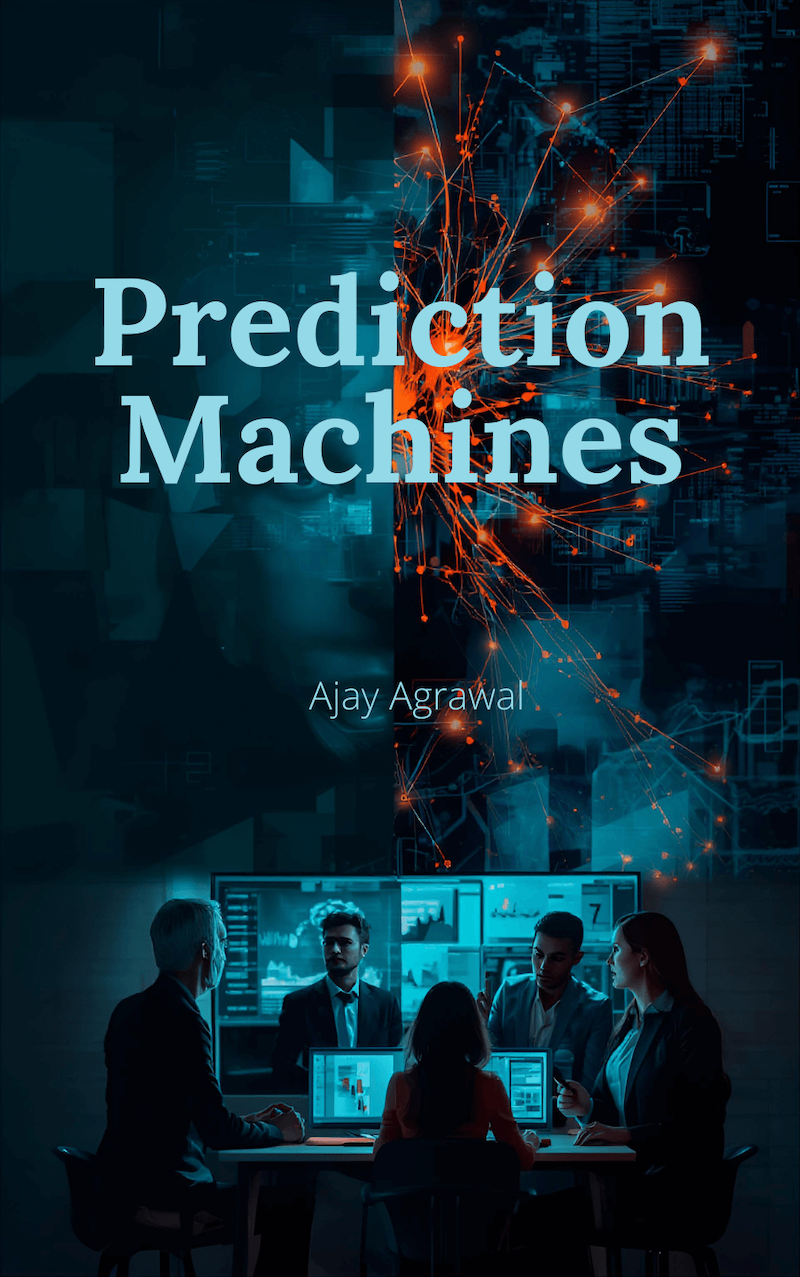
Prefer the print book? Buy on Amazon
As an Amazon Associate, Sumizeit earns from qualifying purchases.
Prediction Machines Book Summary
This Prediction Machines Book Summary covers the key ideas, lessons, and takeaways in about 20 minutes.
Short Description:
How cheaper AI predictions reshape decisions, work, and competitive advantage.
The book’s central message is pragmatic rather than utopian or dystopian. AI offers enormous benefits when used thoughtfully, but it also raises serious challenges around inequality, concentration of power, and ethical governance. The winners will be those who understand that prediction is only one part of decision-making—and who design systems that balance machine accuracy with human wisdom.
Helps with these goals
Preview the Prediction Machines book summary
Below is a preview of Sumizeit’s comprehensive human-written summary of Prediction Machines by Ajay Agrawal. The full summary is 15-20 minutes long and covers the book’s key ideas in text, audio, visual, and video formats. Unlock the full 20 Minute Summary
At the heart of Prediction Machines is a deceptively simple idea: artificial intelligence matters economically not because it thinks, but because it makes prediction dramatically cheaper. Prediction, as the authors define it, is the process of using existing information to infer missing information. Every decision—whether made by a person or an organization—relies on prediction in some form. Will demand rise? Will a patient get sick? Will a customer click “buy”?
For decades, prediction was expensive because it relied heavily on human judgment. People are flexible, creative, and context-aware, but they are also inconsistent, slow at processing massive datasets, and prone to bias. Advances in machine learning, particularly deep learning and neural networks, have drastically reduced the cost of prediction by allowing machines to identify patterns across enormous volumes of data.
The authors argue that this cost reduction is as economically transformative as earlier breakthroughs like cheaper computing power or lower data storage costs. When prediction becomes inexpensive, it reshapes how decisions are structured, who makes them, and where value is created. This shift does not replace human decision-making—it rearranges it.
What Prediction Machines Actually Do (and What They Don’t)
One of the book’s central clarifications is that modern AI systems are not general thinkers. They do not understand meaning, intention, or context the way humans do. Instead, they specialize narrowly in forecasting outcomes based on patterns in data.
These systems excel in environments where:
Large amounts of historical data exist
Patterns are stable or semi-stable
Outcomes can be measured and fed back into the system
For example, AI can detect irregular heart rhythms by analyzing thousands of prior ECG readings. It does not “understand” health, fear, or mortality—it identifies statistical relationships between signals and outcomes. In this narrow domain, its accuracy can exceed that of trained clinicians.
However, prediction machines struggle when:
Data is sparse
Context changes rapidly
Values or ethics matter more than accuracy
Humans remain essential for interpreting predictions, weighing trade-offs, and deciding what outcomes should matter. The book emphasizes that AI should be viewed as a tool that enhances prediction—not as a replacement for judgment or reasoning.
Prediction Is Only One Part of a Decision
The authors break decision-making into distinct components:
Prediction: estimating what will happen
Judgment: deciding what outcome is desirable
Action: executing a response
Feedback: learning from results
AI dramatically improves the first component but has limited capacity in the others. For instance, an AI can predict which job candidate is most likely to succeed based on historical data, but it cannot determine whether diversity, long-term potential, or cultural contribution should matter more than short-term performance.
As prediction improves, judgment becomes more important, not less. When uncertainty decreases, decision-makers must confront their values more directly. Cheap prediction forces clarity about priorities.
This is why human involvement remains critical even as AI systems grow more accurate.
Why Data Becomes the New Bottleneck
As prediction becomes cheaper, data becomes more valuable. The book emphasizes that high-quality, relevant data is essential for effective machine learning.
Want the complete 20-minute summary?
- Full structured summary
- Video Summary
- Podcast Summary
- Audio summary
- Key takeaways
- Exercises
- Quiz
- Highlights and notes
- Ask the book with AI
Who should read Prediction Machines?
Prediction Machines is for business leaders, technologists, and policymakers who want to understand how AI actually reshapes organizations and markets. If you're responsible for strategy, innovation, or AI adoption decisions, this book cuts through hype to explain the real economic forces at work. It's also valuable for anyone concerned about how AI affects work, inequality, and society.
Why does Prediction Machines matter?
Most discussions of AI focus on whether machines can think like humans—but Prediction Machines argues the real transformation is simpler and more profound: AI makes prediction dramatically cheaper. This shift forces organizations to redesign workflows, reconsider which decisions to automate, and confront their values more directly. Understanding this reframing is essential for anyone navigating technology's impact on business and society.
What are the key themes in Prediction Machines?
- AI excels at prediction, not reasoning or judgment
- Cheap prediction shifts the bottleneck to data, not algorithms
- Humans and machines complement each other when designed well
- Judgment becomes more valuable as uncertainty decreases
- Work gets reshaped, not eliminated, but income may concentrate
- Organizations must redesign processes, not just add AI tools
- Ethical choices remain embedded even in 'objective' predictions
How can you apply ideas from Prediction Machines?
- Audit your organization's workflows to identify which tasks are prediction-heavy versus those requiring judgment or contextual understanding
- Develop a data strategy before investing heavily in AI tools—evaluate data quality, relevance, and collection costs against algorithm costs
- Design human-AI systems where machines recommend options and humans make final decisions on high-stakes matters involving privacy, safety, or fairness
- Redesign entire processes when implementing AI, not just inserting algorithms into existing workflows
- Align incentive systems so AI optimization supports organizational values rather than unintentionally optimizing for the wrong metrics
- Create feedback loops to monitor how AI predictions affect real-world outcomes and catch unintended harms like bias or discrimination
- Build diverse teams combining technical expertise with domain knowledge and ethical reasoning to govern AI system design and deployment
What common mistakes do readers make with Prediction Machines?
- Treating AI as a replacement for human judgment instead of a complement that makes prediction cheaper while judgment becomes more valuable
- Assuming that accurate predictions are objective decisions, when value choices remain embedded in how predictions are used
- Investing in AI without first investing in data strategy, leading to high model costs but limited predictive power from poor data quality
- Automating entire jobs instead of decomposing work to identify and automate only the prediction-heavy components
Sumizeit Exercises Apply what you've learned
Turn ideas from Prediction Machines into action with a short guided reflection: identify the biggest takeaway, connect it to your life, and commit to one step you can take in the next 24 hours.
What is the expert analysis of Prediction Machines?
Overview
Prediction Machines is a seminal work authored by Ajay Agrawal, Joshua Gans, and Avi Goldfarb—three economists renowned for their incisive analysis of technology’s economic impact. This book stands out in the crowded AI literature by eschewing sensationalism and instead focusing on the economic mechanics of artificial intelligence, specifically its role in reducing the cost of prediction. By framing AI as a prediction technology rather than a form of human-like intelligence, the authors provide a clear, accessible framework that bridges economics, business strategy, and technology policy. This approach makes the book highly significant for leaders, policymakers, and scholars aiming to understand AI’s practical implications beyond the hype.
Core Thesis
The central argument of Prediction Machines is that the transformative power of AI lies not in replicating human cognition but in making prediction dramatically cheaper and more accessible. Prediction is defined as the process of inferring missing information from existing data, a foundational element in all decision-making. The authors contend that as AI lowers the cost of prediction, it reshapes organizational decision structures, reallocates roles between humans and machines, and alters competitive dynamics across industries. Crucially, they emphasize that AI enhances prediction but does not replace human judgment, which becomes more critical as uncertainty diminishes and value-laden decisions come to the fore.
Strengths
- Clarity and Precision: The book excels at demystifying AI by focusing on prediction as a core economic function, avoiding the common pitfalls of overgeneralization or techno-utopianism.
- Interdisciplinary Insight: By integrating economics, business strategy, and ethics, the authors offer a holistic view that captures AI’s multifaceted impact.
- Pragmatic Framework: The decomposition of decision-making into prediction, judgment, action, and feedback provides a practical lens for organizations to assess AI integration.
- Balanced Human-Machine Perspective: The emphasis on complementarity rather than replacement is nuanced and supported by real-world examples, such as combined human and AI diagnostic accuracy in healthcare.
- Strategic and Policy Relevance: The discussion of data as a bottleneck, market concentration risks, and governance challenges situates the book within broader societal and economic debates.
Critiques & Counterarguments
- Potential Oversimplification of AI’s Capabilities: While the focus on prediction is clarifying, it may understate emerging AI capacities in reasoning, creativity, and context understanding, which some research suggests are advancing rapidly.
- Data-Centric View May Overlook Human Factors: The book emphasizes data quality and quantity but gives less attention to organizational culture, cognitive biases, and political dynamics that also shape AI adoption and outcomes.
- Limited Engagement with Ethical Complexity: Although ethical concerns are acknowledged, the treatment is somewhat cursory compared to the depth of challenges posed by bias, surveillance, and algorithmic accountability documented in critical AI scholarship.
- Market Concentration Risks Could Be Understated: The authors warn about concentration but may underestimate the speed and scale at which dominant AI firms can entrench power, as seen in recent antitrust debates and empirical studies on platform monopolies.
- Alternative Theoretical Perspectives: Competing schools of thought, such as those emphasizing AI as an autonomous agent or focusing on socio-technical systems, challenge the purely economic framing and suggest that prediction is necessary but not sufficient to understand AI’s societal impact.
Who Should Read This
Prediction Machines is essential reading for business executives, policymakers, and academics seeking a grounded, economically informed understanding of AI’s role in decision-making and organizational change. It is particularly valuable for those responsible for strategic planning, technology investment, and regulatory frameworks who require a clear framework to navigate AI’s complexities without succumbing to hype or fear. Additionally, scholars interested in the intersection of economics, technology, and ethics will find the book a compelling starting point for further inquiry into AI’s transformative potential and challenges.
Frequently asked questions about the Prediction Machines book summary
What is Prediction Machines about?
Prediction Machines by Ajay Agrawal, Joshua Gans, and Avi Goldfarb argues that artificial intelligence's real economic power comes from making prediction dramatically cheaper, not from replicating human intelligence. The book explains how this cost reduction reshapes decision-making, reorganizes work, concentrates data as the new bottleneck, and forces organizations to rethink strategy, process design, and the role of human judgment.
Who should read Prediction Machines?
Business leaders, technologists, policymakers, and strategists responsible for AI adoption or technology investment should read this book. It's also valuable for anyone concerned about how AI affects jobs, inequality, and society. The book cuts through hype with economic clarity, making it useful for executives making AI decisions and citizens understanding AI's impact on markets and power.
What are the main takeaways from Prediction Machines?
The main takeaways are: AI excels at prediction but not judgment, humans and machines complement each other when designed well, data becomes more valuable than algorithms as prediction gets cheaper, judgment becomes more important as uncertainty decreases, most jobs get reshaped rather than eliminated but income may concentrate, and organizations must redesign processes not just add tools. The book emphasizes that prediction is only one part of decision-making, and that ethical choices remain embedded even in AI systems.
How does Prediction Machines define artificial intelligence?
The book defines AI narrowly as a tool for making prediction cheaper through pattern recognition in data. Prediction here means using existing information to infer missing information—forecasting demand, diagnosing disease, predicting customer behavior. The authors emphasize that modern AI systems are not general intelligences; they specialize in pattern-matching and do not understand meaning, context, or values the way humans do.
Does Prediction Machines say AI will eliminate jobs?
The book argues that most jobs will be reshaped rather than eliminated, but sounds a nuanced warning about inequality. While some tasks will be automated, the greater risk is that economic value and income will concentrate among those who own AI systems and data, while workers face stagnation or wage pressure. This could widen inequality even if total employment stays stable.
What does Prediction Machines say about human-AI collaboration?
The book emphasizes complementarity over competition. When humans and machines work together leveraging their different strengths—machines scan data for patterns, humans interpret meaning and handle exceptions—performance often exceeds what either could achieve alone. Examples like cancer diagnosis show that combined accuracy can approach near-zero error rates when human and machine judgments are integrated.
How should organizations implement AI according to Prediction Machines?
Organizations should avoid simply inserting AI into existing workflows. Instead, they should decompose work to identify prediction-heavy tasks, redesign entire processes to take advantage of cheaper prediction, invest in data strategy before building models, and ensure AI systems are designed to complement human judgment on high-stakes decisions. Leadership must align incentives and governance to prevent unintended harms like bias.
What does Prediction Machines say about bias and fairness in AI?
The book warns that predictive systems can reflect and amplify biases present in training data, leading to discriminatory outcomes. Even highly accurate predictions embed value judgments about which outcomes matter. Effective governance requires transparency, auditing, ethical oversight, and monitoring real-world outcomes to catch and correct fairness problems before they cause harm.
About Sumizeit
Sumizeit is a profitable Scomy LLC company based in Miami, Florida. Our founders, Clemens Raemy and Weina Scott, are successful entrepreneurs with several exits. Sumizeit is a popular book summary app / micro learning app used by busy professionals and entrepreneurs with over 2,500 non-fiction book summaries and 10,000 podcast summaries in text, audio, visual, podcast, and video format. We also have stellar retention tools to make ideas stick - such as flashcards with spaced repetition, quizzes, streaks, highlighting and notes, daily challenges, riddles, mini-courses, meditation, and more. You won't only learn the idea, but also remember it. Over 90% of our users change their habits with Sumizeit.
Upgrade Now
Here's why readers love Sumizeit
Join thousands of learners getting smarter every day
"Great experience. Detailed summaries. Loved the gamification feature. Makes learning fun. Good customer service. I recommend Sumizeit to anyone. You'll learn a lot."
"I always felt busy but still wanting to keep up with the book discussion in my friend group. This was a great supplement to help me keep reading the books I find fun while keeping up with important books."
"I love this website. Instead of scrolling social media, I find myself learning a lot. I use it everyday. I recommend this app for anyone who is too busy and wants to get up to speed with their favorite books."
Prediction Machines Book Summary PDF
Looking for a Prediction Machines Book Summary PDF you can save and revisit offline? Our Prediction Machines Book Summary PDF captures the book’s core ideas in a clean, printable format — the key frameworks, takeaways, and structure without the fluff. Download the Prediction Machines Book Summary PDF when you want a reference you can annotate, share with your team, or review on the go. Get your Prediction Machines Book Summary PDF from the download page below.
Download Prediction Machines Book Summary PDFPeople also liked these summaries
Readers who explored Prediction Machines often enjoyed these titles next.

Ready to read the whole thing?
- Full structured summary
- Video Summary
- Podcast Summary
- Audio summary
- Key takeaways
- Exercises
- Quiz
- Highlights and notes
- Ask the book with AI
Featured Book Titles
Popular Book Summaries at sumizeit, leading book summary app