


Prefer the print book? Buy on Amazon
As an Amazon Associate, Sumizeit earns from qualifying purchases.
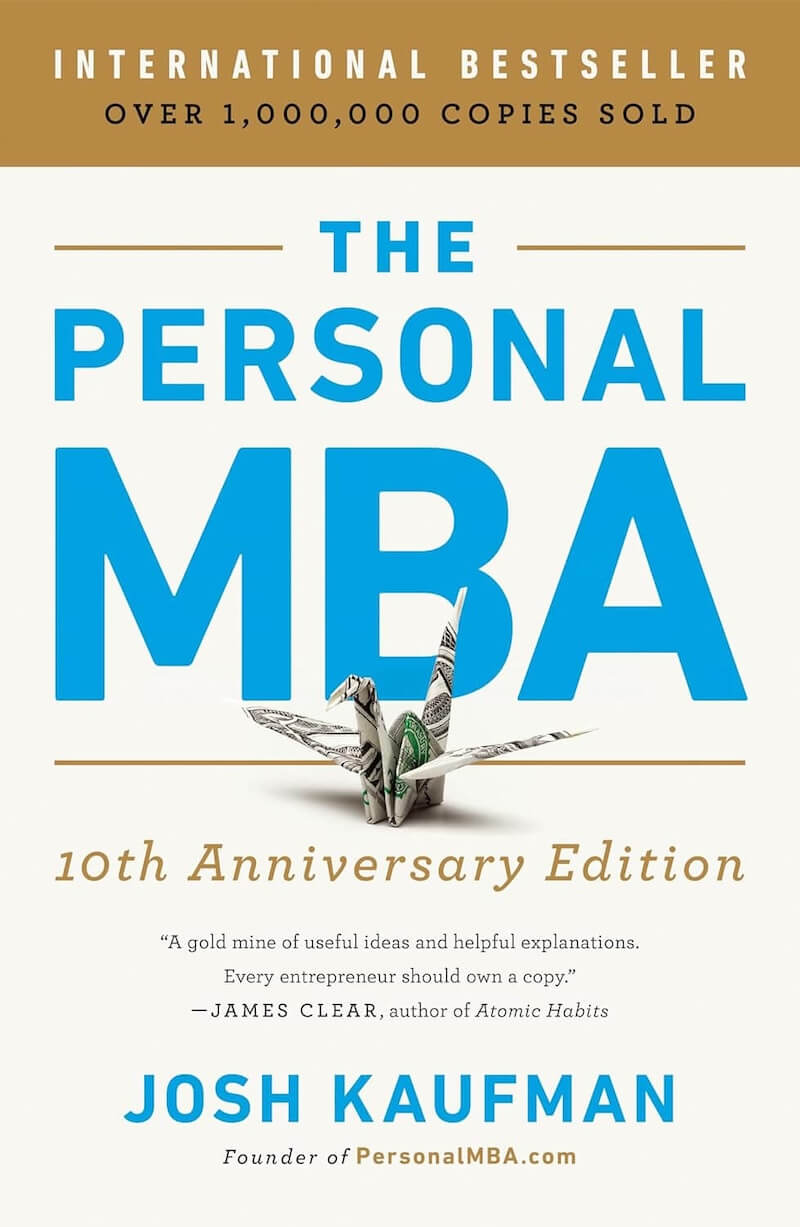
Personal MBA Book Summary
This Personal MBA Book Summary covers the key ideas, lessons, and takeaways in about 20 minutes.
Short Description:
The Personal MBA teaches business mastery through fundamentals and practice.
Helps with these goals
Want a Free Weekly Read?
Get a free summary every week straight to your mailbox.
Preview the Personal MBA book summary
Below is a preview of Sumizeit’s comprehensive human-written summary of Personal MBA by Josh Kaufman. The full summary is 15-20 minutes long and covers the book’s key ideas in text, audio, visual, and video formats. Unlock the full 20 Minute Summary
The Personal MBA challenges the widespread belief that business success requires attending a prestigious business school and earning an expensive MBA degree. Josh Kaufman argues that meaningful business education does not depend on academic credentials, high-priced tuition, or formal classrooms. Instead, it requires mastering the fundamental principles that govern how every business operates and developing the ability to apply those principles through experimentation, critical thinking, and real-world practice.
Kaufman emphasizes that business knowledge is not proprietary or mystical—it is accessible to anyone willing to learn. Traditional MBA programs often promise access to elite networks and lucrative careers, yet they frequently fail to provide the practical skills necessary to build or run a successful business. Many graduates leave school deeply in debt, with theoretical knowledge that does not translate into effective entrepreneurial or leadership capability.
In contrast, Kaufman presents a self-directed approach to business education that is affordable, flexible, and actionable. Individuals can learn business fundamentals on their own terms, using books, mentors, experimentation, and direct experience. The goal is not academic performance, but the ability to solve problems, deliver value, and create meaningful results. Business mastery, he argues, belongs not to those who earn a diploma, but to those who learn continuously and apply what they learn strategically.
The Limitations of Traditional MBA Programs
Kaufman provides a detailed critique of the traditional MBA system and explains why it often underdelivers on its promises. MBA programs command exceptionally high tuition costs—easily exceeding $200,000 when accounting for tuition, living expenses, and lost income during years spent in school. Students often borrow large amounts of money to attend prestigious institutions with the belief that their investment will pay off through high-earning corporate roles.
However, Kaufman argues that this model is risky and outdated. Business schools frequently train students for theoretical problem-solving rather than real-world execution. Coursework consists largely of case studies, conceptual frameworks, and retrospective analyses that portray business decisions as tidy, rational, and logical, ignoring the ambiguity, chaos, and improvisation required in real practice. These case studies present highly simplified narratives that strip away complexity and hindsight bias, making strategic choices appear inevitable rather than deeply uncertain.
MBA programs also tend to prepare students for middle-management roles in large corporations rather than for entrepreneurship or innovation. Their structure rewards compliance, structured thinking, and analytical modeling—not bold experimentation, rapid execution, or independent decision-making. Even students who dream of launching startups often postpone action due to accumulated debt, risk aversion, and the pressure to secure stable incomes quickly after graduating.
Kaufman argues that real business skill emerges not from studying hypothetical scenarios but from confronting real obstacles, selling real products, dealing with real customers, and learning from real results. The idea that business expertise requires institutional certification is, in his view, largely a marketing narrative.
The Five Core Components of Every Successful Business
Kaufman explains that all businesses, regardless of size, industry, or mission, operate using five essential components. These components function like interconnected gears—if any part is weak, the entire system suffers.
Want the complete 20-minute summary?
- Full structured summary
- Video Summary
- Podcast Summary
- Audio summary
- Key takeaways
- Exercises
- Quiz
- Highlights and notes
- Ask the book with AI
Who should read Personal MBA?
Personal MBA is for aspiring entrepreneurs, business builders, and professionals who want to develop business acumen without pursuing a traditional MBA. It's ideal for self-directed learners who prefer practical knowledge over theoretical frameworks, as well as anyone seeking to understand how successful businesses actually operate and scale.
Why does Personal MBA matter?
In today's economy, business knowledge is increasingly accessible and valuable, yet traditional MBA programs remain expensive, time-consuming, and often misaligned with real entrepreneurial needs. Josh Kaufman's Personal MBA demonstrates that lasting business success depends on mastering fundamental principles and applying them through experimentation—not on formal credentials or six-figure tuition. This approach democratizes business education and empowers individuals to build sustainable ventures without institutional gatekeeping or crippling debt.
What are the key themes in Personal MBA?
- Business education is accessible to anyone willing to learn independently
- All businesses operate using five interconnected core components
- Real-world execution and customer feedback matter more than theoretical frameworks
- Continuous improvement and systems thinking drive sustainable growth
- Understanding human psychology and behavior is central to business success
- Entrepreneurship is a mindset of experimentation and resilience, not just starting companies
- Financial literacy is essential for survival and informed decision-making
- Leadership means service, empowerment, and removing obstacles for teams
How can you apply ideas from Personal MBA?
- Test business ideas through small, low-cost experiments before committing significant resources—use landing pages, pre-orders, or demonstration videos to validate demand
- Map your business's five core components (value creation, marketing, sales, delivery, finance) and identify which areas need strengthening to improve overall performance
- Create a simple financial dashboard tracking revenue, expenses, cash flow, and customer acquisition cost to guide decisions and prevent cash flow crises
- Implement systems documentation and process improvement across operations to enable consistent delivery as your business scales, reducing manual work through automation and delegation
- Listen deeply in sales conversations to understand customer pain points and remove friction through guarantees, trials, or simplified purchasing rather than aggressive persuasion
- Build a personal learning plan using books, mentors, and direct experience rather than pursuing formal education—focus on applying insights immediately to real problems
- Identify bottlenecks limiting your business's performance and prioritize fixing the constraint rather than optimizing areas that don't affect overall results
What common mistakes do readers make with Personal MBA?
- Falling in love with your own idea rather than validating that real customers actually want to pay for your solution
- Assuming that an MBA degree or formal business credential is necessary to build a successful business, leading to unnecessary debt and delayed action
- Focusing on revenue growth while ignoring cash flow timing and profitability, risking bankruptcy despite appearing successful on paper
- Neglecting the value delivery and customer service components of business, which transform one-time transactions into loyal advocates and recurring revenue
- Making large bets based on untested assumptions rather than conducting small experiments and gathering real-world evidence before scaling
- Treating failure as humiliation rather than information, preventing honest reflection and adaptation that drives continuous improvement
Sumizeit Exercises Apply what you've learned
Turn ideas from Personal MBA into action with a short guided reflection: identify the biggest takeaway, connect it to your life, and commit to one step you can take in the next 24 hours.
What is the expert analysis of Personal MBA?
Overview
The Personal MBA by Josh Kaufman presents a compelling challenge to the conventional wisdom that a prestigious business school education is essential for success in the business world. Kaufman, an accomplished author and educator, leverages his expertise in entrepreneurship and self-education to advocate for a democratized approach to business mastery. His work resonates in an era marked by rising educational costs and skepticism toward traditional institutional models, offering a practical, accessible alternative that empowers individuals to take control of their own business learning journey.
Core Thesis
Kaufman’s central argument is that formal MBA programs, with their exorbitant costs and theoretical focus, often fail to equip students with the practical skills necessary for real-world business success. Instead, he posits that mastering five fundamental components—value creation, marketing, sales, value delivery, and finance—through self-directed learning, experimentation, and continuous application is the true path to business competence. This thesis reframes business education as an ongoing, experiential process rather than a credential-driven milestone.
Strengths
- Practical Framework: Kaufman distills business operations into five core components, providing a clear, actionable roadmap that transcends industry and scale.
- Accessible and Inclusive: The book democratizes business education, removing barriers related to cost, geography, and institutional gatekeeping.
- Emphasis on Real-World Application: By prioritizing experimentation, customer validation, and iterative learning, Kaufman aligns with contemporary entrepreneurial best practices.
- Integration of Psychology and Human Behavior: The attention to cognitive biases, emotional drivers, and social dynamics enriches the business discourse beyond dry financial or strategic models.
- Encouragement of Lifelong Learning: The advocacy for self-education and continuous improvement reflects modern understandings of skill acquisition and adaptability in rapidly changing markets.
Critiques & Counterarguments
- Oversimplification of MBA Value: While Kaufman critiques traditional MBA programs for their shortcomings, some elite institutions have evolved to incorporate experiential learning, entrepreneurship labs, and real-time projects. His broad dismissal may overlook these nuanced improvements.
- Limited Attention to Networking Benefits: The book downplays the role of elite networks and social capital, which empirical research shows can significantly influence career trajectories and access to resources, especially in corporate environments.
- Evidence Base and Academic Rigor: Kaufman’s arguments, though compelling, rely heavily on anecdotal examples and case studies rather than systematic empirical research, which may limit their generalizability.
- Risk of Self-Directed Learning Pitfalls: Not all learners possess the discipline or critical judgment to curate effective curricula or avoid misinformation, potentially leading to gaps in knowledge or flawed business decisions.
- Contrasting Views on Formal Education: Schools of thought in organizational behavior and management emphasize the value of structured learning environments for developing complex skills such as negotiation, leadership, and ethics—areas that may be underemphasized in Kaufman’s framework.
Who Should Read This
The Personal MBA is ideal for aspiring entrepreneurs, self-starters, and professionals disillusioned with traditional business education models who seek a pragmatic, cost-effective approach to mastering business fundamentals. It appeals to lifelong learners who value autonomy and real-world experience over formal credentials. Additionally, individuals considering entrepreneurship or small business ownership will find Kaufman’s emphasis on actionable knowledge and experimentation particularly valuable. However, those pursuing careers in corporate leadership or academia may need to supplement this book with more specialized or credentialed education.
Frequently asked questions about the Personal MBA book summary
What is Personal MBA about?
Personal MBA by Josh Kaufman challenges the necessity of formal business education and demonstrates that anyone can develop practical business mastery by learning the five core components that drive all successful businesses: value creation, marketing, sales, value delivery, and finance. The book advocates for self-directed, affordable learning through books, mentors, experimentation, and real-world experience instead of expensive, time-consuming MBA programs.
Who should read Personal MBA?
Personal MBA is essential reading for aspiring entrepreneurs, business builders, freelancers, and professionals who want to understand how businesses work without pursuing a traditional MBA. It's ideal for self-directed learners who prefer practical knowledge over theory, as well as anyone seeking to develop sustainable business skills on their own terms and timeline.
What are the main takeaways from Personal MBA?
The main takeaways from Personal MBA are that business mastery is accessible through self-education and real-world practice rather than formal credentials, that all successful businesses operate using five interconnected components, that customer validation and feedback matter more than theoretical planning, and that continuous improvement and systems thinking drive sustainable growth. Success depends on understanding human psychology, delivering genuine value, and managing finances wisely—not on expensive degrees or institutional gatekeeping.
What are the five core components of every business according to Personal MBA?
The five core components are value creation (identifying and solving real customer problems), marketing (earning attention and building understanding), sales (converting interest into revenue), value delivery (keeping promises and creating loyalty), and finance (measuring and managing money). These components function like interconnected gears—weakness in any area limits overall business performance and sustainability.
Does Personal MBA criticize MBA programs, and why?
Yes, Personal MBA critiques traditional MBA programs for being expensive (often exceeding $200,000 with tuition and opportunity costs), teaching theoretical problem-solving rather than real-world execution, leaving graduates in debt, and preparing students for corporate employment rather than entrepreneurship. Kaufman argues that case study learning oversimplifies decisions and ignores the ambiguity and improvisation required in actual business practice.
How does Personal MBA define successful sales and marketing?
Personal MBA reframes sales as guiding customers to decisions that genuinely improve their lives, emphasizing listening and removing friction rather than manipulation. For marketing, Kaufman stresses that people buy based on emotion and identity first, so effective marketing connects to what customers desire and aspire to achieve, using social proof and authentic communication to build trust rather than relying on product claims alone.
What role does continuous improvement play in Personal MBA?
Continuous improvement is central to Personal MBA's philosophy, building on the Japanese concept of Kaizen—making constant incremental changes rather than massive one-time reforms. By identifying bottlenecks, implementing small process improvements, and gathering feedback from real operations, businesses compound gains over time and transform average performance into excellence without reinventing their entire system.
How does Personal MBA approach business education differently than traditional schools?
Personal MBA advocates for self-directed learning through books, mentors, observation, and direct experience—an approach that is flexible, affordable, and immediately applicable to real problems. Unlike structured classroom education, self-education evolves with actual business needs and provides faster feedback loops, making it more relevant and faster than theoretical frameworks taught in formal programs.
About Sumizeit
Sumizeit is a profitable Scomy LLC company based in Miami, Florida. Our founders, Clemens Raemy and Weina Scott, are successful entrepreneurs with several exits. Sumizeit is a popular book summary app / micro learning app used by busy professionals and entrepreneurs with over 2,500 non-fiction book summaries and 10,000 podcast summaries in text, audio, visual, podcast, and video format. We also have stellar retention tools to make ideas stick - such as flashcards with spaced repetition, quizzes, streaks, highlighting and notes, daily challenges, riddles, mini-courses, meditation, and more. You won't only learn the idea, but also remember it. Over 90% of our users change their habits with Sumizeit.
Upgrade Now
Here's why readers love Sumizeit
Join thousands of learners getting smarter every day
"Great experience. Detailed summaries. Loved the gamification feature. Makes learning fun. Good customer service. I recommend Sumizeit to anyone. You'll learn a lot."
"I always felt busy but still wanting to keep up with the book discussion in my friend group. This was a great supplement to help me keep reading the books I find fun while keeping up with important books."
"I love this website. Instead of scrolling social media, I find myself learning a lot. I use it everyday. I recommend this app for anyone who is too busy and wants to get up to speed with their favorite books."
Personal MBA Book Summary PDF
Looking for a Personal MBA Book Summary PDF you can save and revisit offline? Our Personal MBA Book Summary PDF captures the book’s core ideas in a clean, printable format — the key frameworks, takeaways, and structure without the fluff. Download the Personal MBA Book Summary PDF when you want a reference you can annotate, share with your team, or review on the go. Get your Personal MBA Book Summary PDF from the download page below.
Download Personal MBA Book Summary PDFPeople also liked these summaries
Readers who explored Personal MBA often enjoyed these titles next.



Ready to read the whole thing?
- Full structured summary
- Video Summary
- Podcast Summary
- Audio summary
- Key takeaways
- Exercises
- Quiz
- Highlights and notes
- Ask the book with AI
Featured Book Titles
Popular Book Summaries at sumizeit, leading book summary app