


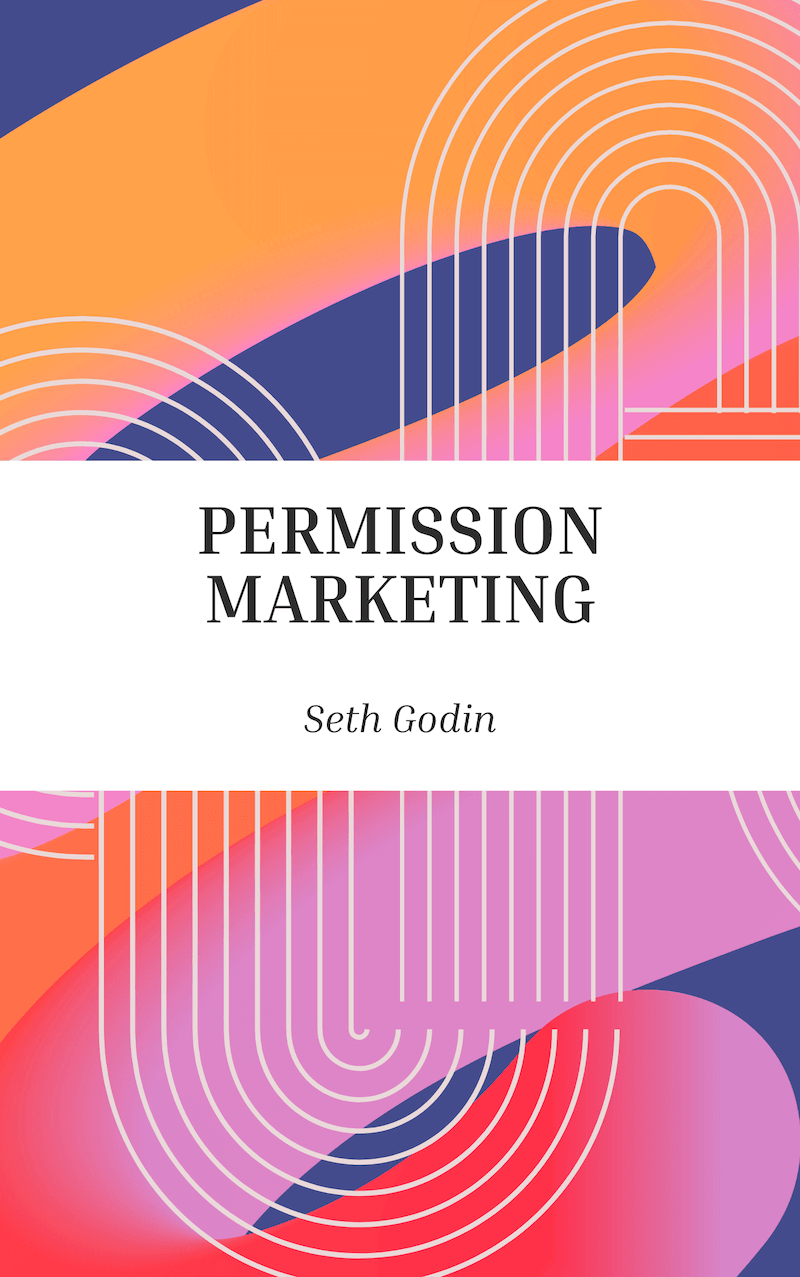
Prefer the print book? Buy on Amazon
As an Amazon Associate, Sumizeit earns from qualifying purchases.
Permission Marketing Book Summary
This Permission Marketing Book Summary covers the key ideas, lessons, and takeaways in about 20 minutes.
In a world of endless noise, attention is the ultimate privilege. Brands that treat it with care — like an ongoing conversation instead of a sales pitch — will build loyalty that no amount of advertising money can buy.
Helps with these goals
Want the complete 20-minute summary?
- Full structured summary
- Video Summary
- Podcast Summary
- Audio summary
- Key takeaways
- Exercises
- Quiz
- Highlights and notes
- Ask the book with AI
Not ready to upgrade?
Get this summary + 2 more picks sent to your inbox, free.
What is in the Permission Marketing book summary?
Below is a preview of Sumizeit’s expert-written summary of Permission Marketing by Seth Godin. The full summary covers the book’s key ideas in text, audio, and video.
Seth Godin’s Permission Marketing: Turning Strangers into Friends and Friends into Customers transformed how businesses think about customer relationships and attention. Before his ideas emerged, most marketing relied on sheer interruption — television commercials cutting into programs, loud radio jingles, pop-ups on early internet browsers, and billboards screaming for attention. These methods worked during an era of limited channels and captive audiences.
But as the marketplace expanded and consumers gained control over what they watched and read, this approach began to collapse. Godin recognized that companies were spending billions to be ignored. The modern consumer, flooded with information, developed what he called “attention fatigue.” The solution? A shift from interruption to invitation.
Godin coined Permission Marketing to describe this new philosophy: instead of shouting at consumers, invite them to participate voluntarily. Earn their trust before asking for their money. When you gain their permission to communicate, you’re no longer competing for attention — you’re cultivating a relationship.
He compares this transformation to dating. You don’t propose marriage to someone the first time you meet. You start with an introduction, get to know each other, and slowly deepen the relationship through trust and shared values. Similarly, businesses must stop acting like desperate suitors and start behaving like thoughtful partners who invest in long-term connection.
Why Interruption Marketing Fails in the Modern World
Today’s consumers are bombarded with thousands of marketing messages every single day — in their social media feeds, inboxes, podcasts, and even on receipts or shopping carts. As a result, attention has become the most valuable and limited resource in business.
People have built powerful filters. They scroll past banner ads, skip YouTube commercials, and install ad blockers. When people feel manipulated, they not only ignore the message — they develop negative associations with the brand.
Example: A viewer watching a recipe video on YouTube is interrupted by a 30-second car ad. Even if they don’t consciously dislike the car brand, their brain associates it with annoyance. Permission marketing eliminates this resentment by ensuring that communication is invited and relevant.
In the mid-20th century, an ad on one of three major TV networks could reach half the country. Now, audiences are split among thousands of TV channels, millions of websites, and countless apps. Even the most expensive Super Bowl ad — once the pinnacle of mass reach — may have little long-term effect because viewers multitask, check their phones, or watch online highlights later without commercials.
In the past, advertising could make ordinary products seem extraordinary. But in modern markets, product quality has largely leveled out. Nearly every shampoo, toothpaste, and smartphone performs adequately. When consumers perceive little difference between brands, emotional connection becomes the deciding factor — and interruption marketing is terrible at building emotion.
As Godin explains, people no longer respond to noise. They respond to trust.
What Permission Marketing Really Means
Permission Marketing is based on the idea that a person who has given you permission to communicate — by subscribing to an…
Want the complete 20-minute summary?
- Full structured summary
- Video Summary
- Podcast Summary
- Audio summary
- Key takeaways
- Exercises
- Quiz
- Highlights and notes
- Ask the book with AI
Who should read Permission Marketing?
Permission Marketing is essential for marketers, entrepreneurs, and business leaders who want to build lasting customer relationships in an oversaturated attention economy. Whether you're running a startup, managing a brand, or rethinking your marketing strategy, this book offers a proven framework for standing out by respecting rather than interrupting your audience.
Why does Permission Marketing matter?
In today's digital world, consumers are bombarded with thousands of marketing messages daily and have built powerful defenses against intrusive advertising. Permission Marketing shows why traditional interruption tactics fail and reveals how forward-thinking companies earn customer loyalty through trust, personalization, and genuine value—a philosophy that has only become more critical as privacy regulations tighten and ad fatigue increases.
What are the key themes in Permission Marketing?
- Shift from interruption to invitation-based marketing
- Permission as the foundation of customer relationships
- Attention as the most valuable limited resource
- Building trust through consistent, relevant communication
- Long-term relationship equity over quick conversions
- Ethical data use and transparency as competitive advantages
Want the complete 20-minute summary?
- Full structured summary
- Video Summary
- Podcast Summary
- Audio summary
- Key takeaways
- Exercises
- Quiz
- Highlights and notes
- Ask the book with AI
How can you apply ideas from Permission Marketing?
- Create a lead magnet—free guide, template, or trial—that attracts your target audience without requiring a purchase upfront
- Build an email newsletter that educates, entertains, or solves problems for subscribers, establishing your brand as a trusted resource before promoting products
- Design a loyalty program that rewards repeat engagement with points, exclusive access, or surprise gifts to deepen customer relationships
- Gather customer preference data transparently and use it to personalize product recommendations, email content, and communication timing
- Develop a content calendar that shares stories, tips, and behind-the-scenes insights aligned with your audience's values and lifestyle
- Set up feedback loops—surveys, reviews, preferences—to continuously refine your messaging and prove you're listening to customer needs
- Create tiered permission levels where customers can choose which types of communication they receive and how often, respecting their boundaries
What common mistakes do readers make with Permission Marketing?
- Treating the first email as a sales pitch instead of an investment in relationship-building, leading to high unsubscribe rates before trust is established
- Collecting customer data without explicit permission or clear explanation of how it will be used, which violates trust and may breach privacy regulations
- Sending generic, one-size-fits-all messages to opt-in audiences, defeating the personalization advantage of permission marketing
- Asking for deeper permission (more data, new channels) too quickly without demonstrating consistent value and building sufficient trust first
- Failing to segment audiences by interest or behavior, resulting in irrelevant messages that train customers to ignore your communications
Sumizeit Exercises Apply what you've learned
Turn ideas from Permission Marketing into action with a short guided reflection: identify the biggest takeaway, connect it to your life, and commit to one step you can take in the next 24 hours.
What is the expert analysis of Permission Marketing?
Overview
Permission Marketing is a seminal work by Seth Godin, a pioneering figure in modern marketing thought and digital entrepreneurship. Published in 1999, the book marks a paradigm shift from traditional interruption-based advertising to a more respectful, relationship-driven approach. Godin’s insights anticipated the rise of personalized, data-informed marketing strategies that dominate today’s digital economy. His status as a prolific author and marketing visionary lends significant weight to the book’s influence across business, psychology, and consumer behavior disciplines.
Core Thesis
Godin’s central argument is that the era of interruption marketing—characterized by unsolicited, disruptive advertisements—is obsolete in an age of media saturation and empowered consumers. Instead, marketers must earn explicit permission from consumers before engaging them, transforming marketing from a one-way broadcast into an ongoing, trust-based dialogue. This “permission marketing” fosters emotional loyalty and long-term relationships by delivering anticipated, personal, and relevant communication, thereby converting attention into genuine engagement and, ultimately, profit.
Strengths
- Prescient Analysis: Godin foresaw the decline of mass advertising and the rise of personalized marketing decades before these trends became mainstream, demonstrating remarkable foresight.
- Clear Conceptual Framework: The analogy of marketing as dating provides an accessible and compelling metaphor that clarifies the gradual, trust-building nature of effective marketing relationships.
- Practical Application: The book offers actionable steps and real-world examples from companies like Amazon, Spotify, and Patagonia, illustrating how permission marketing operates across diverse industries.
- Ethical Emphasis: Godin’s insistence on responsible data use and transparency anticipates contemporary concerns about privacy and consumer trust, positioning the book as ethically grounded.
- Integration of Psychology and Business: By highlighting emotional loyalty and attention as scarce resources, the book bridges marketing tactics with deeper psychological insights into consumer behavior.
Critiques & Counterarguments
- Overidealization of Consumer Consent: While permission marketing advocates voluntary engagement, in practice, consumers often grant permission without full awareness of data use or marketing intent, raising ethical questions about informed consent.
- Limited Address of Power Imbalances: The framework underplays how large corporations can leverage vast data and algorithmic power to subtly manipulate consumer preferences, blurring the line between permission and coercion.
- Potential for Oversaturation of Permission Channels: As more brands adopt permission marketing, consumers may experience “permission fatigue,” diminishing the effectiveness of opt-in communications and echoing some issues of interruption marketing.
- Competing Research on Consumer Attention: Some behavioral economists argue that attention is not only scarce but also irrationally allocated, influenced by cognitive biases and heuristics that permission marketing may not fully address.
- Real-World Contradictions: Despite permission marketing’s promise, many successful brands still rely heavily on interruption tactics (e.g., Super Bowl ads, influencer endorsements), suggesting a hybrid model rather than a wholesale replacement.
Who Should Read This
Permission Marketing is essential reading for marketing professionals, business strategists, and entrepreneurs seeking to navigate the complexities of the modern attention economy. It also appeals to scholars of consumer psychology and ethics interested in the evolving dynamics between brands and individuals. Furthermore, anyone involved in digital communication, customer experience design, or data privacy will find Godin’s insights invaluable for fostering authentic, sustainable engagement in an era of information overload.
Frequently asked questions about the Permission Marketing book summary
What is Permission Marketing about?
Permission Marketing by Seth Godin is about shifting from intrusive advertising that interrupts consumers to a relationship-based approach where customers voluntarily opt in to receive personalized, valuable communication. The core idea is that earning permission to communicate, rather than fighting for attention through noise and repetition, builds stronger customer loyalty and sustainable business growth.
Who should read Permission Marketing?
This book is essential for marketers, entrepreneurs, business leaders, and anyone responsible for customer acquisition and retention who wants to build lasting relationships in today's crowded digital marketplace. It's particularly valuable for those frustrated with declining ROI on traditional advertising and ready to adopt a customer-first philosophy.
What are the main takeaways from Permission Marketing?
The core takeaways are: (1) Interruption marketing fails because consumers are overwhelmed and have built defenses against intrusive ads, (2) Permission marketing—inviting customers to opt in to relevant communication—builds trust and loyalty more efficiently, (3) Successful permission marketing follows five steps: offer an incentive, educate consistently, reinforce trust, deepen permission gradually, and convert to profit, and (4) The future belongs to brands whose messages are anticipated, personal, and valuable to the customer.
How do I start a permission marketing campaign?
Begin by creating an irresistible incentive—a free guide, trial, or exclusive content—that attracts your target audience and encourages them to opt in. Once you have permission, consistently deliver valuable education or entertainment that builds trust before asking for a purchase. Gradually deepen the relationship by personalizing communication and respecting customer privacy.
What's the difference between Permission Marketing and traditional advertising?
Traditional advertising interrupts consumers with unsolicited messages and relies on repetition to build awareness, while Permission Marketing invites opt-in audiences and focuses on building trust through relevant, valuable communication. Permission marketing is efficient because it reaches receptive people, eliminates wasted ad spend on disinterested audiences, and creates emotional loyalty rather than transactional relationships.
Why does permission marketing work better in today's market?
Modern consumers are bombarded with thousands of daily marketing messages, have installed ad blockers, and actively ignore intrusive ads. Attention has become scarce and valuable. Permission marketing works because it respects this scarcity, reaches only interested audiences, and builds relationships that advertising money alone cannot buy.
What role does data play in Permission Marketing?
Data enables personalization at scale—allowing companies to deliver individually relevant messages similar to how a local shopkeeper remembers a customer's preferences. However, data must be collected transparently with explicit consent and used ethically; any violation of privacy destroys permission instantly and permanently damages trust.
How do companies profit from permission marketing?
Seth Godin outlines three profitable models built on permission: (1) Subscriptions where customers pay regularly without reapproving each purchase, (2) Loyalty programs that reward repeat engagement with points or perks, and (3) Personal trust models for high-ticket sales relying on one-on-one relationships. Each succeeds because it's based on earned trust, not manipulation.
About Sumizeit
Sumizeit is a profitable Scomy LLC company based in Miami, Florida. It has been helping readers learn from nonfiction books for 7 years with expert-written summaries in text, audio, podcast, and video.
Want the complete 20-minute summary?
- Full structured summary
- Video Summary
- Podcast Summary
- Audio summary
- Key takeaways
- Exercises
- Quiz
- Highlights and notes
- Ask the book with AI
Here's why readers love Sumizeit
Join thousands of learners getting smarter every day
"Great experience. Detailed summaries. Loved the gamification feature. Makes learning fun. Good customer service. I recommend Sumizeit to anyone. You'll learn a lot."
"I always felt busy but still wanting to keep up with the book discussion in my friend group. This was a great supplement to help me keep reading the books I find fun while keeping up with important books."
"I love this website. Instead of scrolling social media, I find myself learning a lot. I use it everyday. I recommend this app for anyone who is too busy and wants to get up to speed with their favorite books."
Permission Marketing Book Summary PDF
Looking for a Permission Marketing Book Summary PDF you can save and revisit offline? Our Permission Marketing Book Summary PDF captures the book’s core ideas in a clean, printable format — the key frameworks, takeaways, and structure without the fluff. Download the Permission Marketing Book Summary PDF when you want a reference you can annotate, share with your team, or review on the go. Get your Permission Marketing Book Summary PDF from the download page below.
Download Permission Marketing Book Summary PDFPeople also liked these summaries
Readers who explored Permission Marketing often enjoyed these titles next.


Want the complete 20-minute summary?
- Full structured summary
- Video Summary
- Podcast Summary
- Audio summary
- Key takeaways
- Exercises
- Quiz
- Highlights and notes
- Ask the book with AI
Featured Book Titles
Popular Book Summaries at sumizeit, leading book summary app