
Question 1 of 10


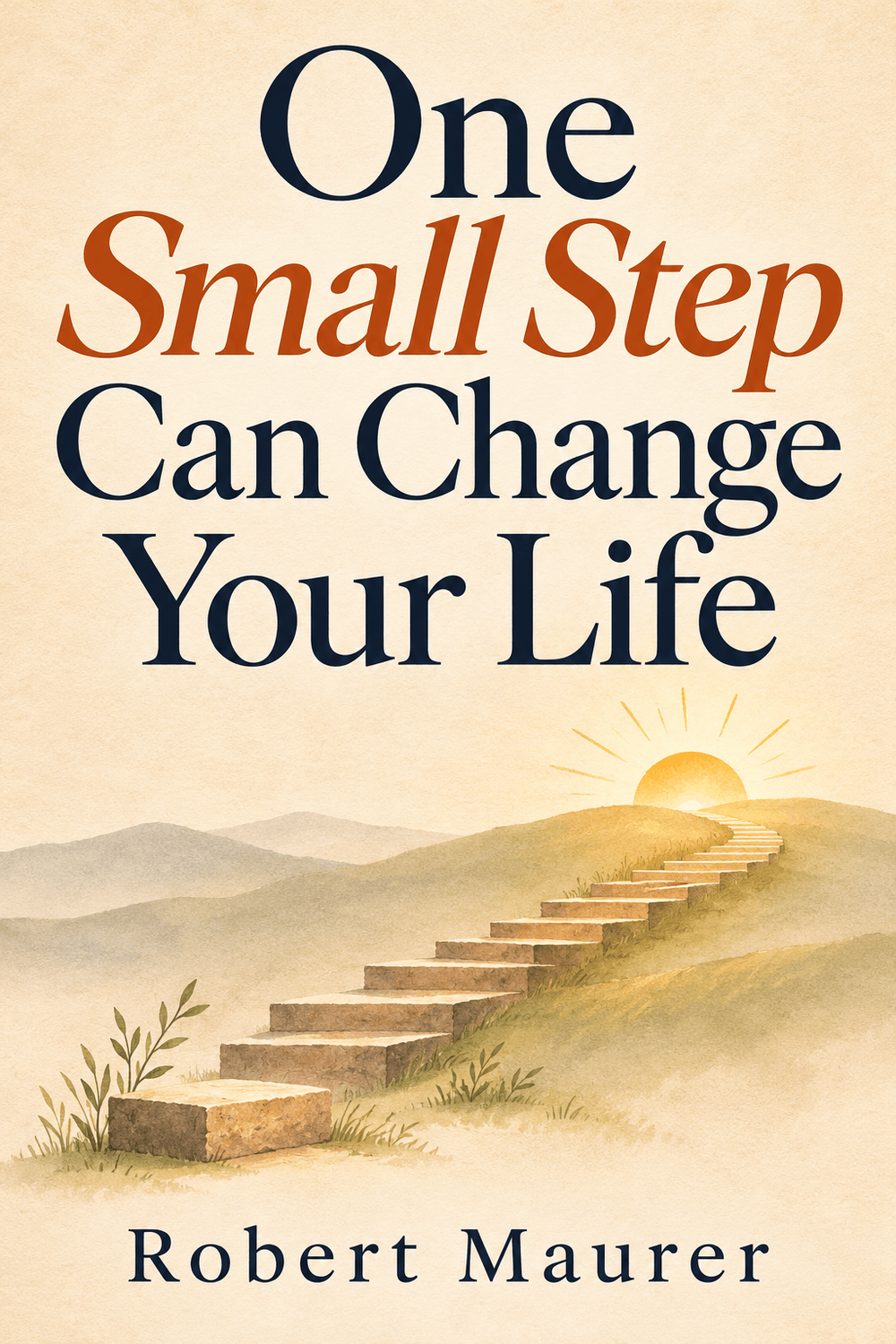
Prefer the print book? Buy on Amazon
As an Amazon Associate, Sumizeit earns from qualifying purchases.
Book Summary
One Small Step Can Change Your Life Book Summary
This One Small Step Can Change Your Life Book Summary covers the key ideas, lessons, and takeaways in about 20 minutes.
Short Description:
How tiny, easy steps slip past fear and add up to big, lasting life change
Big, dramatic change fails so often because it scares your brain, and a scared brain stops thinking and runs back to old habits. Maurer's way around this is to go small enough that fear never wakes up. Ask one gentle question. Picture the task for a few seconds. Take a step so tiny you can't fail. Fix the little problem in front of you, give yourself a small reward, and notice the good moments as you go. None of these feels like much on its own, which is the point. The steps pile up and build momentum, and the change that once looked impossible ends up feeling ordinary.
Helps with these goals
Preview the One Small Step Can Change Your Life book summary
Below is a preview of Sumizeit’s comprehensive human-written summary of One Small Step Can Change Your Life by Robert Maurer. The full summary is 15-20 minutes long and covers the book’s key ideas in text, audio, visual, and video formats. Unlock the full 20 Minute Summary
You know the feeling. You decide to switch careers, lose weight, or finally write the book, and within a week you're back to your old routine. Robert Maurer, a clinical psychologist, says this has nothing to do with laziness or weak willpower. Your brain is doing what it was built to do.
Your ancestors survived by staying alert to danger and reacting fast. That alarm system is still in your head, and it hasn't caught up with modern life. Today it rarely has a predator to worry about, so it goes off whenever you step away from your safe, familiar routine. To your brain, any change looks like a threat. A new job sets it off. So does a new breakfast.
Once the alarm rings, two things go wrong. First, your brain hands control to its survival instincts, which means fight, flight, or freeze. The parts that handle clear thinking and problem solving go quiet. That's why you can sit with a big decision for months and never manage to weigh it calmly. You freeze instead. Second, the alarm produces fear, and the fear grows with the size of the change and how much it matters to you. Fear is uncomfortable, so you run back to what you know. You want to get healthy, yet you end up on the couch with a bag of chips, because the couch feels safe.
How small steps get past the alarm
Maurer's answer comes from kaizen, a Japanese approach built on steady improvement through small, consistent steps. He first ran into it while consulting for companies, and he saw that it worked just as well for people as it did for factories.
The idea is simple. If big changes set off the alarm, make the change so small that the alarm never notices. A tiny, easy action slips past your brain's defenses. Your thinking brain stays switched on, and the fear that usually comes with change mostly stays away.
Small steps do two more things for you. They build momentum. Clearing one drawer is so easy and feels so good that you move on to the closet, and a few weeks later the whole house is in order. They also make new behavior stick. Each small action wears down a bit of your resistance, until the new way of doing things feels normal. Add one glass of water to your morning and before long you're reaching for water all day without thinking about it.
Maurer says this changes how change feels. What used to scare you starts to feel doable, even enjoyable. He then gives six ways to put small steps to work.
Ask small questions
The first strategy is to ask yourself small, gentle questions. A question works like a cue for your brain. Ask one, and your mind starts hunting for an answer. Your attention moves away from all the reasons you can't change and toward ways you could.
The size of the question matters.
Want the complete 20-minute summary?
- Full structured summary
- Video Summary
- Podcast Summary
- Audio summary
- Key takeaways
- Exercises
- Quiz
- Highlights and notes
- Ask the book with AI
Who should read One Small Step Can Change Your Life?
One Small Step Can Change Your Life is for anyone who has struggled to break bad habits, start new ones, or achieve meaningful goals. Whether you're overwhelmed by big life changes, paralyzed by perfectionism, or stuck in cycles of failed resolutions, this book offers a practical framework that works. It's especially valuable for people who feel anxious about change or have repeatedly failed using traditional willpower-based approaches.
Why does One Small Step Can Change Your Life matter?
In a world obsessed with dramatic transformation and overnight success, Robert Maurer reveals why most people fail at change—and offers a science-backed alternative. Understanding how your brain resists large shifts in behavior unlocks a path forward that feels manageable rather than terrifying. This approach has proven itself across corporate environments, personal development, and real-world crises, making it one of the most actionable frameworks for sustainable change available today.
What are the key themes in One Small Step Can Change Your Life?
- Your brain is wired to resist change as a survival mechanism
- Small steps bypass the brain's fear response and build lasting habits
- Momentum compounds: tiny actions create surprising results over time
- Questions, visualization, and rewards reprogram your behavior more effectively than willpower alone
- Progress is built on noticing and fixing small problems before they grow
- Consistency matters more than size when creating real change
How can you apply ideas from One Small Step Can Change Your Life?
- Ask one small question daily—such as 'What's one way I could improve this?' or 'What small step could I take today?'—and let repetition reveal better answers over time
- Spend 10-30 seconds daily visualizing yourself successfully completing a task that makes you nervous, using all five senses to make the mental image vivid
- Break any large goal into steps so trivial they feel almost laughable, then complete one before moving to the next
- When facing a crisis or big problem, identify and solve the smallest piece first to regain momentum and build confidence
- Give yourself small, immediate rewards after completing desired behaviors—a few minutes of rest, a favorite snack, or a short walk—to strengthen the habit loop
- Scan your daily life for small annoyances or warning signs (squeaky chair, recurring typo, date who interrupts) and fix them before they become bigger problems
- Notice and appreciate small positive moments throughout your day—sunlight, a text from a friend, good coffee—to improve mood and stay motivated on long-term goals
What common mistakes do readers make with One Small Step Can Change Your Life?
- Setting a goal so large it activates the brain's alarm system, triggering fear that shuts down thinking and motivation
- Using big rewards as motivation, which creates pressure and shifts focus to the prize rather than building lasting habits
- Attempting to sustain change through willpower alone, ignoring the brain's neurological resistance to unfamiliar behavior
- Ignoring small problems and warning signs until they become crises, when early intervention would have prevented the damage
Sumizeit Exercises Apply what you've learned
Turn ideas from One Small Step Can Change Your Life into action with a short guided reflection: identify the biggest takeaway, connect it to your life, and commit to one step you can take in the next 24 hours.
What is the expert analysis of One Small Step Can Change Your Life?
Overview
One Small Step Can Change Your Life is a compelling work by Robert Maurer, a clinical psychologist with extensive experience in behavioral sciences and corporate consulting. Maurer’s expertise, combined with his academic affiliations at UCLA and the University of Washington, lends credibility to his exploration of human behavior and change. The book’s significance lies in its practical application of the Japanese philosophy of kaizen—continuous, incremental improvement—to personal transformation. By bridging psychology, neuroscience, and self-improvement, Maurer offers a refreshing antidote to the often overwhelming and discouraging narratives surrounding change.
Core Thesis
Maurer’s central argument is that the human brain’s evolutionary survival mechanisms perceive change as a threat, triggering fear and resistance that sabotage even the most well-intentioned efforts. The key to overcoming this innate barrier is to circumvent the brain’s alarm system by taking exceptionally small, manageable steps—so small that they do not provoke fear or resistance. These micro-actions build momentum, foster new habits, and gradually rewire the brain’s response to change, making transformation not only possible but sustainable and even enjoyable.
Strengths
- Integration of Neuroscience and Practical Wisdom: Maurer skillfully connects evolutionary psychology with everyday behavior, explaining why change feels so difficult in a way that resonates with readers on both intellectual and emotional levels.
- Actionable, Incremental Strategies: The book’s six strategies—asking small questions, mental rehearsal, tiny actions, fixing small problems, giving small rewards, and noticing small moments—are concrete, easy to implement, and grounded in real-world experience.
- Focus on Psychological Safety: By emphasizing minimal steps that avoid triggering the brain’s fear response, Maurer provides a psychologically informed framework that respects human limitations and reduces the risk of burnout or failure.
- Broad Applicability: The principles apply across diverse domains, from personal health and creativity to relationships and professional growth, making the book relevant to a wide audience.
- Encouragement of Mindfulness and Positive Reinforcement: The attention to small rewards and noticing positive moments aligns well with contemporary positive psychology, enhancing motivation and well-being.
Critiques & Counterarguments
- Potential Oversimplification: While the kaizen approach is elegant, some readers may find the emphasis on tiny steps insufficient for addressing deeply entrenched habits or systemic issues that require more comprehensive interventions.
- Limited Discussion of Individual Differences: The book does not extensively address how personality traits, mental health conditions, or socio-economic factors might affect one’s ability to implement small steps, potentially limiting its universality.
- Competing Research on Motivation: Some behavioral economists and psychologists argue that larger, more immediate incentives can sometimes be more effective than small rewards, especially in contexts requiring urgent or high-stakes change.
- Real-World Evidence of Nonlinear Change: Critics from complexity science might argue that change is often nonlinear and emergent, not always amenable to gradual incrementalism; sudden, transformative shifts can sometimes be necessary and effective.
- Risk of Complacency: There is a subtle risk that focusing on “tiny” steps could foster complacency or procrastination if readers mistake minimal action for sufficient progress, especially without clear milestones or accountability mechanisms.
Who Should Read This
This book is ideal for readers who have struggled with sustained personal change and are seeking a psychologically sound, gentle approach to transformation. It is particularly valuable for those interested in self-improvement, behavioral psychology, and practical philosophy, including professionals in coaching, therapy, and organizational development. Additionally, anyone overwhelmed by the prospect of large-scale change will find Maurer’s incremental method both accessible and empowering, making it a useful guide for cultivating lasting habits and resilience in a complex, fast-paced world.
Discussion questions for One Small Step Can Change Your Life Short questions you can actually use in a conversation
Frequently asked questions about the One Small Step Can Change Your Life book summary
What is One Small Step Can Change Your Life about?
One Small Step Can Change Your Life by Robert Maurer explains why big changes trigger fear in your brain and how to overcome this using kaizen—a Japanese approach based on small, consistent steps. The book offers six practical strategies—asking small questions, mental rehearsal, tiny actions, fixing small problems, giving small rewards, and noticing small moments—that bypass fear and build lasting change.
Who should read One Small Step Can Change Your Life?
This book is ideal for anyone struggling with habits, goals, or life changes—people who feel overwhelmed, anxious, or stuck in cycles of failure. It works especially well for perfectionists, those who've relied on willpower without success, people in crisis seeking to regain control, and anyone who wants to understand why their brain resists change.
What are the main takeaways from One Small Step Can Change Your Life?
The core insight is that your brain treats all change as a threat, triggering fear that sabotages progress. Robert Maurer's solution is to make changes so small the alarm never activates. Key takeaways include asking gentle questions to redirect your mind, visualizing success to reduce anxiety, taking steps so tiny you can't fail, fixing small problems before they grow, rewarding the process not just results, and noticing good moments along the way.
Why does traditional goal-setting and willpower fail?
Traditional approaches rely on big, dramatic changes that activate your brain's survival alarm—the same system that kept your ancestors safe from predators. When this alarm fires, your thinking mind shuts down, fear floods in, and your brain forces you back to familiar routines for safety. No amount of willpower can overcome this neurological response.
How can I use small steps to lose weight or build healthy habits?
Instead of overhauling your entire diet, ask yourself a small question like 'What's one vegetable I could add this week?' or 'What's one extra glass of water I could drink?' Then take one tiny action—add broccoli to your shopping list or set your alarm five minutes early for a morning walk. Reward yourself immediately with something small, and watch the momentum build as each easy win makes the next step feel natural.
How does visualization help with change?
Your brain can't distinguish between a vividly imagined experience and a real one—it processes both the same way. By spending a few seconds daily visualizing yourself completing a task successfully, you rehearse the skill and make it feel familiar. When you actually attempt it, the action feels less scary because your brain has already experienced it many times.
What's the right size for a small step?
A small step should feel so trivial that you almost question whether it counts as progress. If it seems almost silly, you've got the size right. The point is that you can't fail, and each easy win builds momentum toward bigger changes. Once a step feels completely comfortable, you add another one.
Can kaizen really work for major life changes?
Yes—Robert Maurer discovered kaizen while consulting for major companies like Disney and the US Navy, and he's seen it work for individuals facing career changes, health crises, relationship problems, and personal projects. The approach works because it's based on how your brain actually functions rather than fighting against it.
About Sumizeit
Sumizeit is a profitable Scomy LLC company based in Miami, Florida. Our founders, Clemens Raemy and Weina Scott, are successful entrepreneurs with several exits. Sumizeit is a popular book summary app / micro learning app used by busy professionals and entrepreneurs with over 2,500 non-fiction book summaries and 10,000 podcast summaries in text, audio, visual, podcast, and video format. We also have stellar retention tools to make ideas stick - such as flashcards with spaced repetition, quizzes, streaks, highlighting and notes, daily challenges, riddles, mini-courses, meditation, and more. You won't only learn the idea, but also remember it. Over 90% of our users change their habits with Sumizeit.
Upgrade Now
Here's why readers love Sumizeit
Join thousands of learners getting smarter every day
"Great experience. Detailed summaries. Loved the gamification feature. Makes learning fun. Good customer service. I recommend Sumizeit to anyone. You'll learn a lot."
"I always felt busy but still wanting to keep up with the book discussion in my friend group. This was a great supplement to help me keep reading the books I find fun while keeping up with important books."
"I love this website. Instead of scrolling social media, I find myself learning a lot. I use it everyday. I recommend this app for anyone who is too busy and wants to get up to speed with their favorite books."
One Small Step Can Change Your Life Book Summary PDF
Looking for a One Small Step Can Change Your Life Book Summary PDF you can save and revisit offline? Our One Small Step Can Change Your Life Book Summary PDF captures the book’s core ideas in a clean, printable format — the key frameworks, takeaways, and structure without the fluff. Download the One Small Step Can Change Your Life Book Summary PDF when you want a reference you can annotate, share with your team, or review on the go. Get your One Small Step Can Change Your Life Book Summary PDF from the download page below.
Download One Small Step Can Change Your Life Book Summary PDFPeople also liked these summaries
Readers who explored One Small Step Can Change Your Life often enjoyed these titles next.



Ready to read the whole thing?
- Full structured summary
- Video Summary
- Podcast Summary
- Audio summary
- Key takeaways
- Exercises
- Quiz
- Highlights and notes
- Ask the book with AI
Featured Book Titles
Popular Book Summaries at sumizeit, leading book summary app
Atomic Habits Book Summary Rich Dad Poor Dad Book Summary The Four Agreements Book Summary The 48 Laws of Power Book Summary When Breath Becomes Air Book Summary Think and Grow Rich Book Summary