


As an Amazon Associate, Sumizeit earns from qualifying purchases.
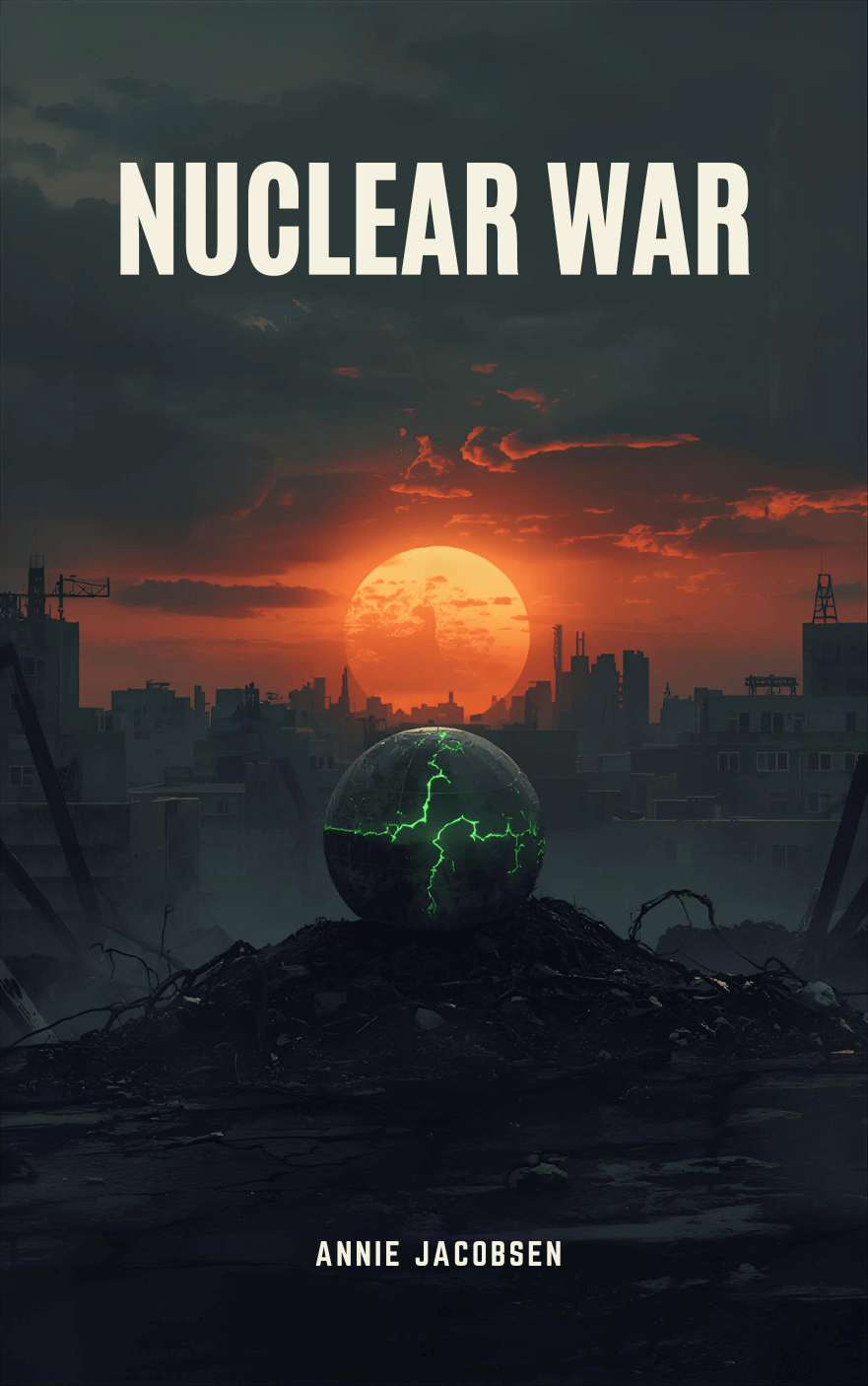
Nuclear War Book Summary
This Nuclear War Book Summary covers the key ideas, lessons, and takeaways in about 20 minutes.
The book ultimately asks whether survival can truly rest on threats of annihilation. By exposing the mechanics behind nuclear decision-making, Jacobsen forces readers to confront a sobering reality: the greatest danger facing humanity is not malice—but the systems we built believing they would keep us safe.
Helps with these goals
Want the complete 20-minute summary?
- Full structured summary
- Video Summary
- Podcast Summary
- Audio summary
- Key takeaways
- Exercises
- Quiz
- Highlights and notes
- Ask the book with AI
What is in the Nuclear War book summary?
Below is a preview of Sumizeit’s expert-written summary of Nuclear War by Annie Jacobsen. The full summary covers the book’s key ideas in text, audio, and video.
Annie Jacobsen’s Nuclear War traces how humanity arrived at a moment where civilization can be erased in less than an hour. The book does not begin with explosions or missiles, but with decisions—small ones at first—that slowly built the most destructive system ever created. Jacobsen shows that nuclear war is not a single event but the outcome of decades of planning, rivalry, fear, and technological escalation.
After World War II, the United States emerged as the first nation to possess atomic weapons. What began as a wartime scientific breakthrough quickly transformed into a permanent military structure. Instead of dismantling nuclear capabilities after victory, the U.S. accelerated production. Bombs multiplied. Delivery systems expanded. New institutions formed to ensure these weapons could be launched at any moment.
This shift fundamentally altered how nations thought about conflict. War was no longer about armies clashing on battlefields—it became about minutes, sensors, codes, and irreversible decisions. Jacobsen emphasizes that nuclear war planning was built on the assumption that hesitation could mean extinction.
From that moment forward, global security became tethered to machines that never sleep and humans who must decide under unbearable pressure.
The rise of permanent nuclear readiness
In the years following the Second World War, the United States created a massive organization dedicated solely to nuclear warfare readiness. This institution, later known as the Strategic Air Command, became the backbone of American nuclear power.
Its mission was simple yet terrifying: ensure the ability to launch nuclear weapons at any time, under any circumstances. Aircraft crews trained continuously. Missiles were kept fueled and targeted. Command centers operated day and night. At its peak, hundreds of thousands of personnel were involved in maintaining this constant state of alert.
Jacobsen explains that readiness became a belief system. Leaders feared that even a moment of vulnerability could invite catastrophe. As a result, the nation normalized the idea that civilization might end with only minutes of warning.
This culture produced a military mindset where preparation itself became proof of safety. If retaliation was guaranteed, then attack might be deterred. But this logic also meant that systems had to be fast—so fast that reflection and restraint were often sacrificed.
Nuclear safety, paradoxically, relied on speed.
When rivalry shaped annihilation planning
One of the most disturbing elements Jacobsen uncovers is how internal competition helped shape nuclear war strategy. Different branches of the U.S. military originally controlled their own nuclear weapons. Each had its own targeting ideas, doctrines, and priorities.
This fragmentation created chaos. Without coordination, a nuclear response could become inconsistent or overlapping. To solve this, leadership demanded a unified strategy.
The result was the creation of a single master war plan—one that integrated every nuclear weapon into a coordinated sequence of destruction.
Rather than limiting damage, this unification dramatically increased it.
The plan did not focus on military targets alone. Entire cities were included. Population centers were marked. The objective was not victory in a traditional sense but overwhelming devastation delivered so rapidly that no enemy could respond meaningfully.
Want the complete 20-minute summary?
- Full structured summary
- Video Summary
- Podcast Summary
- Audio summary
- Key takeaways
- Exercises
- Quiz
- Highlights and notes
- Ask the book with AI
Who should read Nuclear War?
Nuclear War is essential reading for anyone concerned about global security, policy makers, historians, and citizens who want to understand the systems that could end civilization. Whether you're interested in Cold War history, military strategy, or the ethical foundations of modern defense, this book provides crucial context for understanding how humanity arrived at permanent nuclear readiness.
Why does Nuclear War matter?
In an era of geopolitical tension and technological advancement, understanding how nuclear war would actually unfold is no longer academic—it's a matter of informed citizenship. Annie Jacobsen's Nuclear War exposes the automated systems, decision-making procedures, and paradoxes of deterrence that govern global survival, revealing that catastrophe is not unthinkable but meticulously planned. As nations modernize arsenals and new actors enter the nuclear sphere, this book forces readers to confront whether current systems truly protect us or merely postpone disaster.
What are the key themes in Nuclear War?
- The machinery of nuclear readiness and permanent military alert
- How fear and rivalry shaped strategic planning for mass destruction
- The paradox of deterrence: peace preserved through the threat of extinction
- The acceleration of technology outpacing human judgment and restraint
- Bureaucratic systems designed to enable rapid retaliation over reflection
- The global consequences of nuclear war beyond immediate destruction
- The erosion of democratic processes under existential time pressure
What are the key lessons from the Nuclear War book summary?
Nuclear war planning is not speculation but documented procedure
Jacobsen reveals that detailed, minute-by-minute protocols for nuclear response already exist today. These are not theoretical scenarios but actual procedures that guide military and presidential decision-making under extreme time pressure.
Speed was chosen over safety in nuclear command systems
The architecture of nuclear readiness prioritizes rapid response over careful deliberation. The system is designed to encourage action rather than allow time for verification, negotiation, or reflection.
Internal military competition escalated total destruction capacity
When different branches of the military controlled separate nuclear arsenals, bureaucratic coordination created a unified master war plan that dramatically increased devastation rather than limiting it.
Deterrence rests on the assumption of eternal rationality
The doctrine that nuclear peace depends on mutual assured destruction assumes flawless judgment, perfect technology, and rational leadership—conditions humanity has never consistently achieved.
Modern weapons were continuously perfected while restraint was publicly discussed
Alongside treaties and arms reduction agreements, governments systematically modernized warheads, improved guidance systems, and developed nearly undetectable submarine platforms, deepening rather than limiting nuclear capability.
The president faces an impossible choice with minimal time
Decision makers have less than 30 minutes to authorize responses that would end millions of lives, with only pre-written options available and no opportunity for investigation or diplomacy.
Nuclear weapons cause effects beyond the blast itself
Electromagnetic pulses disable infrastructure across vast distances, causing hospitals, power grids, and water systems to fail simultaneously, collapsing modern society within hours.
Immediate survivors face a world without functional systems
Those outside the blast radius encounter radiation, destroyed hospitals, collapsed communication networks, and the inability of emergency services to respond—creating a slow suffocation of civilization.
Nuclear winter extends consequences to the entire planet
Soot injected into the upper atmosphere blocks sunlight globally, causing temperatures to plummet, crop failures across continents, and famine affecting billions even in untouched regions.
Radioactive contamination creates zones of permanent danger
Some areas remain too toxic for human habitation for generations, and radiation exposure causes enduring health consequences including birth defects, infertility, and widespread cancer among survivors.
Nuclear war would fundamentally alter human evolution
Selection pressure would favor species that reproduce quickly and tolerate harsh conditions, while human populations would shrink and knowledge accumulated over millennia could disappear within a generation.
The bureaucracy of annihilation resembles historical systems of organized killing
Planning mass death in advance—calculating casualties, designing target lists, and rehearsing destruction—creates moral discomfort even among those who designed these systems.
Once created, nuclear systems cannot be uninvented
The knowledge and capability to build these weapons persists regardless of treaties or intentions, meaning the structures for annihilation remain permanently embedded in global security architecture.
Deterrence keeps humanity permanently on the edge of catastrophe
While deterrence may have prevented war, it achieves peace by maintaining the constant threat of extinction and relies on systems capable of triggering disaster through error or misinterpretation.
Democratic norms vanish instantly under existential threat
During nuclear crisis, power consolidates immediately, procedures give way to urgency, and the fate of millions becomes dependent on a handful of voices making decisions in sealed rooms.
The greatest danger is not malice but the systems we built for protection
Nuclear war would not begin with hatred or chaos but with procedures quietly unfolding exactly as designed, revealing that our safety mechanisms themselves pose the greatest existential risk.
Want the complete 20-minute summary?
- Full structured summary
- Video Summary
- Podcast Summary
- Audio summary
- Key takeaways
- Exercises
- Quiz
- Highlights and notes
- Ask the book with AI
How can you apply ideas from Nuclear War?
- Understand the historical decisions that created permanent nuclear readiness and how to evaluate current policies that maintain or modify these systems
- Recognize the time constraints and psychological pressures that nuclear commanders face, informing debates about decision-making authority and automated response systems
- Assess the adequacy of current emergency preparedness plans by understanding the full scope of nuclear war consequences beyond initial blasts
- Evaluate arms control treaties and nuclear modernization programs by understanding the gap between public statements about restraint and behind-the-scenes weapons development
- Inform voting and advocacy on nuclear policy by understanding the procedural realities rather than abstract strategy discussions
What common mistakes do readers make with Nuclear War?
- Assuming nuclear war would be limited to military targets rather than cities—strategic planning has long included population centers in targeting calculations
- Believing that fallout shelters or evacuation plans would meaningfully protect against global consequences—nuclear winter affects the entire planet regardless of shelter
- Underestimating the time constraints on decision-making—the system allows less than 30 minutes for choices that cannot be revised once executed
- Thinking deterrence is stable—the systems meant to prevent war are built on assumptions of perfection and rationality that are fundamentally unreliable
Sumizeit Exercises Apply what you've learned
Turn ideas from Nuclear War into action with a short guided reflection: identify the biggest takeaway, connect it to your life, and commit to one step you can take in the next 24 hours.
What is the expert analysis of Nuclear War?
Overview
Nuclear War by Annie Jacobsen is a meticulously researched exploration of the origins, mechanics, and consequences of nuclear warfare. Jacobsen, an investigative journalist renowned for her deep dives into national security and military history, offers a sobering account that transcends mere historical narrative. Instead, she reveals the intricate, often terrifying systems and decisions that have entrenched humanity in a state of permanent nuclear readiness. The book’s significance lies in its ability to demystify complex defense infrastructures and strategic doctrines, making palpable the existential risks embedded in modern geopolitics.
Core Thesis
Jacobsen’s central argument is that nuclear war is not an unpredictable catastrophe but a meticulously engineered process—one born from decades of bureaucratic rivalry, technological escalation, and a pervasive culture of fear. She contends that the global nuclear apparatus prioritizes speed and assured retaliation over reflection or restraint, creating a paradox where survival depends on the constant threat of mutual annihilation. This system, while designed to deter war, simultaneously ensures that any conflict would be swift, devastating, and irreversible, underscoring the precariousness of humanity’s safety.
Strengths
- Comprehensive Historical Context: Jacobsen situates nuclear war within a broad historical framework, tracing its evolution from post-World War II decisions to contemporary strategic doctrines, which enriches the reader’s understanding of how we arrived at this precarious moment.
- Detailed Procedural Reconstruction: The minute-by-minute hypothetical nuclear attack scenario is a standout feature, vividly illustrating the terrifying speed and complexity of decision-making under extreme duress.
- Integration of Technical and Human Elements: By combining technical explanations of weaponry and detection systems with the human dimension—such as the president’s impossible choices—Jacobsen humanizes an otherwise abstract and mechanized subject.
- Ethical Reflection: The book does not shy away from the moral implications of nuclear strategy, prompting readers to grapple with the profound ethical dilemmas inherent in planning mass destruction.
- Accessible yet Scholarly: Jacobsen’s investigative rigor is matched by clear, compelling prose that makes complex military and scientific concepts accessible without oversimplification.
Critiques & Counterarguments
- Potential Overemphasis on U.S. Military Bureaucracy: While Jacobsen focuses extensively on American nuclear strategy and institutions, the global nuclear landscape involves multiple actors with divergent doctrines. A more balanced examination of other nuclear powers’ strategic cultures could provide a fuller picture.
- Deterministic View of Nuclear Decision-Making: The portrayal of nuclear response as almost automatic underestimates the role of human judgment, diplomacy, and fail-safes that, according to some scholars, mitigate the risk of accidental war. Critics from the rational actor school argue that decision-makers are more cautious and deliberative than depicted.
- Limited Engagement with Deterrence Theory Debates: Jacobsen challenges deterrence logic but does not fully engage with the extensive academic literature defending deterrence as a stabilizing force. Some research suggests that despite its flaws, deterrence has prevented direct great-power conflicts for decades.
- Technological Evolution and Emerging Threats: The book’s focus on traditional nuclear arsenals may underplay the implications of emerging technologies such as cyber warfare, artificial intelligence, and hypersonic weapons, which complicate the strategic calculus and could either exacerbate or mitigate nuclear risks.
- Psychological and Political Complexities: The analysis could benefit from deeper exploration of the psychological resilience and political incentives that influence leaders’ decisions, as well as the role of international institutions in crisis management.
Who Should Read This
Nuclear War is essential reading for policymakers, security analysts, historians, and scholars of international relations who seek a granular understanding of nuclear strategy beyond abstract theory. It is also invaluable for informed citizens and activists concerned with global security and ethical governance. Those interested in the intersection of technology, bureaucracy, and existential risk will find Jacobsen’s work a compelling call to awareness and reflection on the fragile architecture underpinning modern peace.
Frequently asked questions about the Nuclear War book summary
What is Nuclear War about?
Nuclear War by Annie Jacobsen is an investigative account of how humanity built systems capable of ending civilization in less than an hour. The book traces the historical decisions, military strategies, and automated procedures that created permanent nuclear readiness, then walks readers through a minute-by-minute reconstruction of what nuclear war would actually entail—from initial detection through global devastation and long-term extinction-level consequences.
Who should read Nuclear War?
This book is essential for anyone concerned with global security, national policy, history, or the ethical foundations of modern defense. It appeals to policy makers, historians, informed citizens, and anyone who wants to understand the systems that could end civilization. Whether you're interested in Cold War strategy or contemporary geopolitical risk, Jacobsen's meticulous research illuminates how we arrived at a moment where annihilation is meticulously planned.
What are the main takeaways from Nuclear War?
The central insight of Nuclear War is that humanity lives inside systems designed for instant apocalypse. Jacobsen reveals that nuclear war is not unthinkable but procedurally planned, that deterrence paradoxically keeps us on the edge of catastrophe, and that the greatest danger is not malice but the automated mechanisms we built believing they would keep us safe. The book ultimately asks whether survival can truly rest on permanent threats of annihilation.
How much time would decision-makers have in a nuclear crisis?
According to Jacobsen's analysis in Nuclear War, the U.S. government would have less than 30 minutes from missile detection to respond. This extremely compressed timeline means there is no opportunity for investigation, diplomacy, or verification—only pre-written response options and pressure to act before potential retaliation capability is lost.
What happens to the planet after nuclear war beyond the initial explosions?
Nuclear War details catastrophic global consequences including electromagnetic pulses that disable infrastructure across continents, nuclear winter from soot blocking sunlight worldwide, crop failures and famine affecting billions even in untouched regions, permanent radioactive contamination, ozone layer damage, and ecosystem collapse. These effects would create a poisoned world where even survivors face generational suffering.
How did military competition shape nuclear war planning?
In Nuclear War, Jacobsen explains how different U.S. military branches initially controlled separate nuclear arsenals, each with its own targeting priorities. To impose order, leadership demanded unified strategy, which paradoxically created a master war plan that dramatically increased devastation by integrating every weapon into a coordinated sequence of destruction targeting not just military sites but entire cities.
Does Jacobsen argue that deterrence has kept us safe?
Jacobsen presents a paradox: while deterrence may have prevented war for decades, it also keeps humanity permanently on the edge of catastrophe. The systems meant to protect us through the threat of mutual destruction are capable of triggering that destruction through error, misinterpretation, or haste. Safety, in this framework, depends on the constant threat of extinction.
What research methods does Jacobsen use in Nuclear War?
As an investigative journalist, Jacobsen combines declassified government documents, interviews with military and political experts, historical analysis, and detailed procedural information to reconstruct how nuclear systems actually work. Her meticulous reporting translates complex defense strategies into comprehensible terms, grounding abstract policy in concrete human consequences.
About Sumizeit
Sumizeit is a profitable Scomy LLC company based in Miami, Florida. It has been helping readers learn from nonfiction books for 7 years with expert-written summaries in text, audio, podcast, and video.
Want the complete 20-minute summary?
- Full structured summary
- Video Summary
- Podcast Summary
- Audio summary
- Key takeaways
- Exercises
- Quiz
- Highlights and notes
- Ask the book with AI
Here's why readers love Sumizeit
Join thousands of learners getting smarter every day
"Great experience. Detailed summaries. Loved the gamification feature. Makes learning fun. Good customer service. I recommend Sumizeit to anyone. You'll learn a lot."
"I always felt busy but still wanting to keep up with the book discussion in my friend group. This was a great supplement to help me keep reading the books I find fun while keeping up with important books."
"I love this website. Instead of scrolling social media, I find myself learning a lot. I use it everyday. I recommend this app for anyone who is too busy and wants to get up to speed with their favorite books."
Nuclear War Book Summary PDF
Looking for a Nuclear War Book Summary PDF you can save and revisit offline? Our Nuclear War Book Summary PDF captures the book’s core ideas in a clean, printable format — the key frameworks, takeaways, and structure without the fluff. Download the Nuclear War Book Summary PDF when you want a reference you can annotate, share with your team, or review on the go. Get your Nuclear War Book Summary PDF from the download page below.
Download Nuclear War Book Summary PDFPeople also liked these summaries
Readers who explored Nuclear War often enjoyed these titles next.




Want the complete 20-minute summary?
- Full structured summary
- Video Summary
- Podcast Summary
- Audio summary
- Key takeaways
- Exercises
- Quiz
- Highlights and notes
- Ask the book with AI
Featured Book Titles
Popular Book Summaries at sumizeit, leading book summary app
