


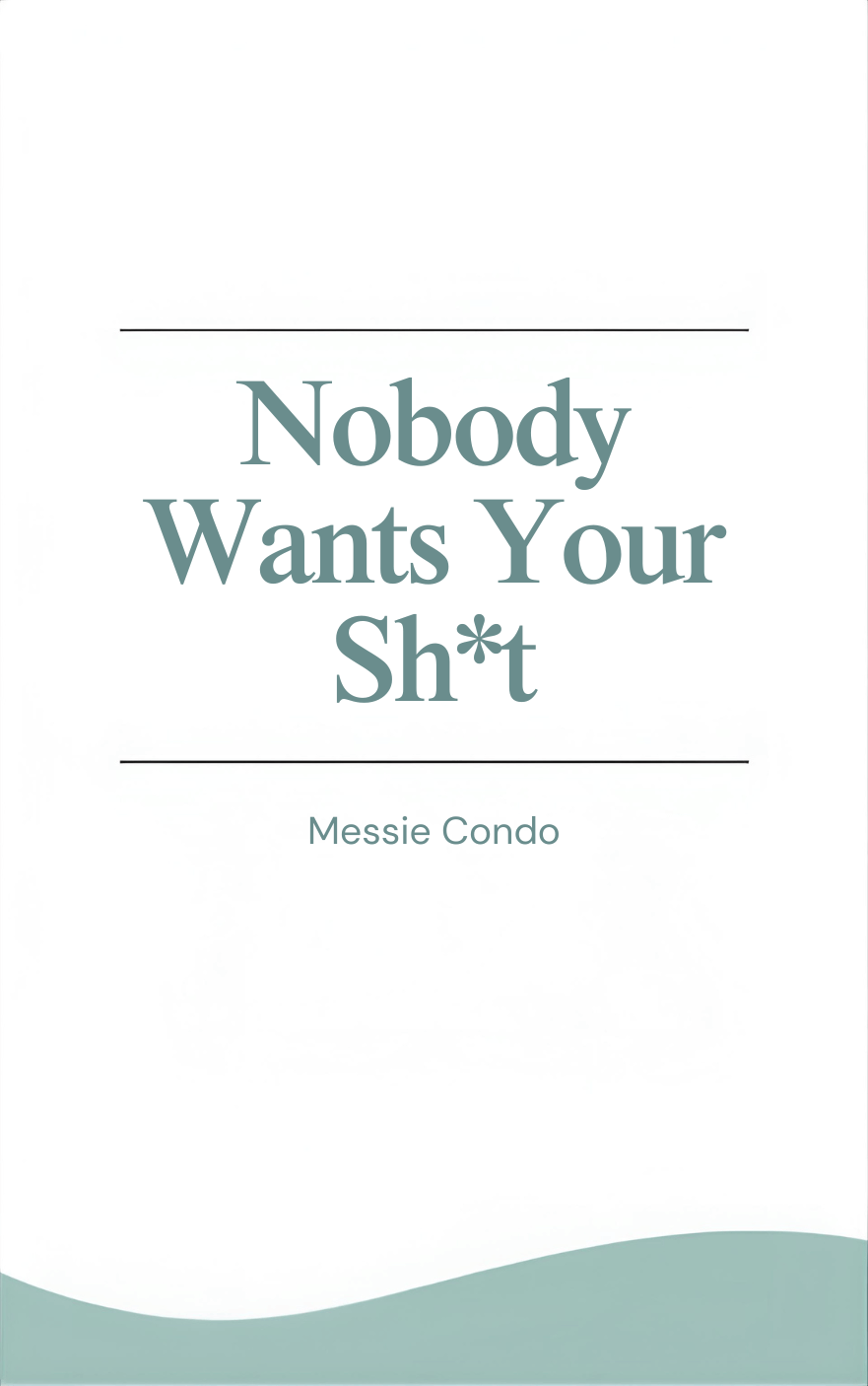
Prefer the print book? Buy on Amazon
As an Amazon Associate, Sumizeit earns from qualifying purchases.
Nobody Wants Your Sh*t Book Summary
This Nobody Wants Your Sh*t Book Summary covers the key ideas, lessons, and takeaways in about 20 minutes.
Short Description:
A powerful guide to decluttering your life, freeing your mind, and easing burdens for loved ones
Ultimately, the book teaches that our greatest legacy is not what we leave behind, but how lightly and intentionally we live. When we choose experiences over accumulation, clarity over chaos, and communication over avoidance, we create homes — and lives — that feel open, calm, and deeply meaningful.
Helps with these goals
Preview the Nobody Wants Your Sh*t book summary
Below is a preview of Sumizeit’s comprehensive human-written summary of Nobody Wants Your Sh*t by Messie Condo. The full summary is 15-20 minutes long and covers the book’s key ideas in text, audio, visual, and video formats. Unlock the full 20 Minute Summary
Messie Condo begins with a blunt but compassionate truth: most people don’t realize how much their belongings are influencing their emotions, behavior, and mental health. Over time, objects stop being helpful tools and slowly become sources of pressure. Every pile, drawer, and overflowing closet acts as a constant reminder of unfinished decisions. Even when we are not consciously thinking about our clutter, it continues to drain our attention.
Living among too many possessions overwhelms the brain. Each visible item competes for mental processing, increasing fatigue and reducing clarity. This constant stimulation creates a background hum of stress that never truly turns off. Condo explains that this is why people often feel anxious or irritable at home even when nothing obvious is wrong. The environment itself becomes the stressor.
When the home feels chaotic, people struggle to rest. Sleep becomes lighter, focus weakens, and motivation drops. Instead of feeling restored by being at home, individuals feel trapped by it. Condo emphasizes that organization is not about perfection or appearance — it is about creating an environment that supports peace, energy, and emotional stability rather than draining it .
How Clutter Affects the Body, Not Just the Mind
A cluttered home doesn’t only impact emotions; it can also affect physical well-being. Condo highlights that crowded spaces increase the risk of accidents, especially for older adults or anyone with limited mobility. Items left on floors or stacked in hallways can easily cause trips and falls, turning ordinary movement into danger.
Beyond safety risks, clutter contributes to poor air quality. Dust, allergens, and mold accumulate more easily in packed environments that are difficult to clean. Over time, this can worsen breathing issues, allergies, and chronic fatigue.
Stress plays a major role here as well. Constant low-level tension raises heart rate and blood pressure. When the body remains in a mild fight-or-flight mode for extended periods, it increases the risk of long-term health conditions. Condo makes it clear that reducing possessions is not just a lifestyle choice — it can be a preventive health decision that supports longevity and daily comfort .
Regaining Control by Choosing What Stays
One of the most powerful shifts Condo encourages is reclaiming authority over your surroundings. Many people feel as though their belongings own them. They clean around piles instead of addressing them, or store items simply because they don’t know what else to do.
Decluttering reverses that dynamic. Each decision to keep or release an item becomes an act of self-direction. Instead of living according to past versions of yourself — old careers, abandoned hobbies, or outdated aspirations — you begin shaping your environment to reflect who you are now.
This process restores confidence. Small wins, such as organizing a single drawer or shelf, build momentum. Over time, people experience pride and satisfaction not from buying new items, but from intentionally curating what remains. Condo frames this as a form of personal growth: simplifying your space becomes a way of simplifying your life .
Letting Go of the…
Want the complete 20-minute summary?
- Full structured summary
- Video Summary
- Podcast Summary
- Audio summary
- Key takeaways
- Exercises
- Quiz
- Highlights and notes
- Ask the book with AI
Who should read Nobody Wants Your Sh*t?
Anyone feeling overwhelmed by possessions, stressed at home, or struggling with clutter is a natural fit for this book. It's also essential reading for people concerned about the legacy they'll leave their families and those seeking to align their environment with their current life rather than past versions of themselves.
Why does Nobody Wants Your Sh*t matter?
In a culture of constant consumption, this book addresses a hidden mental and physical health crisis: clutter silently drains energy, worsens anxiety, and creates stress that lingers in everyday life. By tackling both the practical and emotional barriers to decluttering, Nobody Wants Your Sh*t by Messie Condo offers a compassionate path to reclaiming peace, clarity, and freedom—while also considering the burden we leave for loved ones.
What are the key themes in Nobody Wants Your Sh*t?
- Clutter as a silent stressor affecting mental and physical health
- Reclaiming personal authority over your environment
- Separating memories from physical objects
- Redefining happiness around experiences rather than possessions
- The emotional and financial cost of keeping items out of guilt or fear
- Building sustainable systems rather than one-time cleaning efforts
- Legacy and responsibility to future generations
- Mindful decision-making through personal guidelines
How can you apply ideas from Nobody Wants Your Sh*t?
- Start a 'one drawer per week' decluttering plan to build momentum and prevent overwhelm
- Create personal decision-making rules (e.g., 'Would I bring this if I moved?') and use them consistently for every item
- Photograph sentimental items before releasing them, then document the stories in a journal to preserve memories without physical clutter
- Establish a 'no new items without space' policy to prevent clutter from rebuilding after your initial decluttering effort
- Have explicit conversations with family members about your belongings and end-of-life wishes to prevent confusion and resentment
- Organize important documents, passwords, and financial records so loved ones can access critical information without stress
- Practice giving items to people who want them rather than throwing them away, and observe how generosity feels better than hoarding
- Replace the question 'What should I buy next?' with 'How do I want to live?' to shift focus from accumulation to intentional living
What common mistakes do readers make with Nobody Wants Your Sh*t?
- Waiting for the 'perfect time' to start decluttering, which often never comes—starting small with one drawer is far more effective
- Keeping items out of guilt about past purchases, which only extends the emotional pain each time you see them
- Holding onto everything 'just in case' because you might need it someday, which reinforces scarcity thinking and weakens confidence in your adaptability
- Attempting to declutter your entire home at once, leading to burnout and abandoning the process before sustainable habits form
- Believing that memories live in physical objects and feeling obligated to keep inherited items that don't bring you joy
- Skipping the crucial step of having honest conversations with family about your belongings and preferences, leaving them confused after you're gone
Sumizeit Exercises Apply what you've learned
Turn ideas from Nobody Wants Your Sh*t into action with a short guided reflection: identify the biggest takeaway, connect it to your life, and commit to one step you can take in the next 24 hours.
What is the expert analysis of Nobody Wants Your Sh*t?
Overview
Nobody Wants Your Sh*t is a compelling exploration of the psychological, physical, and emotional toll that clutter exerts on individuals and households. Authored by Messie Condo, a figure recognized for her candid yet empathetic approach to decluttering, the book transcends typical organizational manuals by integrating insights from health, psychology, and lifestyle philosophy. Condo’s perspective is informed by the Swedish concept of döstädning, which emphasizes decluttering as a means to reduce emotional burdens and foster peace, not merely to achieve aesthetic order. This positions the book as a significant contribution to contemporary self-improvement literature, particularly for readers seeking a holistic understanding of how possessions influence well-being.
Core Thesis
Condo’s central argument is that clutter is far from a neutral backdrop; it actively drains cognitive resources, elevates stress, and undermines both mental and physical health. The accumulation of possessions creates a persistent, low-level stressor that compromises rest, focus, and motivation. Decluttering, therefore, is not a superficial act of tidying but a profound exercise in reclaiming agency over one’s environment and life. By intentionally choosing what to keep and what to release, individuals align their surroundings with their current identity and values, fostering emotional clarity and resilience. Furthermore, the author reframes decluttering as an act of generosity and legacy-building, encouraging readers to consider the impact of their possessions on loved ones and future generations.
Strengths
- Multidimensional Approach: Condo adeptly connects clutter to mental health, physical safety, and even long-term well-being, offering a comprehensive rationale for decluttering beyond aesthetics.
- Practical Framework: The book provides actionable strategies, such as creating personal decision rules and starting with manageable tasks, which make the daunting process of decluttering accessible and sustainable.
- Emotional Sensitivity: By addressing common psychological barriers—sentimentality, financial regret, scarcity mindset—Condo validates readers’ struggles and offers compassionate reframing rather than judgment.
- Legacy and Communication Focus: The emphasis on preparing loved ones, communicating wishes, and releasing guilt around inherited items enriches the discourse around possessions with a thoughtful, relational dimension.
- Philosophical Depth: The prioritization of experiences over accumulation and the encouragement to live intentionally elevate the book from a simple self-help guide to a reflective manifesto on meaningful living.
Critiques & Counterarguments
- Potential Oversimplification of Attachment: While Condo challenges sentimental attachment to objects by separating memory from physical items, some psychological research suggests that physical mementos can play a crucial role in identity and emotional regulation, particularly in trauma recovery or grief contexts.
- Limited Engagement with Cultural Variability: The book’s recommendations may not fully account for cultural differences in the meaning of possessions, communal living arrangements, or economic constraints that affect decluttering practices.
- Scarcity Mindset Complexity: The advice to discard items “just in case” may underestimate the nuanced economic realities and psychological security that some individuals derive from material reserves, especially in uncertain socioeconomic conditions.
- Evidence Base and Empirical Support: The book relies heavily on anecdotal observations and philosophical reasoning; integrating more empirical studies from environmental psychology or behavioral economics could strengthen its claims.
- Minimal Addressing of Consumer Culture: Condo encourages mindful purchasing but does not deeply interrogate systemic drivers of accumulation such as advertising, planned obsolescence, or societal pressures, which might limit the book’s transformative potential.
Who Should Read This
Nobody Wants Your Sh*t is ideally suited for readers who are seeking more than just organizational tips—those interested in the interplay between environment, psychology, and lifestyle philosophy. It will resonate with individuals feeling overwhelmed by possessions and desiring a compassionate, practical roadmap to reclaim mental clarity and physical safety. Professionals in mental health, wellness coaching, and lifestyle consulting may find Condo’s integrative approach valuable for client work. Additionally, readers grappling with the emotional complexities of downsizing, preparing for life transitions, or seeking to foster intentional living habits will benefit from the book’s nuanced guidance.
Frequently asked questions about the Nobody Wants Your Sh*t book summary
What is Nobody Wants Your Sh*t about?
Nobody Wants Your Sh*t by Messie Condo is a practical guide to decluttering and intentional living that reveals how clutter silently drains mental and physical health. Beyond organizing tips, the book addresses the emotional barriers to letting go—guilt, fear, sentimentality, and scarcity thinking—while emphasizing that simplifying your environment is ultimately an act of self-care and a gift to your loved ones.
Who should read Nobody Wants Your Sh*t?
Anyone feeling overwhelmed by possessions, stressed at home, or trapped by clutter will benefit from this book. It's especially valuable for people concerned about the burden they might leave their families, those seeking to align their space with their current life, and anyone interested in moving beyond consumption-driven happiness toward experiences and meaningful relationships.
What are the main takeaways from Nobody Wants Your Sh*t?
The core takeaways are that clutter quietly consumes energy and emotional capacity, memories live in people not objects, and experiences create more lasting fulfillment than possessions. The book emphasizes that decluttering is about reclaiming authority over your environment, building sustainable systems through personal rules, and considering the legacy you leave your loved ones through clarity rather than accumulated things.
How does clutter affect your mental and physical health according to the book?
Condo explains that visible clutter competes for mental processing power, creating constant background stress that affects sleep, focus, and motivation. Physically, crowded spaces increase accident risk, trap dust and allergens, and keep your nervous system in a mild fight-or-flight mode that raises blood pressure and heart rate over time, increasing risk of chronic illness.
What does Messie Condo say about sentimental items and memories?
Condo gently dismantles the belief that releasing an object means losing the memory attached to it. She explains that memories live in people, not things, and suggests preserving meaning through photos, journaling, and conversations instead of keeping physical relics that no longer serve your current life.
How should you approach decluttering to avoid overwhelm?
Rather than tackling everything at once, Condo recommends starting small with one drawer, shelf, or category. This approach builds confidence through early wins, makes decision-making easier, and helps create sustainable habits instead of temporary cleanup cycles that often fail.
Why does the book emphasize telling family about your belongings and wishes?
Condo stresses that open communication about your possessions, preferences, and end-of-life wishes prevents confusion, conflict, and resentment among loved ones. Clear records and conversations allow families to focus on grieving and healing rather than being overwhelmed by logistics and guilt about inherited items they don't want.
What's the book's philosophy on experiences versus possessions?
Nobody Wants Your Sh*t emphasizes that experiences and relationships create lasting fulfillment while possessions provide only brief excitement that fades quickly. By prioritizing moments, conversations, and meaningful relationships over buying and accumulating, you free yourself from endless consumption cycles and discover deeper, more lasting happiness.
About Sumizeit
Sumizeit is a profitable Scomy LLC company based in Miami, Florida. Our founders, Clemens Raemy and Weina Scott, are successful entrepreneurs with several exits. Sumizeit is a popular book summary app / micro learning app used by busy professionals and entrepreneurs with over 2,500 non-fiction book summaries and 10,000 podcast summaries in text, audio, visual, podcast, and video format. We also have stellar retention tools to make ideas stick - such as flashcards with spaced repetition, quizzes, streaks, highlighting and notes, daily challenges, riddles, mini-courses, meditation, and more. You won't only learn the idea, but also remember it. Over 90% of our users change their habits with Sumizeit.
Upgrade Now
Here's why readers love Sumizeit
Join thousands of learners getting smarter every day
"Great experience. Detailed summaries. Loved the gamification feature. Makes learning fun. Good customer service. I recommend Sumizeit to anyone. You'll learn a lot."
"I always felt busy but still wanting to keep up with the book discussion in my friend group. This was a great supplement to help me keep reading the books I find fun while keeping up with important books."
"I love this website. Instead of scrolling social media, I find myself learning a lot. I use it everyday. I recommend this app for anyone who is too busy and wants to get up to speed with their favorite books."
Nobody Wants Your Sh*t Book Summary PDF
Looking for a Nobody Wants Your Sh*t Book Summary PDF you can save and revisit offline? Our Nobody Wants Your Sh*t Book Summary PDF captures the book’s core ideas in a clean, printable format — the key frameworks, takeaways, and structure without the fluff. Download the Nobody Wants Your Sh*t Book Summary PDF when you want a reference you can annotate, share with your team, or review on the go. Get your Nobody Wants Your Sh*t Book Summary PDF from the download page below.
Download Nobody Wants Your Sh*t Book Summary PDFPeople also liked these summaries
Readers who explored Nobody Wants Your Sh*t often enjoyed these titles next.

Ready to read the whole thing?
- Full structured summary
- Video Summary
- Podcast Summary
- Audio summary
- Key takeaways
- Exercises
- Quiz
- Highlights and notes
- Ask the book with AI
Featured Book Titles
Popular Book Summaries at sumizeit, leading book summary app