


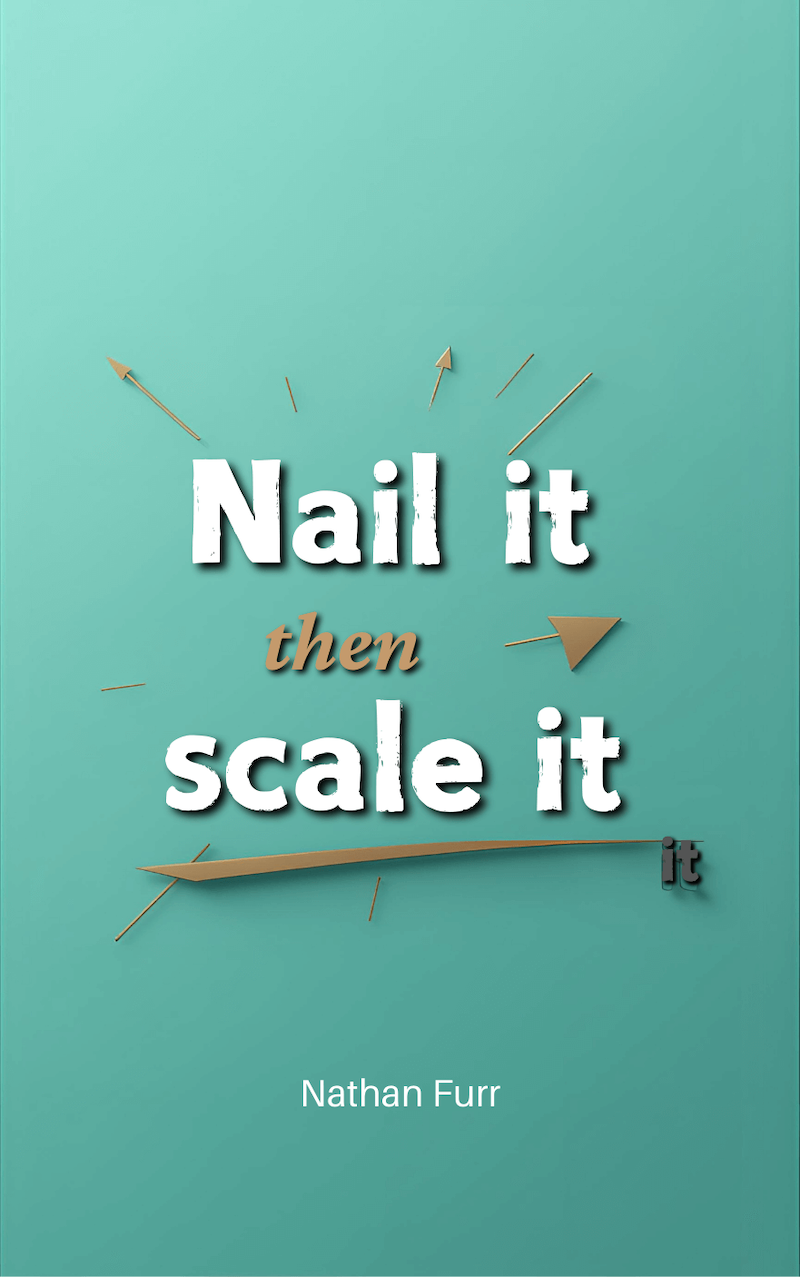
Prefer the print book? Buy on Amazon
As an Amazon Associate, Sumizeit earns from qualifying purchases.
Nail It Then Scale It Book Summary
This Nail It Then Scale It Book Summary covers the key ideas, lessons, and takeaways in about 20 minutes.
Short Description:
Nail It Then Scale It validates problems before scaling startup growth.
Helps with these goals
Preview the Nail It Then Scale It book summary
Below is a preview of Sumizeit’s comprehensive human-written summary of Nail It Then Scale It by Nathan Furr. The full summary is 15-20 minutes long and covers the book’s key ideas in text, audio, visual, and video formats. Unlock the full 20 Minute Summary
Entrepreneurship is often portrayed as inventing a product first and searching for customers later. Many founders romanticize the build-first approach—coding for months, hiring teams, raising capital—only to discover the market does not actually want what they made. Nail It Then Scale It argues that entrepreneurship is not about guessing—it is a disciplined search for truth. Instead of scaling prematurely, founders must validate customer pain, test solutions rapidly, prove revenue potential, refine a go-to-market strategy, validate business economics, and only then expand. The book provides a methodical and evidence-driven roadmap for this journey, showing that startups succeed by learning faster than they fail.
Nathan Furr reframes entrepreneurship as a scientific exploration rather than heroic intuition. A startup is a temporary vehicle searching for a repeatable, scalable business model. It should run experiments, gather data, eliminate assumptions, and iterate toward certainty. The authors warn that scaling without proof only magnifies waste. Instead, progress must follow a sequence: nail the problem → nail the solution → nail the business → scale it. Growth becomes a multiplier only after validation, not before.
Identify a Pain Worth Solving
Every successful venture begins not with an idea, but with pain—a frustration so intense that people actively seek relief. A problem must hurt, disrupt workflow, cost time, damage reputation, or create emotional stress. Mild inconvenience rarely motivates purchase; urgent pain does. A founder should ask: Who is struggling? Why does it matter? What is the cost of doing nothing? If customers would ignore an email about solving the problem, the pain is weak. If they respond eagerly to a cold outreach, the pain is likely severe.
Instead of guessing what people need, founders should talk to real humans. Emails, LinkedIn messages, phone calls, customer interviews—the goal is conversation. A high response rate signals real urgency. Listening matters more than pitching. Entrepreneurs must dig beneath surface complaints to uncover the underlying cause. They should write a monetizable pain statement, describing a specific customer, their painful situation, and why they desperately want change. This becomes a hypothesis to test, revise, or discard as insights emerge.
Customer Discovery as a Learning Tool
Early-stage entrepreneurs must battle their own biases. Human brains search for validation, not truth. We hear what confirms our assumptions and ignore contradictory signals. Nail It Then Scale It encourages founders to become “expert novices”—confident enough to explore, humble enough to learn. Instead of proving their idea is right, founders must actively look for evidence that it might be wrong. Honest learning happens when the ego steps aside.
Recording interviews, transcribing notes, tagging patterns, comparing responses across multiple people—these practices create clarity. Conversations should reveal how customers currently solve the problem, how painful the process is, when it matters most, and what happens if it remains unsolved.
Want the complete 20-minute summary?
- Full structured summary
- Video Summary
- Podcast Summary
- Audio summary
- Infographic
- Key takeaways
- Exercises
- Quiz
- Highlights and notes
- Ask the book with AI
Who should read Nail It Then Scale It?
Nail It Then Scale It is essential for first-time founders, startup teams, and entrepreneurs who want to reduce the risk of building products nobody wants. It's equally valuable for established business leaders launching new ventures or entering unfamiliar markets. Anyone tired of the myth that great ideas alone drive success will find this practical, evidence-based approach refreshing.
Why does Nail It Then Scale It matter?
Most startups fail not from lack of ambition but from scaling too fast without validating their core assumptions. In today's competitive landscape, speed to market matters less than speed to truth—understanding what customers actually need before investing heavily. Nail It Then Scale It provides a disciplined framework to replace guesswork with evidence, helping founders succeed by learning faster than they fail.
What are the key themes in Nail It Then Scale It?
- Validation over intuition: Replace hunches with customer evidence
- Rapid iteration: Test cheaply and frequently before perfecting
- Pain-driven development: Build solutions to urgent, monetizable problems
- Unit economics: Prove profitability before scaling
- Lean discipline: Maintain constraints and avoid bloat
- Go-to-market strategy: Understand how customers actually buy
How can you apply ideas from Nail It Then Scale It?
- Conduct structured customer interviews focused on current behavior and past spending rather than hypothetical interest to uncover monetizable pain
- Build clickable prototypes, landing pages, or concierge MVPs before writing production code to test assumptions cheaply
- Track pricing signals and willingness to pay through customer conversations to inform pricing models before full launch
- Map the complete customer buying journey including all stakeholders and decision-makers before finalizing go-to-market strategy
- Test unit economics with real customer data—conversion rates, payback periods, churn, and lifetime value—before investing in growth
- Create a monetizable pain statement describing a specific customer, their problem, and why they urgently want change to focus development
- Remove all non-essential features and ruthlessly prioritize based on which problems customers complain about most consistently
What common mistakes do readers make with Nail It Then Scale It?
- Building a complete product in stealth mode without customer validation, only to discover the market doesn't want it
- Scaling sales, marketing, and operations before proving unit economics and repeat revenue, magnifying losses instead of profit
- Asking leading questions like 'Would you buy this?' instead of behavior-based questions that reveal true priorities and habits
- Pursuing growth and new initiatives while neglecting the original pain point and core features that drove early traction
Sumizeit Exercises Apply what you've learned
Turn ideas from Nail It Then Scale It into action with a short guided reflection: identify the biggest takeaway, connect it to your life, and commit to one step you can take in the next 24 hours.
What is the expert analysis of Nail It Then Scale It?
Overview
Nail It Then Scale It is a seminal work by Nathan Furr, a respected innovation professor and startup advisor known for bridging academic rigor with practical entrepreneurial insights. The book challenges the conventional wisdom that startups succeed by building first and finding customers later. Instead, Furr advocates a disciplined, evidence-driven methodology that treats entrepreneurship as a scientific search for validated business models. This approach has resonated widely within startup ecosystems and entrepreneurship education, offering a pragmatic alternative to the often romanticized “build and hope” narrative.
Core Thesis
The central argument of Nail It Then Scale It is that startups fail primarily because they scale prematurely, without first validating critical assumptions about customer pain, solution fit, and business economics. Furr posits that successful ventures follow a sequential process: identify and validate a painful problem worth solving, rapidly prototype and iterate solutions, confirm economic viability through real customer payments, understand the customer’s buying journey, and only then scale operations. This disciplined progression transforms entrepreneurship from guesswork into a systematic learning process, where speed of learning trumps speed of building.
Strengths
- Methodical Framework: The book’s clear, stepwise NISI framework (Nail the Pain, Nail the Solution, Nail the Business, Nail Go-to-Market, Scale It) provides founders with an actionable roadmap that reduces ambiguity and risk.
- Emphasis on Customer Discovery: Furr’s insistence on deep, behavior-based customer interviews and monetizable pain statements grounds product development in real market needs rather than founder assumptions or vanity metrics.
- Rapid Prototyping and Iteration: Advocating for cheap, fast experiments over polished products encourages agility and prevents costly sunk investments in unvalidated ideas.
- Economic Validation: The focus on unit economics and real revenue as the ultimate proof of product-market fit is a vital corrective to overly optimistic startup narratives.
- Scalability with Discipline: The book acknowledges that scaling requires a cultural and operational shift, warning against the chaos of early-stage improvisation becoming a liability in growth phases.
- Integration of Market Context: Recognizing that different markets require tailored strategies adds nuance often missing in one-size-fits-all startup advice.
Critiques & Counterarguments
- Potential Oversimplification of Entrepreneurial Complexity: While the NISI framework is elegant, real-world startups often face overlapping, nonlinear challenges that resist neat sequencing. The model may understate the iterative messiness and serendipity involved in innovation.
- Risk of Excessive Conservatism: The book’s strong emphasis on validation and economic proof could discourage bold, visionary bets that do not initially show clear customer pain or immediate revenue but have transformative potential (e.g., breakthrough technologies or platform plays).
- Limited Engagement with Alternative Models: Competing schools of thought, such as effectuation theory or lean startup variants emphasizing pivoting and emergent strategies, receive little direct discussion, leaving readers without a comparative lens.
- Evidence Base and Case Studies: The summary does not detail empirical evidence or diverse case studies supporting the framework’s universal applicability. Critics might argue that the approach favors certain industries (B2B, SaaS) more than others (deep tech, consumer products).
- Market Dynamics and Timing: The framework presumes that customer pain and willingness to pay are stable and discoverable early, but in rapidly evolving or nascent markets, customers may not yet recognize their needs, complicating validation efforts.
Who Should Read This
Nail It Then Scale It is essential reading for early-stage entrepreneurs, startup founders, and innovation managers who seek a rigorous, evidence-based approach to building scalable businesses. It is particularly valuable for those who have experienced the pitfalls of premature scaling or who struggle to translate ideas into validated market opportunities. Additionally, investors, accelerators, and entrepreneurship educators will find its framework a useful tool for assessing startup progress and guiding founders toward disciplined growth. Readers looking for a pragmatic counterbalance to hype-driven startup culture will appreciate Furr’s sober, data-centric perspective.
Frequently asked questions about the Nail It Then Scale It book summary
What is Nail It Then Scale It about?
Nail It Then Scale It by Nathan Furr is a practical guide that reframes entrepreneurship as a disciplined search for truth rather than heroic intuition. The book teaches a methodical sequence: validate customer pain, test solutions rapidly, prove customers will pay, understand how they buy, validate business economics, and only then scale. Success comes from learning faster than failing, not from building perfectly before customers confirm demand.
Who should read Nail It Then Scale It?
First-time founders, startup teams, and entrepreneurs wanting to reduce the risk of building products nobody wants will find this book essential. It's equally valuable for established business leaders launching new ventures or entering unfamiliar markets, and for anyone frustrated with the myth that great ideas alone drive startup success. Anyone tired of guesswork and seeking an evidence-based approach to entrepreneurship will benefit.
What are the main takeaways from Nail It Then Scale It?
The core message is that startups fail from scaling too fast without validation, not from lack of ideas. Nail It Then Scale It teaches founders to identify painful problems customers would pay to fix, validate assumptions through cheap experiments rather than perfection, let customers' willingness to pay prove demand, and only scale after pain, solution, economics, and go-to-market strategy are proven. Progress is measured by learning velocity, not features shipped.
What is the NISI framework and how does it work?
NISI is the sequential framework in Nail It Then Scale It: Nail the Pain (validate a real, monetizable customer problem), Nail the Solution (prototype rapidly and iterate using feedback), Nail the Idea/Business (confirm customers will pay and economics work), and Scale It (grow only after validation). The sequence is critical—skipping steps or reordering priorities leads to waste. Scaling without completing earlier phases magnifies risk.
How does Nail It Then Scale It define a 'real' customer problem?
A real problem must be painful enough that customers actively seek solutions and respond urgently to outreach. It must hurt, disrupt workflow, cost time, damage reputation, or create emotional stress. Mild inconvenience never justifies purchase. The best signal is a high response rate to cold outreach and customer willingness to pay. Real demand is proven only when customers commit money, not when they express polite interest.
What does Nail It Then Scale It say about minimum viable products?
The book argues that MVPs should include only features that directly solve core pain—everything else wastes time and complicates iteration. Rough prototypes like sketches, landing pages, or manual concierge services expose customer preferences faster than polished products. Constraints and cheapness accelerate learning by reducing founder attachment to ideas. Building less allows teams to pivot easily if feedback demands change.
Why does Nail It Then Scale It emphasize payment over positive feedback?
Because interest and praise are cheap while money represents genuine commitment and willingness to pay. Customers often give polite compliments to ideas they'd never purchase. Preorders, deposits, and paid pilots prove product-market fit far better than enthusiasm or positive feedback. The book famously states that the only real market survey is a purchase order.
How should startups handle crisis according to Nail It Then Scale It?
Nail It Then Scale It treats crisis as purification rather than failure. When money runs short or growth stalls, constraints force teams back to core problems and essential features. Scarcity breeds discipline and creativity that founders should retain even with later abundance. Even successful companies that forget lean thinking often collapse. Crisis removes distractions and restores clarity around what truly matters.
About Sumizeit
Sumizeit is a profitable Scomy LLC company based in Miami, Florida. Our founders, Clemens Raemy and Weina Scott, are successful entrepreneurs with several exits. Sumizeit is a popular book summary app / micro learning app used by busy professionals and entrepreneurs with over 2,500 non-fiction book summaries and 10,000 podcast summaries in text, audio, visual, podcast, and video format. We also have stellar retention tools to make ideas stick - such as flashcards with spaced repetition, quizzes, streaks, highlighting and notes, daily challenges, riddles, mini-courses, meditation, and more. You won't only learn the idea, but also remember it. Over 90% of our users change their habits with Sumizeit.
Upgrade Now
Here's why readers love Sumizeit
Join thousands of learners getting smarter every day
"Great experience. Detailed summaries. Loved the gamification feature. Makes learning fun. Good customer service. I recommend Sumizeit to anyone. You'll learn a lot."
"I always felt busy but still wanting to keep up with the book discussion in my friend group. This was a great supplement to help me keep reading the books I find fun while keeping up with important books."
"I love this website. Instead of scrolling social media, I find myself learning a lot. I use it everyday. I recommend this app for anyone who is too busy and wants to get up to speed with their favorite books."
Nail It Then Scale It Book Summary PDF
Looking for a Nail It Then Scale It Book Summary PDF you can save and revisit offline? Our Nail It Then Scale It Book Summary PDF captures the book’s core ideas in a clean, printable format — the key frameworks, takeaways, and structure without the fluff. Download the Nail It Then Scale It Book Summary PDF when you want a reference you can annotate, share with your team, or review on the go. Get your Nail It Then Scale It Book Summary PDF from the download page below.
Download Nail It Then Scale It Book Summary PDFPeople also liked these summaries
Readers who explored Nail It Then Scale It often enjoyed these titles next.

Ready to read the whole thing?
- Full structured summary
- Video Summary
- Podcast Summary
- Audio summary
- Infographic
- Key takeaways
- Exercises
- Quiz
- Highlights and notes
- Ask the book with AI
Featured Book Titles
Popular Book Summaries at sumizeit, leading book summary app