


Prefer the print book? Buy on Amazon
As an Amazon Associate, Sumizeit earns from qualifying purchases.
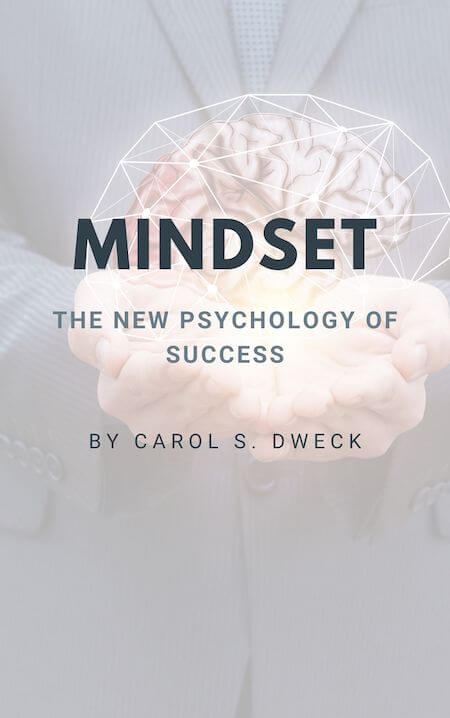
Mindset Book Summary
This Mindset Book Summary covers the key ideas, lessons, and takeaways in about 20 minutes.
Growth mindset embraces effort and learning over fixed ability.
Abilities are not fixed and aren’t determined at birth. If you are willing to put in the work, you can become great at almost anything. A fixed mindset accepts that some people are good at some things and they can’t choose which ones. But if that doesn’t satisfy you, then you probably have a growth mindset.
If you have a fixed mindset, you are more likely to get in your own way. You’re afraid of failure and think of new challenges as too risky. Rather than put yourself out there, you don’t even try.
A growth mindset lets you accept failure as part of the experience. You learn your lessons and adjust, allowing for continued development and future success. But you’re not looking for accolades. You’re looking for improvement and constantly challenging yourself to get better.
You can change from a fixed mindset to a growth mindset. Although your mindset is molded by your childhood influences, there are opportunities to change your behaviors. It takes work, but adopting a growth mindset is worth it.
Helps with these goals
Want the complete 20-minute summary?
- Full structured summary
- Video Summary
- Podcast Summary
- Key takeaways
- Exercises
- Quiz
- Highlights and notes
- Ask the book with AI
Want a Free Weekly Read?
Get a free summary every week straight to your mailbox.
Preview the Mindset book summary
Below is a preview of Sumizeit’s comprehensive human-written summary of Mindset by Carol Dweck. The full summary is 15-20 minutes long and covers the book’s key ideas in text, audio, visual, and video formats. Unlock the full 20 Minute Summary
How much of who you are is determined at birth? Many physical attributes can’t be changed. Your health might be predisposed to be better or worse regardless of what you do. But what about your talents and skills?
You may be naturally better at music, athletics, or math. Physical attributes like height or hand size may also enhance your abilities. But that’s not enough. Even with some innate talent, you have to work at it.
The way you think about your own capabilities is your mindset. Carol Dweck describes the fixed and growth mindsets. These opposing mindsets determine how you approach your skills and whether you believe you can develop them.
The fixed mindset accepts some talents as ones you’re born with and others as unattainable. The growth mindset sees anything as possible with enough work, opening up more opportunities. Your mindset influences all aspects of your life.
If you have a fixed mindset, you believe you are who you are.
Natural talent wins with a fixed mindset. A person is good at some things and bad at others. If you have a fixed mindset, you believe people can’t change their personality traits.
Imagine you have a task that is unfamiliar or is something you know you’re not great at. If you have a fixed mindset, you would assume it’s impossible for you to do. You wouldn’t think about acquiring the skills to complete the task or improve the skills you have.
For example, if you play a musical instrument it may be hard to get beyond simple chord changes. Unless music theory comes easily to you, you might give up. A fixed mindset doesn’t consider investing the time to learn.
Companies can also have a fixed mindset. These are ones that look for people who are naturals at the work they do. Students that have done great in school are considered smart and capable. A company with a fixed mindset wouldn’t think about how anyone might be trained to do the job well.
Similarly, companies with a fixed mindset culture are unlikely to accept failure. If someone isn’t great at their job or is thought of as a slacker, you might think they’ll stay that way forever. A fixed mindset doesn’t think people learn from mistakes.
The potential for hard work to change who you are is central to the growth mindset.
A growth mindset isn’t about the results you get. It’s about rising to the challenge. You understand the value of elbow grease. Sure, it’s great to win or get an A on an exam but that’s not at the core of a growth mindset.
You see more than the goal at the end of the road. If you have a growth mindset, you know the hours you put in achieving that goal will only make you better. And with improvement, you see endless possibilities for yourself.
As with a fixed mindset, companies have a growth mindset too. Instead of assuming that people can’t be trained, these companies…
Want the complete 20-minute summary?
- Full structured summary
- Video Summary
- Podcast Summary
- Key takeaways
- Exercises
- Quiz
- Highlights and notes
- Ask the book with AI
Who should read Mindset?
Mindset is for anyone feeling stuck by self-imposed limits—whether you're a student struggling with academics, a professional hitting career plateaus, or someone seeking better relationships. It's essential reading for parents, educators, and leaders who want to understand how beliefs shape potential and performance.
Why does Mindset matter?
In a world that constantly measures and labels us, Mindset reveals that your greatest ceiling isn't your talent—it's your beliefs about your ability to grow. Understanding the difference between fixed and growth mindsets empowers you to unlock capabilities you didn't know were possible, transforming how you approach challenges at work, school, and home.
What are the key themes in Mindset?
- Fixed vs. growth mindset frameworks
- The role of effort and deliberate practice in achievement
- How praise and feedback shape beliefs about ability
- Resilience through reframing failure as learning
- Mindset's impact on relationships and teamwork
- Leadership and organizational culture
- Childhood development and parenting strategies
Want the complete 20-minute summary?
- Full structured summary
- Video Summary
- Podcast Summary
- Key takeaways
- Exercises
- Quiz
- Highlights and notes
- Ask the book with AI
How can you apply ideas from Mindset?
- Replace 'I'm not good at this' with 'I'm not good at this yet' to activate growth-oriented thinking in real time
- Praise effort, strategy, and persistence in children and colleagues rather than innate ability or IQ
- When facing setbacks, ask 'What can I learn from this?' instead of 'Why am I so bad at this?'
- Deliberately seek challenging tasks outside your comfort zone as evidence of growth potential, not proof of inadequacy
- In relationships, frame conflicts as opportunities to understand your partner better and strengthen connection through dialogue
- Design organizational cultures and feedback systems that celebrate progress and learning from failure, not just final outcomes
- Create a personal growth plan with specific effort-based milestones rather than talent-based predictions
What common mistakes do readers make with Mindset?
- Assuming your mindset is fixed and unchangeable—many people read Mindset and think 'I'm just a fixed-mindset person,' missing that mindset itself can shift
- Confusing growth mindset with blind optimism or ignoring genuine feedback in the name of 'staying positive'
- Praising hard work without ensuring children are actually learning; effort alone without strategy can reinforce fixed patterns
- Applying growth mindset selectively—adopting it for career while maintaining fixed thinking about relationships or health
Sumizeit Exercises Apply what you've learned
Turn ideas from Mindset into action with a short guided reflection: identify the biggest takeaway, connect it to your life, and commit to one step you can take in the next 24 hours.
What is the expert analysis of Mindset?
Overview
Mindset: The New Psychology of Success is a seminal work by Carol Dweck, a distinguished psychologist and professor at Stanford University. Dweck’s extensive academic background and research in social, developmental, and personality psychology underpin this influential book. The significance of Mindset lies in its profound exploration of how our beliefs about our own abilities—specifically the dichotomy between a fixed and a growth mindset—shape our success across domains such as education, business, relationships, and personal development. The book has resonated widely, impacting educators, corporate leaders, and individuals seeking to understand the psychology behind motivation and achievement.
Core Thesis
Dweck’s central argument is that individuals operate with one of two mindsets: a fixed mindset, which assumes that talents and intelligence are innate and immutable, and a growth mindset, which posits that abilities can be developed through effort, learning, and perseverance. This fundamental distinction influences how people approach challenges, respond to failure, and pursue success. The growth mindset fosters resilience, continuous improvement, and openness to feedback, whereas the fixed mindset often leads to avoidance of challenges and fear of failure. Importantly, Dweck asserts that mindsets are malleable and can be cultivated, thereby opening the door to personal transformation and expanded potential.
Strengths
- Clarity and Accessibility: Dweck presents complex psychological concepts in a clear and engaging manner, making the research accessible to a broad audience beyond academia.
- Practical Application: The book offers actionable insights for educators, parents, managers, and individuals, emphasizing the importance of praising effort over innate ability and fostering environments conducive to growth.
- Cross-Domain Relevance: By applying the mindset framework to various contexts—education, business leadership, relationships—Dweck demonstrates the universal applicability of her theory.
- Empirical Foundation: The work is grounded in decades of rigorous psychological research, including experimental studies and longitudinal observations that support the impact of mindset on motivation and achievement.
- Empowering Message: The notion that abilities are not fixed but can be developed is both hopeful and motivating, encouraging readers to embrace challenges and persist through setbacks.
Critiques & Counterarguments
- Oversimplification of Complex Traits: Critics argue that the binary division between fixed and growth mindsets may oversimplify the nuanced spectrum of human motivation and ability, neglecting other psychological and socio-cultural factors that influence success.
- Variable Empirical Support: While many studies affirm the benefits of a growth mindset, some meta-analyses suggest that the effect sizes are modest and context-dependent, raising questions about the universality and magnitude of mindset interventions.
- Potential for Misapplication: The emphasis on effort can sometimes lead to blaming individuals for systemic inequalities or structural barriers that limit opportunities, thus ignoring external factors beyond personal control.
- Competing Theories: Alternative psychological frameworks, such as self-determination theory, highlight intrinsic motivation and autonomy as critical drivers of behavior, suggesting that mindset alone may not fully account for achievement differences.
- Real-World Evidence: In certain high-performance fields, innate talent and biological constraints do play a significant role, which the growth mindset may understate, potentially leading to unrealistic expectations about the malleability of all abilities.
Who Should Read This
Mindset is essential reading for educators, leaders, coaches, parents, and anyone invested in personal or professional development. Its insights are invaluable for those seeking to foster resilience, motivate others, or understand the psychological underpinnings of success and failure. Additionally, individuals facing challenges or contemplating change will find Dweck’s framework empowering and practical. However, readers with a sophisticated interest in psychology should engage with the book critically, considering its limitations and the broader context of motivational research.
Frequently asked questions about the Mindset book summary
What is Mindset about?
Mindset by Carol Dweck explores how two fundamental belief systems—fixed and growth mindsets—shape your potential and performance across all areas of life. The book demonstrates that people with a fixed mindset believe abilities are innate and unchangeable, while those with a growth mindset see abilities as developable through effort, opening up possibilities for achievement that fixed-mindset thinking closes off.
Who should read Mindset?
Mindset is ideal for students, professionals, parents, educators, and anyone feeling limited by beliefs about their capabilities. It's particularly valuable for leaders and managers who want to build high-performing teams and for parents who want to raise resilient children who embrace challenges rather than avoid them.
What are the main takeaways from Mindset?
The core takeaway is that your beliefs about your abilities profoundly shape your willingness to pursue goals, persist through difficulty, and ultimately achieve success. Key insights include: abilities aren't fixed, effort is the path to mastery, failure is valuable feedback not personal rejection, relationships thrive when both partners adopt growth thinking, and mindset can be changed at any age with intentional practice.
What's the difference between fixed and growth mindset?
A fixed mindset assumes your talents and intelligence are static traits you're born with, making challenges threatening and failure devastating. A growth mindset views abilities as malleable, treating challenges as opportunities to develop skills and seeing failure as information rather than judgment, enabling persistence and continuous improvement.
Can you change from a fixed mindset to a growth mindset?
Yes, absolutely. Dweck emphasizes that mindset isn't genetic or permanent—it's learned and therefore can be relearned. Change requires awareness of fixed-mindset triggers, deliberate practice with growth-oriented self-talk, and patience with yourself as you build new habits, but the shift is achievable at any age.
How does mindset affect relationships?
A fixed mindset assumes people and relationships are unchangeable, leading to hopelessness when conflicts arise. A growth mindset treats relationship challenges as opportunities for deeper understanding and mutual development, enabling partners to work through difficulties and strengthen their connection rather than accepting conflict as permanent.
How should parents apply Mindset?
Rather than praising children for intelligence or talent, parents should emphasize effort, strategy, and persistence. This teaches children that abilities grow through work, making them more resilient and willing to embrace challenges. Avoiding labels and helping children view setbacks as learning opportunities builds foundations for lifelong growth.
About Sumizeit
Sumizeit is a profitable Scomy LLC company based in Miami, Florida. Our founders, Clemens Raemy and Weina Scott, are successful entrepreneurs with several exits. Sumizeit is a popular book summary app / micro learning app used by busy professionals and entrepreneurs with over 2,500 non-fiction book summaries and 10,000 podcast summaries in text, audio, visual, podcast, and video format. We also have stellar retention tools to make ideas stick - such as flashcards with spaced repetition, quizzes, streaks, highlighting and notes, daily challenges, riddles, mini-courses, meditation, and more. You won't only learn the idea, but also remember it. Over 90% of our users change their habits with Sumizeit.
Upgrade Now
Want the complete 20-minute summary?
- Full structured summary
- Video Summary
- Podcast Summary
- Key takeaways
- Exercises
- Quiz
- Highlights and notes
- Ask the book with AI
Here's why readers love Sumizeit
Join thousands of learners getting smarter every day
"Great experience. Detailed summaries. Loved the gamification feature. Makes learning fun. Good customer service. I recommend Sumizeit to anyone. You'll learn a lot."
"I always felt busy but still wanting to keep up with the book discussion in my friend group. This was a great supplement to help me keep reading the books I find fun while keeping up with important books."
"I love this website. Instead of scrolling social media, I find myself learning a lot. I use it everyday. I recommend this app for anyone who is too busy and wants to get up to speed with their favorite books."
Mindset Book Summary PDF
Looking for a Mindset Book Summary PDF you can save and revisit offline? Our Mindset Book Summary PDF captures the book’s core ideas in a clean, printable format — the key frameworks, takeaways, and structure without the fluff. Download the Mindset Book Summary PDF when you want a reference you can annotate, share with your team, or review on the go. Get your Mindset Book Summary PDF from the download page below.
Download Mindset Book Summary PDFPeople also liked these summaries
Readers who explored Mindset often enjoyed these titles next.




Want the complete 20-minute summary?
- Full structured summary
- Video Summary
- Podcast Summary
- Key takeaways
- Exercises
- Quiz
- Highlights and notes
- Ask the book with AI
Featured Book Titles
Popular Book Summaries at sumizeit, leading book summary app