


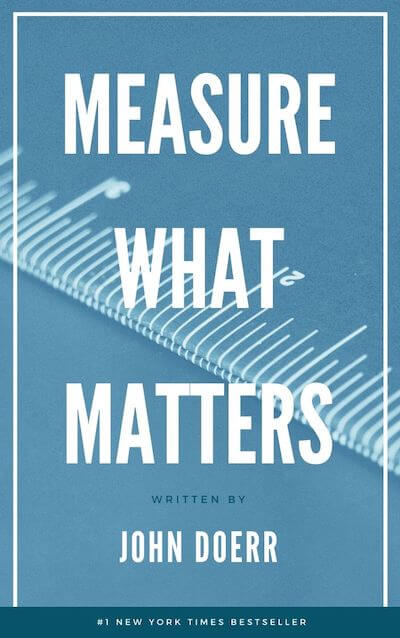
Prefer the print book? Buy on Amazon
As an Amazon Associate, Sumizeit earns from qualifying purchases.
Measure What Matters Book Summary
This Measure What Matters Book Summary covers the key ideas, lessons, and takeaways in about 20 minutes.
Short Description:
OKRs focus teams on meaningful goals to maximize success.
Helps with these goals
Want a Free Weekly Read?
Get a free summary every week straight to your mailbox.
Preview the Measure What Matters book summary
Below is a preview of Sumizeit’s comprehensive human-written summary of Measure What Matters by John Doerr. The full summary is 15-20 minutes long and covers the book’s key ideas in text, audio, visual, and video formats. Unlock the full 20 Minute Summary
Before John Doerr was a venture capitalist and the author of Measure What Matters, he was just a guy looking for a girl. In the summer of 1975, Doerr went to Silicon Valley to try to reconnect with his ex-girlfriend without knowing where she worked. But luck was on his side. He landed an internship at Intel, which turned out to be where she worked. Doerr got the girl.
It also turned out to be a gamechanger for his career. At Intel, Doerr learned about objectives and key results (OKRs). Championed by Intel co-founder Andy Grove, Doerr saw their impact firsthand. Using a few objectives that were measured against key results, Intel saw consistent growth with Grove at the helm. Grove was CEO of Intel for 11 years and the company grew by 40% each year.
After seeing the proof at Intel, Doerr wanted to spread the gospel of OKRs. Measure What Matters are about achieving success by focusing on what’s important.
The main points of the book are:
An idea means nothing without a plan.
Have you ever had an idea that went nowhere? Ideas are common. Without following through, the idea is meaningless.
To turn an idea into a success, you need a structured approach. You have to know what steps to take to get from theory to reality. Designing the right plan for the right idea is the real challenge.
Doerr’s OKR management framework has a solution to this challenge. You have to break everything down into measurable accomplishments with two steps. First, you define what success looks like. This is the objective component of the OKR framework. Second, you map out how to get there. This is the key results component of the OKR framework described below.
Think of the idea as a resource that you start with. It is important and necessary, but success depends on what you do with that resource.
For the road to success, you need to know the destination and how to make sure you’re on the right path.
Doerr’s OKR system has two main parts: the objectives (O) and the key results (KR).
The objectives are the destination. This is what success looks like to you in terms of a few goals. Objectives are usually long-term and think about the big picture or the overall vision. The objectives should be inspirational, aspirational, and significant.
The key results are the landmarks on the way to the destination. You are not only measuring whether or not you get to the objective. You need targets along the way that are specific, measurable, and verifiable. You want to make sure you’re going the right way before you get too far away from the goal. Breaking down the overall goal into pieces helps keep you on track towards each objective.
You can’t be vague or ambiguous about what success means.
OKRs should have deadlines and metrics that are clear. It is a lot harder to get somewhere if you don’t really know what it is…
Want the complete 20-minute summary?
- Full structured summary
- Video Summary
- Podcast Summary
- Audio summary
- Key takeaways
- Exercises
- Quiz
- Highlights and notes
- Ask the book with AI
Who should read Measure What Matters?
Measure What Matters is essential for leaders, managers, and anyone responsible for setting or tracking goals in their organization. Whether you run a startup, manage a team, or work in a large corporation, this book shows you how to move from vague aspirations to concrete, measurable outcomes. It's particularly valuable for those frustrated with traditional goal-setting methods that produce minimal results.
Why does Measure What Matters matter?
In a world of constant change and competing priorities, most organizations fail because they lack focus and clarity on what truly matters. John Doerr's OKR framework has driven the success of some of the world's most innovative companies, from Intel to Google to Amazon. Today's fast-moving business environment demands a goal-setting system that creates alignment, maintains accountability, and adapts quickly—and Measure What Matters provides exactly that.
What are the key themes in Measure What Matters?
- Objectives and Key Results (OKRs) as a performance management system
- The power of focus: doing fewer things exceptionally well
- Alignment: connecting individual work to organizational vision
- Continuous performance management over annual reviews
- Stretch goals and the innovation they inspire
- Transparency and accountability in goal tracking
- Building a culture of achievement and collaboration
How can you apply ideas from Measure What Matters?
- Break your quarterly or annual vision into 3-5 specific objectives, then define 2-4 key results for each with clear metrics and deadlines
- Hold regular check-in meetings (weekly or bi-weekly) to review progress on key results and identify blockers early
- Publish OKRs transparently across the organization so teams understand priorities and can identify alignment opportunities
- Align team and individual goals to at least one company-wide OKR to ensure everyone's work contributes to organizational success
- Set stretch goals that have a 70% success rate—ambitious enough to inspire innovation but achievable with focused effort
- Replace annual performance reviews with quarterly feedback cycles tied to OKR progress and continuous development conversations
- Establish a culture where teams can propose new OKRs from the bottom up, not just receive them from above
What common mistakes do readers make with Measure What Matters?
- Setting too many OKRs at once, which dilutes focus and prevents meaningful progress on any single objective
- Creating vague or unmeasurable objectives that can't be tracked, making accountability impossible
- Disconnecting individual and team goals from company OKRs, leaving employees unaware of how their work matters
- Setting OKRs once per year and ignoring them until year-end, missing opportunities for timely course correction
Sumizeit Exercises Apply what you've learned
Turn ideas from Measure What Matters into action with a short guided reflection: identify the biggest takeaway, connect it to your life, and commit to one step you can take in the next 24 hours.
What is the expert analysis of Measure What Matters?
Overview
Measure What Matters is a seminal work authored by John Doerr, a renowned venture capitalist and early investor in transformative technology companies such as Google, Amazon, and Twitter. Drawing from his extensive experience at Intel and Kleiner Perkins, Doerr introduces and advocates the Objectives and Key Results (OKRs) framework, a goal-setting methodology that has reshaped organizational performance management. The book is significant for its practical insights into how clear, measurable, and ambitious goals can drive innovation, alignment, and accountability across diverse organizations.
Core Thesis
At the heart of Measure What Matters lies the argument that success is less about having ideas and more about effectively executing them through focused, transparent, and measurable objectives. Doerr posits that the OKR framework—comprising inspirational objectives and quantifiable key results—enables organizations to maintain alignment, foster accountability, and stretch beyond comfort zones. This system transforms abstract ambitions into actionable plans and continuous performance management, replacing outdated annual reviews with dynamic, ongoing feedback loops that sustain momentum and adaptability.
Strengths
- Practical Framework: Doerr offers a clear, actionable system that organizations of all sizes can implement to enhance focus and productivity.
- Integration of Culture and Strategy: The book emphasizes embedding OKRs into organizational culture, ensuring that goal-setting is not a mechanical exercise but a shared commitment.
- Use of Real-World Examples: Drawing from Intel’s success under Andy Grove and Doerr’s own investment portfolio, the book grounds its principles in proven outcomes.
- Emphasis on Ambition and Innovation: By encouraging “stretch” goals, the framework fosters creativity and continuous improvement rather than complacency.
- Modernizing Performance Management: The critique of traditional annual reviews and advocacy for continuous feedback aligns with contemporary organizational psychology research.
Critiques & Counterarguments
- Potential Oversimplification: While OKRs provide structure, the book may understate the complexity of human motivation and organizational dynamics that influence goal attainment beyond measurable results.
- Evidence Base: The reliance on anecdotal success stories, primarily from high-tech companies, raises questions about the universal applicability of OKRs across industries with different operational realities.
- Risk of Metric Fixation: Critics from behavioral economics and management theory warn that an overemphasis on quantifiable key results can lead to gaming the system or neglecting qualitative factors such as employee well-being and creativity.
- Competing Frameworks: Alternative goal-setting and performance systems, such as Balanced Scorecards or Management by Objectives (MBO), offer broader perspectives that integrate financial, customer, internal process, and learning metrics, potentially providing a more holistic approach.
- Challenges in Implementation: The book acknowledges but may underplay the cultural resistance and leadership commitment required to embed OKRs effectively, which can be significant barriers in traditional or bureaucratic organizations.
Who Should Read This
Measure What Matters is essential reading for business leaders, managers, and entrepreneurs seeking a robust framework to translate vision into measurable outcomes. It is particularly valuable for those operating in fast-paced, innovation-driven environments where agility and alignment are critical. Additionally, organizational development professionals and human resource strategists will find the insights on continuous performance management relevant for modernizing their practices. While the book is accessible to a broad audience, its greatest impact will be felt by readers committed to cultivating a high-performance culture anchored in transparency and ambition.
Frequently asked questions about the Measure What Matters book summary
What is Measure What Matters about?
Measure What Matters by John Doerr is about the Objectives and Key Results (OKR) framework, a goal-setting methodology that helps organizations focus on what truly matters and execute effectively. The book explains how OKRs—which consist of clear objectives paired with measurable key results—can transform performance management, align teams, maintain accountability, and drive innovation at all levels of an organization.
Who should read Measure What Matters?
Anyone responsible for setting goals, managing teams, or running an organization should read Measure What Matters. This includes C-suite executives, managers, entrepreneurs, team leads, and individual contributors who want to improve goal-setting and performance. The book is especially valuable for those frustrated with traditional annual reviews and vague goal-setting practices.
What are the main takeaways from Measure What Matters?
The main takeaways include: (1) OKRs provide a structured framework for turning ideas into measurable success; (2) Focus on a few high-quality objectives rather than many mediocre ones; (3) Align individual and team goals with organizational objectives for maximum impact; (4) Replace annual performance reviews with continuous feedback and progress monitoring; (5) Set ambitious stretch goals that inspire innovation while remaining achievable. The four superpowers of OKRs are focus, alignment, accountability, and stretch.
How do OKRs differ from traditional goal-setting?
OKRs differ from traditional goals in several ways: they are more specific and measurable, they emphasize quality over quantity, they encourage ambitious stretch goals rather than guaranteed outcomes, and they require transparency and continuous monitoring rather than annual reviews. OKRs also deliberately separate objectives (what you want to achieve) from key results (how you'll measure success), creating clarity that traditional vague goals often lack.
What are the four superpowers of OKRs?
The four superpowers of OKRs are: (1) Focus—committing resources to a few meaningful objectives; (2) Alignment—ensuring team and individual goals connect to organizational objectives; (3) Accountability—making goals transparent so progress can be tracked and teams can support each other; and (4) Stretch—setting ambitious but achievable goals that inspire innovation and engagement.
How often should OKRs be reviewed and updated?
OKRs should be reviewed continuously, typically on a weekly or bi-weekly basis, rather than once per year. Regular check-ins allow teams to identify blockers early, celebrate progress, and make adjustments as needed. This continuous performance management approach replaces traditional annual reviews and ensures that organizations stay aligned and responsive to changing circumstances.
What is the ideal success rate for a stretch goal?
According to Measure What Matters, the ideal success rate for a stretch goal is approximately 70%. This means the goal should be ambitious enough to require innovation and full effort, but achievable enough that teams remain motivated. A goal with 100% certainty is too easy and lacks motivational power, while one that's impossible to reach will discourage effort.
About Sumizeit
Sumizeit is a profitable Scomy LLC company based in Miami, Florida. Our founders, Clemens Raemy and Weina Scott, are successful entrepreneurs with several exits. Sumizeit is a popular book summary app / micro learning app used by busy professionals and entrepreneurs with over 2,500 non-fiction book summaries and 10,000 podcast summaries in text, audio, visual, podcast, and video format. We also have stellar retention tools to make ideas stick - such as flashcards with spaced repetition, quizzes, streaks, highlighting and notes, daily challenges, riddles, mini-courses, meditation, and more. You won't only learn the idea, but also remember it. Over 90% of our users change their habits with Sumizeit.
Upgrade Now
Here's why readers love Sumizeit
Join thousands of learners getting smarter every day
"Great experience. Detailed summaries. Loved the gamification feature. Makes learning fun. Good customer service. I recommend Sumizeit to anyone. You'll learn a lot."
"I always felt busy but still wanting to keep up with the book discussion in my friend group. This was a great supplement to help me keep reading the books I find fun while keeping up with important books."
"I love this website. Instead of scrolling social media, I find myself learning a lot. I use it everyday. I recommend this app for anyone who is too busy and wants to get up to speed with their favorite books."
Measure What Matters Book Summary PDF
Looking for a Measure What Matters Book Summary PDF you can save and revisit offline? Our Measure What Matters Book Summary PDF captures the book’s core ideas in a clean, printable format — the key frameworks, takeaways, and structure without the fluff. Download the Measure What Matters Book Summary PDF when you want a reference you can annotate, share with your team, or review on the go. Get your Measure What Matters Book Summary PDF from the download page below.
Download Measure What Matters Book Summary PDFPeople also liked these summaries
Readers who explored Measure What Matters often enjoyed these titles next.


Ready to read the whole thing?
- Full structured summary
- Video Summary
- Podcast Summary
- Audio summary
- Key takeaways
- Exercises
- Quiz
- Highlights and notes
- Ask the book with AI
Featured Book Titles
Popular Book Summaries at sumizeit, leading book summary app