Question 1 of 5
What is the main focus of Section 1 in the summary of Making Numbers Count?
Section 1 focuses on strategies for effectively communicating numbers and making them accessible and engaging for people.


Prefer the print book? Buy on Amazon
As an Amazon Associate, Sumizeit earns from qualifying purchases.
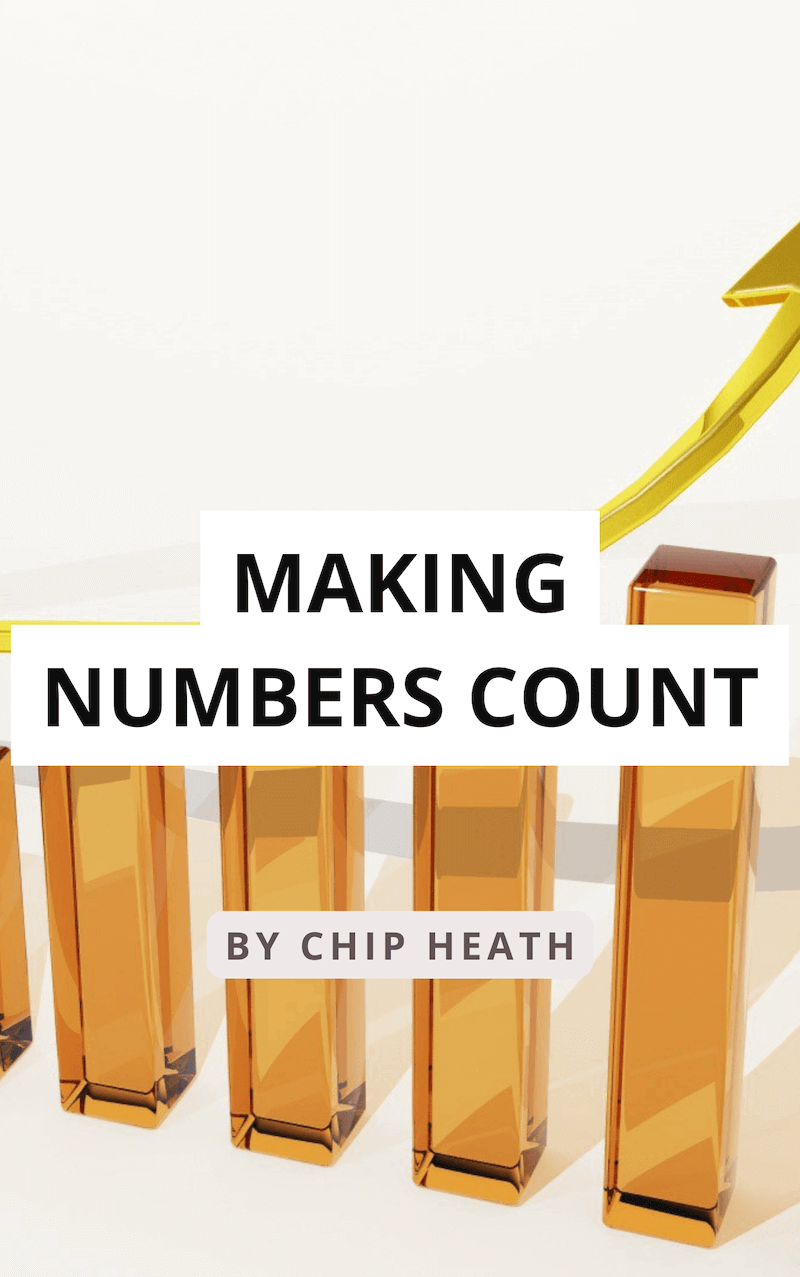
This Making Numbers Count Book Summary covers the key ideas, lessons, and takeaways in about 20 minutes.
Helps with these goals
Want a Free Weekly Read?
Get a free summary every week straight to your mailbox.
Below is a preview of Sumizeit’s comprehensive human-written summary of Making Numbers Count by Chip Heath and Karla Starr. The full summary is 15-20 minutes long and covers the book’s key ideas in text, audio, visual, and video formats. Unlock the full 20 Minute Summary
The section focuses on strategies for effectively communicating numbers to people. The authors argue that numbers are a powerful tool for conveying important information, but they can be challenging to understand and remember. To make numbers count, it is essential to present them in a way that is both accessible and engaging.
One key strategy the authors recommend is to use concrete examples to illustrate abstract concepts. People tend to understand and remember information better when it is presented in a familiar and relatable context. For example, instead of saying that a company's profits have increased by 10%, it might be more effective to say that the company has made an additional $1 million in profits.
Another important strategy is to use visual aids, such as graphs or charts, to help people see the patterns and trends in the numbers. Visual representations can make complex data more accessible and easier to interpret. However, it is important to use visual aids wisely and avoid cluttering them with unnecessary information.
The authors also stress the importance of framing numbers in a way that resonates with the audience's values and priorities. For example, if you are trying to persuade someone to invest in a renewable energy project, you might focus on the potential financial benefits, as well as the positive environmental impact.
Finally, the authors emphasize the importance of making numbers memorable. People are more likely to remember information that is presented in a compelling and memorable way. This might involve using a catchy tagline, telling a story, or using humor to make the numbers more engaging.
The second section emphasizes the importance of using numbers that elicit emotions and connect with people on a deeper level. The authors explain that although numbers are typically associated with rational thinking and decision-making, they can also have an emotional impact that can drive action.
The authors provide several examples of emotional numbers, such as the number of children who die each day from preventable diseases or the amount of money spent on pet food annually in the United States. These numbers tap into people's emotions and can motivate them to take action or make a change.
One key to using emotional numbers effectively is to connect them to something that people care about. For example, if you are trying to raise awareness about a particular disease, you could use statistics about the number of people affected by the disease and how it impacts their lives. This can help people see the human side of the issue and feel more motivated to get involved.
Another important aspect of using emotional numbers is to avoid overwhelming people with too much information. The authors suggest using a "golden number" or a single statistic that can convey the essence of the issue. This helps people focus on the most important information and makes it easier for them to remember and act upon.
The authors also recommend using visuals to help convey emotional numbers.…
Making Numbers Count is ideal for anyone who needs to present data, statistics, or financial information to others—from business professionals and marketers to nonprofit leaders and educators. Whether you're pitching to investors, communicating with stakeholders, or trying to drive public awareness, this book equips you with proven techniques to make your numbers resonate and stick in people's minds.
In an age of data overload, the ability to communicate numbers clearly and compellingly is a competitive advantage. Making Numbers Count by Chip Heath and Karla Starr reveals why most people struggle with numerical information and provides science-backed strategies to bridge that gap. When you can translate numbers into formats people understand and remember, you gain the power to influence decisions, drive action, and create real change.
Turn ideas from Making Numbers Count into action with a short guided reflection: identify the biggest takeaway, connect it to your life, and commit to one step you can take in the next 24 hours.
Making Numbers Count: The Art of Communicating Financial Information Effectively is authored by Chip Heath and Karla Starr, two distinguished figures whose combined expertise spans organizational behavior, psychology, and communication. Heath, a Stanford professor renowned for his work on decision-making and effective communication, collaborates with Starr, a writer with a strong background in psychology and neuroscience. Together, they address a perennial challenge in both business and public discourse: how to communicate numerical data in ways that are not only accurate but also compelling and accessible. The book’s significance lies in its interdisciplinary approach, merging empirical research with practical strategies to transform abstract numbers into meaningful narratives that resonate emotionally and intellectually.
The central argument of Making Numbers Count is that numbers, while inherently powerful, often fail to influence or inform because they are presented in ways that are abstract, inaccessible, or disconnected from the audience’s values and experiences. Heath and Starr contend that to make numbers truly count, communicators must employ techniques that ground figures in relatable contexts, evoke emotional responses, and utilize visual and comparative tools such as scale models. The book posits that effective numerical communication hinges on transforming raw data into stories and images that engage both the rational and emotional faculties of the audience, thereby enhancing comprehension, retention, and motivation to act.
Making Numbers Count is ideally suited for professionals across business, journalism, policy-making, and education who regularly engage with data communication but struggle to make their numerical messages resonate. It is particularly valuable for managers, marketers, and communicators seeking to bridge the gap between complex quantitative information and diverse audiences. Additionally, those new to data visualization or numerical storytelling will find the book’s clear guidance and practical examples highly accessible. However, readers with advanced expertise in statistics or data science may find the content more introductory than transformative.
Try a few questions from the Making Numbers Count quiz. Unlock the full summary for the full quiz and answers that will help the ideas stick.
Question 1 of 5
Section 1 focuses on strategies for effectively communicating numbers and making them accessible and engaging for people.
Question 2 of 5
The authors recommend using concrete examples to illustrate abstract concepts, making information more familiar and relatable.
Question 3 of 5
The summary explains the "golden number" is a single statistic to help people focus on the most important information and remember it more easily.
Question 4 of 5
The summary lists the number of children who die each day from preventable diseases as an example of an emotional number that taps into people's emotions.
Question 5 of 5
The authors explain that scale models help people visualize data, making large or abstract numbers more tangible and understandable.
Making Numbers Count by Chip Heath and Karla Starr is a guide to communicating numerical information in ways that people actually understand and remember. The book reveals why most people struggle with statistics and provides practical techniques—such as using concrete comparisons, emotional angles, visual aids, and storytelling—to make data meaningful, memorable, and persuasive.
Anyone who presents data, statistics, or financial information to others should read this book. That includes business professionals, entrepreneurs, marketers, nonprofit leaders, educators, analysts, and anyone else who wants to improve how they communicate numbers and drive decision-making through data.
Key takeaways include translating abstract numbers into concrete, relatable comparisons; using emotional appeals to complement rational arguments; choosing a single powerful statistic rather than overwhelming audiences; creating visual representations that clarify rather than complicate; and tailoring data presentation to your specific audience's values and literacy level. The book emphasizes that how you communicate numbers matters as much as the numbers themselves.
Making Numbers Count recommends several techniques: framing numbers in stories rather than presenting them as isolated facts, using comparisons to familiar objects or experiences, focusing on emotional relevance, and choosing a single 'golden number' that encapsulates your key message. Combining these approaches with clear visuals and language tailored to your audience will maximize retention.
A scale model is a visual or physical representation that shows large or abstract numbers in proportion, making them easier to visualize and understand. For example, representing the national debt using stacked visual representations or comparing the solar system to objects in familiar sizes helps people grasp enormity and significance that raw statistics alone cannot convey.
Emotional numbers tap into people's values and feelings, motivating action in ways that rational statistics alone cannot. For example, describing the number of children affected by a disease creates empathy and urgency, whereas presenting the same data as a percentage or abstract statistic may leave people unmoved.
Making Numbers Count highlights effective approaches used by organizations like The New York Times, National Geographic, and the Weather Channel. These include interactive bubble charts tracking changes over time, heat maps showing intensity or severity, stacked bar charts displaying distribution, and infographics that combine data with relatable visuals—all designed to clarify rather than clutter.
Test your presentation on people similar to your target audience and ask them to explain back what they learned. If they can articulate your key message in their own words and remember your statistics later, your communication is working. If they seem confused or can't recall the data, simplify your approach and use more concrete comparisons and storytelling.
Sumizeit is a profitable Scomy LLC company based in Miami, Florida. It has been helping readers learn from nonfiction books for 7 years with expert-written summaries in text, audio, podcast, and video.
Join thousands of learners getting smarter every day
"Great experience. Detailed summaries. Loved the gamification feature. Makes learning fun. Good customer service. I recommend Sumizeit to anyone. You'll learn a lot."
"I always felt busy but still wanting to keep up with the book discussion in my friend group. This was a great supplement to help me keep reading the books I find fun while keeping up with important books."
"I love this website. Instead of scrolling social media, I find myself learning a lot. I use it everyday. I recommend this app for anyone who is too busy and wants to get up to speed with their favorite books."
Looking for a Making Numbers Count Book Summary PDF you can save and revisit offline? Our Making Numbers Count Book Summary PDF captures the book’s core ideas in a clean, printable format — the key frameworks, takeaways, and structure without the fluff. Download the Making Numbers Count Book Summary PDF when you want a reference you can annotate, share with your team, or review on the go. Get your Making Numbers Count Book Summary PDF from the download page below.
Download Making Numbers Count Book Summary PDFReaders who explored Making Numbers Count often enjoyed these titles next.
Popular Book Summaries at sumizeit, leading book summary app