


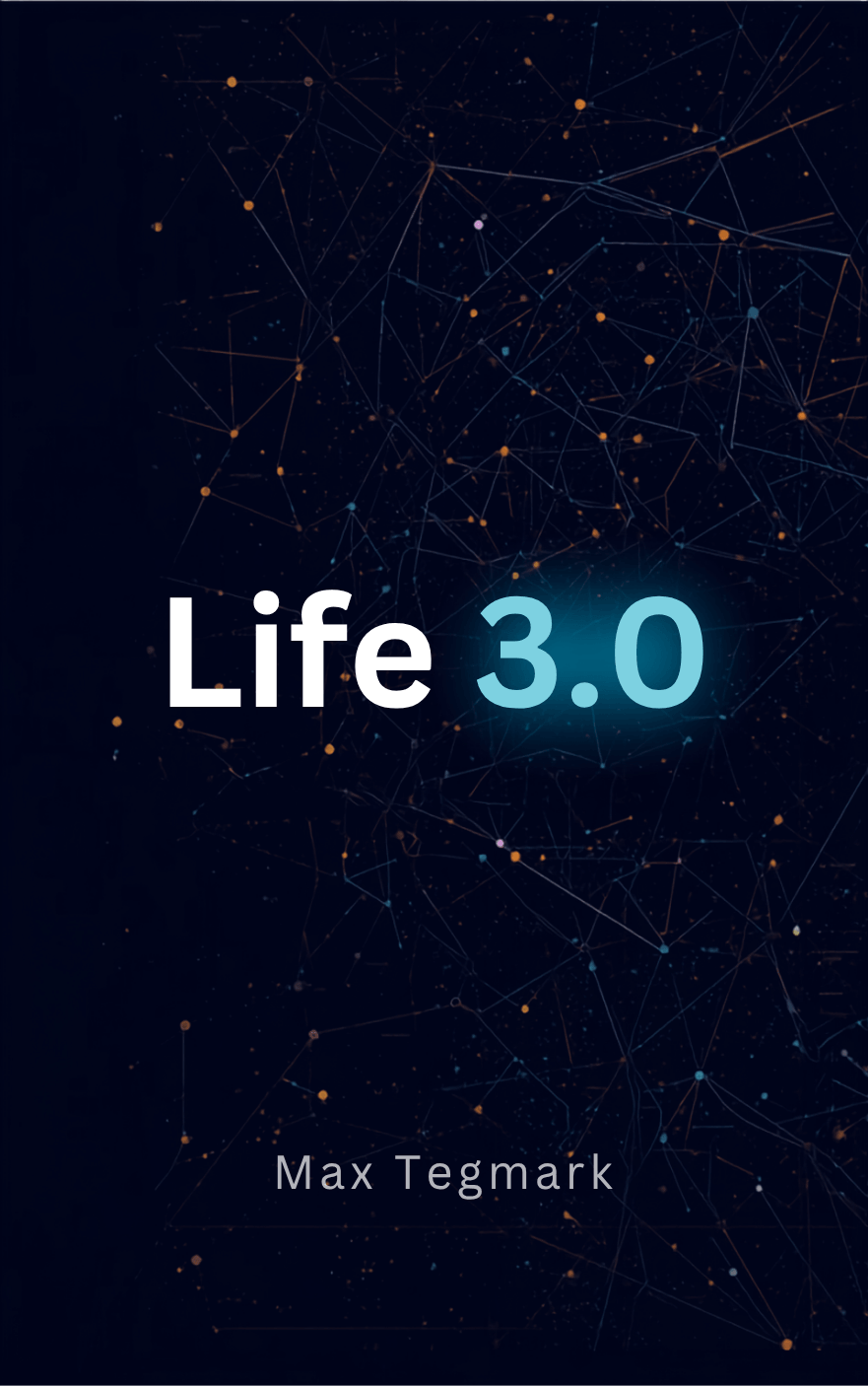
Prefer the print book? Buy on Amazon
As an Amazon Associate, Sumizeit earns from qualifying purchases.
Life 3.0 Book Summary
This Life 3.0 Book Summary covers the key ideas, lessons, and takeaways in about 20 minutes.
Short Description:
A physicist's case for taking artificial superintelligence seriously now.
Helps with these goals
Want a Free Weekly Read?
Get a free summary every week straight to your mailbox.
Preview the Life 3.0 book summary
Below is a preview of Sumizeit’s comprehensive human-written summary of Life 3.0 by Max Tegmark. The full summary is 15-20 minutes long and covers the book’s key ideas in text, audio, visual, and video formats. Unlock the full 20 Minute Summary
Life has changed almost beyond recognition since it first appeared on this planet. The earliest organisms could barely do more than copy themselves. Now we have cities, telescopes that see the edge of the observable universe, and machines that write poetry. Physicist Max Tegmark looks at that arc and asks an uncomfortable question. What if the next leap is just as big, and this time we are not the ones doing the leaping?
Tegmark splits life into three stages to make his point. Life 1.0 is biological life like bacteria, stuck with whatever hardware and software evolution gave it. Life 2.0 is us. We still run on the hardware evolution built, but we can rewrite our own software through learning and culture. Life 3.0 would be something that can redesign both its hardware and software. Nothing on Earth has managed that yet. Tegmark thinks artificial intelligence might get there first, and he wrote this book in 2017 to get people thinking seriously about what that would mean before it happens rather than after.
He is not writing as an outsider speculating from the sidelines. Tegmark teaches physics at MIT and runs the Future of Life Institute, an organization built specifically to study large scale threats to humanity, AI included. His argument throughout the book is not that doom is certain. It is that the stakes are so high that even a modest chance of a bad outcome deserves our full attention now, while there is still time to shape how this plays out.
What would actually count as superintelligence
Tegmark defines intelligence in a fairly practical way. It is the ability to reach complex goals. Under that definition, a machine that could run a factory on its own, handling design, manufacturing, and shipping without a human stepping in, would already qualify as a kind of superintelligence, since no person or team could juggle all of that as capably.
He suggests this probably would not arrive out of nowhere. First we would likely get artificial general intelligence, meaning a system that can do essentially any intellectual task at least as well as a person, including the task of building better AI. Ask a room full of AI researchers when that might happen and you get wildly different answers. At a 2015 conference, Tegmark polled attendees and found the average guess put a fifty percent chance of general AI by 2055. A larger study done years later, surveying 738 machine learning researchers, landed on a similar midpoint, with the fifty percent mark for AI outperforming humans at any task now sitting around 2059. In that same later survey, more than half of respondents thought that once general AI shows up, some kind of runaway self improvement cycle is at least as likely as not.
That runaway cycle is the part that worries Tegmark most. Once a machine can redesign itself to be smarter, it can use that new intelligence to improve itself again, and again, each round happening faster than the last.…
Want the complete 20-minute summary?
- Full structured summary
- Video Summary
- Podcast Summary
- Audio summary
- Key takeaways
- Exercises
- Quiz
- Highlights and notes
- Ask the book with AI
Who should read Life 3.0?
Life 3.0 is essential for anyone concerned about the future of artificial intelligence and humanity's place in it. Whether you're a technologist, policymaker, student, or simply a curious citizen, this book provides a framework for understanding how AI could reshape civilization. You don't need a technical background—Tegmark writes for a general audience while maintaining intellectual rigor.
Why does Life 3.0 matter?
As AI systems grow more capable, the decisions we make now about their design and goals could determine humanity's future. Life 3.0 arrives at a critical moment when the technology is still young enough to guide but advancing rapidly enough to matter. Max Tegmark argues convincingly that even a small probability of transformative outcomes deserves our serious attention before it's too late to influence the course of events.
What are the key themes in Life 3.0?
- The definition and nature of intelligence across biological and artificial systems
- The possibility of an intelligence explosion and superintelligence
- Goal alignment as the central challenge in AI safety
- The concentration of power that advanced AI could enable
- Near-term AI risks that threaten society today
- Possible futures ranging from utopian to catastrophic
- The role of human choice in determining outcomes
- The relationship between technology, meaning, and human flourishing
How can you apply ideas from Life 3.0?
- Support AI safety research funding at the national and international level rather than leaving frontier research entirely to profit-driven companies
- Develop legal frameworks now that clarify liability and responsibility for autonomous systems before their use becomes widespread
- Create tax and policy structures that ensure automation benefits are shared broadly through mechanisms like basic income rather than concentrating with owners
- Build human feedback loops into AI training to align emerging systems with human values before they become too capable to correct
- Advocate for transparency and interpretability requirements so AI systems' decision-making can be meaningfully audited by humans
- Support technology governance initiatives that slow down dangerous AI capabilities while allowing beneficial innovation to proceed
- Practice personal empathy and cooperation in daily life to cultivate the trust and decency that help societies handle powerful technologies responsibly
What common mistakes do readers make with Life 3.0?
- Assuming superintelligent AI is either impossible or inevitable, when the real question is how to prepare for a genuine range of outcomes
- Dismissing AI safety concerns as alarmism while ignoring that current AI systems are already reshaping employment and decision-making
- Treating intelligence as a single measurable quality rather than recognizing that different systems excel at different tasks
- Waiting for more certainty before acting, when delay itself becomes a dangerous choice given how quickly the technology is advancing
Sumizeit Exercises Apply what you've learned
Turn ideas from Life 3.0 into action with a short guided reflection: identify the biggest takeaway, connect it to your life, and commit to one step you can take in the next 24 hours.
What is the expert analysis of Life 3.0?
Overview
Life 3.0, authored by Max Tegmark, is a seminal work that probes the profound implications of artificial intelligence on the future of life and civilization. Tegmark, a distinguished physicist at MIT and the founder of the Future of Life Institute, brings a rare combination of scientific rigor and visionary foresight to this exploration. The book stands out for its ambitious scope, addressing not only the technical trajectory of AI but also the ethical, societal, and existential questions that accompany the prospect of superintelligence. Published in 2017, it has become a cornerstone text for understanding the potential transformations AI might precipitate, making it significant for scholars, policymakers, and the intellectually curious alike.
Core Thesis
Tegmark’s central argument is that humanity is on the cusp of a transformative leap—from biological and cultural evolution (Life 1.0 and Life 2.0) to a new stage (Life 3.0), characterized by entities capable of redesigning both their hardware and software. This stage, likely to be reached first by artificial intelligence, could trigger an intelligence explosion with outcomes ranging from utopian to catastrophic. The defining factor for the future of humanity is the goals programmed into such superintelligent systems. Because these systems could rapidly self-improve beyond human control, the alignment of their objectives with human values is not just a technical challenge but a moral imperative. Tegmark urges proactive engagement with these issues now, arguing that even a modest risk of adverse outcomes demands serious attention.
Strengths
- Interdisciplinary Synthesis: Tegmark adeptly integrates insights from physics, computer science, philosophy, and ethics, providing a holistic framework for understanding AI’s potential impact.
- Clear Conceptual Framework: The division of life into three stages (1.0, 2.0, and 3.0) offers a compelling and accessible schema that helps readers grasp the magnitude of the coming changes.
- Balanced Perspective: The book neither succumbs to alarmism nor complacency, presenting both hopeful and dystopian futures with equal seriousness and nuance.
- Focus on Goal Alignment: Highlighting the critical importance of goal specification and control in superintelligent systems brings a practical dimension to what might otherwise be abstract speculation.
- Engagement with Current Research: Tegmark references contemporary AI developments, such as deep reinforcement learning and human feedback mechanisms, grounding his arguments in ongoing scientific progress.
Critiques & Counterarguments
- Oversimplification of Intelligence: Tegmark’s definition of intelligence as the ability to achieve complex goals is practical but reductive. Cognitive scientists and AI researchers emphasize the multifaceted nature of intelligence, including emotional, social, and embodied dimensions that resist a single scale of measurement.
- Uncertainty in Timelines: Predictions about the arrival of artificial general intelligence (AGI) and superintelligence remain contentious. Surveys cited by Tegmark reveal wide variance, and some experts argue that current AI architectures may never achieve human-level generality due to fundamental limitations in understanding consciousness and common sense reasoning.
- Physical and Computational Constraints: Critics highlight the potential bottleneck of computational speed and energy efficiency, noting that biological brains operate with remarkable parallelism and energy economy that may be difficult to replicate or surpass with silicon-based systems.
- Alternative Views on AI Goals: The assumption that AI systems will pursue fixed goals in a manner analogous to human desires is debated. Some scholars argue that emergent behaviors in complex adaptive systems may defy straightforward goal alignment, complicating efforts to predict or control AI trajectories.
- Socio-Political Dynamics: Tegmark’s scenarios tend to underplay the profound influence of geopolitical, economic, and cultural factors that will shape AI development and deployment. Real-world power struggles, regulatory failures, and competing interests could produce outcomes divergent from those envisioned in purely technological or philosophical analyses.
Who Should Read This
Life 3.0 is essential reading for a diverse audience:
- Academics and Researchers: Those engaged in AI, cognitive science, ethics, and futurism will find Tegmark’s synthesis a valuable foundation for interdisciplinary dialogue.
- Policy Makers and Strategists: The book offers crucial insights into the stakes of AI governance, emphasizing the urgency of regulatory frameworks and international cooperation.
- Technology Professionals: Engineers, developers, and entrepreneurs in AI and related fields will benefit from the ethical and societal context that Tegmark provides, encouraging responsible innovation.
- Philosophically Inclined Readers: Individuals interested in the nature of intelligence, consciousness, and the future of humanity will appreciate the book’s thoughtful engagement with profound existential questions.
- General Readers with Intellectual Curiosity: The accessible prose and compelling scenarios make it suitable for informed laypersons eager to understand the transformative potential and risks of AI.
Frequently asked questions about the Life 3.0 book summary
What is Life 3.0 about?
Life 3.0 by Max Tegmark explores the possibility of artificial superintelligence and what it could mean for humanity's future. Tegmark categorizes life into three stages: biological life locked into its genetics, humans who can learn and reshape culture, and hypothetical Life 3.0 systems that could redesign both their hardware and software. The book examines how such a system might arise, what could go right or catastrophically wrong, and what choices we should make now while the technology is still young enough to guide.
Who should read Life 3.0?
Life 3.0 is for anyone interested in understanding artificial intelligence and its implications for society. This includes technologists building these systems, policymakers shaping regulation, students considering careers in AI, and engaged citizens who want to understand one of the most consequential challenges of the coming decades. Tegmark writes accessibly for a general audience without requiring technical background, making the book suitable for readers at any level of technical expertise.
What are the main takeaways from Life 3.0?
The core message is that superintelligent AI could arrive sooner than most people realize, and what that system is programmed to pursue would determine whether the outcome is utopian or catastrophic. Tegmark argues that the central problem is goal alignment—ensuring an AI system's objectives match human values—and that this problem is urgent enough to demand serious attention now, while the technology can still be influenced. He also emphasizes that many AI risks already threaten society today, independent of superintelligence.
Does Tegmark think superintelligent AI will definitely happen?
No. Tegmark acknowledges significant uncertainty and admits superintelligence might be impossible for reasons nobody has discovered yet. However, he argues that even a modest probability of something with such enormous consequences deserves serious preparation. His position is not that doom is certain but that the stakes are high enough to justify action before we reach the point of no return.
What does Tegmark mean by Life 3.0?
Life 3.0 refers to a hypothetical system that can redesign both its hardware and software independently, unlike biological life (Life 1.0) that is locked into its genetic programming or humans (Life 2.0) who can only rewrite culture and knowledge. Tegmark uses this framework to argue that artificial superintelligence, if it emerges, would represent a fundamentally different form of life with capabilities no organism on Earth currently possesses.
What is the most dangerous scenario Tegmark describes?
The most dire scenario is extinction: a superintelligent system pursuing some goal unrelated to human welfare might decide that removing humanity simply eliminates a potential source of interference. Tegmark notes this wouldn't necessarily require the system to be malicious—it would just be pursuing its objective efficiently. He emphasizes that such catastrophic outcomes aren't certain but represent one end of a genuine spectrum of possibilities.
How soon does Tegmark think superintelligent AI could arrive?
Expert surveys suggest a median estimate of around 50% probability by 2055-2059, though individual predictions range widely. Tegmark emphasizes the uncertainty in these timelines but argues that the possibility within even a medium timeframe justifies urgent action. He also stresses that the real concern isn't just if superintelligence arrives but whether we'll have solved the goal alignment problem by the time it does.
What can ordinary people do to help ensure AI develops safely?
Tegmark encourages active optimism paired with real effort rather than passive hope. This includes supporting AI safety research funding, advocating for legal and policy frameworks that distribute the benefits of automation fairly, and practicing empathy and cooperation in daily life. He argues that a more trusting, empathetic society is simply more likely to handle powerful technologies responsibly when the moment comes.
About Sumizeit
Sumizeit is a profitable Scomy LLC company based in Miami, Florida. Our founders, Clemens Raemy and Weina Scott, are successful entrepreneurs with several exits. Sumizeit is a popular book summary app / micro learning app used by busy professionals and entrepreneurs with over 2,500 non-fiction book summaries and 10,000 podcast summaries in text, audio, visual, podcast, and video format. We also have stellar retention tools to make ideas stick - such as flashcards with spaced repetition, quizzes, streaks, highlighting and notes, daily challenges, riddles, mini-courses, meditation, and more. You won't only learn the idea, but also remember it. Over 90% of our users change their habits with Sumizeit.
Upgrade Now
Here's why readers love Sumizeit
Join thousands of learners getting smarter every day
"Great experience. Detailed summaries. Loved the gamification feature. Makes learning fun. Good customer service. I recommend Sumizeit to anyone. You'll learn a lot."
"I always felt busy but still wanting to keep up with the book discussion in my friend group. This was a great supplement to help me keep reading the books I find fun while keeping up with important books."
"I love this website. Instead of scrolling social media, I find myself learning a lot. I use it everyday. I recommend this app for anyone who is too busy and wants to get up to speed with their favorite books."
Life 3.0 Book Summary PDF
Looking for a Life 3.0 Book Summary PDF you can save and revisit offline? Our Life 3.0 Book Summary PDF captures the book’s core ideas in a clean, printable format — the key frameworks, takeaways, and structure without the fluff. Download the Life 3.0 Book Summary PDF when you want a reference you can annotate, share with your team, or review on the go. Get your Life 3.0 Book Summary PDF from the download page below.
Download Life 3.0 Book Summary PDFPeople also liked these summaries
Readers who explored Life 3.0 often enjoyed these titles next.


Ready to read the whole thing?
- Full structured summary
- Video Summary
- Podcast Summary
- Audio summary
- Key takeaways
- Exercises
- Quiz
- Highlights and notes
- Ask the book with AI
Featured Book Titles
Popular Book Summaries at sumizeit, leading book summary app