Question 1 of 5
What main idea does Isaacson argue about real genius in the book?
Isaacson argues that real genius comes from connecting different fields; Leonardo studied art, anatomy, math, water, light, and machines and let each feed the others.


Prefer the print book? Buy on Amazon
As an Amazon Associate, Sumizeit earns from qualifying purchases.
This Leonardo da Vinci Book Summary covers the key ideas, lessons, and takeaways in about 20 minutes.
Helps with these goals
Want a Free Weekly Read?
Get a free summary every week straight to your mailbox.
Below is a preview of Sumizeit’s comprehensive human-written summary of Leonardo da Vinci by Walter Isaacson. The full summary is 15-20 minutes long and covers the book’s key ideas in text, audio, visual, and video formats. Unlock the full 20 Minute Summary
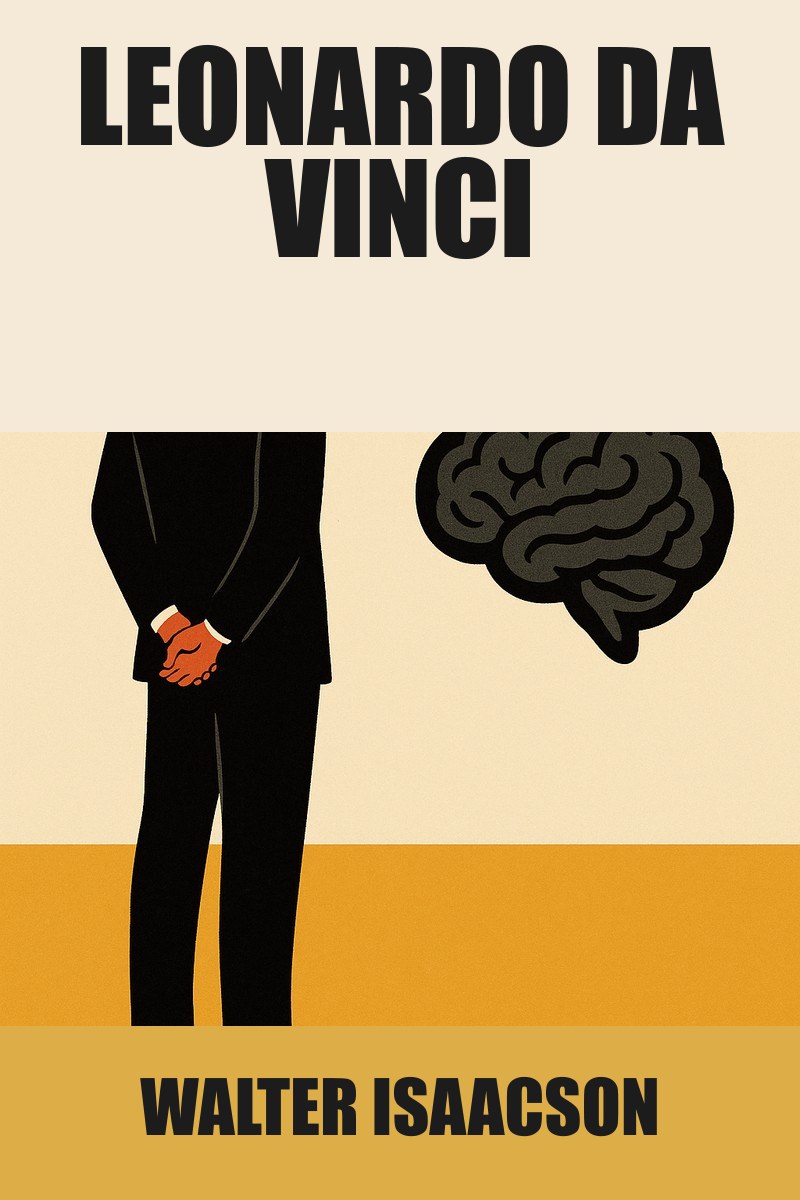
Walter Isaacson's biography follows the painter, engineer, and scientist who became the model for the Renaissance man. It covers where Leonardo lived, who paid him, who he loved, what he figured out, and why so much of his work never got finished. Isaacson also pulls out lessons you can use in your own life.
Leonardo had no family name because he was born outside of marriage. "Da Vinci" only means he came from Vinci, so this summary calls him Leonardo.
Isaacson argues that real genius comes from connecting different fields. Leonardo studied art, anatomy, math, water, light, and machines, and each subject fed the others. His paintings look alive because he understood how eyes, muscles, and shadows work. His science was sharper because he had trained himself to draw what he saw.
People liked Leonardo. He was handsome, dressed in short pink robes, made friends easily, and gave away his time and his things. He cared little about money. He worked enough to get by and spent the rest of his hours chasing whatever puzzled him.
Isaacson points to four ways he stood apart, and each one gave him some freedom.
First, he was illegitimate. With no claim to a family trade or inheritance, nobody expected him to become a notary like his father. He could invent his own path.
Second, he was left handed. He wrote from right to left so his hand wouldn't smear the ink, which is why his notebooks look like mirror writing.
Third, he was gay, and he did not hide it, even though sodomy was illegal.
Fourth, he was a vegetarian who loved animals and hated how people treated them. He avoided killing insects and bought caged birds just to free them. Still, his science came first, and he once cut open a pig with a beating heart to study it.
Leonardo was born on April 15, 1452, near the town of Vinci. He spent his first twelve years going back and forth between his mother's home and his father's family home. In 1464 he moved to Florence to live with his father.
In 1468 his father arranged an apprenticeship with Andrea del Verrocchio, an artist and engineer. There Leonardo learned core painting methods. One was chiaroscuro, which uses light and dark shading to make flat images look solid. Another was sfumato, which softens edges so shapes melt into each other instead of ending in hard lines. Verrocchio's statue of David, which Leonardo probably modeled for, already had the curls, the lively pose, the accurate anatomy, and the mysterious face that Leonardo would later push further.
Florence also introduced him to patronage. The Medici family ran the city and paid for much of its art. Artists like Botticelli won their favor by painting Medici faces into religious scenes. Leonardo would not bend his work to please anyone. He took money from patrons, but only for projects that excited him, and he ignored jobs he found dull.
Leonardo da Vinci by Walter Isaacson is for anyone curious about how genius actually works and how to cultivate curiosity across disciplines. Whether you're an artist seeking scientific insight, a scientist wanting to think more creatively, or simply someone who wants to understand how to connect seemingly unrelated fields, this biography offers a model for intellectual growth. It appeals to readers who admire polymaths and want to learn habits they can apply to their own lives.
In an age of specialization, Leonardo da Vinci reminds us that breakthrough thinking often comes from bridging different domains. Isaacson shows how Leonardo's refusal to separate art from science, anatomy from engineering, and observation from imagination produced insights centuries ahead of his time. Understanding how Leonardo worked—his curiosity, his sketching practice, his willingness to question accepted wisdom—offers practical lessons for anyone trying to innovate or think more deeply in their own field.
Turn ideas from Leonardo da Vinci into action with a short guided reflection: identify the biggest takeaway, connect it to your life, and commit to one step you can take in the next 24 hours.
Leonardo da Vinci by Walter Isaacson is a meticulously researched biography that illuminates the life and mind of one of history’s most enigmatic figures. Isaacson, a renowned biographer celebrated for his works on Steve Jobs and Benjamin Franklin, delves deeply into Leonardo’s multifaceted genius as a painter, scientist, engineer, and thinker. This book stands out for its synthesis of Leonardo’s art and science, drawing extensively on the master’s own notebooks to reveal how his interdisciplinary curiosity shaped his legacy. Published in 2017, it offers a comprehensive portrait that situates Leonardo not just as a Renaissance icon but as a model for creative thinking applicable even today.
Isaacson’s central argument is that Leonardo da Vinci’s genius was not a product of innate superiority or privileged education, but rather emerged from a relentless curiosity that transcended disciplinary boundaries. By connecting art, anatomy, mathematics, engineering, and natural philosophy, Leonardo cultivated a unique mode of inquiry grounded in observation, experimentation, and imagination. Isaacson posits that Leonardo’s approach—characterized by universal curiosity, creative synthesis, and an acceptance of imperfection—offers enduring lessons on how genius can be cultivated through the integration of diverse fields and a commitment to lifelong learning.
This biography is ideal for readers who appreciate richly detailed historical narratives that blend art, science, and philosophy. Scholars and enthusiasts of Renaissance history, art history, and the history of science will find Isaacson’s work a valuable synthesis of Leonardo’s polymathic endeavors. Additionally, creative professionals and lifelong learners seeking inspiration from a historical exemplar of curiosity and innovation will benefit from the book’s practical insights. Readers interested in the psychology of genius and the interplay between creativity and discipline will also find this biography a compelling and thought-provoking study.
Try a few questions from the Leonardo da Vinci quiz. Unlock the full summary for the full quiz and answers that will help the ideas stick.
Question 1 of 5
Isaacson argues that real genius comes from connecting different fields; Leonardo studied art, anatomy, math, water, light, and machines and let each feed the others.
Question 2 of 5
The summary states Leonardo had no family name because he was born outside of marriage and 'da Vinci' simply means he came from Vinci.
Question 3 of 5
The summary explains he was left handed and wrote right to left so his hand wouldn't smear the ink, which is why his notebooks look like mirror writing.
Question 4 of 5
In 1468 his father arranged an apprenticeship with Andrea del Verrocchio, where Leonardo learned core painting methods like chiaroscuro and sfumato.
Question 5 of 5
Sfumato softens edges so shapes melt into each other instead of ending in hard lines; chiaroscuro uses light and dark shading to make images look solid.
Question 1 of 10
Walter Isaacson's Leonardo da Vinci is a biography of the Renaissance painter, engineer, and scientist who became the model for the multidisciplinary genius. The book explores how Leonardo's curiosity across art, anatomy, mathematics, engineering, and natural science fed each other, and how his habits—drawing constantly, asking odd questions, and refusing to separate art from science—produced some of history's most innovative ideas. Isaacson argues that Leonardo's genius came not from superhuman ability but from learnable practices like observation, experimentation, and connecting seemingly unrelated fields.
Anyone curious about how to think creatively across disciplines should read this book. Artists and scientists will find unexpected insights in how Leonardo combined both ways of thinking. Entrepreneurs and innovators will discover practical habits for deeper problem-solving. Students and lifelong learners will see how curiosity, observation, and sketching can unlock understanding in any field. Even readers who simply admire unconventional people will find Leonardo's life story compelling—his independence, his refusal to compromise his vision, and his willingness to question authority make for engaging reading.
The core takeaway is that genius grows from curiosity, imagination, and the willingness to connect everything—skills anyone can practice. Specific lessons include: stay curious like a child, learn through observation and drawing rather than only reading, pay attention to details, let imagination run free, use experiments to find facts, draw to understand complicated ideas, look for places where subjects overlap, aim for excellence, and write everything down. Isaacson emphasizes that Leonardo's flaws—his perfectionism and refusal to finish projects—were inseparable from his innovation, showing that the path to genius is rarely smooth or conventional.
Leonardo's inability to read Latin or Greek and his failure to master the classical texts of his era freed him from reverence for written authority. Instead of relying on what scholars had written, he learned by looking, testing, and drawing. This meant he could question accepted wisdom and trust his own observations, sometimes arriving at conclusions before formal science had. His outsider status as someone without a classical education made him more willing to challenge established ideas and invent his own methods.
Isaacson attributes Leonardo's unfinished projects to his perfectionism and his refusal to compromise his vision. When a work fell short of what he imagined—like The Adoration of the Magi, where he wanted each of thirty figures to cast shadows on all the others—he stopped rather than settle for less. While this cost humanity the loss of completed masterpieces and unpublished discoveries, the same drive pushed his surviving works and ideas centuries ahead of their time. His incompleteness was a feature of his genius, not a flaw separate from it.
Leonardo's notebooks show how constant recording—of observations, questions, sketches, to-do lists, and overheard stories—became a tool for thinking and discovery. Modern readers can adopt this practice by keeping their own notebooks to capture ideas from multiple areas of life, forcing themselves to look closely and make connections. Writing and sketching slow you down and deepen understanding in ways that passive reading doesn't. Leonardo's notebooks also reveal that the act of recording itself, not just the final product, has value in developing creativity and insight.
Leonardo used scientific knowledge—especially anatomy, optics, and mathematics—to make his paintings more lifelike and emotionally powerful. In The Last Supper, he used optics and geometry to draw viewers' eyes to Jesus, and studied the anatomy of human emotion to give each apostle a distinct, believable gesture. In the Mona Lisa, he used optics to create her famous ambiguous smile, dissecting mouths to understand how smiles form, then using the way the retina sees shadows to make the smile appear and disappear as you look. His paintings work because he understood not just how to paint but how eyes, muscles, light, and perspective actually work.
Sumizeit is a profitable Scomy LLC company based in Miami, Florida. It has been helping readers learn from nonfiction books for 7 years with expert-written summaries in text, audio, podcast, and video.
Join thousands of learners getting smarter every day
"Great experience. Detailed summaries. Loved the gamification feature. Makes learning fun. Good customer service. I recommend Sumizeit to anyone. You'll learn a lot."
"I always felt busy but still wanting to keep up with the book discussion in my friend group. This was a great supplement to help me keep reading the books I find fun while keeping up with important books."
"I love this website. Instead of scrolling social media, I find myself learning a lot. I use it everyday. I recommend this app for anyone who is too busy and wants to get up to speed with their favorite books."
Looking for a Leonardo da Vinci Book Summary PDF you can save and revisit offline? Our Leonardo da Vinci Book Summary PDF captures the book’s core ideas in a clean, printable format — the key frameworks, takeaways, and structure without the fluff. Download the Leonardo da Vinci Book Summary PDF when you want a reference you can annotate, share with your team, or review on the go. Get your Leonardo da Vinci Book Summary PDF from the download page below.
Download Leonardo da Vinci Book Summary PDFReaders who explored Leonardo da Vinci often enjoyed these titles next.
Popular Book Summaries at sumizeit, leading book summary app