


Prefer the print book? Buy on Amazon
As an Amazon Associate, Sumizeit earns from qualifying purchases.
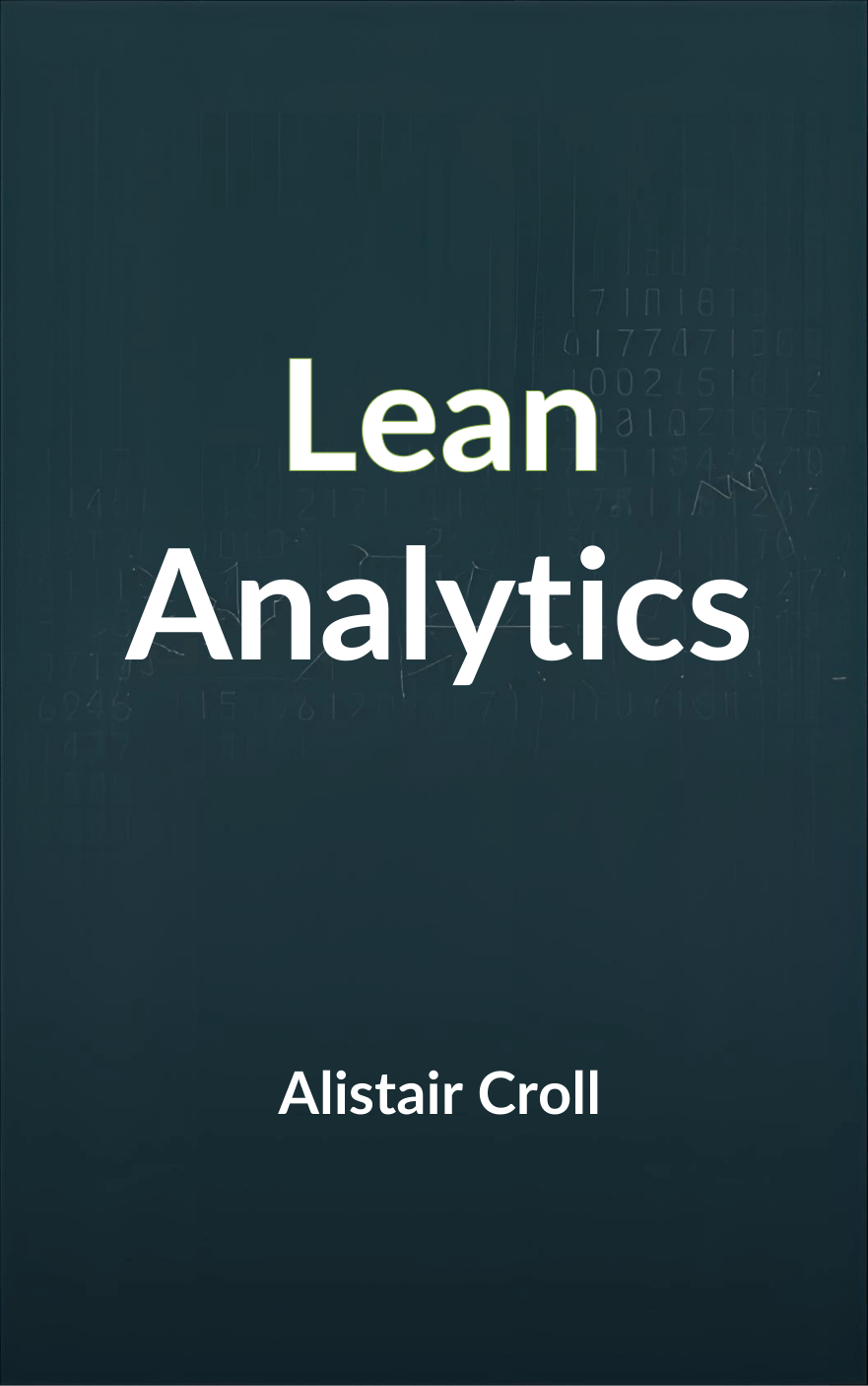
Lean Analytics Book Summary
This Lean Analytics Book Summary covers the key ideas, lessons, and takeaways in about 20 minutes.
Short Description:
Lean Analytics builds startups through rapid learning and data-driven decisions.
The book teaches that growth is not an accident; it is engineered through disciplined measurement and iteration. Companies that master data-informed experimentation are able to pivot intelligently, scale sustainably, and create products that solve meaningful problems.
Helps with these goals
Want a Free Weekly Read?
Get a free summary every week straight to your mailbox.
Preview the Lean Analytics book summary
Below is a preview of Sumizeit’s comprehensive human-written summary of Lean Analytics by Alistair Croll. The full summary is 15-20 minutes long and covers the book’s key ideas in text, audio, visual, and video formats. Unlock the full 20 Minute Summary
Startups are built on uncertainty. Founders begin with ideas, inspiration, and the confidence that their vision can transform a market. Yet that same confidence often becomes a liability when passion replaces evidence. Lean Analytics by Alistair Croll and Benjamin Yoskovitz argues that the companies most likely to succeed are not those with the most money, the biggest teams, or the most disruptive concepts, but those that learn the fastest. Data becomes the fuel that powers this learning process, shrinking the distance between assumption and reality.
Croll and Yoskovitz insist that building a successful company is an exercise in disciplined measurement. Instead of basing decisions on intuition alone, startups must validate every critical assumption with real-world feedback. Lean Analytics provides a framework that guides entrepreneurs at each stage—from understanding customer needs to scaling a working business—through the strategic use of metrics and experimentation.
The book challenges the traditional belief that startups win by polishing perfect products behind closed doors. Instead, it embraces continuous improvement driven by real customer behavior. If you cannot measure progress, you cannot improve it; if you cannot improve it, you cannot win.
Building Startups on Evidence Rather than Assumptions
One of the most common reasons startups fail is that they waste time building things people never wanted. Founders often fall in love with the solution instead of the problem. Lean Analytics teaches entrepreneurs to flip the process: first prove someone cares, then build something worth paying for.
Airbnb is one of the book’s most recognizable examples. In the company’s early years, the founders noticed that many listings were underperforming despite strong demand. They speculated that poor-quality photos made customers doubt the legitimacy of the spaces. Instead of investing immediately in expensive national photography services, they conducted a manual experiment: personally visiting hosts in New York, photographing spaces themselves, and uploading professional images to test the impact.
The result was dramatic—bookings increased significantly. The data proved the intuition, giving evidence to justify scaling the initiative. This experiment is a textbook example of how incremental testing minimizes risk and ensures resources are spent only where impact is clear. Without this data-centric approach, Airbnb may have wasted capital on assumptions or abandoned the idea prematurely.
Lean Analytics encourages startups to treat instinct not as truth, but as a hypothesis requiring validation. The process is iterative: form a theory, test it with minimal investment, observe and measure results, and either continue or change direction based on what the data reveals.
Avoiding the Trap of Vanity Metrics
A major theme in the book is the danger of metrics that look impressive but mean nothing. Many founders proudly report that they have hundreds of thousands of signups, millions of page views, or thousands of downloads. But unless these numbers drive growth, engagement, retention, or revenue, they provide a false sense of success.
For example:
A social network may boast one million registered users, but if only three percent log in weekly, the value of that audience is weak.
A mobile game might reach…
Want the complete 20-minute summary?
- Full structured summary
- Video Summary
- Podcast Summary
- Audio summary
- Key takeaways
- Exercises
- Quiz
- Highlights and notes
- Ask the book with AI
Who should read Lean Analytics?
Lean Analytics is essential for startup founders, product managers, and entrepreneurs who want to build companies based on evidence rather than intuition. If you're launching a new venture or scaling an existing one, this book provides the frameworks to make smarter decisions faster by learning from real customer data.
Why does Lean Analytics matter?
In today's fast-moving startup ecosystem, the companies that win are those that learn fastest—not those with the most funding or largest teams. Lean Analytics teaches you how to avoid the costly mistake of building products nobody wants by using disciplined measurement and rapid experimentation to validate assumptions before spending capital.
What are the key themes in Lean Analytics?
- Learning velocity as a competitive advantage
- Validating assumptions through experimentation
- Avoiding vanity metrics and focusing on actionable data
- Stage-based growth frameworks
- Model-specific metrics for different business types
- Data-driven decision making over intuition
- The One Metric That Matters at each stage
How can you apply ideas from Lean Analytics?
- Run low-cost experiments to test product hypotheses before investing heavily in development or marketing
- Replace vanity metrics with actionable ones that directly correlate to revenue, retention, or engagement
- Identify and track your One Metric That Matters for your current business stage, and revisit it as you evolve
- Use the five-stage framework (Empathy, Stickiness, Virality, Revenue, Scale) to diagnose which metrics and priorities apply right now
- Conduct customer interviews and retention analyses to achieve measurable product-market fit before scaling acquisition spend
- Analyze your specific business model metrics (churn for SaaS, viral coefficient for networks, conversion for e-commerce, etc.) rather than applying generic dashboards
- Create feedback loops where data automatically triggers prioritization decisions, removing subjective bias from resource allocation
What common mistakes do readers make with Lean Analytics?
- Celebrating vanity metrics like total signups or downloads without checking engagement or conversion rates
- Scaling marketing aggressively before achieving product-market fit, amplifying acquisition of users who don't stick
- Tracking dozens of metrics without identifying the one that matters most, leading to diffused focus and slower decisions
- Relying on intuition and passion instead of testing assumptions with real customer data before committing capital
Sumizeit Exercises Apply what you've learned
Turn ideas from Lean Analytics into action with a short guided reflection: identify the biggest takeaway, connect it to your life, and commit to one step you can take in the next 24 hours.
What is the expert analysis of Lean Analytics?
Overview
Lean Analytics, co-authored by Alistair Croll and Benjamin Yoskovitz, stands as a seminal work in the intersection of entrepreneurship, data science, and lean startup methodology. Alistair Croll, a seasoned entrepreneur and analytics expert, brings a wealth of experience in technology innovation and data-driven decision-making to this text. The book is significant for its rigorous yet accessible framework that empowers startups to navigate uncertainty through disciplined measurement and iterative learning. It challenges conventional wisdom by positing that the velocity of learning—not capital or team size—is the decisive factor in startup success.
Core Thesis
The central argument of Lean Analytics is that startups thrive by systematically validating assumptions with real-world data, thereby minimizing waste and accelerating growth. Rather than relying on intuition or vanity metrics, founders must identify and focus on the One Metric That Matters (OMTM) at each stage of their company’s evolution—whether it be customer empathy, product stickiness, virality, revenue, or scale. This disciplined approach to measurement transforms guesswork into evidence-based decision-making, enabling startups to pivot intelligently and optimize resources effectively.
Strengths
- Pragmatic Framework: The book excels in providing a clear, actionable roadmap that maps metrics to distinct stages of startup growth, making complex concepts tangible for practitioners.
- Emphasis on Learning Velocity: By foregrounding rapid experimentation and data validation, it reframes startup success as a function of learning speed rather than mere execution or funding.
- Real-World Case Studies: Use of well-known companies like Airbnb, Dropbox, Spotify, and Amazon grounds theoretical insights in concrete examples, enhancing credibility and relatability.
- Focus on Avoiding Vanity Metrics: The critique of misleading metrics encourages founders to prioritize actionable data that directly influence business outcomes.
- Adaptability Across Models: The recognition that different business models require tailored metrics demonstrates nuanced understanding of diverse startup ecosystems.
Critiques & Counterarguments
- Potential Oversimplification: While the OMTM concept is powerful, the singular focus on one metric at a time risks oversimplifying complex, multifaceted business realities where multiple indicators interact dynamically.
- Evidence Scope: The book heavily relies on success stories from tech-centric startups, which may limit applicability to industries with longer sales cycles, regulatory constraints, or less quantifiable customer behaviors.
- Lean Startup Critiques: Some scholars argue that lean methodologies can underemphasize visionary leadership and the role of qualitative insights, which are difficult to capture in metrics but critical for breakthrough innovation.
- Data Quality and Interpretation: The framework assumes access to reliable data and analytical capability; however, startups often struggle with noisy or incomplete data, which can mislead decision-making.
- Competing Schools of Thought: Alternative approaches, such as Design Thinking or Blue Ocean Strategy, prioritize creativity and market creation over iterative measurement, suggesting that not all innovation fits neatly into lean analytics paradigms.
Who Should Read This
Lean Analytics is essential reading for entrepreneurs, startup founders, product managers, and innovation leaders who seek a rigorous, data-driven approach to building scalable businesses. It is particularly valuable for those operating in fast-paced, technology-driven markets where rapid iteration and customer feedback loops are feasible. Additionally, investors and advisors can benefit from its frameworks to better evaluate startup traction and potential. However, readers from more traditional industries or those emphasizing visionary strategy over metrics may need to adapt its lessons thoughtfully.
Frequently asked questions about the Lean Analytics book summary
What is Lean Analytics about?
Lean Analytics by Alistair Croll is a guide to building successful startups through disciplined measurement and rapid experimentation. The book argues that the companies most likely to win are those that learn fastest by validating assumptions with real customer data rather than betting on intuition alone.
Who should read Lean Analytics?
Lean Analytics is essential for startup founders, product managers, entrepreneurs, and anyone building or scaling a new business. It's also valuable for leaders in established companies who want to adopt data-driven decision-making and reduce waste.
What are the main takeaways from Lean Analytics?
The core insights are: (1) learning velocity beats resources, (2) validate assumptions through low-cost experiments before scaling, (3) focus on actionable metrics instead of vanity metrics, (4) follow stage-specific frameworks (Empathy, Stickiness, Virality, Revenue, Scale), and (5) tailor metrics to your business model rather than using universal dashboards.
What is the One Metric That Matters (OMTM)?
The One Metric That Matters is a single focus metric chosen for each stage of your business to maintain clarity and alignment. It changes as you evolve—from customer interviews in Empathy to retention in Stickiness to referral rate in Virality to CLV:CAC ratio in Revenue.
How do you identify vanity metrics versus actionable metrics?
Vanity metrics look impressive but don't drive real growth (like total signups or page views), while actionable metrics directly impact revenue, retention, or engagement (like conversion rate, weekly active users, or churn rate). Ask: does this metric change my decisions or strategy?
What are the five stages of Lean Analytics?
The five stages are Empathy (understanding customer pain deeply), Stickiness (proving ongoing engagement), Virality (measuring organic word-of-mouth), Revenue (establishing profitable monetization), and Scale (optimizing operations and market expansion). Each requires different metrics and strategies.
How does Airbnb's photography experiment illustrate Lean Analytics principles?
Airbnb tested the hypothesis that poor photos hurt bookings by manually photographing listings in New York and measuring the impact. This low-cost experiment provided data justifying scaled investment, exemplifying how to validate assumptions before spending capital.
Why is churn rate critical for SaaS companies?
In SaaS, if customers leave faster than you acquire new ones, growth becomes impossible regardless of how much you spend on marketing. Churn rate is often the most important metric because it directly determines whether the business model is sustainable.
About Sumizeit
Sumizeit is a profitable Scomy LLC company based in Miami, Florida. Our founders, Clemens Raemy and Weina Scott, are successful entrepreneurs with several exits. Sumizeit is a popular book summary app / micro learning app used by busy professionals and entrepreneurs with over 2,500 non-fiction book summaries and 10,000 podcast summaries in text, audio, visual, podcast, and video format. We also have stellar retention tools to make ideas stick - such as flashcards with spaced repetition, quizzes, streaks, highlighting and notes, daily challenges, riddles, mini-courses, meditation, and more. You won't only learn the idea, but also remember it. Over 90% of our users change their habits with Sumizeit.
Upgrade Now
Here's why readers love Sumizeit
Join thousands of learners getting smarter every day
"Great experience. Detailed summaries. Loved the gamification feature. Makes learning fun. Good customer service. I recommend Sumizeit to anyone. You'll learn a lot."
"I always felt busy but still wanting to keep up with the book discussion in my friend group. This was a great supplement to help me keep reading the books I find fun while keeping up with important books."
"I love this website. Instead of scrolling social media, I find myself learning a lot. I use it everyday. I recommend this app for anyone who is too busy and wants to get up to speed with their favorite books."
Lean Analytics Book Summary PDF
Looking for a Lean Analytics Book Summary PDF you can save and revisit offline? Our Lean Analytics Book Summary PDF captures the book’s core ideas in a clean, printable format — the key frameworks, takeaways, and structure without the fluff. Download the Lean Analytics Book Summary PDF when you want a reference you can annotate, share with your team, or review on the go. Get your Lean Analytics Book Summary PDF from the download page below.
Download Lean Analytics Book Summary PDFPeople also liked these summaries
Readers who explored Lean Analytics often enjoyed these titles next.

Ready to read the whole thing?
- Full structured summary
- Video Summary
- Podcast Summary
- Audio summary
- Key takeaways
- Exercises
- Quiz
- Highlights and notes
- Ask the book with AI
Featured Book Titles
Popular Book Summaries at sumizeit, leading book summary app