


Prefer the print book? Buy on Amazon
As an Amazon Associate, Sumizeit earns from qualifying purchases.
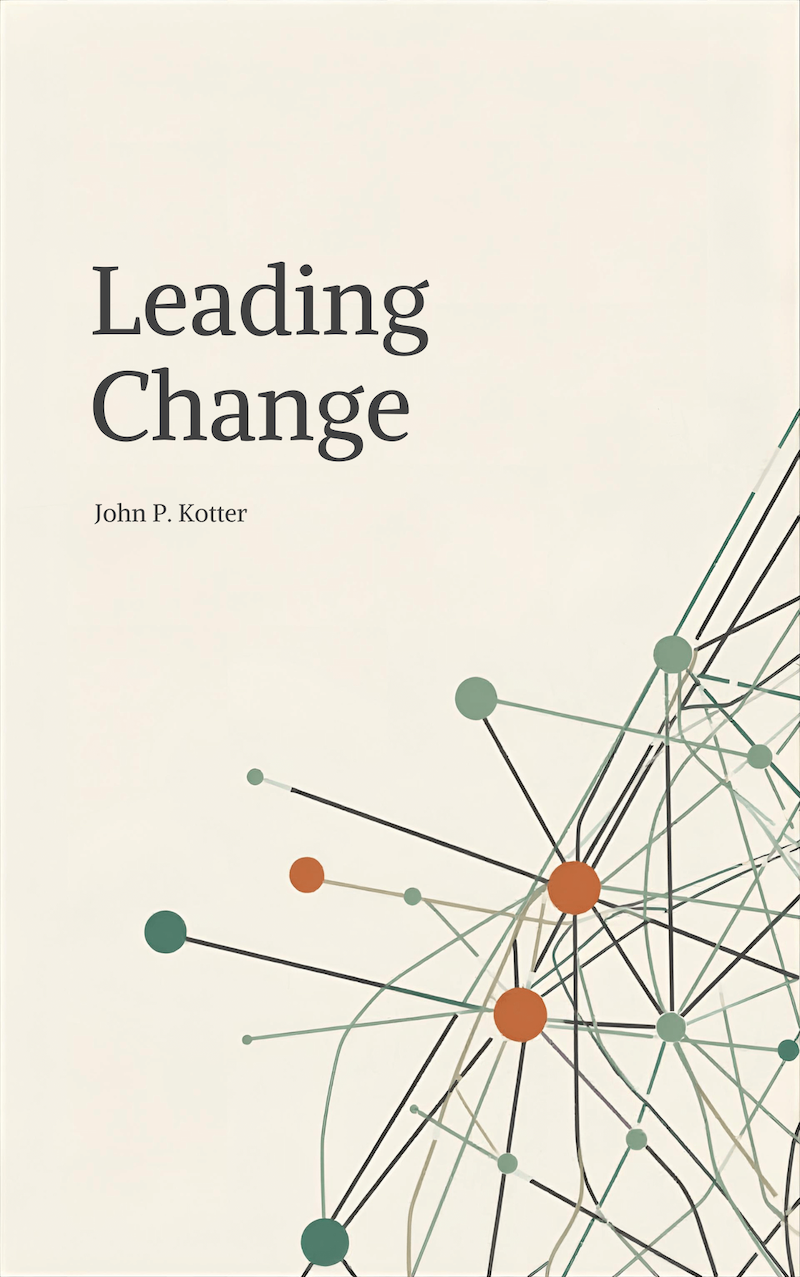
Leading Change Book Summary
This Leading Change Book Summary covers the key ideas, lessons, and takeaways in about 20 minutes.
Short Description:
A practical, easy guide to leading lasting organizational change.
Kotter ultimately shows that lasting change is not a project—it is a journey that reshapes how people think, behave, and lead. Organizations that master change do not chase stability; they build the capacity to evolve continuously. By aligning urgency, leadership coalitions, vision, action, and culture, leaders can transform uncertainty from a threat into an advantage.
Helps with these goals
Want a Free Weekly Read?
Get a free summary every week straight to your mailbox.
Preview the Leading Change book summary
Below is a preview of Sumizeit’s comprehensive human-written summary of Leading Change by John P. Kotter. The full summary is 15-20 minutes long and covers the book’s key ideas in text, audio, visual, and video formats. Unlock the full 20 Minute Summary
Kotter begins from a blunt reality: stability is no longer a safe position for organizations. Economic globalization, technological acceleration, and shifting customer expectations mean that standing still is equivalent to falling behind. Companies that once succeeded by refining existing processes now face competitors that rewrite the rules entirely. In this environment, improvement is not enough—reinvention becomes essential.
Kotter argues that many organizations confuse operational excellence with adaptability. They may optimize costs, tighten controls, and increase efficiency, yet still fail when markets shift. The reason is simple: management systems are designed to preserve order, while change requires disruption. When organizations rely too heavily on control, predictability, and hierarchy, they unintentionally smother the very forces that allow them to evolve.
The book’s central claim is that sustained transformation depends on leadership rather than administration. Leadership, in Kotter’s framing, is not tied to job titles. It is the capacity to set direction, energize people, and guide an organization through uncertainty. Without leadership, even well-funded change initiatives collapse under resistance, fear, and inertia.
The Invisible Enemy: Comfort and False Security
One of the most dangerous barriers to transformation is complacency. Kotter describes complacency as a psychological state in which people believe that current success guarantees future safety. When profits are stable and crises are absent, employees and executives alike convince themselves that change is unnecessary or risky.
This mindset often arises from past victories. Organizations that have “won before” assume they will win again using the same strategies. Over time, warning signs—new competitors, customer dissatisfaction, technological shifts—are rationalized away. Leaders point to today’s numbers rather than tomorrow’s threats.
Kotter emphasizes that the absence of disaster does not indicate health. Many organizations fail not because they ignore a crisis, but because they wait for one. By the time survival feels urgent, options are limited, morale is low, and trust in leadership has eroded.
Breaking through complacency requires confronting uncomfortable truths. Leaders must surface inconvenient data, openly discuss threats, and challenge comforting assumptions. This is emotionally difficult work, as it destabilizes identities built around success. Yet without discomfort, momentum never begins.
Creating Emotional Momentum Instead of Logical Arguments
A recurring theme in the book is that facts alone rarely move people. Charts, projections, and financial models may convince the rational mind, but change requires emotional commitment. Kotter argues that transformation starts when people feel that remaining the same is more dangerous than changing.
Effective leaders therefore frame change as a matter of urgency rather than optimization. They tell stories, highlight customer pain, expose competitive risks, and make threats visible and personal. The goal is not panic, but alertness—a shared recognition that action is required now, not later.
Symbolic actions play a powerful role here. When executives make visible sacrifices—cutting privileges, redirecting budgets, or altering long-standing traditions—they send a message that the situation is serious. These gestures communicate urgency far more effectively than speeches or emails.
Urgency, Kotter notes, must be sustained rather than sparked once. If leaders relax after initial buy-in, old habits quickly return.
Want the complete 20-minute summary?
- Full structured summary
- Video Summary
- Podcast Summary
- Audio summary
- Key takeaways
- Exercises
- Quiz
- Highlights and notes
- Ask the book with AI
Who should read Leading Change?
Leading Change is essential for executives, managers, and organizational leaders who face pressure to transform their companies in rapidly shifting markets. It is equally valuable for anyone in a position to influence change—from project managers to team leads—who want to understand why change initiatives often fail and how to lead them successfully. If you work in an organization struggling with resistance to new initiatives or competing priorities, this book provides a roadmap for moving people, not just processes.
Why does Leading Change matter?
In today's world, stability is a liability. Economic disruption, technological acceleration, and evolving customer expectations mean that organizations that fail to change will eventually fail entirely. Yet most change initiatives collapse under resistance, miscommunication, and poor leadership—not lack of resources or intelligence. John P. Kotter's Leading Change cuts through the noise by explaining that transformation is fundamentally a human challenge, not a technical one, making it indispensable for leaders navigating constant disruption.
What are the key themes in Leading Change?
- Transformation requires leadership, not just management
- Complacency is the silent killer of organizations
- Emotional commitment drives change more than logical arguments
- Guiding coalitions are more effective than lone heroes
- Vision must be clear yet flexible enough to guide daily behavior
- Short-term wins sustain momentum during long transformations
- Cultural integration is the final and most critical stage
- Change is a continuous journey, not a one-time project
How can you apply ideas from Leading Change?
- Audit your organization for complacency signals—stable profits, absence of recent crises, or dismissal of competitive threats—and use this data to create genuine urgency before a crisis forces change
- Form a guiding coalition by identifying influential people across functions and levels who have both authority and credibility, then give them real decision-making power and resources
- Craft a clear vision statement that balances ambition with plausibility, then translate it into simple language that employees can use to evaluate their daily work
- Replace one-way communication with structured dialogue—town halls, small group discussions, and feedback sessions—that invite questions and address concerns directly
- Identify and eliminate structural barriers such as misaligned incentives, outdated processes, or reporting lines that prevent people from adopting new behaviors
- Define and celebrate short-term wins that are meaningful and linked to your vision, then use recognition and visibility to reinforce desired behaviors
- Assess your talent pipeline and hiring criteria to ensure you are bringing in people who align with your transformation vision and values, not just skills
What common mistakes do readers make with Leading Change?
- Waiting for a crisis to force change instead of creating urgency during stable times, which leaves fewer options and erodes trust when transformation finally becomes necessary
- Relying on logical arguments and data alone to convince people, forgetting that emotional commitment drives change more powerfully than spreadsheets
- Attempting to lead transformation alone or through a powerless committee, rather than building a coalition with genuine influence and decision-making authority
- Declaring victory too early after initial wins, which allows complacency to return and old habits to resurface before change is embedded in culture
- Trying to change culture through mandates and messaging before behaviors have shifted, when culture actually emerges from consistent experience of new ways of working
- Ignoring resistance instead of addressing it directly, which signals that the change is optional and allows skeptics to undermine momentum
Sumizeit Exercises Apply what you've learned
Turn ideas from Leading Change into action with a short guided reflection: identify the biggest takeaway, connect it to your life, and commit to one step you can take in the next 24 hours.
What is the expert analysis of Leading Change?
Overview
Leading Change by John P. Kotter stands as a seminal work in the field of organizational transformation and leadership. Kotter, a distinguished Harvard Business School professor and a globally recognized expert on leadership, offers a rigorous, experience-based framework for understanding why change efforts often falter and how they can succeed. Published in the late 20th century but enduring in relevance, the book addresses the pressing challenges organizations face in an era marked by rapid globalization, technological disruption, and shifting market dynamics. Kotter’s synthesis of academic insight and practical application has made this text a cornerstone for leaders, managers, and scholars seeking to navigate and orchestrate complex change.
Core Thesis
Kotter’s central argument is that successful and sustained organizational transformation hinges on leadership rather than mere management or administration. He posits that traditional management systems—focused on control, order, and efficiency—are ill-equipped to handle the disruptive nature of change. Instead, leadership must create a compelling sense of urgency, build guiding coalitions, craft and communicate a clear vision, remove barriers, generate short-term wins, and embed new behaviors into the organizational culture. Crucially, Kotter emphasizes the emotional and social dimensions of change, arguing that logical arguments alone cannot overcome complacency or resistance. Transformation is a continuous journey requiring collective effort and adaptive leadership rather than isolated heroic acts.
Strengths
- Comprehensive and Practical Framework: Kotter’s eight-step process provides a clear, actionable roadmap that balances strategic vision with operational detail, making it accessible to practitioners across industries.
- Human-Centered Approach: The book’s focus on emotional momentum, overcoming complacency, and the social dynamics of coalitions addresses the oft-overlooked psychological barriers to change.
- Integration of Culture and Leadership Development: By underscoring that culture change follows behavioral change and that leadership capacity must be cultivated, Kotter connects transformation to long-term organizational resilience.
- Timeless Relevance: Despite changes in technology and market conditions, the principles of urgency, vision, coalition-building, and embedding change remain foundational for contemporary change management.
- Emphasis on Interconnectedness: Kotter’s recognition of the systemic and networked nature of modern organizations encourages a holistic perspective that anticipates ripple effects across functions and stakeholders.
Critiques & Counterarguments
- Potential Oversimplification of Complex Change: While Kotter’s eight-step model is elegant, real-world transformations often involve nonlinear, iterative, and emergent processes that may not fit neatly into sequential phases.
- Limited Attention to Power Dynamics and Politics: The framework somewhat underplays the role of organizational politics, conflicting interests, and power struggles that can decisively shape change outcomes.
- Evidence Base and Empirical Validation: Some critics argue that Kotter’s conclusions, while grounded in extensive observation, rely heavily on anecdotal examples rather than rigorous empirical studies, limiting generalizability.
- Competing Theories of Change: Alternative models, such as complexity theory and adaptive leadership, emphasize emergent change and decentralized decision-making more strongly, challenging Kotter’s structured approach.
- Risk of Leadership-Centric Bias: By focusing predominantly on leadership qualities and actions, the model may underemphasize systemic constraints and the role of broader socio-economic forces beyond managerial control.
Who Should Read This
Leading Change is essential reading for senior executives, organizational leaders, change agents, and consultants who are responsible for guiding transformation initiatives. It is equally valuable for scholars and students of leadership and organizational behavior seeking a foundational understanding of change dynamics. The book’s blend of theoretical insight and practical guidance makes it particularly useful for those operating in volatile, complex environments where adaptability is critical. Additionally, its emphasis on emotional and cultural factors offers profound lessons for anyone interested in the human side of organizational life and the challenges of mobilizing collective action.
Frequently asked questions about the Leading Change book summary
What is Leading Change about?
Leading Change by John P. Kotter is a framework for understanding why organizational transformations fail and how to lead them successfully. The book argues that transformation is fundamentally a human and emotional challenge, not merely a technical or strategic one, and provides an eight-step process for guiding organizations through sustained change by building urgency, creating vision, forming coalitions, and embedding new behaviors into culture.
Who should read Leading Change?
Leading Change is essential for executives, managers, and organizational leaders responsible for driving transformation. It is also valuable for project managers, team leads, and anyone in a position to influence organizational behavior who wants to understand why change initiatives often fail and how to increase the likelihood of success.
What are the main takeaways from Leading Change?
The core takeaways are that transformation requires leadership over management, that emotional commitment matters more than logical arguments, that guiding coalitions are more effective than lone heroes, and that change is a continuous journey that must reshape culture to be truly lasting. Kotter emphasizes that organizations fail not from lack of resources but from underestimating the human side of change.
How does Kotter define a guiding coalition?
A guiding coalition is a group of influential individuals with sufficient authority, credibility, and expertise to lead transformation together. It must include both formal leaders and respected informal influencers, have real decision-making power and resource allocation authority, and operate with internal trust and alignment to send consistent messages and maintain credibility.
Why does Kotter emphasize creating urgency?
Kotter argues that without genuine urgency, people will not commit to the difficult work of change. Complacency—the belief that current success guarantees future safety—is the silent enemy. Leaders must surface inconvenient truths and create emotional recognition that change is necessary now, not as an optional improvement.
What role do short-term wins play in Leading Change?
Short-term wins sustain momentum during long transformations by providing visible evidence that effort is working and sacrifices are worthwhile. They maintain energy and credibility, reward contributors, and reinforce desired behaviors. However, Kotter warns against declaring victory too early, as premature success can breed complacency.
How does culture change according to Kotter?
Culture changes not through mandates or messaging, but when new behaviors consistently produce better results and are visibly rewarded over time. People believe what they experience, not what they are told. Cultural change comes last in the transformation journey, after behaviors have shifted and new ways of working have proven effective.
Why does Kotter say management and leadership are different?
Management systems are designed to preserve order and efficiency, while leadership involves setting direction and motivating people through uncertainty. Both are necessary, but transformation cannot happen without strong leadership that challenges the status quo and disrupts existing patterns, something management systems actively resist.
About Sumizeit
Sumizeit is a profitable Scomy LLC company based in Miami, Florida. Our founders, Clemens Raemy and Weina Scott, are successful entrepreneurs with several exits. Sumizeit is a popular book summary app / micro learning app used by busy professionals and entrepreneurs with over 2,500 non-fiction book summaries and 10,000 podcast summaries in text, audio, visual, podcast, and video format. We also have stellar retention tools to make ideas stick - such as flashcards with spaced repetition, quizzes, streaks, highlighting and notes, daily challenges, riddles, mini-courses, meditation, and more. You won't only learn the idea, but also remember it. Over 90% of our users change their habits with Sumizeit.
Upgrade Now
Here's why readers love Sumizeit
Join thousands of learners getting smarter every day
"Great experience. Detailed summaries. Loved the gamification feature. Makes learning fun. Good customer service. I recommend Sumizeit to anyone. You'll learn a lot."
"I always felt busy but still wanting to keep up with the book discussion in my friend group. This was a great supplement to help me keep reading the books I find fun while keeping up with important books."
"I love this website. Instead of scrolling social media, I find myself learning a lot. I use it everyday. I recommend this app for anyone who is too busy and wants to get up to speed with their favorite books."
Leading Change Book Summary PDF
Looking for a Leading Change Book Summary PDF you can save and revisit offline? Our Leading Change Book Summary PDF captures the book’s core ideas in a clean, printable format — the key frameworks, takeaways, and structure without the fluff. Download the Leading Change Book Summary PDF when you want a reference you can annotate, share with your team, or review on the go. Get your Leading Change Book Summary PDF from the download page below.
Download Leading Change Book Summary PDFPeople also liked these summaries
Readers who explored Leading Change often enjoyed these titles next.


Ready to read the whole thing?
- Full structured summary
- Video Summary
- Podcast Summary
- Audio summary
- Key takeaways
- Exercises
- Quiz
- Highlights and notes
- Ask the book with AI
Featured Book Titles
Popular Book Summaries at sumizeit, leading book summary app