


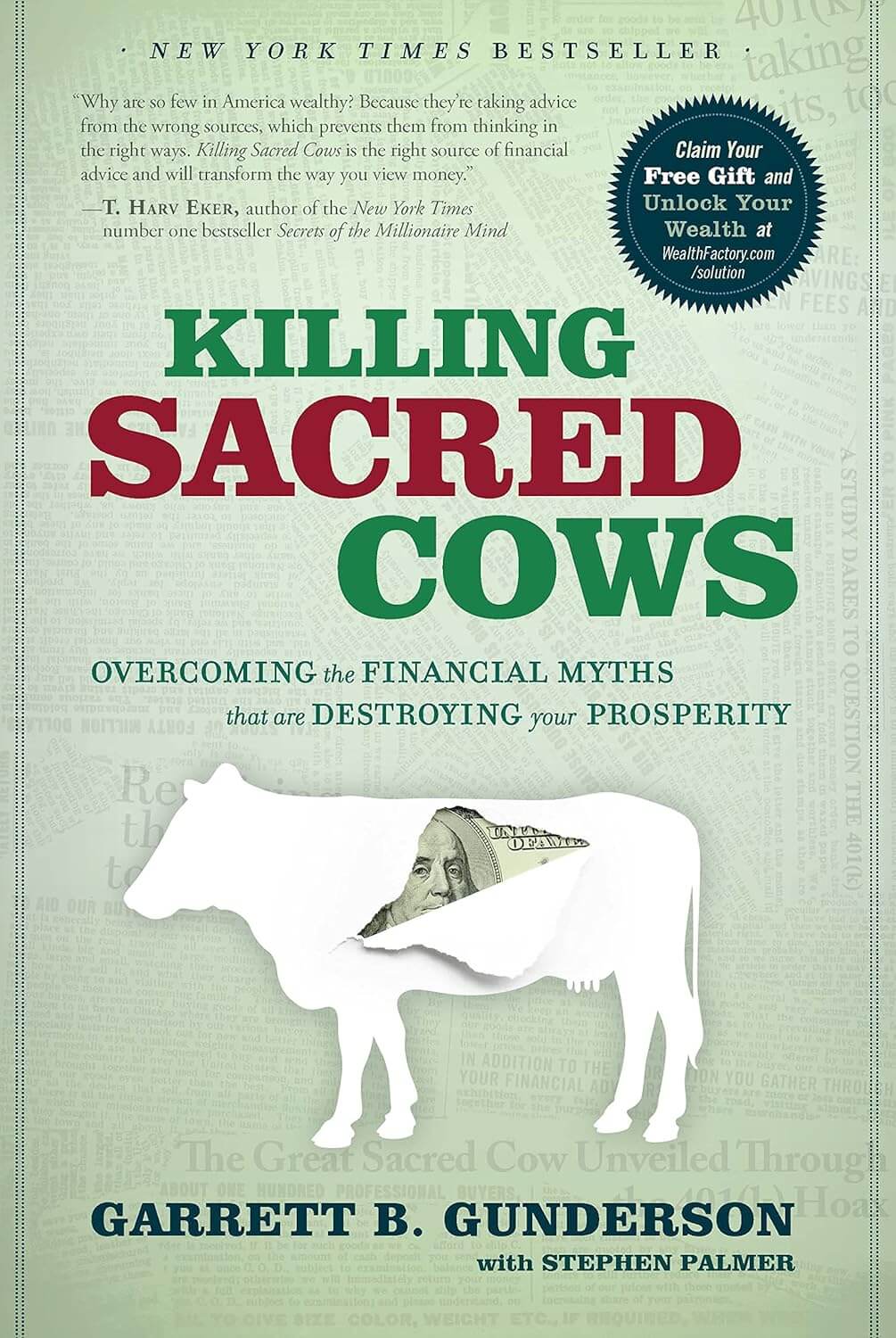
Prefer the print book? Buy on Amazon
As an Amazon Associate, Sumizeit earns from qualifying purchases.
Killing Sacred Cows Book Summary
This Killing Sacred Cows Book Summary covers the key ideas, lessons, and takeaways in about 20 minutes.
Short Description:
Killing Sacred Cows challenges financial myths and promotes value creation.
Gunderson’s central message is that wealth is not primarily built by extreme frugality, blind retirement accumulation, or rigid debt avoidance. Wealth is built by creating value for others, investing in your capacity to produce, and structuring your finances around control and cash flow.
He encourages you to replace scarcity thinking with a creative mindset: instead of fighting over limited resources, focus on producing solutions people care about and building systems that generate ongoing income.
For retirement, he argues the goal shouldn’t just be a large account balance—it should be sustainable cash flow that funds your life without fear. For debt, he argues the question isn’t “is debt bad?” but “does this debt increase assets and future income or drain them?” For investing, he argues that education and understanding reduce risk more effectively than simply avoiding opportunity.
Ultimately, Gunderson wants you to stop worshiping financial slogans and start building a financial strategy that buys you the thing money is supposed to buy: freedom.
Helps with these goals
Preview the Killing Sacred Cows book summary
Below is a preview of Sumizeit’s comprehensive human-written summary of Killing Sacred Cows by Garrett B. Gunderson . The full summary is 15-20 minutes long and covers the book’s key ideas in text, audio, visual, and video formats. Unlock the full 20 Minute Summary
Killing Sacred Cows is built around a simple idea: lots of people follow financial advice that sounds responsible, gets repeated everywhere, and feels morally “right”—but still doesn’t produce real freedom.
Garrett B. Gunderson argues that certain financial beliefs become unquestionable. People treat them like universal laws: max out retirement accounts, avoid debt at all costs, save relentlessly, and assume the future will take care of itself if you follow the standard plan. He calls these beliefs “sacred cows,” and his goal is to challenge them—not to be provocative for fun, but to show how they can quietly limit your choices, your wealth, and your quality of life.
Rather than teaching one rigid system, the book tries to change how you evaluate financial decisions. Gunderson pushes you to stop asking, “Is this what people say I should do?” and start asking, “Does this increase my freedom, cash flow, control, and ability to create value?”
At its core, the book argues that wealth isn’t primarily created by restricting your life and hoarding money. It’s created by producing value for others, building income streams, and structuring your finances so your money supports your life—not the other way around.
The Big Shift: Moving From Scarcity to Creation
Gunderson begins by challenging a scarcity-based view of money.
Many people unconsciously treat wealth as limited—like there’s only so much to go around. When you believe that, money becomes something you protect obsessively. Every purchase feels dangerous, every investment feels like a gamble, and other people’s success can feel like a threat.
He argues that this mindset is the root of many self-defeating financial habits because it trains you to play defense forever.
The alternative he promotes is a creation-based mindset:
Wealth expands when people solve problems.
Value can be created endlessly because human needs and preferences keep evolving.
You increase your wealth by creating value that others willingly exchange money for.
This shift matters because it turns money from a scarce resource you chase into a tool you use to create a better life.
How Scarcity Thinking Warps Financial Behavior
Gunderson claims scarcity thinking produces behaviors that look “disciplined,” but often reduce both wealth and happiness.
There’s a difference between mindful spending and refusing to invest in things that improve your ability to produce.
If you constantly avoid spending—even on tools, education, support, or systems—you may protect your bank balance while shrinking your capacity to earn.
Examples of capacity-boosting spending include:
upgrading equipment that improves output or reliability
paying for coaching or training that increases income potential
outsourcing low-value tasks so you can focus on higher-value work
investing in systems that reduce time waste and mistakes
Gunderson’s point is that some expenses aren’t “costs.” They’re multipliers.
A scarcity mindset can make you so cautious that you stop seeing opportunities.
When you’re focused on preserving what you have, you become risk-averse by default. You say no to collaborations, no to investments in growth, no to new ideas—because your brain is trained to protect the present rather than…
Want the complete 20-minute summary?
- Full structured summary
- Video Summary
- Podcast Summary
- Audio summary
- Key takeaways
- Exercises
- Quiz
- Highlights and notes
- Ask the book with AI
Who should read Killing Sacred Cows?
Killing Sacred Cows is for anyone who feels trapped by conventional financial advice—those who follow all the rules (max retirement accounts, avoid debt, save aggressively) yet still lack real freedom and control. It's ideal for entrepreneurs, business owners, and people who question whether the standard path actually leads to the life they want.
Why does Killing Sacred Cows matter?
Most financial advice treats wealth as something you protect rather than create, leaving people stuck in scarcity thinking and self-defeating habits. Garrett B. Gunderson's book matters because it reframes the conversation: true financial freedom comes from building capacity, creating value, and generating cash flow—not from following rigid rules that prioritize fear over opportunity.
What are the key themes in Killing Sacred Cows?
- Shift from scarcity mindset to creation mindset
- Wealth creation through value production, not just saving
- Investing in personal capacity as your most important asset
- Strategic debt versus destructive debt
- Cash flow and freedom over passive accumulation
- Financial intelligence and control reduce risk more than avoidance
- Challenging sacred cows in retirement and investing
How can you apply ideas from Killing Sacred Cows?
- Audit your spending and identify which expenses multiply your earning power versus which ones merely protect your comfort
- Develop a specific high-income skill or area of expertise that increases the value you can create for others
- Build at least one cash-flowing asset or income stream independent of your primary job
- Evaluate any debt you carry by asking whether it funds growth or consumption, then restructure accordingly
- Create a personal development plan focused on sales, negotiation, business understanding, or technical skills that directly improve earning potential
- Design a retirement strategy around sustainable cash flow rather than a single accumulation target
- Establish relationships with mentors and peers who model wealth creation and challenge your financial assumptions
What common mistakes do readers make with Killing Sacred Cows?
- Treating all debt as equally harmful rather than evaluating whether it builds or destroys assets and income
- Confusing frugality with wisdom, cutting spending on capacity-building investments that would dramatically improve earning power
- Believing that following the standard financial plan guarantees freedom, when it often leaves people psychologically unable to enjoy their savings
- Assuming risk lives in specific investments rather than in your lack of knowledge and control over what you own
Sumizeit Exercises Apply what you've learned
Turn ideas from Killing Sacred Cows into action with a short guided reflection: identify the biggest takeaway, connect it to your life, and commit to one step you can take in the next 24 hours.
What is the expert analysis of Killing Sacred Cows?
Overview
Killing Sacred Cows by Garrett B. Gunderson stands as a provocative critique of entrenched financial orthodoxies that dominate mainstream personal finance discourse. Gunderson, a financial author and entrepreneur, challenges the conventional wisdom that equates wealth accumulation with rigid saving, debt aversion, and passive retirement planning. Instead, he advocates for a paradigm shift toward value creation, cash flow generation, and financial freedom grounded in control and understanding. This book is significant because it disrupts the moralistic narratives around money that often limit individuals’ financial potential and psychological well-being.
Core Thesis
The central insight of Killing Sacred Cows is that many widely accepted financial “rules” function as unquestioned sacred cows that inadvertently constrain freedom rather than enhance it. Gunderson argues that wealth is not primarily built through scarcity, frugality, or rigid adherence to traditional retirement saving, but through actively creating value for others, investing in one’s capacity to produce, and structuring finances to prioritize cash flow and control. He reframes money as a tool for creative expansion rather than a scarce resource to be guarded, urging readers to replace defensive scarcity thinking with an entrepreneurial mindset focused on growth and opportunity.
Strengths
- Challenging Conventional Wisdom: Gunderson’s critique of standard financial advice is both timely and necessary, exposing how moralistic financial dogma can hinder wealth-building and personal freedom.
- Emphasis on Value Creation: By centering wealth on producing meaningful value and scalable income streams, the book offers a dynamic and actionable framework that aligns with entrepreneurial and modern financial realities.
- Psychological Insight: The exploration of scarcity mindset’s psychological traps—such as excessive frugality and fear-driven risk aversion—adds depth beyond mere financial mechanics, addressing emotional and behavioral dimensions.
- Practical Nuance on Debt and Risk: Gunderson’s distinction between destructive and strategic debt, and his argument that risk is mitigated through knowledge and control rather than avoidance, provide a refreshing, nuanced perspective often missing in personal finance literature.
- Holistic Approach: The integration of personal development, financial intelligence, and protection strategies (like insurance) presents a comprehensive vision of sustainable wealth-building.
Critiques & Counterarguments
- Evidence and Empirical Support: While the book’s ideas are compelling, it relies heavily on conceptual arguments and anecdotal examples rather than robust empirical data or rigorous case studies to substantiate claims about the superiority of value creation over traditional saving strategies.
- Oversimplification of Scarcity vs. Creation: The dichotomy between scarcity and creation mindsets, though useful, risks oversimplifying complex financial behaviors and economic realities where scarcity constraints are real and impactful for many individuals.
- Limited Attention to Structural Factors: Gunderson’s focus on individual mindset and behavior underemphasizes systemic economic factors—such as wage stagnation, market volatility, and unequal access to capital—that can limit value creation opportunities regardless of mindset.
- Contrasting Schools of Thought: Traditional financial planners emphasize diversification, risk mitigation through passive investing, and disciplined saving precisely because these strategies have proven effective for broad populations; Gunderson’s entrepreneurial approach may not suit all risk tolerances or life circumstances.
- Potential for Overemphasis on Self-Investment: While investing in personal capacity is valuable, critics might argue that the book underestimates the risks and opportunity costs involved, especially for those without access to quality education or networks.
Who Should Read This
Killing Sacred Cows is ideally suited for readers who are financially literate but dissatisfied with conventional advice and eager to rethink their relationship with money. Entrepreneurs, investors, and professionals seeking to move beyond scarcity-driven financial habits toward a more creative, control-oriented approach will find Gunderson’s insights particularly resonant. Additionally, those interested in the psychological dimensions of wealth and the interplay between mindset and financial outcomes will appreciate the book’s nuanced perspective. However, readers looking for prescriptive, step-by-step investment plans or those with highly risk-averse profiles may need to supplement this book with more traditional financial guidance.
Frequently asked questions about the Killing Sacred Cows book summary
What is Killing Sacred Cows about?
Killing Sacred Cows by Garrett B. Gunderson challenges conventional financial advice that sounds responsible but doesn't create real freedom. The book argues that wealth is built through creating value and generating cash flow, not through extreme frugality, rigid debt avoidance, and passive accumulation. Gunderson reframes how you should evaluate financial decisions: instead of asking what you're supposed to do, ask what increases your freedom, control, and ability to create value.
Who should read Killing Sacred Cows?
Killing Sacred Cows is ideal for entrepreneurs, business owners, and anyone who feels constrained by conventional financial wisdom despite following all the rules. It's for people questioning whether maxing retirement accounts, avoiding all debt, and saving aggressively actually leads to freedom. The book appeals to those ready to challenge assumptions and build wealth through creation rather than restriction.
What are the main takeaways from Killing Sacred Cows?
The main takeaways from Killing Sacred Cows include: shift from scarcity thinking to a creation mindset focused on producing value; invest in your capacity and skills as your most important asset; evaluate debt by whether it builds or destroys wealth rather than treating it as categorically bad; build cash flow and multiple income streams instead of relying on a single retirement account; use financial intelligence and control to reduce risk more effectively than avoiding opportunities; and structure your finances around freedom and quality of life rather than fear-driven rules.
How does Garrett B. Gunderson define financial freedom?
In Killing Sacred Cows, Gunderson defines financial freedom as having control, cash flow, and the ability to create value without constant anxiety or the burden of rigid plans. True freedom comes from multiple sustainable income streams and understanding how your money works, not from accumulating a large balance and then hoping you can finally spend it. Freedom is the thing money is supposed to buy—the ability to live according to your priorities without fear.
What does Killing Sacred Cows say about debt?
Killing Sacred Cows distinguishes between destructive debt (borrowing for consumption and lifestyle) and strategic debt (borrowing to acquire assets or build businesses that generate income). Gunderson argues that debt should be evaluated by its function and impact, not treated as universally wrong. Used deliberately to increase wealth-producing assets, strategic debt can accelerate financial growth when structured responsibly.
Why does Killing Sacred Cows challenge the traditional retirement model?
Gunderson challenges traditional retirement because it relies on assumptions that rarely hold in real life: uninterrupted employment, steady contributions, predictable growth, and the ability to spend freely after decades of hoarding. Even when the plan works mathematically, many people struggle psychologically to enjoy their savings. Killing Sacred Cows argues the goal should be sustainable cash flow, not just a large account balance.
What role does personal development play in Killing Sacred Cows?
In Killing Sacred Cows, personal development—skills, knowledge, relationships, and judgment—is treated as your most important asset and permanent portfolio. These investments compound over time and often outpace passive saving in terms of earning power. Gunderson emphasizes practical investments in sales, negotiation, technical skills, and business understanding as ways to directly expand the wealth you can create.
How does Killing Sacred Cows define value and value creation?
In Killing Sacred Cows, value isn't fixed inside objects—it comes from people and what they need, want, or care about solving. Wealth grows when you identify problems people genuinely care about, create solutions they recognize as meaningful, deliver those solutions reliably, and structure them to scale. This reframes wealth creation from scarcity (fighting over limited resources) to abundance (producing solutions that serve others).
About Sumizeit
Sumizeit is a profitable Scomy LLC company based in Miami, Florida. Our founders, Clemens Raemy and Weina Scott, are successful entrepreneurs with several exits. Sumizeit is a popular book summary app / micro learning app used by busy professionals and entrepreneurs with over 2,500 non-fiction book summaries and 10,000 podcast summaries in text, audio, visual, podcast, and video format. We also have stellar retention tools to make ideas stick - such as flashcards with spaced repetition, quizzes, streaks, highlighting and notes, daily challenges, riddles, mini-courses, meditation, and more. You won't only learn the idea, but also remember it. Over 90% of our users change their habits with Sumizeit.
Upgrade Now
Here's why readers love Sumizeit
Join thousands of learners getting smarter every day
"Great experience. Detailed summaries. Loved the gamification feature. Makes learning fun. Good customer service. I recommend Sumizeit to anyone. You'll learn a lot."
"I always felt busy but still wanting to keep up with the book discussion in my friend group. This was a great supplement to help me keep reading the books I find fun while keeping up with important books."
"I love this website. Instead of scrolling social media, I find myself learning a lot. I use it everyday. I recommend this app for anyone who is too busy and wants to get up to speed with their favorite books."
Killing Sacred Cows Book Summary PDF
Looking for a Killing Sacred Cows Book Summary PDF you can save and revisit offline? Our Killing Sacred Cows Book Summary PDF captures the book’s core ideas in a clean, printable format — the key frameworks, takeaways, and structure without the fluff. Download the Killing Sacred Cows Book Summary PDF when you want a reference you can annotate, share with your team, or review on the go. Get your Killing Sacred Cows Book Summary PDF from the download page below.
Download Killing Sacred Cows Book Summary PDFPeople also liked these summaries
Readers who explored Killing Sacred Cows often enjoyed these titles next.



Ready to read the whole thing?
- Full structured summary
- Video Summary
- Podcast Summary
- Audio summary
- Key takeaways
- Exercises
- Quiz
- Highlights and notes
- Ask the book with AI
Featured Book Titles
Popular Book Summaries at sumizeit, leading book summary app