
Question 1 of 10


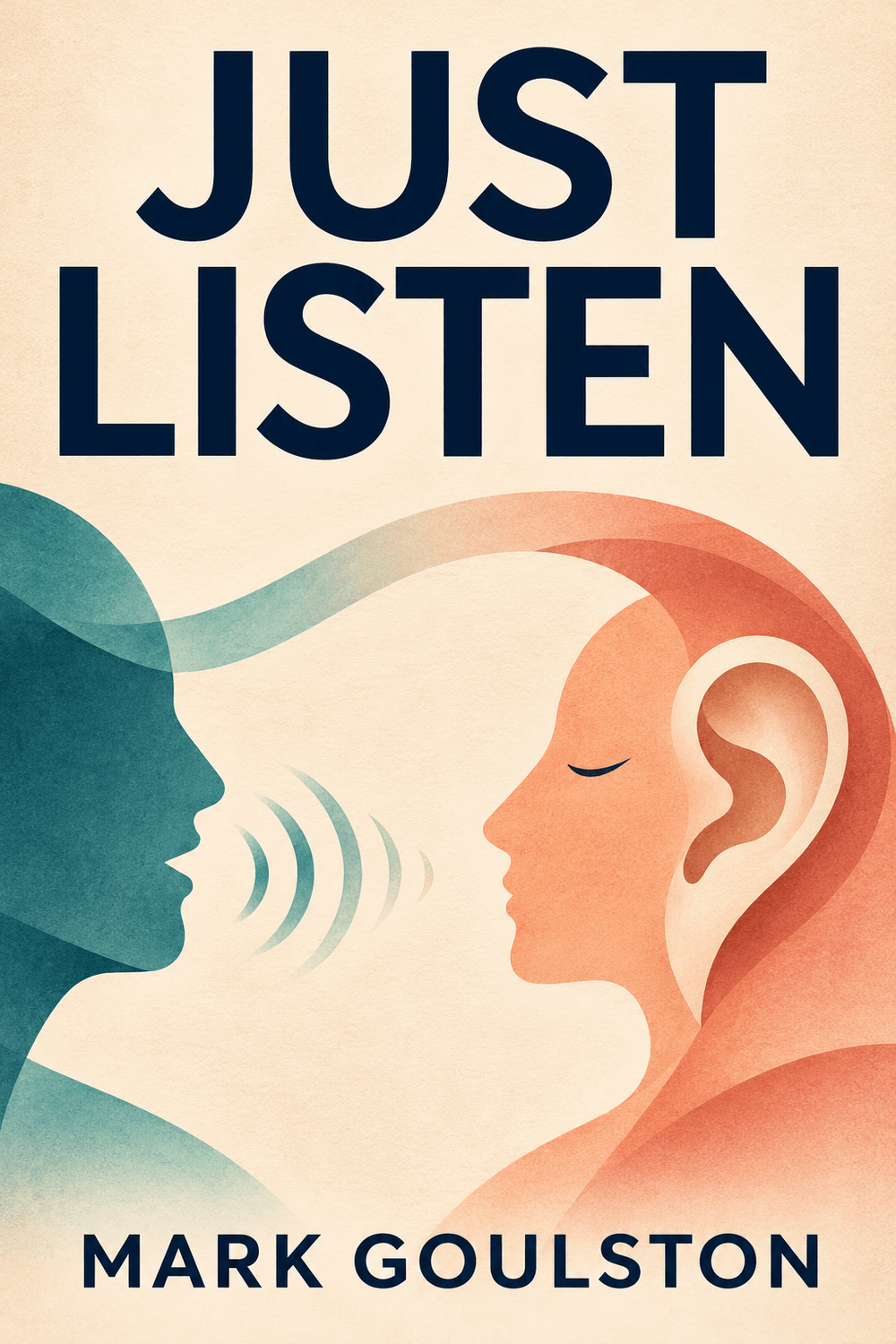
Prefer the print book? Buy on Amazon
As an Amazon Associate, Sumizeit earns from qualifying purchases.
Book Summary
Just Listen Book Summary
This Just Listen Book Summary covers the key ideas, lessons, and takeaways in about 20 minutes.
Short Description:
How listening first gets people to open up, trust you, and hear your ideas
People can't hear you until they feel heard. That idea runs through every chapter of Just Listen. An upset person needs to vent before they can think. Someone who disagrees with you needs to feel understood before they'll consider your view. A difficult coworker often needs to feel valued before they'll stop being difficult. In each case the move is the same. Stop pushing, turn your attention to the other person, and let them empty out what they're carrying. The influence you wanted tends to follow, because people give their attention to those who gave it to them first. Goulston adds two cautions. You have to manage your own biases and blind spots to listen well, and a few people, psychopaths above all, won't respond to any of it.
Helps with these goals
Preview the Just Listen book summary
Below is a preview of Sumizeit’s comprehensive human-written summary of Just Listen by Mark Goulston. The full summary is 15-20 minutes long and covers the book’s key ideas in text, audio, visual, and video formats. Unlock the full 20 Minute Summary
Most of us try to persuade people by talking. We make our case, add more reasons, and repeat ourselves a little louder when nothing lands. Mark Goulston says this gets the order wrong. The person in front of you is busy with their own worries, needs, and goals, and there's no room in their head for your idea yet.
So you start with them. You listen until you understand how things look from their side and what they're struggling with. Once they feel heard, they relax, and they become willing to hear you out. That is the whole book in a few lines. If you want to change what someone thinks or does, listening comes first and your pitch comes second.
Goulston learned this in some hard rooms. He is a psychiatrist who has talked with suicidal patients, trained FBI negotiators, and coached executives. The methods in the book come from that work.
The empathy gap everyone carries
Think about the last time someone really got what you were going through. You probably felt lighter, and you probably liked that person more afterward. Goulston says this reaction is close to universal, and he has a reason for it.
We spend our days tuning in to the people around us, and we expect them to tune in to us too. Mostly they don't. That leaves a gap, a steady hunger to be understood. When someone finally fills it, the relief is strong and so is the gratitude. A coworker notices the work nobody else saw. A friend lets you talk about a problem at home you've kept quiet about. You want to give something back to that person, and often what you give back is your attention.
This is why listening works as a tool of influence. You give people the thing they almost never get, and they return it.
What stress does to a person's brain
Before someone can take in your idea, you have to get past their emotions. Goulston explains this with a simple picture of the brain in three layers.
The reptile layer handles raw survival reactions. It acts without thinking. If a tree cracks over your head, you don't wonder why. You run. The mammal layer is where emotions live. It isn't as closed to reason as the reptile layer, but feelings run the show there, and clear thinking is still hard. The human layer sits on top. It takes in what the other two report and makes rational decisions.
Under stress, people drop down into the lower layers. Someone panicking about a deadline or crying over a breakup can't weigh your argument, because the part of them that weighs arguments is offline. Your job is to walk them back up, from reptile to mammal to human. You do that by dealing with the emotion first.
Two things that make it worse
Goulston warns against two common moves. The first is telling someone to calm down.
Want the complete 20-minute summary?
- Full structured summary
- Video Summary
- Podcast Summary
- Audio summary
- Key takeaways
- Exercises
- Quiz
- Highlights and notes
- Ask the book with AI
Who should read Just Listen?
Just Listen is for anyone who wants to influence, persuade, or improve relationships through better communication. Whether you're a manager, salesperson, parent, or simply someone who struggles to get others to hear you, this book offers practical techniques grounded in psychology and real-world negotiation experience.
Why does Just Listen matter?
In a world of constant noise and competing agendas, most people feel chronically unheard. Mark Goulston reveals that the path to influence isn't better arguments or louder talking—it's genuine listening. By understanding how stress affects the brain and learning to calm others before presenting your ideas, you can transform conflicts, close deals, and build trust far more effectively than traditional persuasion methods.
What are the key themes in Just Listen?
- Listening as a tool of influence and persuasion
- The neuroscience of stress and how it shuts down reasoning
- The universal hunger to be understood and valued
- Managing your own biases and blind spots in communication
- Building empathy through perspective-taking
- The difference between being interesting versus being interested
How can you apply ideas from Just Listen?
- In difficult conversations with family or colleagues, let the other person fully vent before presenting your side, dramatically improving outcomes in conflict resolution
- Use the seven-step calming sequence with upset employees or customers to de-escalate tension and rebuild relationship trust
- Transform sales conversations by asking questions about the prospect's challenges first, then positioning your solution as addressing what they actually need
- Improve parenting by listening to what's really bothering your child before offering solutions or discipline, which builds trust and reduces future conflicts
- Build team morale by giving meaningful, three-part thank yous that specifically recognize effort and explain impact, rather than generic praise
- Navigate difficult coworkers by identifying whether they're needy, bullies, narcissists, or something else—then adjusting your approach accordingly
- Enhance your credibility in professional settings by proactively addressing one weakness and explaining how you manage it, which builds authentic confidence
What common mistakes do readers make with Just Listen?
- Pushing harder by repeating your argument louder or adding more reasons, when the real barrier is that the other person doesn't feel heard yet
- Telling someone to calm down, which signals control and usually escalates upset rather than reducing it
- Getting defensive when someone brings a problem, which makes them feel alone with it and deepens the bad feeling you wanted to shrink
- Trying to be impressive or interesting rather than genuinely curious, which reads as self-absorbed and needy instead of confident
- Assuming your own interpretation of someone's words or motive is correct without checking their perspective first, leading to misunderstanding and defensiveness
- Ignoring your own biases and blind spots, which distorts how you perceive and interpret the other person's behavior
Sumizeit Exercises Apply what you've learned
Turn ideas from Just Listen into action with a short guided reflection: identify the biggest takeaway, connect it to your life, and commit to one step you can take in the next 24 hours.
What is the expert analysis of Just Listen?
Overview
Just Listen is a compelling work by Mark Goulston, a psychiatrist renowned for his expertise in crisis communication and negotiation. Drawing on his extensive experience with suicidal patients, FBI negotiators, and corporate leaders, Goulston distills the art of influence into a deceptively simple premise: true persuasion begins with listening. Published in 2009, this book stands out in the crowded field of communication and self-improvement literature by emphasizing empathy and emotional intelligence as foundational tools for connection and influence.
Core Thesis
Goulston’s central argument is that effective communication and influence hinge on the ability to listen deeply and empathetically before attempting to persuade. He posits that people cannot absorb new ideas or change their minds until they first feel genuinely heard and understood. This process involves recognizing the emotional states that block rational thinking, addressing those emotions first, and then guiding the conversation toward mutual understanding and collaboration. The book’s thesis challenges the common impulse to push harder with arguments, instead advocating a patient, emotionally attuned approach to dialogue.
Strengths
- Practical Framework: Goulston offers a clear, step-by-step method for de-escalating tension and fostering openness, such as his seven-step process for “talking someone down.” This actionable guidance makes the book valuable for readers seeking concrete tools.
- Integration of Neuroscience and Psychology: The explanation of the brain’s “three layers” (reptile, mammal, human) provides an accessible model for understanding why people react emotionally under stress and how to navigate those responses effectively.
- Broad Applicability: The principles extend beyond personal relationships to professional settings, including leadership, negotiation, and conflict resolution, making the book relevant across diverse contexts.
- Insightful Attention to Emotional Dynamics: The emphasis on empathy, emotional validation, and managing one’s own biases enriches the discussion and encourages self-awareness in communication.
- Realistic Recognition of Limits: Goulston’s candid discussion of difficult personality types, especially psychopaths, and the acknowledgment that some individuals resist empathetic engagement adds a sobering, pragmatic dimension.
Critiques & Counterarguments
- Overreliance on Anecdotal Evidence: While Goulston’s clinical and negotiation experiences are impressive, the book leans heavily on anecdotal insights rather than rigorous empirical research. This may limit its generalizability and invites skepticism from those seeking data-driven validation.
- Potential Oversimplification of Complex Interactions: The three-layer brain model, though useful as a heuristic, risks reducing nuanced psychological and neurological processes to overly simplistic categories, which might mislead readers about the complexity of emotional regulation.
- Limited Engagement with Alternative Communication Theories: The book does not sufficiently address competing frameworks such as assertive communication, dialectical behavior therapy techniques, or cognitive-behavioral approaches that emphasize directness and boundary-setting, which can sometimes be more effective than empathetic listening alone.
- Challenges in High-Stakes or Power-Imbalanced Situations: In scenarios involving systemic power imbalances or abusive dynamics, the strategy of listening first may inadvertently enable harmful behavior or delay necessary confrontation, a nuance that the book touches on but does not fully explore.
- Changing Cultural Contexts: The book’s examples and advice, while broadly applicable, may not fully account for cultural variations in communication styles and emotional expression, which can affect the efficacy of its methods globally.
Who Should Read This
Just Listen is ideal for professionals and individuals invested in improving their interpersonal influence and emotional intelligence. This includes leaders, managers, negotiators, therapists, educators, and anyone navigating conflict or seeking to deepen their relational skills. Readers who appreciate psychologically informed, empathetic approaches to communication will find Goulston’s insights both practical and inspiring. However, those looking for a heavily research-based or culturally nuanced treatise may find the book’s approach somewhat limited. Ultimately, it serves as a valuable primer on the power of listening as a transformative tool in human connection.
Discussion questions for Just Listen Short questions you can actually use in a conversation
Frequently asked questions about the Just Listen book summary
What is Just Listen about?
Just Listen by Mark Goulston is about why listening is more powerful than talking when you want to influence or persuade someone. The core idea is that people can't hear you until they feel heard themselves. The book provides practical techniques for understanding others' perspectives, calming emotional reactions, and building the trust that makes genuine communication and influence possible.
Who should read Just Listen?
Just Listen is essential for managers, salespeople, parents, negotiators, and anyone who wants to improve their ability to influence or resolve conflicts. It's particularly valuable for people who often feel unheard or struggle in difficult conversations, as well as those who push harder with talking instead of stepping back to listen first.
What are the main takeaways from Just Listen?
The main takeaways are: people won't consider your ideas until they feel understood; stress moves people into emotional brain states where logic is offline, so address emotion first; asking someone to calm down backfires, but letting them fully vent works; reflecting back what you heard builds connection and shifts them from resistant to cooperative; and make people feel understood, interesting, and valued to unlock their willingness to listen to you. Goulston also cautions that a few personality types, like psychopaths, won't respond to these methods.
How does the brain respond to stress according to Just Listen?
Goulston describes the brain in three layers: the reptile layer handles survival reactions, the mammal layer processes emotions, and the human layer handles rational decision-making. Under stress, people drop into the lower layers and lose access to reasoning. To move someone back to rational thinking, you must address their emotion first, which calms the reptile and mammal layers and brings the rational brain back online.
What is the seven-step calming sequence in Just Listen?
The sequence is: watch the body for signs of distress and get them into an open posture; ask them to tell the problem while you listen without interrupting; repeat the problem back and ask if you have it right; ask how it makes them feel to help name the emotion; affirm the urgency and ask how they think it could be solved; show empathy by acknowledging how hard this is; and finally encourage them by reminding them of past successes and offering your help.
Why does genuine listening work better than stronger arguments?
Most people feel chronically unheard because others are too busy with their own concerns to listen. When someone finally gives genuine attention and understanding, it fills a deep psychological need and creates gratitude. People naturally reciprocate the attention they receive, so when you listen first, they become willing to listen to you. This reciprocal dynamic works better than any argument because it removes the defensiveness that strong pushing creates.
What should you do with people who don't respond to listening?
Goulston identifies four types: needy people need clear boundaries and honesty about what must change; bullies respond to strength and calm without showing weakness; narcissists will only engage if the task serves their self-interest; and psychopaths won't respond to empathy at all because they lack normal emotional capacity. For psychopaths and others who drain you without reciprocating, Goulston advises getting as far away as possible and protecting yourself.
About Sumizeit
Sumizeit is a profitable Scomy LLC company based in Miami, Florida. Our founders, Clemens Raemy and Weina Scott, are successful entrepreneurs with several exits. Sumizeit is a popular book summary app / micro learning app used by busy professionals and entrepreneurs with over 2,500 non-fiction book summaries and 10,000 podcast summaries in text, audio, visual, podcast, and video format. We also have stellar retention tools to make ideas stick - such as flashcards with spaced repetition, quizzes, streaks, highlighting and notes, daily challenges, riddles, mini-courses, meditation, and more. You won't only learn the idea, but also remember it. Over 90% of our users change their habits with Sumizeit.
Upgrade Now
Here's why readers love Sumizeit
Join thousands of learners getting smarter every day
"Great experience. Detailed summaries. Loved the gamification feature. Makes learning fun. Good customer service. I recommend Sumizeit to anyone. You'll learn a lot."
"I always felt busy but still wanting to keep up with the book discussion in my friend group. This was a great supplement to help me keep reading the books I find fun while keeping up with important books."
"I love this website. Instead of scrolling social media, I find myself learning a lot. I use it everyday. I recommend this app for anyone who is too busy and wants to get up to speed with their favorite books."
Just Listen Book Summary PDF
Looking for a Just Listen Book Summary PDF you can save and revisit offline? Our Just Listen Book Summary PDF captures the book’s core ideas in a clean, printable format — the key frameworks, takeaways, and structure without the fluff. Download the Just Listen Book Summary PDF when you want a reference you can annotate, share with your team, or review on the go. Get your Just Listen Book Summary PDF from the download page below.
Download Just Listen Book Summary PDFPeople also liked these summaries
Readers who explored Just Listen often enjoyed these titles next.




Ready to read the whole thing?
- Full structured summary
- Video Summary
- Podcast Summary
- Audio summary
- Key takeaways
- Exercises
- Quiz
- Highlights and notes
- Ask the book with AI
Featured Book Titles
Popular Book Summaries at sumizeit, leading book summary app
Atomic Habits Book Summary Rich Dad Poor Dad Book Summary The Four Agreements Book Summary The 48 Laws of Power Book Summary When Breath Becomes Air Book Summary Think and Grow Rich Book Summary