


Prefer the print book? Buy on Amazon
As an Amazon Associate, Sumizeit earns from qualifying purchases.
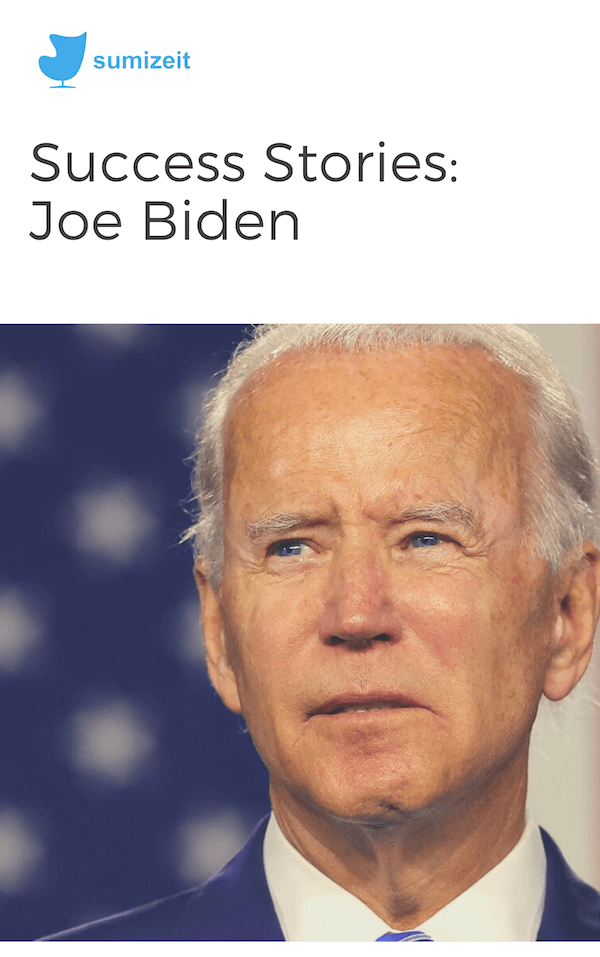
Joe Biden Book Summary
This Joe Biden Book Summary covers the key ideas, lessons, and takeaways in about 20 minutes.
Short Description:
Learn about Joe Biden’s life and success story.
Helps with these goals
Want the complete 20-minute summary?
- Full structured summary
- Video Summary
- Podcast Summary
- Audio summary
- Key takeaways
- Exercises
- Quiz
- Highlights and notes
- Ask the book with AI
Want a Free Weekly Read?
Get a free summary every week straight to your mailbox.
Preview the Joe Biden book summary
Below is a preview of Sumizeit’s comprehensive human-written summary of Joe Biden by Sumizeit Team. The full summary is 15-20 minutes long and covers the book’s key ideas in text, audio, visual, and video formats. Unlock the full 20 Minute Summary
Joe Biden is a man of many accolades: long-running state senator, former vice president to Barack Obama, and 2020 presidential candidate and Democratic nominee. From the outside, his story is similar to most career politicians.
But there are hidden intricacies in Joe’s biography. For instance, the little-known fact that he nearly quit politics only weeks after winning his first election in 1972.
The Early Years
Biden was born into an Irish-Catholic family in Scranton, Pennsylvania in 1942. His father had been a wealthy man at one point, but by the time Biden was born he was suffering financially. For the early years of Biden’s life, the entire family lived with his maternal grandparents to save money.
In the 1950s, formerly prosperous Scranton was a place with few prospects and little to no opportunity for employment. Joe Biden Sr. couldn’t find regular work, so the family moved into an apartment in Claymont, Delaware. They soon moved to Wilmington, where Joe attended high school and found early success as an athlete.
Biden wasn’t very good at school, but he thrived athletically and was a popular and well-liked kid. By his senior year, he took a chronically losing football team to state championships, and he was voted class president during his junior and senior years of high school. He went on to attend the University of Delaware where he played college football and met his first wife Neilia Hunter.
Biden’s law career began with lackluster performance At Syracuse University College of Law - he later reflected that law school was “the biggest bore in the world.” He was accused of plagiarizing five pages of a law article, which came up in his first presidential bid. But Biden wasn’t interested in a long-term career as a lawyer. He told his wife Neilia that someday he was going to be the president of the United States.
An Unexpected Victory
Biden only worked as a lawyer for a few years, flipping between work as a public defender and a corporate lawyer. He loved criminal law but it didn’t pay well - he had to manage properties on the side to pay the bills. In 1969, he decided to run for New Castle County Council on a liberal platform and won - a surprise for a typically conservative county. As he was taking his seat at the council, he was already talking about running for U.S. Senate.
The senate race of 1972 was a strange one. Biden was pitted against long-time Republican senator J. Caleb Boggs, who wanted to retire but ran again with Nixon’s encouragement to avoid a fight in the primary between two well-known Republican candidates. Boggs was so well-known and long-standing that no one wanted to run against him. That’s when Biden stepped in.
Biden had no money for a campaign. His sister managed his campaign, and his family staffed it. He was behind thirty percentage points in the summer before the election, and as far as anyone could tell, he had no chance…
Want the complete 20-minute summary?
- Full structured summary
- Video Summary
- Podcast Summary
- Audio summary
- Key takeaways
- Exercises
- Quiz
- Highlights and notes
- Ask the book with AI
Who should read Joe Biden?
This book is for anyone interested in understanding the life and career of Joe Biden, from his humble Irish-Catholic roots to his rise as a major political figure. It appeals to readers curious about how personal tragedy shapes character, political enthusiasts wanting context on Biden's values and priorities, and those seeking inspiration from stories of resilience and perseverance against overwhelming odds.
Why does Joe Biden matter?
Joe Biden's story illuminates how grief, determination, and personal values can forge a political leader and shape policy decisions over decades. Understanding Biden's journey—from an unlikely underdog victory to navigating multiple personal tragedies—provides crucial context for understanding his priorities and approach to leadership. In an era of intense political polarization, Biden's biography offers lessons on balancing ambition with family, principles with compromise, and personal loss with public service.
What are the key themes in Joe Biden?
- Resilience in the face of personal tragedy
- The power of emotional connection in politics
- Balancing ambition with family obligations
- Underdog perseverance and unlikely victories
- The influence of grief and loss on character
- Working-class advocacy and middle-class values
Want the complete 20-minute summary?
- Full structured summary
- Video Summary
- Podcast Summary
- Audio summary
- Key takeaways
- Exercises
- Quiz
- Highlights and notes
- Ask the book with AI
How can you apply ideas from Joe Biden?
- Use emotional authenticity and personal connection to build influence and persuade others, rather than relying solely on resources or status
- Implement firm boundaries around family time and personal priorities, even in demanding careers, to maintain balance and perspective
- View setbacks and failures as learning opportunities that build resilience rather than as permanent defeats
- Stay connected to your community and root values to prevent losing touch with what matters most
- Seek mentorship and support during critical decisions, particularly during times of crisis or uncertainty
- Maintain consistency in your core principles and values over decades to build long-term credibility and trust
- Transform personal grief and hardship into deeper empathy and understanding for others facing similar struggles
What common mistakes do readers make with Joe Biden?
- Assuming that early academic struggles or setbacks predetermine future failure and limiting your ambitions accordingly
- Choosing career advancement over family connection, leading to isolation and loss of grounding when crises occur
- Abandoning your values and platform in an attempt to appeal to establishment figures rather than trusting your authentic message
- Giving up after a single failure, rather than viewing it as a learning experience that can inform future attempts
Sumizeit Exercises Apply what you've learned
Turn ideas from Joe Biden into action with a short guided reflection: identify the biggest takeaway, connect it to your life, and commit to one step you can take in the next 24 hours.
What is the expert analysis of Joe Biden?
Overview
This biography of Joe Biden, authored by the Sumizeit Team, offers a concise yet compelling portrait of one of America’s most enduring political figures. Spanning from Biden’s humble beginnings in Scranton, Pennsylvania, to his ascension as a presidential candidate in 2020, the book captures the resilience and complexity behind a career often viewed through a simplistic political lens. The significance of this work lies in its exploration of the personal tragedies and formative experiences that shaped Biden’s trajectory, providing readers with a nuanced understanding of a leader whose life story intertwines perseverance with public service.
Core Thesis
The central insight of the book is that Joe Biden’s political success is inseparable from his personal resilience and ability to balance the demands of public life with profound private loss. The narrative argues that Biden’s enduring commitment to his principles and family, despite repeated tragedies and setbacks, is the foundation of his long career and eventual rise to the presidency. This thesis positions Biden not merely as a politician but as a figure emblematic of perseverance in the face of adversity.
Strengths
- Humanizing the Political Figure: The book excels at revealing the emotional and psychological dimensions of Biden’s life, moving beyond policy and electoral victories to highlight his vulnerabilities and motivations.
- Chronological Clarity: The clear, chronological structure aids in understanding the evolution of Biden’s character and career, making complex political milestones accessible.
- Focus on Resilience: By emphasizing Biden’s response to personal tragedy and health challenges, the book offers a compelling narrative of strength that resonates beyond politics.
- Contextualizing Political Milestones: The summary effectively situates Biden’s political decisions and campaigns within broader social and historical contexts, such as the Vietnam War and civil rights movements.
Critiques & Counterarguments
- Oversimplification of Political Legacy: While the book touches on Biden’s legislative work, it glosses over controversies such as the 1994 Crime Bill, which has been widely criticized for contributing to mass incarceration, particularly of racial minorities. A more critical engagement with these aspects would provide a balanced view.
- Limited Exploration of Policy Impact: The narrative focuses heavily on personal biography at the expense of detailed analysis of Biden’s policy positions and their real-world consequences, which are essential for a comprehensive political biography.
- Potential Hagiography: The portrayal risks veering into hagiography by emphasizing resilience and character while downplaying political missteps and criticisms, such as accusations of plagiarism and embellishments regarding civil rights activism.
- Competing Interpretations: Scholars from political science and history might argue that Biden’s career reflects broader systemic dynamics in American politics, including the role of centrist pragmatism and institutional power, rather than solely individual perseverance.
- Contextual Datedness: The book’s focus on the 2020 campaign and “Build Back Better” platform may lack the foresight of subsequent political developments and challenges faced during Biden’s presidency, limiting its long-term analytical value.
Who Should Read This
This biography is ideal for readers seeking an accessible yet thoughtful introduction to Joe Biden’s life and career, particularly those interested in the interplay between personal adversity and public leadership. It will appeal to students of political history, general readers curious about contemporary American politics, and anyone inspired by stories of resilience. However, readers looking for a rigorous, critical political analysis or an in-depth policy evaluation may find the book’s scope somewhat limited.
Frequently asked questions about the Joe Biden book summary
What is Joe Biden about?
Joe Biden by Sumizeit Team is a biographical account of the 46th President of the United States, tracing his journey from an Irish-Catholic family struggling financially in post-war Pennsylvania to becoming a major political figure. The book explores how personal tragedy—including the loss of his first wife, daughter, and later his son Beau—shaped his character, values, and approach to public service, ultimately fueling his decades-long pursuit of the presidency.
Who should read Joe Biden?
This book is ideal for readers interested in political biography, those seeking inspiration from stories of resilience and overcoming adversity, and anyone wanting to understand Biden's motivations and values. It appeals to students of American politics, people curious about how grief shapes leadership, and those interested in how ordinary people can achieve extraordinary things through perseverance and emotional authenticity.
What are the main takeaways from Joe Biden?
Key takeaways include understanding how personal tragedy and resilience can forge character and values, recognizing that charisma and emotional connection often matter more than resources in persuading others, and learning that balancing ambition with family and principles is essential for long-term success. The book illustrates how consistent values over decades, mentorship in crisis moments, and staying connected to your roots enable achievement despite overwhelming obstacles.
How did Joe Biden's early family struggles shape his political platform?
Biden's childhood experience of financial hardship—living with grandparents and moving from Pennsylvania to Delaware seeking better opportunities—instilled in him a deep commitment to working families and the middle class. This personal experience directly influenced his decades-long advocacy for civil rights, environmental protection, better healthcare, and mass transit, making his political platform reflect the struggles he witnessed growing up.
How did tragedy influence Joe Biden's character and leadership?
The death of Biden's first wife Neilia and daughter Naomi just weeks after his first Senate victory was devastating, yet it deepened his empathy and resilience. Later, his son Beau's death from cancer and his own two brain aneurysms reinforced his understanding of human suffering and vulnerability. These experiences informed his ability to connect authentically with people facing grief and hardship, making him a more empathetic public servant.
What does Joe Biden's political career teach us about overcoming failure?
Biden's failed 1988 presidential campaign, plagiarism scandal in law school, and various controversies throughout his career didn't end his political journey; instead, they became learning experiences that strengthened his resolve. His story demonstrates that failure and setbacks are natural parts of ambitious pursuits and that persistence, combined with the support of others, can transform temporary defeats into eventual success.
How did Joe Biden balance his Senate career with raising children as a single father?
After his first wife's death, Biden implemented a strict personal policy that his Senate work would stop if his sons called, prioritizing fatherhood during critical years. He commuted from Delaware to Washington regularly and made family his primary focus alongside his legislative duties, proving that it's possible to maintain high political office while being actively engaged in parenting.
About Sumizeit
Sumizeit is a profitable Scomy LLC company based in Miami, Florida. Our founders, Clemens Raemy and Weina Scott, are successful entrepreneurs with several exits. Sumizeit is a popular book summary app / micro learning app used by busy professionals and entrepreneurs with over 2,500 non-fiction book summaries and 10,000 podcast summaries in text, audio, visual, podcast, and video format. We also have stellar retention tools to make ideas stick - such as flashcards with spaced repetition, quizzes, streaks, highlighting and notes, daily challenges, riddles, mini-courses, meditation, and more. You won't only learn the idea, but also remember it. Over 90% of our users change their habits with Sumizeit.
Upgrade Now
Want the complete 20-minute summary?
- Full structured summary
- Video Summary
- Podcast Summary
- Audio summary
- Key takeaways
- Exercises
- Quiz
- Highlights and notes
- Ask the book with AI
Here's why readers love Sumizeit
Join thousands of learners getting smarter every day
"Great experience. Detailed summaries. Loved the gamification feature. Makes learning fun. Good customer service. I recommend Sumizeit to anyone. You'll learn a lot."
"I always felt busy but still wanting to keep up with the book discussion in my friend group. This was a great supplement to help me keep reading the books I find fun while keeping up with important books."
"I love this website. Instead of scrolling social media, I find myself learning a lot. I use it everyday. I recommend this app for anyone who is too busy and wants to get up to speed with their favorite books."
Joe Biden Book Summary PDF
Looking for a Joe Biden Book Summary PDF you can save and revisit offline? Our Joe Biden Book Summary PDF captures the book’s core ideas in a clean, printable format — the key frameworks, takeaways, and structure without the fluff. Download the Joe Biden Book Summary PDF when you want a reference you can annotate, share with your team, or review on the go. Get your Joe Biden Book Summary PDF from the download page below.
Download Joe Biden Book Summary PDFPeople also liked these summaries
Readers who explored Joe Biden often enjoyed these titles next.


Want the complete 20-minute summary?
- Full structured summary
- Video Summary
- Podcast Summary
- Audio summary
- Key takeaways
- Exercises
- Quiz
- Highlights and notes
- Ask the book with AI
Featured Book Titles
Popular Book Summaries at sumizeit, leading book summary app