

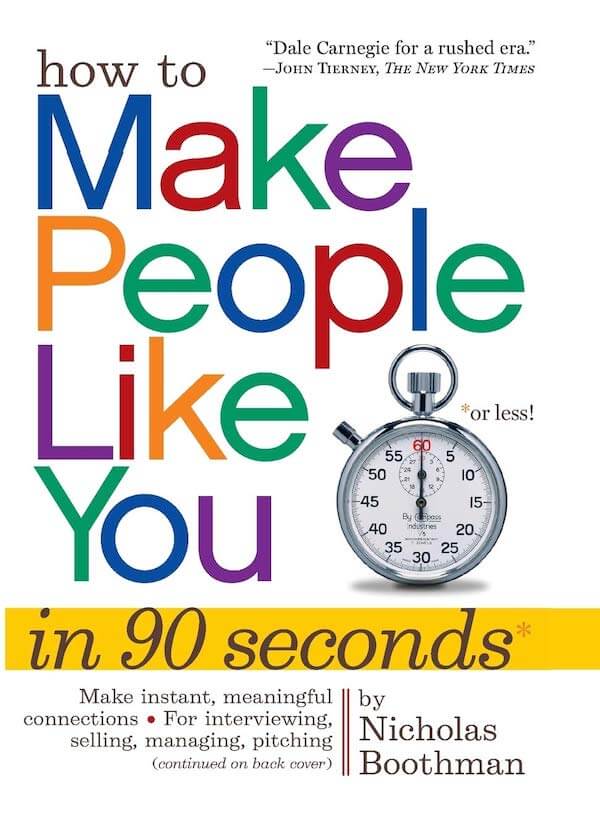
We all know people who are “really nice, once you get to know me”. However, sometimes you need to make a good impression, and you need to do it fast: like when you’re on a date or you need to wow someone at a job interview. In Nicholas Boothman’s How to Make People Like You in 90 Seconds or Less, he explains how to make a great first impression, and fast. Read on to learn why eye contact is key, why your body language could make you seem untrustworthy, and what to say to connect with someone you’ve just met.
Helps with these goals
As an Amazon Associate, Sumizeit earns from qualifying purchases.
In How to Make People Like You in 90 Seconds or Less, Nicholas Boothman explores how mastering the art of rapid connection can transform your personal and professional life. He begins by emphasizing that connection is not merely a social skill—it’s a biological and psychological necessity. Human beings, Boothman explains, are wired for connection because belonging to a group once meant survival. From prehistoric tribes to modern workplaces, collaboration and trust have always been the glue holding society together.
Boothman supports this with data from studies by Harvard and the MacArthur Foundation, which show that people with strong social relationships are happier, healthier, and even live longer. For example, the 1979 Alameda County study revealed that those with limited social ties were nearly three times more likely to die early than those who were socially active. Relationships, he argues, are the invisible infrastructure of a meaningful life—they boost self-esteem, enhance resilience, and foster emotional security.
He also notes that opportunities in life—whether it’s getting a dream job, meeting the right business partner, or forming friendships—often come from people who like you. When others enjoy your presence, they naturally want to help you succeed. A hiring manager might recommend you for a promotion not because of your résumé, but because of how you made them feel. The essence of Boothman’s philosophy is clear: people help those they connect with, and connection is something anyone can learn to create deliberately.
Boothman’s signature insight is that you only have about a minute and a half to make a lasting impression. Within that narrow window, people subconsciously decide whether they trust, respect, or even like you. To master this moment, he presents the “Open–Eye–Beam–Hi–Lean” technique—a sequence that primes both your body and attitude for connection.
Open: Physically and emotionally open yourself up. Uncross your arms, stand tall, and let your face express warmth. Openness signals trust.
Eye: Make confident yet kind eye contact—don’t stare, but hold their gaze long enough to convey sincerity.
Beam: Smile genuinely. Boothman explains that a real smile engages both the mouth and the eyes, releasing endorphins that make you feel better too.
Hi: Greet the person with enthusiasm, using a friendly tone and introducing yourself clearly.
Lean: A slight forward lean indicates interest, signaling engagement without invading space.
He recounts stories from his seminars where shy participants practiced this five-step formula. One student, a nervous college graduate, used it during a networking event and landed a mentor who later helped her secure a full-time position. The key, Boothman stresses, is congruence—your voice, gestures, and words must align. If you say “I’m happy to meet you” with a blank face, the brain perceives a mismatch and distrust forms instantly.
Boothman introduces the concept of the “Really Useful Attitude”—a mindset that radiates positivity, curiosity, and openness. He likens attitude to perfume: others sense it before you speak. Whether you’re conscious of it or not, your attitude seeps into your posture, tone, and facial expressions.
He shares an example from his photography career. When photographing nervous clients, he’d intentionally adopt an encouraging and playful demeanor. Within minutes, their tension melted away, and their smiles became authentic. “Your attitude infects everyone around you,” he writes.
To cultivate a Really Useful Attitude, Boothman suggests focusing on curiosity instead of fear. For instance, instead of thinking “What if they don’t like me?”, shift to “I wonder what’s interesting about this person?” This mental reframe changes your body chemistry—your muscles relax, your eyes soften, and your tone brightens. The opposite, what he calls a “Really Useless Attitude,” includes skepticism, arrogance, or negativity, which instantly push people away. He encourages readers to think of their attitude as a switch they can flip before every encounter, consciously choosing to project warmth and interest.
Humans subconsciously mimic those they feel close to—a phenomenon known as mirroring. Boothman transforms this natural behavior into a conscious strategy called synchronizing. The idea is to align subtly with another person’s body language, pace, and speech patterns to foster comfort and understanding.
If someone speaks slowly and softly, responding at the same tempo signals empathy. If they lean slightly forward while talking, do the same. Over time, when rapport builds, Boothman recommends testing the connection: change your posture or tone slightly and observe whether they follow. If they do, it means they subconsciously trust you.
He recounts a story of a real estate agent who increased her sales simply by applying this method. By matching her clients’ gestures and rhythm, they began to describe her as “someone who just gets me.” Synchronizing is not about manipulation—it’s about respect. It says, “I’m meeting you where you are.”
He also advises caution: mimicry must be subtle. Overdoing it appears fake or mocking. The goal is gentle harmony, not imitation. Done well, it builds an invisible bridge between you and the other person.
Boothman’s research shows that communication is 55% body language, 38% tone of voice, and only 7% actual words. He reminds readers that even before you say a word, your body is already speaking. Standing tall with relaxed shoulders signals confidence. Uncrossed arms and visible hands suggest honesty. Tilting your head slightly while listening shows interest.
He contrasts this with “closed” signals—crossed arms, hunched shoulders, or looking away—which indicate defensiveness or discomfort. A manager, for example, might unknowingly close off a conversation by folding their arms, causing employees to feel dismissed. Boothman recommends consciously keeping an “open heart” posture—chest exposed and palms slightly up—to convey warmth and trustworthiness.
Similarly, your voice can shape emotional impact. A soft, melodic tone invites cooperation, while a rushed or monotone delivery can kill enthusiasm. He gives the example of two customer service representatives: one speaks quickly with a flat voice, while the other uses a measured, expressive tone. Both say the same words, but only the second earns repeat customers. Voice, Boothman concludes, is body language you can hear.
Boothman likens small talk to “the runway before takeoff.” It’s how you prepare for deeper connection. He teaches that powerful conversations rely on open-ended questions, which invite storytelling and emotional sharing. Closed questions—those that can be answered with “yes” or “no”—halt momentum.
He encourages using “environmental comments” to start, such as “The energy here is amazing,” or “This music makes me nostalgic.” These neutral, shared observations make people feel at ease. Then transition into open-ended questions like, “What brought you here today?” or “What do you love most about your work?”
Boothman shares an example of a young entrepreneur who used these methods to build instant rapport with investors. Instead of pitching right away, she first asked, “What projects are you most excited about lately?” This turned the meeting into a conversation rather than a sales pitch—and secured her funding.
Active listening completes the loop. Boothman teaches the three keys of listening: maintaining eye contact, nodding, and responding verbally (“I see,” “That’s interesting”). Reflecting what the other person says—“So it sounds like you really enjoy creative projects”—shows empathy. This makes the other person feel heard, which Boothman identifies as the most powerful form of validation.
Every person processes the world through a dominant sense: Visual, Auditory, or Kinesthetic (touch and feeling). Recognizing this preference allows you to tailor your language to connect instantly.
Visual people (55%) notice appearance, colors, and images. They talk quickly and use phrases like “I see your point” or “That looks great.” Speak their language by using visual words like “imagine,” “picture,” or “bright.”
Auditory people (15%) focus on sound, tone, and rhythm. They enjoy conversation and say things like “That sounds perfect” or “I hear you.” Match their pace and use words like “resonate,” “harmony,” or “ring true.”
Kinesthetic people (30%) process through feelings and sensations. They move more slowly and say “I feel comfortable” or “That doesn’t sit right.” Use touch-related phrases like “get a grip on,” “warm,” or “solid.”
Boothman shares the example of a teacher who struggled to reach one of her students until she realized he was highly kinesthetic. She began using phrases like “Let’s get a feel for this math problem,” and his engagement skyrocketed. Tailoring communication, Boothman says, is not about manipulation but understanding—it’s meeting people in their sensory world.
To truly stand out, Boothman advises cultivating a signature element that makes others remember you. It could be a colorful accessory, a distinctive laugh, or even a catchphrase that reflects your personality. For example, he mentions a lawyer who always wore a bright blue tie and became known as “the lawyer with the blue tie”—a simple but powerful branding cue.
In conversation, he recommends using sensory-rich language to engage imagination. Rather than saying “The park was nice,” you might say, “The grass shimmered in the sun, and children’s laughter echoed through the air.” Such details create mental imagery that lingers long after the conversation ends. Boothman explains that people remember how you made them feel, not necessarily what you said.
He also advises giving sincere, specific compliments: instead of “You look nice,” say, “That color really brings out your eyes.” Specificity shows authenticity, making your praise feel genuine.
Boothman lists common “rapport-killers”: interrupting, finishing sentences, criticizing, complaining, or dominating the talk. These behaviors make others feel invisible. He suggests pausing before responding to ensure you’re listening rather than waiting to speak.
For difficult situations—like dealing with rude coworkers or impatient customers—he advises using empathy as a defuser. Ask yourself two questions: “Do I really need to engage with this person?” and “What outcome do I want?” This helps shift focus from emotion to strategy. For instance, when facing an angry client, instead of reacting defensively, say, “I understand this is frustrating. Let’s see how we can fix it together.” By validating emotions first, you reopen communication channels.
Boothman closes the book with the KFC Formula—a framework for continuous improvement in communication:
Know what you want: Enter every interaction with purpose. Do you want to build rapport, persuade, or simply connect?
Find out what you’re getting: Observe others’ reactions. Are they leaning in, smiling, or withdrawing? Their body language is instant feedback.
Change what you do: If it’s not working, adjust your approach—alter tone, posture, or topic until the energy shifts.
He gives an example of a corporate trainer who noticed half her audience looking bored. She switched from slides to a storytelling format, instantly regaining their attention. The “KFC” mindset teaches adaptability: success in relationships depends not on rigid scripts but on flexibility and feedback.
Nicholas Boothman’s How to Make People Like You in 90 Seconds or Less offers a step-by-step manual for mastering the subtle science of human connection. Through tools like the “Open–Eye–Beam–Hi–Lean” greeting, sensory-based communication, and synchronizing techniques, he reveals how anyone can create trust and warmth almost instantly. The book’s deeper message is that likability isn’t about manipulation or charm—it’s about authenticity. When your attitude, body language, and words align with genuine curiosity and care, people feel safe and valued around you. Boothman teaches that connection is not an accident—it’s a choice, one you can make in every interaction.
Nicholas Boothman is a former fashion and advertising photographer who spent over 25 years studying how people express emotion through posture and expression. His experiences directing models taught him how subtle gestures can transform perception in seconds. Later, he trained in neurolinguistic programming (NLP) and founded the Persuasion Technology Group, teaching professionals how to communicate authentically and effectively. His clients have included Fortune 500 companies, educators, and healthcare professionals. Boothman’s books—including How to Make People Like You in 90 Seconds or Less, Convince Them in 90 Seconds or Less, and How to Connect in Business in 90 Seconds or Less —have been translated into over 30 languages. Through his writing and workshops, he continues to empower people worldwide to replace fear and awkwardness with confidence, empathy, and connection.
Looking for a How to Make People Like you in 90 Seconds or Less Book Summary PDF you can save and revisit offline? Our How to Make People Like you in 90 Seconds or Less Book Summary PDF captures the book’s core ideas in a clean, printable format — the key frameworks, takeaways, and structure without the fluff. Download the How to Make People Like you in 90 Seconds or Less Book Summary PDF when you want a reference you can annotate, share with your team, or review on the go. Get your How to Make People Like you in 90 Seconds or Less Book Summary PDF from the download page below.
Download How to Make People Like you in 90 Seconds or Less Book Summary PDFGet full access to 2,500+ book summaries with audio and video
Start Free Trial →