
Question 1 of 10


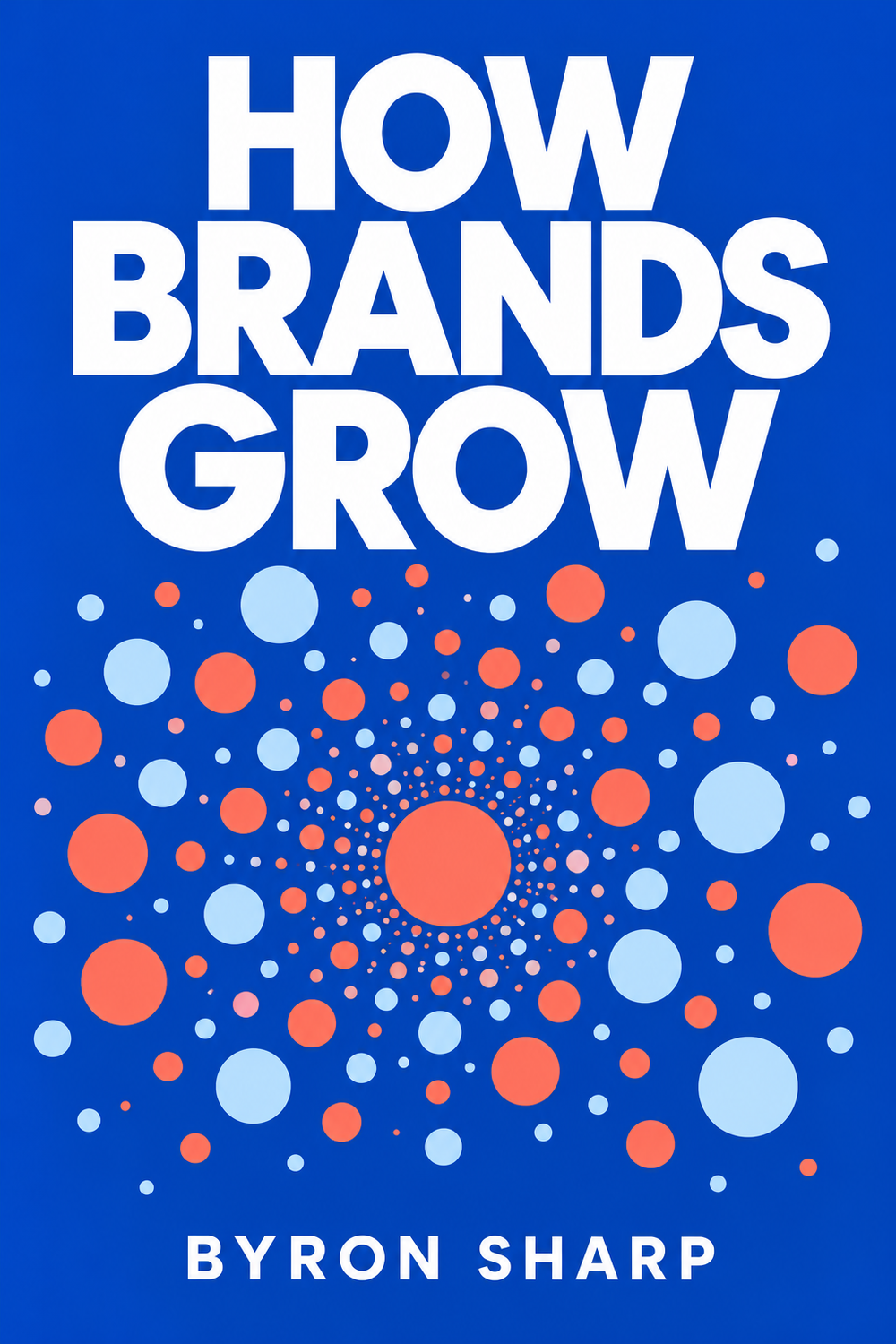
Prefer the print book? Buy on Amazon
As an Amazon Associate, Sumizeit earns from qualifying purchases.
Book Summary
How Brands Grow Book Summary
This How Brands Grow Book Summary covers the key ideas, lessons, and takeaways in about 20 minutes.
Short Description:
Plain English guide to Byron Sharp’s data backed rules for growing any brand
Brands grow by getting more people to buy them, and they do that by being easy to remember and easy to buy, not by chasing loyalty, narrow targets, or clever differences. Reach everyone in the category, keep showing up in ways people notice and connect to your brand, use consistent signals that make you easy to recognize, and put your product where people can find it, because most of your sales come from ordinary, occasional buyers who barely think about you at all.
Helps with these goals
Preview the How Brands Grow book summary
Below is a preview of Sumizeit’s comprehensive human-written summary of How Brands Grow by Byron Sharp. The full summary is 15-20 minutes long and covers the book’s key ideas in text, audio, visual, and video formats. Unlock the full 20 Minute Summary
Most marketing advice sounds smart and almost none of it gets tested. Byron Sharp wrote How Brands Grow to fix that. His claim is blunt. A lot of what business schools and agencies teach about brands is folklore, and the real data says something quite different.
Sharp and his colleagues at the Ehrenberg Bass Institute spent years studying actual buying records from supermarkets, banks, car makers, airlines, and hundreds of other categories. The same patterns kept showing up in every country and every industry. Those patterns became the backbone of the book. If you remember one thing, remember this. Brands grow when more people buy them, and more people buy them when the brand is easy to think of and easy to find.
That sounds simple, and it is. But it cuts against the popular playbook of loyalty, targeting, and differentiation. Sharp spends most of the book showing why.
Marketing needs evidence, not slogans
Sharp starts by asking why marketing has so few proven rules. Fields like medicine and physics build knowledge by finding patterns that repeat under many conditions. Marketing, he says, mostly runs on opinion, case studies of famous winners, and consultant frameworks. A case study of one successful brand tells you very little, because plenty of brands did the same thing and failed.
He argues for a different approach, one that borrows from the late Andrew Ehrenberg. Look for empirical laws. These are patterns that hold across brands, categories, countries, and decades. Once you know the pattern, you can spot what is normal and what is truly unusual. Most of the time, a brand that seems to be doing something special is just behaving the way its size predicts.
This part of the book also sets expectations. Sharp does not offer a magic formula. He offers a set of facts that keep holding up, and he asks marketers to build strategy on them instead of on hunches.
How brands really grow
The first big pattern is called Double Jeopardy. Look at any category and you will see that small brands have fewer buyers than big brands. That part is obvious. The surprise is that small brands also have slightly lower loyalty. Their buyers buy them a bit less often and show a bit less devotion. So a small brand gets hit twice. Fewer people buy it, and those people buy it less often.
Think about what this means. Market share differences between brands come mostly from penetration, which is the share of category buyers who bought the brand in a given period. Loyalty differences are small and follow penetration along. A brand that wants to grow cannot do it by squeezing more purchases out of the same people. It has to reach more people.
Sharp lays out three ways a brand could gain share in theory. It could win more customers, keep customers better, or get existing customers to buy more often. The data shows that winning brands do the first one.
Want the complete 20-minute summary?
- Full structured summary
- Video Summary
- Podcast Summary
- Audio summary
- Key takeaways
- Exercises
- Quiz
- Highlights and notes
- Ask the book with AI
Who should read How Brands Grow?
How Brands Grow is essential for marketing leaders, brand managers, and business strategists who want to move beyond conventional wisdom. It's equally valuable for entrepreneurs, agencies, and anyone responsible for growing a brand's market share. If you've questioned why loyalty programs underperform or why targeting feels limiting, this book speaks directly to your frustrations.
Why does How Brands Grow matter?
Most marketing advice rests on opinion, case studies, and consultant frameworks rather than empirical evidence. Byron Sharp's research, conducted over decades at the Ehrenberg Bass Institute, reveals the actual patterns that drive brand growth across industries and countries. In a field cluttered with unproven tactics and outdated playbooks, How Brands Grow offers a rare foundation of data-backed principles that challenge the status quo.
What are the key themes in How Brands Grow?
- Growth comes from reach, not retention
- Double Jeopardy: small brands have fewer buyers and lower loyalty
- Most customers are light, occasional buyers, not devoted fans
- Mental and physical availability are the real growth levers
- Distinctive brand assets matter more than product differentiation
- Loyalty programs rarely justify their cost
- Advertising builds memory, not persuasion
- Price promotions attract existing customers, not new ones
How can you apply ideas from How Brands Grow?
- Shift marketing budgets from loyalty programs to broad-reach advertising that touches occasional buyers and builds memory structures
- Redesign distribution strategy to place products in more locations and make them highly visible on shelves and online
- Audit and protect distinctive brand assets like colors, logos, and packaging; resist the temptation to refresh them frequently
- Move away from narrow customer segmentation and assume all category buyers are potential customers worth reaching
- Use advertising to create consistent, memorable brand associations rather than attempting to persuade through rational arguments
- Replace heavy reliance on price promotions with steady advertising and availability improvements that build long-term positioning
- Develop new product variants and extensions that expand the occasions and shelf space the brand occupies while maintaining recognizable assets
- Measure success by tracking penetration, mental availability, and physical availability rather than short-term sales spikes or brand sentiment scores
What common mistakes do readers make with How Brands Grow?
- Over-investing in retention and loyalty programs that return minimal growth compared to their cost
- Targeting only a narrow segment of category buyers, missing the majority of potential customers who are occasional buyers
- Judging advertising effectiveness solely on short-term sales lift, ignoring the slower work of building memory and long-term penetration
- Constantly redesigning logos, colors, and brand identity in pursuit of perceived differentiation, erasing years of built-up memory
- Assuming heavy discounting and promotions will attract lasting new customers when data shows they mainly benefit existing buyers
- Trying to compete on emotional connection and brand love in low-stakes, low-attention categories where most purchase decisions are habitual
Sumizeit Exercises Apply what you've learned
Turn ideas from How Brands Grow into action with a short guided reflection: identify the biggest takeaway, connect it to your life, and commit to one step you can take in the next 24 hours.
What is the expert analysis of How Brands Grow?
Overview
How Brands Grow by Byron Sharp stands as a seminal work in marketing science, challenging decades of conventional wisdom with rigorous empirical research. Sharp, a professor and director of the Ehrenberg Bass Institute, builds upon the legacy of Andrew Ehrenberg to propose a data-driven framework that demystifies brand growth. The book’s significance lies in its foundational critique of marketing folklore and its insistence on evidence-based principles, making it essential reading for marketers, academics, and business strategists seeking clarity amid the noise of anecdotal advice.
Core Thesis
Sharp’s central argument is elegantly simple yet profoundly disruptive: brands grow primarily by increasing their customer base—penetration—not by deepening loyalty or differentiation. Growth hinges on mental availability (how easily a brand comes to mind) and physical availability (how accessible the brand is in the marketplace). Loyalty programs, niche targeting, and emotional differentiation are largely overrated strategies. Instead, broad reach, consistent brand assets, and ubiquitous availability drive sustainable market share gains. This thesis reframes brand management as a science of reach and memory rather than persuasion and exclusivity.
Strengths
- Empirical Rigor: Sharp’s work is grounded in extensive, cross-category, and cross-national data, lending robustness to his claims and elevating marketing to a discipline with testable laws.
- Clarity and Parsimony: The book distills complex buying behaviors into accessible, actionable principles, such as Double Jeopardy and Duplication of Purchase, which have stood the test of time.
- Practical Framework: By focusing on mental and physical availability, Sharp provides marketers with concrete levers—advertising reach, distinctive brand assets, distribution—that can be measured and optimized.
- Challenging Orthodoxy: The book courageously confronts entrenched myths about loyalty, segmentation, and differentiation, encouraging a more scientific and less anecdotal approach to marketing strategy.
- Integration of Behavioral Insights: Sharp’s recognition that most buyers are light, occasional purchasers who share brands across categories aligns marketing strategy with real consumer behavior rather than idealized personas.
Critiques & Counterarguments
- Oversimplification of Differentiation: While Sharp downplays differentiation, some schools of thought argue that emotional branding and unique value propositions can create meaningful competitive advantages, particularly in premium or highly innovative categories.
- Limited Consideration of Digital Dynamics: The book’s primary data sources predate the full rise of digital ecosystems, where personalized targeting and engagement may alter patterns of loyalty and penetration.
- Potential Underestimation of Loyalty’s Nuances: Although loyalty is shown to be less impactful on growth, emerging research highlights the role of brand communities, social identity, and advocacy, which may not be fully captured by purchase frequency metrics.
- Contextual Boundaries: The laws described may hold best in mature, fast-moving consumer goods categories but might be less applicable to niche B2B markets, luxury brands, or categories with high switching costs.
- Competing Theories: Alternative frameworks, such as Kotler’s segmentation and targeting or Keller’s brand equity model, emphasize psychological and emotional differentiation, suggesting a more nuanced interplay between penetration and loyalty than Sharp’s model allows.
Who Should Read This
How Brands Grow is indispensable for marketing professionals, brand managers, and business leaders who seek to ground their strategies in empirical evidence rather than tradition or intuition. It is also valuable for academics and students of marketing, psychology, and consumer behavior who desire a rigorous framework for understanding market dynamics. Those skeptical of marketing orthodoxy or interested in the science behind brand growth will find Sharp’s work both provocative and enlightening. However, readers looking for guidance on crafting emotional brand narratives or navigating digital personalization may need to supplement this with other perspectives.
Discussion questions for How Brands Grow Short questions you can actually use in a conversation
Frequently asked questions about the How Brands Grow book summary
What is How Brands Grow about?
How Brands Grow by Byron Sharp is a research-based book that explains how brands actually expand market share, contrary to much conventional marketing wisdom. It draws on decades of empirical data from the Ehrenberg Bass Institute to show that brands grow by reaching more customers and staying easy to remember and buy, not by chasing loyalty or narrow differentiation.
What are the main takeaways from How Brands Grow?
The core takeaways are: brands grow by reaching more buyers, not by retaining existing ones; the majority of sales come from occasional, light buyers; brands should focus on mental availability (easy recall) and physical availability (distribution and shelf presence); distinctive assets matter more than product differentiation; and advertising works by building memory, not by persuasion. These principles cut against much standard marketing practice.
Why is penetration more important than loyalty?
Sharp's research shows that all brands lose customers at nearly the same rate, so retention alone cannot create competitive advantage. Growth instead comes from expanding the number of people who buy the brand. Since existing customers already know the brand and are the easiest to sell to, the greater opportunity lies in reaching new or occasional buyers.
What is Double Jeopardy in How Brands Grow?
Double Jeopardy is Sharp's first major empirical law. Small brands face a disadvantage on two fronts: they have fewer total buyers than large brands, and those buyers are slightly less loyal. This means a small brand must first grow its customer base, as improving loyalty alone cannot close the gap.
How does How Brands Grow challenge loyalty programs?
Sharp argues that loyalty programs disappoint because retention is not a source of competitive advantage; all brands lose customers at similar rates. He also notes that programs often reward existing buyers who would have purchased anyway, wasting margin. The book recommends focusing growth effort on reaching new buyers rather than spending heavily to keep existing ones.
What role does advertising play in How Brands Grow?
According to Sharp, advertising's main job is to build and refresh memory structures so the brand comes to mind easily at purchase. It works by creating consistent, memorable associations tied to distinctive assets, not by changing minds or making rational arguments. Reach and consistency matter more than creative cleverness.
How does How Brands Grow define mental and physical availability?
Mental availability is how easily a brand comes to mind when a buyer faces a purchase decision, built through repeated memory associations. Physical availability is how easy the brand is to find and buy—covering distribution, shelf space, and delivery. Both are essential; a brand strong on one but weak on the other will underperform.
About Sumizeit
Sumizeit is a profitable Scomy LLC company based in Miami, Florida. Our founders, Clemens Raemy and Weina Scott, are successful entrepreneurs with several exits. Sumizeit is a popular book summary app / micro learning app used by busy professionals and entrepreneurs with over 2,500 non-fiction book summaries and 10,000 podcast summaries in text, audio, visual, podcast, and video format. We also have stellar retention tools to make ideas stick - such as flashcards with spaced repetition, quizzes, streaks, highlighting and notes, daily challenges, riddles, mini-courses, meditation, and more. You won't only learn the idea, but also remember it. Over 90% of our users change their habits with Sumizeit.
Upgrade Now
Here's why readers love Sumizeit
Join thousands of learners getting smarter every day
"Great experience. Detailed summaries. Loved the gamification feature. Makes learning fun. Good customer service. I recommend Sumizeit to anyone. You'll learn a lot."
"I always felt busy but still wanting to keep up with the book discussion in my friend group. This was a great supplement to help me keep reading the books I find fun while keeping up with important books."
"I love this website. Instead of scrolling social media, I find myself learning a lot. I use it everyday. I recommend this app for anyone who is too busy and wants to get up to speed with their favorite books."
How Brands Grow Book Summary PDF
Looking for a How Brands Grow Book Summary PDF you can save and revisit offline? Our How Brands Grow Book Summary PDF captures the book’s core ideas in a clean, printable format — the key frameworks, takeaways, and structure without the fluff. Download the How Brands Grow Book Summary PDF when you want a reference you can annotate, share with your team, or review on the go. Get your How Brands Grow Book Summary PDF from the download page below.
Download How Brands Grow Book Summary PDFPeople also liked these summaries
Readers who explored How Brands Grow often enjoyed these titles next.




Ready to read the whole thing?
- Full structured summary
- Video Summary
- Podcast Summary
- Audio summary
- Key takeaways
- Exercises
- Quiz
- Highlights and notes
- Ask the book with AI
Featured Book Titles
Popular Book Summaries at sumizeit, leading book summary app
Atomic Habits Book Summary Rich Dad Poor Dad Book Summary The Four Agreements Book Summary The 48 Laws of Power Book Summary When Breath Becomes Air Book Summary Think and Grow Rich Book Summary