


As an Amazon Associate, Sumizeit earns from qualifying purchases.
Hope Book Summary
This Hope Book Summary covers the key ideas, lessons, and takeaways in about 20 minutes.
The colorful neighborhood of Flores in Buenos Aires, where Pope Francis grew up, is where he drew inspiration for his vision of the Catholic Church. Pope Francis was an advocate for inclusivity and community, focusing on marginalized communities and never turning his back on the impoverished.
Helps with these goals
Want the complete 20-minute summary?
- Full structured summary
- Video Summary
- Podcast Summary
- Audio summary
- Key takeaways
- Exercises
- Quiz
- Highlights and notes
- Ask the book with AI
What is in the Hope book summary?
Below is a preview of Sumizeit’s expert-written summary of Hope by Pope Francis. The full summary covers the book’s key ideas in text, audio, and video.
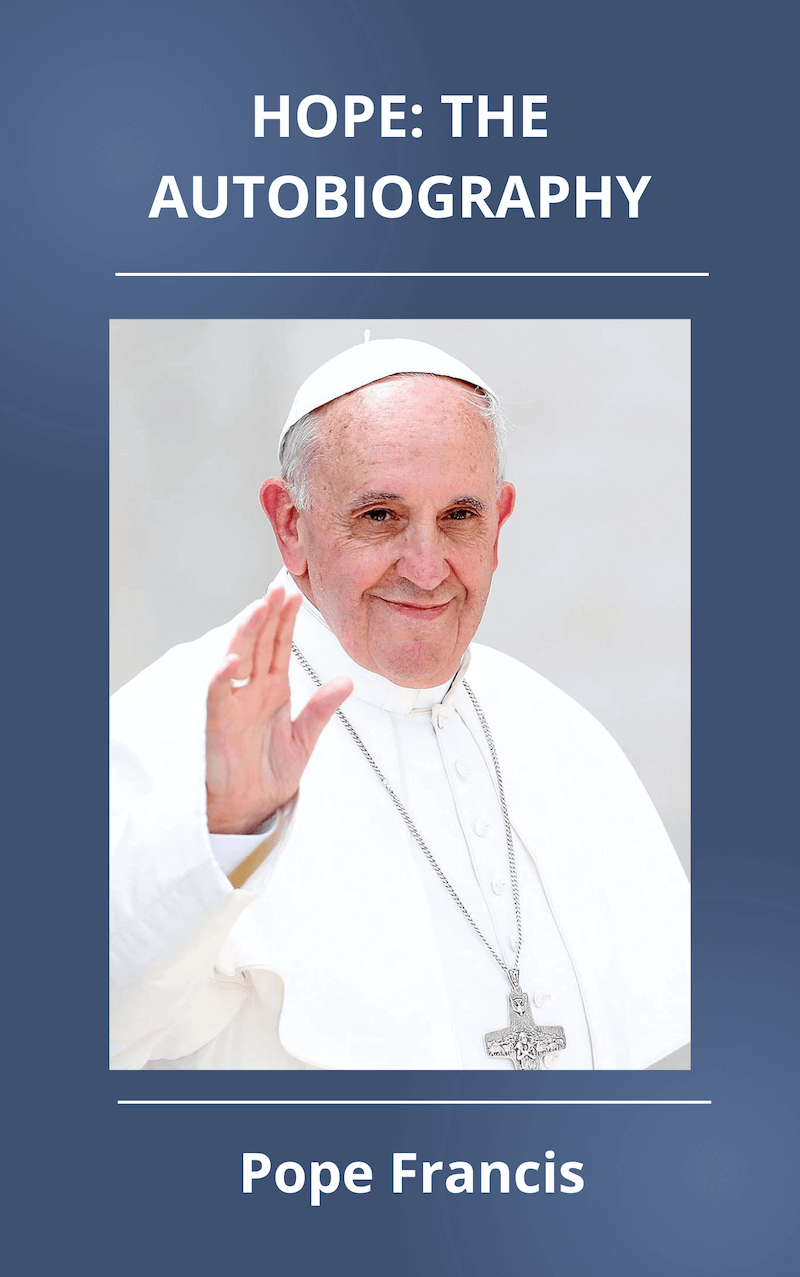
By. Pope Francis, Jorge Mario Bergoglio
In his autobiography, “Hope”, Pope Francis gives readers an inside look at his extraordinary life.
The book, released in 2025, covers Pope Francis’s life from childhood in tumultuous Buenos Aires to his duties in the papacy. He opens up about his personal journey of faith and shares his thoughts on matters facing the Catholic Church and the world around us, from social justice to migration to technology to the role of women and more.
The title “Hope” derives from the theme that strings the autobiography together as Pope Francis discusses the idea of hope as a gift from God during trying times.
Even if you’re not of the Catholic faith, Pope Francis’s story will resonate with all readers looking for a story of modernization, love, faith, perseverance, and most importantly, hope.
Divine Intervention
In October of 1927, a tragedy occurred. The Italian transatlantic SS Principessa Mafalda was traveling from Genoa Italy when it unexpectedly began leaning on one side in the cold waters of the Atlantic, off the coast of Brazil. Shortly after passengers began panicking, the ship’s power failed and passengers onboard were left with no choice but to jump or remain on the sinking ship. There were 288 crew and 971 passengers on board that journey and 314 perished in the frigid waters.
What seemed like an annoying hold-up to Mario Bergoglio and his family at the time, can now be seen as a divine intervention. Bergoglio and his family had intended to be on that boat. They had plans to leave Italy and start a new life in Argentina. To fund their travels, they had to sell their belongings. Unable to sell them in time, they missed the boat and therefore missed being a part of the sinking of the Italian transatlantic SS Principessa Mafalda. Years later, Mario would become father to the future Pope Francis.
It was not until four years later that the Bergoglio family finally made their way to South America as a part of a mass departure of emigrants looking to escape poverty and political turmoil under the fascist leadership of Benito Mussolini.
The great escape made by this family would later impact Pope Francis’s stance on migration, empathizing with displaced people in times of political disorder.
A Childhood Constructed of Humility
Between the ages of two and twenty-one, Jorge Mario Bergoglio (the future Pope Francis), lived with his parents and four siblings in the same house at 531 Calle Membrillar in the Flores neighborhood of Buenos Aires. It was a single-story house with three bedrooms to share amongst the family. Jorge describes the house as always crowded, but full of activities and vibrant conversations.
The streets outside shared the same vibrancy and spirit. In the 1930s and 1940s, Flores was full of working-class families, mainly immigrants. From Jewish families from Odessa to Turkish and Syrian immigrants to even Lebanese Muslims who held passports from the old Ottoman Empire.
Jorge’s life revolved around the few blocks around…
Want the complete 20-minute summary?
- Full structured summary
- Video Summary
- Podcast Summary
- Audio summary
- Key takeaways
- Exercises
- Quiz
- Highlights and notes
- Ask the book with AI
Who should read Hope?
Hope is essential reading for anyone interested in Pope Francis's personal journey, from his childhood in Buenos Aires to his unexpected election as the first Latin American pope. Catholics seeking to understand their church's evolution on social justice and inclusion will find this autobiography particularly meaningful, but the book also resonates with secular readers drawn to stories of faith, perseverance, and hope in the face of adversity.
Why does Hope matter?
Pope Francis has fundamentally reshaped the Catholic Church's approach to modern issues like poverty, migration, LGBTQ+ inclusion, and the role of women, making his personal story essential to understanding contemporary Catholicism. In a world marked by political turmoil and spiritual uncertainty, Hope by Pope Francis offers a meditation on how faith can inspire social change and compassion during dark times.
What are the key themes in Hope?
- The power of hope as a divine gift during suffering
- Faith and social justice as inseparable
- Inclusivity and community over exclusion
- Modernizing tradition to address contemporary challenges
- The dignity of marginalized and impoverished communities
- Interfaith dialogue and multiculturalism
What are the key lessons from the Hope book summary?
Divine Timing and Providence
Pope Francis reflects on how his family's missed passage on the doomed SS Principessa Mafalda shaped his belief in divine intervention, informing his later compassion for displaced migrants and refugees.
Humility as Foundation
Growing up in a crowded working-class neighborhood of Buenos Aires taught Pope Francis the value of humility, multiculturalism, and direct human connection that would define his papacy.
The Unexpected Calling
Despite initially pursuing chemistry, a pivotal confession in 1953 revealed Pope Francis's true vocation to priesthood, demonstrating how spiritual awakening can redirect an entire life's purpose.
Resistance Through Compassion
During Argentina's Dirty War, Pope Francis used his priestly status to protect political prisoners and hide dissident literature, proving that spiritual leadership demands moral action against injustice.
Community Over Solitude
After recovering from a life-threatening illness, Pope Francis chose a community-centered spiritual path rather than isolated monastic life, a choice reflected in his decision to live among visiting priests as pope.
Choosing a Name With Purpose
Pope Francis selected his papal name after Saint Francis of Assisi to signal his commitment to advocating for the poor and marginalized, making his name a declaration of his papacy's direction.
The Church as Female
Pope Francis believes the Church is fundamentally female as a follower of Mary, prompting him to elevate women into positions of power while keeping the door open for future women priests.
Direct Connection Over Preaching
Pope Francis preferred working individually with people in disheveled neighborhoods rather than preaching from a podium, establishing a pastoral style that emphasizes personal relationship over institutional distance.
Accountability and Transparency
After becoming pope, Francis opened Vatican archives to researchers studying the Church's role during the Dirty War, demonstrating his commitment to institutional accountability over protecting institutional reputation.
Breaking Tradition to Serve Tradition
Pope Francis modernizes the Church on divorce, LGBTQ+ acceptance, and women's roles not to abandon Catholic tradition, but to strengthen it by making it relevant to contemporary moral challenges.
The Kingdom Belongs to Children
Pope Francis's childhood love of play and his biblical conviction that the Kingdom of Heaven belongs to children drove his papal attention to child abuse, holding both abusers and institutional protectors accountable.
Labor as Spiritual Practice
During pilgrimages without money, Pope Francis and fellow priests donated manual labor in exchange for food and shelter, embodying a spirituality rooted in humble work rather than privilege.
Unexpected Elections Demand Humility
Pope Francis was not considered a frontrunner for the papacy and had already booked his return flight when elected, a reminder that true leadership often comes without ambition or expectation.
The Intersectionality of Faith and Justice
Through his friendship with Esther Ballestrino de Careaga, a Marxist political activist, Pope Francis learned that progressive politics and spiritual devotion are compatible paths to liberation.
Witnessing Transforms Compassion
Pope Francis's ongoing prayer for La Porota, a sex worker from his childhood who later reformed and ministered to others, exemplifies how witnessing human dignity in unexpected places deepens pastoral compassion.
Go Out Into the Streets
Pope Francis challenges the Church to be broken, wounded, and dirty from street-level ministry rather than weak and isolated behind institutional walls, redefining what faithfulness looks like in practice.
Survival Shapes Perspective
Pope Francis's near-fatal illness as a seminarian forced him to reconsider his vocation and ultimately led him to a more engaged, community-based spirituality that saved his faith.
Neighborhood Vibrancy as Spiritual Education
The diverse immigrant communities of Flores—Jewish, Turkish, Syrian, Lebanese—taught Pope Francis that interfaith dialogue and multicultural acceptance are spiritual practices, not political afterthoughts.
Legacy Determines Papacy
Pope Francis's experiences with poverty, political terror, and human dignity in Argentina directly informed his priorities as pope: inclusion, protection of the marginalized, and modernization with moral grounding.
Want the complete 20-minute summary?
- Full structured summary
- Video Summary
- Podcast Summary
- Audio summary
- Key takeaways
- Exercises
- Quiz
- Highlights and notes
- Ask the book with AI
How can you apply ideas from Hope?
- Evaluate your own life decisions through the lens of unexpected providence and divine timing rather than regret
- Build community connections by working directly with people in need rather than relying solely on institutional programs
- Advocate for institutional transparency and accountability, even when it reflects past failures
- Champion the dignity of marginalized communities through concrete action, not just rhetoric
- Modernize traditions by grounding changes in foundational values rather than abandoning them entirely
- Listen for your true calling even when it contradicts initial plans or expectations
- Practice interfaith dialogue and multiculturalism as spiritual disciplines, not political correctness
What common mistakes do readers make with Hope?
- Assuming Pope Francis advocates for radical change to tradition when he actually seeks to strengthen it through modernization
- Overlooking how Pope Francis's Argentina upbringing directly shaped every major papal priority
- Treating his social justice commitments as separate from his spiritual devotion rather than inseparable
- Expecting immediate resolution on issues like women priests when Pope Francis deliberately leaves doors open for future generations
Sumizeit Exercises Apply what you've learned
Turn ideas from Hope into action with a short guided reflection: identify the biggest takeaway, connect it to your life, and commit to one step you can take in the next 24 hours.
What is the expert analysis of Hope?
Overview
Hope is an autobiographical work by Pope Francis, born Jorge Mario Bergoglio, who ascended to the papacy in 2013 as the first Latin American and Jesuit pope in over a millennium. Released in 2025, this book offers a profound and intimate exploration of his life journey—from his humble beginnings in Buenos Aires to his transformative role as a global religious leader. The significance of this book lies not only in its personal narrative but also in its reflection on the evolving role of the Catholic Church amid contemporary social, political, and technological challenges. Pope Francis’s unique perspective as a spiritual guide committed to social justice and inclusivity makes this work a vital contribution to both religious literature and broader discourses on hope and human resilience.
Core Thesis
The central argument of Hope is that hope, understood as a divine gift, is essential for navigating the complexities and adversities of modern life. Pope Francis intertwines his personal history with theological reflections to demonstrate how faith and hope can inspire perseverance, compassion, and social engagement. He posits that the Church must embrace modernization without abandoning its traditions, fostering inclusivity, humility, and active solidarity with marginalized communities. This hope is not passive optimism but an active, transformative force that calls for a Church engaged with the world’s suffering and injustice.
Strengths
- Authentic Personal Narrative: The autobiography provides a rare and candid insight into the formative experiences that shaped Pope Francis’s worldview, from his immigrant family’s near-tragedy to his upbringing in the multicultural, working-class neighborhood of Flores. This grounding in lived experience lends credibility and emotional depth to his theological and social perspectives.
- Integration of Faith and Social Justice: The book excels in illustrating how spiritual devotion and commitment to social justice are inseparable in Pope Francis’s life and ministry. His involvement during Argentina’s “Dirty War” and his advocacy for marginalized groups underscore this synthesis.
- Modernization of the Church: Francis’s progressive stances on issues such as the role of women, LGBTQ+ inclusion, and the Church’s engagement with contemporary political realities are articulated with nuance, signaling a significant shift in Catholic leadership.
- Accessible yet Thoughtful Prose: The narrative balances theological reflection with relatable storytelling, making complex religious and ethical issues approachable for a wide readership without sacrificing intellectual rigor.
Critiques & Counterarguments
- Selective Historical Engagement: While Pope Francis acknowledges the Church’s failures during Argentina’s “Dirty War,” some critics argue that the treatment of this dark chapter remains somewhat cautious and lacks a full reckoning with institutional complicity. More extensive critical self-examination might have strengthened the book’s moral authority.
- Ambiguity on Key Doctrinal Issues: The book gestures toward inclusivity, especially regarding women’s roles and LGBTQ+ individuals, but stops short of endorsing definitive doctrinal changes. This cautious approach may frustrate readers seeking clearer commitments or reforms.
- Overemphasis on Personal Experience: The heavy reliance on autobiographical anecdotes, while compelling, occasionally risks overshadowing broader theological and philosophical arguments. Some readers may find the narrative episodic rather than systematically analytical.
- Competing Theological Perspectives: Traditionalist Catholic scholars might contest Francis’s progressive interpretations, emphasizing doctrinal continuity over modernization. Conversely, secular critics might argue that the Church’s institutional inertia limits the practical impact of his reforms.
- Global Context and Real-World Evidence: The book’s hopeful vision contrasts with ongoing global challenges such as rising secularism, religious pluralism, and geopolitical conflicts that complicate the Church’s influence and relevance. Empirical studies suggest that hope alone, without structural change, may be insufficient to address these systemic issues.
Who Should Read This
Hope is essential reading for scholars and practitioners interested in contemporary religious leadership, theology, and social ethics. It appeals to those curious about the intersection of faith and modernity, especially readers seeking insight into how a major religious institution grapples with inclusivity and social justice. Additionally, individuals drawn to autobiographical narratives of resilience and moral conviction will find inspiration in Pope Francis’s story. While the book is rooted in Catholic tradition, its themes of hope, perseverance, and compassion resonate broadly, making it relevant to readers across religious and secular divides who are invested in the future of global faith communities and humanitarian engagement.
Frequently asked questions about the Hope book summary
What is Hope about?
Hope is Pope Francis's autobiography that traces his extraordinary journey from his childhood in Buenos Aires to becoming the first Latin American pope in 2013. The book explores how his experiences with poverty, political terror, faith, and community shaped his vision for modernizing the Catholic Church while maintaining its spiritual foundation. Throughout the narrative, Pope Francis emphasizes hope as a divine gift during times of suffering and uncertainty.
Who should read Hope?
Hope appeals to Catholics interested in understanding their church's contemporary direction and Pope Francis's personal motivations, as well as secular readers drawn to stories of faith, perseverance, and social justice. Anyone curious about how lived experience shapes moral leadership, or interested in the intersection of spirituality and activism, will find this autobiography meaningful and thought-provoking.
What are the main takeaways from Hope?
The main takeaways from Hope include the inseparability of faith and social justice, the importance of community and direct human connection in spiritual practice, and the possibility of modernizing institutions while honoring tradition. Pope Francis demonstrates how personal experiences with poverty and political injustice can inform compassionate leadership that prioritizes the marginalized, and he illustrates how unexpected callings often lead to the most meaningful life paths.
How does Pope Francis's childhood influence his papacy?
Pope Francis credits his upbringing in the multicultural Flores neighborhood of Buenos Aires with shaping his commitment to multiculturalism, interfaith dialogue, and aid to the impoverished. His experiences witnessing diverse immigrant communities, playing with neighborhood children, and encountering figures like La Porota taught him that spiritual leadership means engaging directly with marginalized people rather than remaining isolated within institutions.
What is Pope Francis's stance on modernizing the Catholic Church?
Pope Francis believes in modernizing the Church on contemporary issues like divorce, LGBTQ+ inclusion, and women's roles, not by abandoning Catholic tradition but by strengthening it to address present moral challenges. He has eased communion guidelines for divorced Catholics, elevated women into positions of power, and kept the door open for women priests, all while grounding these changes in foundational spiritual values.
How did Argentina's Dirty War impact Pope Francis?
During Argentina's Dirty War, Pope Francis used his priestly status to protect political prisoners and hide dissident literature, an experience that reinforced his belief that spiritual devotion and social justice are inseparable. His exposure to state terror and the suffering of the disappeared deeply influenced his later commitment to opening Vatican archives for transparency and holding institutions accountable.
Why did Pope Francis choose to live in a guesthouse rather than a papal palace?
Pope Francis deliberately chose to live in the Casa Santa Marta guesthouse where visiting priests stay rather than in a traditional papal apartment because he values community over solitude. This choice reflects his belief that spiritual leadership is best practiced through direct human connection and engagement rather than isolation, a preference shaped by his near-fatal illness as a seminarian.
What does Hope reveal about Pope Francis's vision for the Church's future?
Hope reveals that Pope Francis envisions a Church that is 'broken, wounded, and dirty from being out on the streets' rather than 'weak and feeble from being locked away.' His vision combines ancient Catholic tradition with contemporary engagement on poverty, migration, LGBTQ+ rights, and women's empowerment, creating a Church that serves modern moral challenges while maintaining spiritual grounding.
About Sumizeit
Sumizeit is a profitable Scomy LLC company based in Miami, Florida. It has been helping readers learn from nonfiction books for 7 years with expert-written summaries in text, audio, podcast, and video.
Want the complete 20-minute summary?
- Full structured summary
- Video Summary
- Podcast Summary
- Audio summary
- Key takeaways
- Exercises
- Quiz
- Highlights and notes
- Ask the book with AI
Here's why readers love Sumizeit
Join thousands of learners getting smarter every day
"Great experience. Detailed summaries. Loved the gamification feature. Makes learning fun. Good customer service. I recommend Sumizeit to anyone. You'll learn a lot."
"I always felt busy but still wanting to keep up with the book discussion in my friend group. This was a great supplement to help me keep reading the books I find fun while keeping up with important books."
"I love this website. Instead of scrolling social media, I find myself learning a lot. I use it everyday. I recommend this app for anyone who is too busy and wants to get up to speed with their favorite books."
Hope Book Summary PDF
Looking for a Hope Book Summary PDF you can save and revisit offline? Our Hope Book Summary PDF captures the book’s core ideas in a clean, printable format — the key frameworks, takeaways, and structure without the fluff. Download the Hope Book Summary PDF when you want a reference you can annotate, share with your team, or review on the go. Get your Hope Book Summary PDF from the download page below.
Download Hope Book Summary PDFPeople also liked these summaries
Readers who explored Hope often enjoyed these titles next.



Want the complete 20-minute summary?
- Full structured summary
- Video Summary
- Podcast Summary
- Audio summary
- Key takeaways
- Exercises
- Quiz
- Highlights and notes
- Ask the book with AI
Featured Book Titles
Popular Book Summaries at sumizeit, leading book summary app