


Prefer the print book? Buy on Amazon
As an Amazon Associate, Sumizeit earns from qualifying purchases.
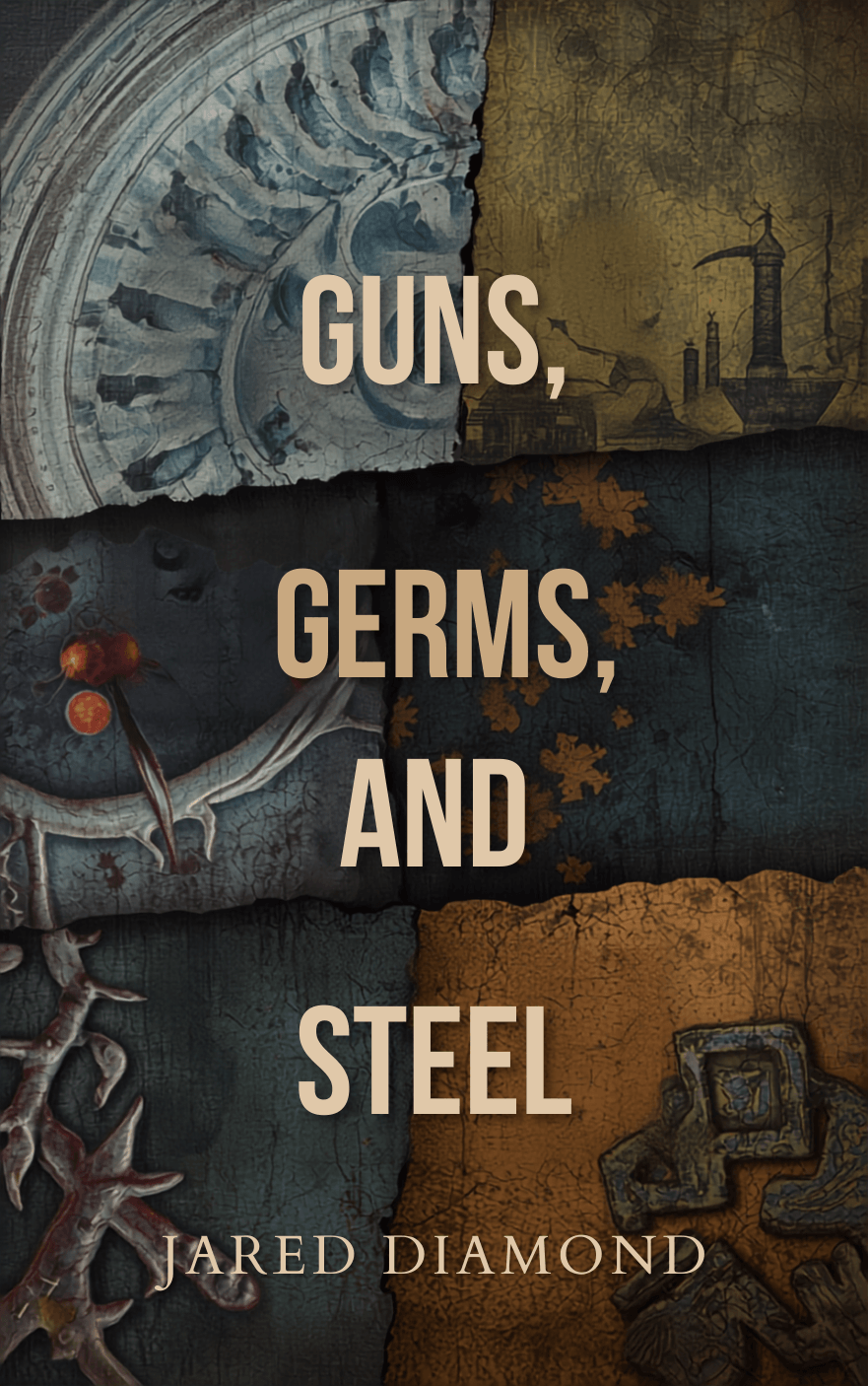
Guns, Germs, and Steel Book Summary
This Guns, Germs, and Steel Book Summary covers the key ideas, lessons, and takeaways in about 20 minutes.
Helps with these goals
Want the complete 20-minute summary?
- Full structured summary
- Video Summary
- Podcast Summary
- Audio summary
- Key takeaways
- Exercises
- Quiz
- Highlights and notes
- Ask the book with AI
Want a Free Weekly Read?
Get a free summary every week straight to your mailbox.
Preview the Guns, Germs, and Steel book summary
Below is a preview of Sumizeit’s comprehensive human-written summary of Guns, Germs, and Steel by Jared Diamond. The full summary is 15-20 minutes long and covers the book’s key ideas in text, audio, visual, and video formats. Unlock the full 20 Minute Summary
Why did Europeans conquer the Americas, Africa, and Australia rather than the other way around? Why didn't Aztec armies sail to Spain? Why didn't Sub-Saharan Africans colonize Europe? These are the questions at the center of Jared Diamond's Guns, Germs, and Steel, a Pulitzer Prize-winning work of historical synthesis that set out to explain the broad pattern of human history without resorting to the racist explanations that had long served as the default answer.
Diamond's answer is both sweeping and deliberately provocative: the differences between societies that allowed some to dominate others had nothing to do with the intelligence or inherent capabilities of their peoples. They had everything to do with geography. Specifically, they had to do with which parts of the world happened to be home to plants and animals well-suited for domestication, and with whether the shape and orientation of those regions allowed agricultural practices, technologies, and diseases to spread efficiently. The book argues that the peoples of Eurasia — encompassing Europe, Asia, and North Africa — ended up dominating much of the world not because they were smarter or more industrious than anyone else, but because they lived on a continent that gave them a head start in food production, which cascaded over millennia into advantages in technology, political organization, and disease immunity.
The book was named one of TIME magazine's best nonfiction books of all time, adapted into a PBS documentary in 2005, and has remained one of the most widely read works of popular history ever published. It has also attracted sustained criticism from anthropologists, archaeologists, and historians who argue that Diamond oversimplifies the record, underweights human choice and cultural factors, and risks rehabilitating a discredited tradition of environmental determinism. Understanding the book requires engaging seriously with both its argument and its critics. What is not in dispute is that Diamond asked the right question at the right moment, and that his attempt to answer it changed how millions of readers thought about the relationship between geography, history, and human possibility.
The Starting Point: New Guinea and a Simple Question
Diamond's intellectual journey toward this book began in New Guinea, where he conducted research among remote tribal communities after completing his doctorate at Cambridge. He was struck by a puzzle that he found impossible to dismiss. The people he encountered were, by any reasonable measure, as intelligent and capable as any person he had met in the industrialized world. They were curious, perceptive, and resourceful in navigating an environment of staggering complexity. Yet their societies had not developed writing, steel tools, centralized government, or the complex institutional structures of the British colonizers who had annexed New Guinea in the nineteenth century. This gap between evident human capability and radically different material and institutional development was what Diamond set out to explain — and his explanation would require tracing causes back not decades or centuries but thousands of years, to the distribution of plants and animals across the surface of the planet.
A New Guinean…
Want the complete 20-minute summary?
- Full structured summary
- Video Summary
- Podcast Summary
- Audio summary
- Key takeaways
- Exercises
- Quiz
- Highlights and notes
- Ask the book with AI
Who should read Guns, Germs, and Steel?
Guns, Germs, and Steel is for anyone curious about why world history unfolded as it did and why some societies developed advanced technology while others did not. It appeals to readers seeking evidence-based explanations that challenge conventional assumptions, as well as students of history, anthropology, and social science looking for a sweeping synthesis that connects geography to civilization.
Why does Guns, Germs, and Steel matter?
This book fundamentally reframes how we understand human history by replacing racial and cultural hierarchies with geographic and biological explanations, making it essential reading in an era still grappling with the legacies of colonialism. Jared Diamond's argument that differences between societies stem from environmental luck rather than inherent human differences remains urgently relevant to contemporary debates about inequality, progress, and civilization.
What are the key themes in Guns, Germs, and Steel?
- Geography as destiny: how continental differences shaped civilizational development
- Agricultural advantage: food surpluses as the foundation of complex societies
- Disease as a hidden weapon: how domesticated animals created epidemic immunity
- Technology and knowledge accumulation through specialization
- Political organization and centralized government as competitive advantages
- The role of chance and accident in determining historical outcomes
- Interconnectedness and diffusion: how east-west continental orientation enabled knowledge spread
Want the complete 20-minute summary?
- Full structured summary
- Video Summary
- Podcast Summary
- Audio summary
- Key takeaways
- Exercises
- Quiz
- Highlights and notes
- Ask the book with AI
How can you apply ideas from Guns, Germs, and Steel?
- Evaluate historical claims about civilizational superiority by examining geographic and environmental factors rather than accepting racial or cultural hierarchies
- Understand how agricultural development determined political structure, allowing prediction of when societies would develop centralized government
- Recognize that technological differences between societies reflect accumulated advantages over centuries rather than intelligence differences
- Apply the concept of geographic constraints to understanding modern global inequality and development patterns
- Consider how disease exposure and immunity shape population health outcomes and public health policy across regions
- Analyze why certain regions historically became technological hubs by examining their access to domesticable plants, animals, and continental connections
What common mistakes do readers make with Guns, Germs, and Steel?
- Assuming that advanced societies developed technology because their people were inherently smarter or more innovative than others
- Overlooking the role of geographic luck in creating initial advantages that compound over millennia
- Treating environmental explanations as complete accounts of history without considering human choice, cultural factors, and individual decisions
- Forgetting that epidemic diseases, not primarily warfare, caused the collapse of indigenous American populations
Sumizeit Exercises Apply what you've learned
Turn ideas from Guns, Germs, and Steel into action with a short guided reflection: identify the biggest takeaway, connect it to your life, and commit to one step you can take in the next 24 hours.
What is the expert analysis of Guns, Germs, and Steel?
Overview
Guns, Germs, and Steel, authored by Jared Diamond, stands as a landmark in popular historical synthesis and interdisciplinary scholarship. Published in 1997 and awarded the Pulitzer Prize for General Nonfiction in 1998, the book tackles one of the most profound questions in human history: why certain societies came to dominate others on a global scale. Diamond, a scientist with expertise spanning physiology, ecology, and anthropology, leverages his diverse background and fieldwork in New Guinea to challenge entrenched, racially biased explanations for historical inequality. His work has not only reshaped public understanding of global history but also sparked extensive academic debate, underscoring its significance in both intellectual and cultural contexts.
Core Thesis
Diamond’s central argument is that the divergent trajectories of human societies are primarily the result of geographic and environmental factors rather than differences in innate intelligence or cultural superiority. Specifically, the availability of domesticable plants and animals, combined with the orientation of continental axes, created conditions that allowed Eurasian societies to develop food surpluses, complex political structures, technologies, and immunities to epidemic diseases. These advantages compounded over millennia, culminating in the Eurasian domination of other continents during the age of exploration and colonization. Thus, history’s unevenness is framed as the outcome of environmental endowments and diffusion patterns rather than racial or cultural determinism.
Strengths
- Interdisciplinary Synthesis: Diamond masterfully integrates insights from biology, ecology, archaeology, and history, offering a cohesive explanatory framework that transcends disciplinary boundaries.
- Challenging Racial Bias: By attributing historical dominance to environmental factors, the book provides a powerful rebuttal to racist and ethnocentric narratives that have long justified inequality.
- Accessible Yet Rigorous: Diamond’s clear prose and compelling storytelling make complex scientific and historical concepts accessible to a broad audience without sacrificing intellectual rigor.
- Provocative Geographic Lens: The emphasis on continental axis orientation and the domestication of plants and animals introduces novel explanatory variables that have enriched scholarly discourse.
- Stimulus for Further Research: The book’s ambitious scope and provocative claims have inspired extensive scholarly engagement, fostering new research and debate in multiple fields.
Critiques & Counterarguments
- Environmental Determinism Concerns: Critics argue that Diamond’s framework risks reviving a discredited form of environmental determinism by underplaying human agency, cultural complexity, and political contingency. This reduction can obscure the nuanced interplay of factors shaping history.
- Oversimplification of Domestication: The portrayal of the Fertile Crescent as the singular cradle of agriculture has been challenged by archaeological evidence indicating multiple independent centers of domestication, suggesting a more complex mosaic of agricultural origins.
- Questioning Animal Domestication Claims: Some studies dispute Diamond’s count and classification of domesticable animals, highlighting regional variations and exceptions that complicate his narrative.
- Axis Orientation and African Geography: The argument about the east-west axis facilitating diffusion is less convincing when applied to Africa, where climatic and ecological barriers may have played a more significant role than axis orientation alone.
- Neglect of Historical Agency and Morality: By framing conquest and colonization as environmentally predetermined, the book risks diminishing the role of individual and collective choices, as well as the ethical dimensions of historical events such as colonial violence and exploitation.
Who Should Read This
Guns, Germs, and Steel is essential reading for scholars and intellectually curious readers interested in history, anthropology, geography, and the social sciences. It appeals particularly to those seeking a broad, integrative perspective on the forces shaping human civilization. Students of global history and development studies will find its arguments foundational, while readers interested in the intersections of environment and society will appreciate its pioneering approach. However, it also demands critical engagement, making it suitable for readers prepared to grapple with its controversies and to explore the ongoing scholarly debates it has engendered.
Frequently asked questions about the Guns, Germs, and Steel book summary
What is Guns, Germs, and Steel about?
Guns, Germs, and Steel by Jared Diamond explains why some societies developed advanced technology, centralized governments, and epidemic disease immunity while others did not, attributing these differences primarily to geography rather than to the intelligence or capability of different peoples. The book argues that Eurasia's advantage stemmed from having domesticable plants and animals, and a geographic orientation that allowed agricultural knowledge and innovations to spread rapidly across the continent.
Who should read Guns, Germs, and Steel?
This book is essential for anyone seeking to understand the deep roots of global inequality and colonialism without relying on racial or cultural explanations. It appeals to history students, anthropology readers, and anyone curious about why world civilizations developed as they did, offering a rigorously researched alternative to traditional hierarchical narratives.
What are the main takeaways from Guns, Germs, and Steel?
The primary takeaway is that geographic and biological accident—not human superiority—determined which societies developed advantages in agriculture, technology, and disease immunity. Diamond shows that food surpluses enabled specialization, which created technological innovation, centralized government, and epidemic diseases; these three advantages compounded over millennia to give Eurasian societies dominance when they encountered other peoples. The book ultimately argues that history reflects geography rather than inherent differences between peoples.
How does Diamond explain the development of advanced technology?
Diamond argues that agricultural surpluses freed people from subsistence labor, allowing specialization in crafts and engineering. Craftspeople who began by improving farming tools eventually made better weapons and ships. Eurasia's large population and east-west orientation allowed innovations to spread rapidly across the continent, causing technological advantages to compound over thousands of years.
What role did domesticated animals play in Eurasian dominance?
Domesticated animals provided food, labor, military mobility, and materials, but their most consequential contribution was creating conditions for epidemic diseases. Close living with domesticated animals allowed diseases like smallpox to jump to human populations, and Eurasian peoples developed partial immunity over millennia. When Europeans encountered unexposed populations, these diseases killed 90-95% of indigenous Americans—a biological advantage that far exceeded weapons in its impact.
Why did agriculture develop in the Fertile Crescent first?
The Fertile Crescent's climate—with mild wet winters and long hot dry summers—produced abundant annual grasses with large, storable seeds ideal for domestication. These grains not only provided nutrition but could be stored through the dry season, giving hunter-gatherers incentives to settle permanently and eventually cultivate the plants. This combination of plant abundance and storability was unique to the region in the ancient world.
What does Diamond mean by continental axis orientation?
Axis orientation refers to whether a continent runs east-west or north-south. Eurasia's east-west orientation meant crops and innovations could spread across regions with similar climates, allowing knowledge to accumulate. The Americas and Africa's north-south orientation meant every step of diffusion crossed into different climatic zones, slowing the spread of agricultural techniques and innovations.
How does Guns, Germs, and Steel respond to criticisms of racism in historical explanations?
Diamond directly challenges racist explanations of history by arguing that observed differences in civilizational development reflect environmental and geographic factors, not inherent human capability. The book demonstrates that indigenous peoples of the Americas, Africa, and Australia were equally intelligent and capable as Europeans—they simply inherited different geographic circumstances that led to different technological and organizational development over thousands of years.
About Sumizeit
Sumizeit is a profitable Scomy LLC company based in Miami, Florida. It has been helping readers learn from nonfiction books for 7 years with expert-written summaries in text, audio, podcast, and video.
Want the complete 20-minute summary?
- Full structured summary
- Video Summary
- Podcast Summary
- Audio summary
- Key takeaways
- Exercises
- Quiz
- Highlights and notes
- Ask the book with AI
Here's why readers love Sumizeit
Join thousands of learners getting smarter every day
"Great experience. Detailed summaries. Loved the gamification feature. Makes learning fun. Good customer service. I recommend Sumizeit to anyone. You'll learn a lot."
"I always felt busy but still wanting to keep up with the book discussion in my friend group. This was a great supplement to help me keep reading the books I find fun while keeping up with important books."
"I love this website. Instead of scrolling social media, I find myself learning a lot. I use it everyday. I recommend this app for anyone who is too busy and wants to get up to speed with their favorite books."
Guns, Germs, and Steel Book Summary PDF
Looking for a Guns, Germs, and Steel Book Summary PDF you can save and revisit offline? Our Guns, Germs, and Steel Book Summary PDF captures the book’s core ideas in a clean, printable format — the key frameworks, takeaways, and structure without the fluff. Download the Guns, Germs, and Steel Book Summary PDF when you want a reference you can annotate, share with your team, or review on the go. Get your Guns, Germs, and Steel Book Summary PDF from the download page below.
Download Guns, Germs, and Steel Book Summary PDFPeople also liked these summaries
Readers who explored Guns, Germs, and Steel often enjoyed these titles next.



Want the complete 20-minute summary?
- Full structured summary
- Video Summary
- Podcast Summary
- Audio summary
- Key takeaways
- Exercises
- Quiz
- Highlights and notes
- Ask the book with AI
Featured Book Titles
Popular Book Summaries at sumizeit, leading book summary app