


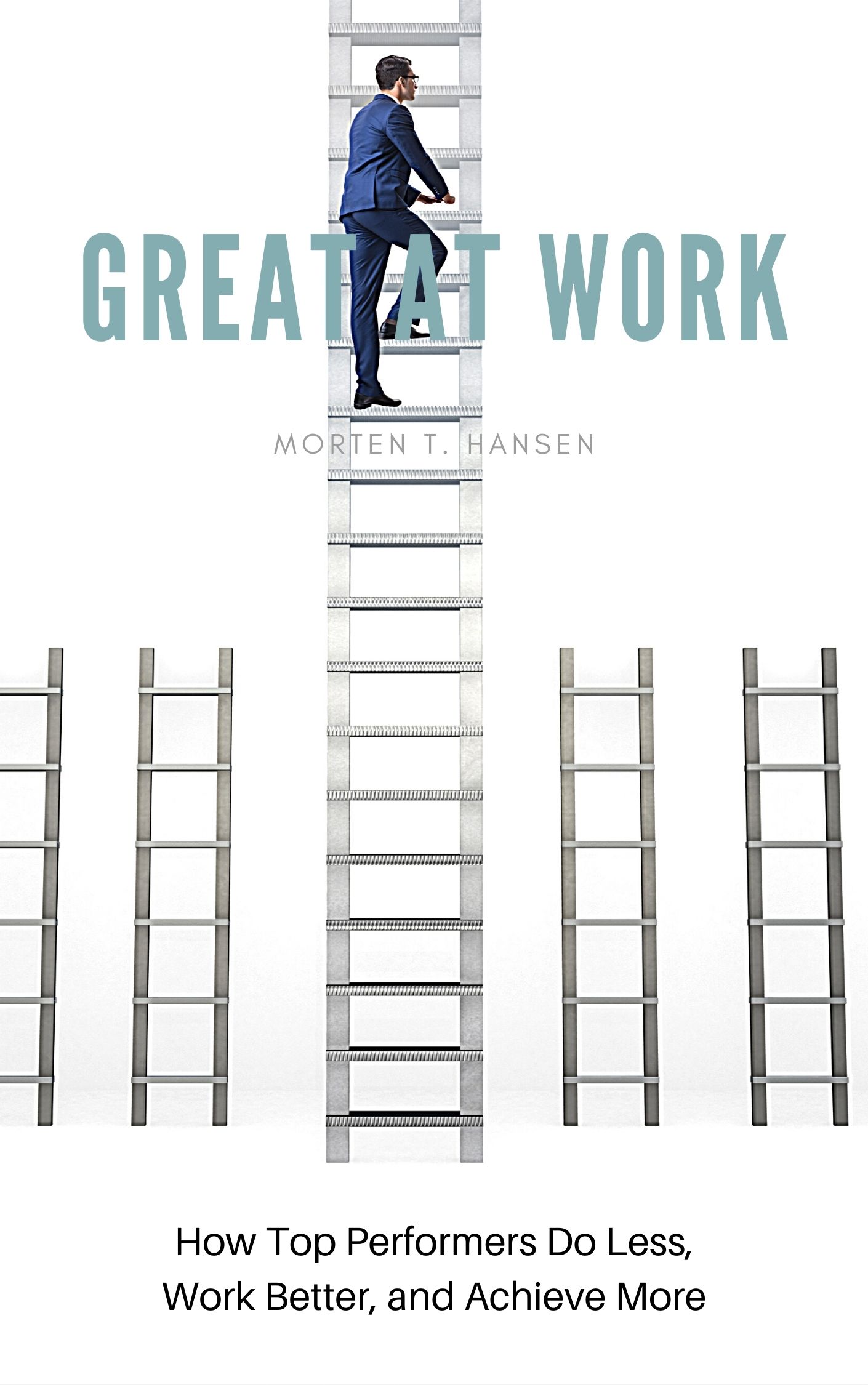
Prefer the print book? Buy on Amazon
As an Amazon Associate, Sumizeit earns from qualifying purchases.
Great at Work Book Summary
This Great at Work Book Summary covers the key ideas, lessons, and takeaways in about 20 minutes.
Helps with these goals
Want the complete 20-minute summary?
- Full structured summary
- Video Summary
- Podcast Summary
- Key takeaways
- Exercises
- Quiz
- Highlights and notes
- Ask the book with AI
Not ready to upgrade?
Get this summary + 2 more picks sent to your inbox, free.
What is in the Great at Work book summary?
Below is a preview of Sumizeit’s expert-written summary of Great at Work by Morten T. Hansen. The full summary covers the book’s key ideas in text, audio, and video.
What does “working smart” really mean? Business professor and author Morten T. Hansen wanted to find out what it really means to be a smart worker, so in 2011 he and his team launched a massive project studying the habits, tricks, and techniques of top performers.
Using interviews, surveys, and over 200 academic papers, Hansen and his team came up with the top seven habits that contributed to top performers’ success. From a survey of 5,000 people, they found that these seven factors accounted for 66 percent of their successful performance. Using these seven top-performance principles, workers were able to work smarter, be more effective, and excel without working longer hours.
Principle One: Do Less To Get More Done
Most people hold the common misconception that to do better, they need to do more work and put in longer hours than everyone else, but what they really need to do is work smarter, not harder. By stretching themselves too thin on a number of projects, they make it difficult to really excel at any one task. If people are constantly multitasking, they become overwhelmed, and the quality of their work suffers.
Hansen’s research shows that the most effective performers commit to less work, but focus their attention fully on a smaller collection of the most important priorities. By narrowing their attention, they are able to concentrate more fully on excelling at the most important tasks. According to his research, Hansen found that performers who used this principle and obsessed only on their priorities outperformed others by an average of 25 percent.
However, it is often difficult to determine what to prioritize, and what to let go. Hansen recommends three strategies to help pare down your task list to only the most essential items.
First, you should reassess how you measure success. Rather than just thinking of success as completing lots of tasks, you should see how many tasks you can eliminate because they do not contribute to your overall larger goal.
Second, you should eliminate all distractions. To fully focus your attention on your most important tasks, you should arrange your workspace so you do not have access to any distractions. You should cut off access to tempting internet and email distractions by designating a work-only laptop that does not have access to the web, and carve out space and time alone so you are not distracted by co-workers.
Lastly, if your boss is not clear about what his priorities are, it might be difficult for you to identify your own. It is important to speak with your boss to identify priorities and get a clear idea of what your overall goals should be.
For example, explorer Roald Amundsen utilized this technique to be the first to lead his team to reach the South Pole in 1911. While his rival, Robert Scott, prepared five different methods to get to the South Pole, Amundsen focused obsessively over just one: sled dogs.
Want the complete 20-minute summary?
- Full structured summary
- Video Summary
- Podcast Summary
- Key takeaways
- Exercises
- Quiz
- Highlights and notes
- Ask the book with AI
Who should read Great at Work?
Great at Work is ideal for professionals, managers, and entrepreneurs who feel overwhelmed by competing priorities and want to boost their performance without burning out. Whether you're climbing the corporate ladder, leading a team, or running your own business, this book offers practical strategies for anyone looking to work smarter rather than harder.
Why does Great at Work matter?
In today's always-on work culture, many people mistakenly believe that success requires endless hours and multitasking across dozens of projects. Morten T. Hansen's research-backed framework challenges this myth, showing that top performers achieve 25% higher results by focusing on fewer priorities and mastering seven specific habits. This book cuts through productivity noise to reveal what actually separates exceptional performers from the rest.
What are the key themes in Great at Work?
- Working smarter, not harder through selective focus
- Balancing passion with purposeful work
- Continuous skill development through deliberate practice
- Strategic collaboration and disciplined teamwork
- Value-driven workflow redesign
- Persuasion through emotional connection and logic
Want the complete 20-minute summary?
- Full structured summary
- Video Summary
- Podcast Summary
- Key takeaways
- Exercises
- Quiz
- Highlights and notes
- Ask the book with AI
How can you apply ideas from Great at Work?
- Audit your task list this week and eliminate at least three non-essential activities that don't directly support your primary goals
- Set up a distraction-free work environment by blocking calendar time and removing digital temptations during deep-work sessions
- Schedule a brief meeting with your manager to clarify top-priority objectives and eliminate ambiguity around what success looks like
- Choose one professional skill to develop and commit to 15 minutes daily of targeted practice with measurable micro behaviors
- Redesign your workflow by identifying one process and assessing its value through an external, customer-focused lens rather than internal metrics
- Volunteer for one project or responsibility that combines your genuine passion with a sense of broader organizational purpose
- Lead your next team meeting using the fight-and-unite framework: encourage open debate on key decisions, then close with clear alignment and commitment
What common mistakes do readers make with Great at Work?
- Assuming more hours worked equals better performance, when research shows strategic focus produces 25% better results
- Measuring productivity by tasks completed rather than by the external value those tasks create for customers or the business
- Neglecting skill development because there's no dedicated training time, instead of integrating practice into daily work
- Avoiding collaborative projects due to concern about added complexity, missing opportunities for disciplined collaboration that could yield significant value
- Proposing new ideas with logic alone, forgetting that emotional connection and a sense of larger purpose are equally powerful persuasion tools
Sumizeit Exercises Apply what you've learned
Turn ideas from Great at Work into action with a short guided reflection: identify the biggest takeaway, connect it to your life, and commit to one step you can take in the next 24 hours.
What is the expert analysis of Great at Work?
Overview
Great at Work: The Hidden Habits of Top Performers is authored by Morten T. Hansen, a distinguished management professor at the University of California, Berkeley, and a faculty member at Apple University. Hansen brings a rigorous academic background combined with practical insights from his consulting experience at Boston Consulting Group. This book stands out in the crowded field of productivity literature by grounding its findings in extensive empirical research, including surveys of 5,000 professionals and analysis of over 200 academic papers. Hansen’s work is significant because it challenges the conventional wisdom that working longer hours equates to better performance, instead offering a nuanced, evidence-based framework for working smarter and achieving superior results.
Core Thesis
The central argument of Great at Work is that top performers excel not by working harder or longer, but by adopting seven distinct habits that enable them to focus on what truly matters, optimize their workflows, continuously improve their skills, and effectively collaborate and influence others. Hansen’s research reveals that these habits collectively account for a majority of the variance in high performance, underscoring that success is less about effort quantity and more about strategic effort quality. The book’s thesis reframes productivity as a disciplined, purposeful practice that integrates passion, purpose, and smart collaboration rather than mere busyness or multitasking.
Strengths
- Empirical Rigor: Hansen’s conclusions are supported by large-scale surveys, interviews, and a synthesis of academic literature, lending credibility and robustness to his claims.
- Actionable Framework: The seven principles provide a clear, structured approach that readers can implement, from prioritizing fewer tasks to redesigning workflows and mastering “disciplined collaboration.”
- Balanced Perspective: The book acknowledges complexities such as the trade-offs between efficiency and quality, and the emotional as well as logical dimensions of winning support, offering a holistic view of performance.
- Illustrative Case Studies: Real-world examples—from explorers like Roald Amundsen to corporate leaders—enrich the narrative and demonstrate the principles in diverse contexts.
- Integration of Passion and Purpose: Hansen’s “P-squared” concept deepens the discussion by connecting motivation to meaningful engagement, moving beyond mechanistic productivity hacks.
Critiques & Counterarguments
- Potential Oversimplification: While the seven habits are compelling, the book may understate the complexity of organizational and individual variability. Not all roles or industries can equally apply these principles, especially in highly unpredictable or creative fields.
- Limited Attention to Structural Constraints: The focus on individual habits may overlook systemic factors such as organizational culture, power dynamics, or economic conditions that significantly impact performance and cannot be remedied solely by personal discipline.
- Competing Research on Multitasking: Although Hansen cautions against multitasking, some contemporary cognitive science research suggests that certain forms of task-switching can be beneficial, particularly in creative or knowledge work, challenging the blanket dismissal of multitasking.
- Emotional Appeals in Persuasion: The recommendation to use high-arousal emotions to win support may raise ethical concerns and contradict research advocating for balanced, rational persuasion to foster sustainable commitment and trust.
- Risk of Overemphasis on Metrics: The book’s endorsement of metrics and quantification, while useful, may inadvertently promote a culture of measurement that sidelines qualitative aspects of work, such as intuition, empathy, and long-term vision.
Who Should Read This
Great at Work is ideally suited for professionals and leaders who seek to enhance their effectiveness without succumbing to burnout. It appeals to managers aiming to cultivate high-performing teams, knowledge workers striving to optimize their daily routines, and anyone interested in evidence-based strategies for personal and organizational productivity. Additionally, students of business, organizational psychology, and management will find Hansen’s integration of research and practice a valuable resource. However, readers should approach the book as a guide rather than a prescriptive formula, adapting its principles thoughtfully within their unique contexts.
Frequently asked questions about the Great at Work book summary
What is Great at Work about?
Great at Work by Morten T. Hansen reveals the seven hidden habits that distinguish top performers from the rest. Based on extensive research of 5,000 professionals and 200+ academic papers, Hansen shows that exceptional performance comes from working smarter—not longer—by mastering selective focus, continuous learning, balanced passion and purpose, and effective collaboration.
Who should read Great at Work?
Great at Work is essential for professionals, managers, entrepreneurs, and anyone feeling overwhelmed by competing demands at work. It's particularly valuable for people struggling to balance productivity with well-being, those seeking to advance their careers, and leaders looking to boost team performance without burnout.
What are the main takeaways from Great at Work?
The seven core principles are: do less to focus more, redesign workflows for external value, integrate learning into daily work, combine passion with purpose, win support through emotional connection, lead meetings with fight-and-unite dynamics, and practice disciplined collaboration. Collectively, these habits account for 66% of top performers' success and can improve results by an average of 25%.
How can I work smarter without working more hours?
Working smarter means prioritizing fewer, higher-impact tasks rather than spreading yourself thin across many projects. It requires redesigning your workflow around genuine external value, eliminating distractions, integrating skill development into daily work, and aligning your efforts with clear organizational priorities. This strategic focus consistently outperforms longer hours.
What is the Learning Loop and how do I use it?
The Learning Loop integrates skill development into your regular work by practicing targeted micro behaviors, collecting feedback daily, and measuring progress with metrics. Dedicate just 15 minutes daily to one skill, break it into small actionable steps, enlist mentors for feedback, and persist through temporary performance dips—this approach compounds improvement over time.
How do I combine passion and purpose in my work?
P-squared means aligning both your genuine passions and your sense of larger purpose. Actively redesign your role to incorporate work you love, then connect it to how your contribution serves organizational success. This combination energizes effort and sustains motivation far better than passion alone.
What does disciplined collaboration mean?
Disciplined collaboration means pursuing cross-team projects only when they create genuine organizational value after accounting for collaboration costs. Each project should have a clear business case, unified objectives, and quantifiable deadlines. This focused approach improves performance by 14% compared to over-collaborating or staying siloed.
About Sumizeit
Sumizeit is a profitable Scomy LLC company based in Miami, Florida. It has been helping readers learn from nonfiction books for 7 years with expert-written summaries in text, audio, podcast, and video.
Want the complete 20-minute summary?
- Full structured summary
- Video Summary
- Podcast Summary
- Key takeaways
- Exercises
- Quiz
- Highlights and notes
- Ask the book with AI
Here's why readers love Sumizeit
Join thousands of learners getting smarter every day
"Great experience. Detailed summaries. Loved the gamification feature. Makes learning fun. Good customer service. I recommend Sumizeit to anyone. You'll learn a lot."
"I always felt busy but still wanting to keep up with the book discussion in my friend group. This was a great supplement to help me keep reading the books I find fun while keeping up with important books."
"I love this website. Instead of scrolling social media, I find myself learning a lot. I use it everyday. I recommend this app for anyone who is too busy and wants to get up to speed with their favorite books."
Great at Work Book Summary PDF
Looking for a Great at Work Book Summary PDF you can save and revisit offline? Our Great at Work Book Summary PDF captures the book’s core ideas in a clean, printable format — the key frameworks, takeaways, and structure without the fluff. Download the Great at Work Book Summary PDF when you want a reference you can annotate, share with your team, or review on the go. Get your Great at Work Book Summary PDF from the download page below.
Download Great at Work Book Summary PDFPeople also liked these summaries
Readers who explored Great at Work often enjoyed these titles next.


Want the complete 20-minute summary?
- Full structured summary
- Video Summary
- Podcast Summary
- Key takeaways
- Exercises
- Quiz
- Highlights and notes
- Ask the book with AI
Featured Book Titles
Popular Book Summaries at sumizeit, leading book summary app